

Evaluating players accurately remains one of the most challenging tasks for basketball coaches worldwide. Many rely on subjective observations or outdated methods that introduce bias and miss critical insights about a player’s true value and potential. Combining traditional scouting techniques with modern analytics creates a more complete picture, helping you make informed decisions about roster construction, playing time, and development priorities. This comprehensive guide walks you through a proven step-by-step approach to assess player skills and potential, equipping you with practical tools and frameworks to improve team performance through better evaluation practices.
Table of Contents
- Key takeaways
- Understand the essentials of player evaluation
- Prepare your evaluation tools and data collection methods
- Execute player evaluation: step-by-step guide
- Verify evaluation results and avoid common pitfalls
- Enhance your coaching with Hoop Mentality resources
- Frequently asked questions
Key Takeaways
| Point | Details |
|---|---|
| Balanced scouting and analytics | Combining traditional scouting with analytics reduces bias and reveals insights not captured by the eye test. |
| Archetype driven evaluation | Evaluate players by archetypes rather than fixed positions to reflect modern basketball roles. |
| Standardized evaluation checklists | Use standardized templates to rate shooting, ball handling, defense, decision making, and physical tools for consistent comparisons. |
| Tracking data insights | Incorporate advanced tracking data to gain nuanced insights into movement and positioning. |
Understand the essentials of player evaluation
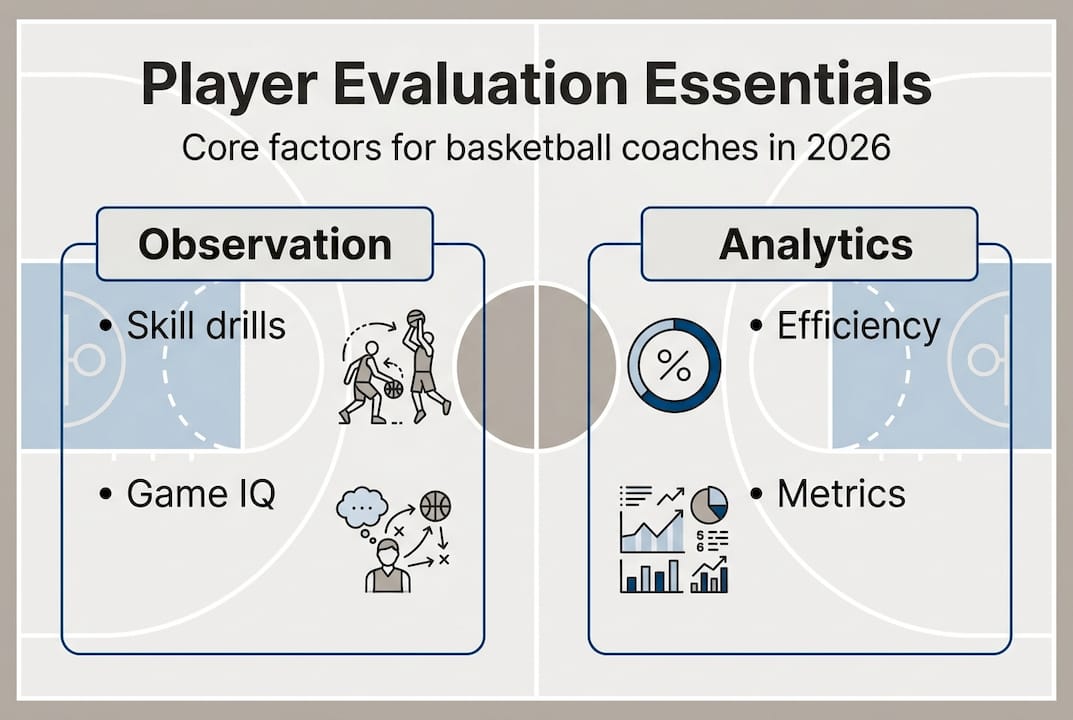
Traditional evaluation methods form the foundation of player assessment. Coaches have long relied on observation during drills, scrimmages, and games to judge fundamentals like shooting form, defensive positioning, and court awareness. Scouting checklists provide structure to these observations, helping you systematically record strengths and weaknesses across multiple skill categories. While these methods offer valuable context about work ethic, coachability, and intangibles, they can be influenced by cognitive biases and inconsistent standards between evaluators.
Advanced metrics complement traditional observation by quantifying performance in ways the eye test might miss. Shooting Rating (SR), Contested Assists (CA), and Potential Assists (PA) provide objective benchmarks, with league average values around 75 for each metric. Youth players show distinct performance patterns by age group, with U16 athletes consistently outperforming U14 players in physical attributes like vertical jump, sprint speed, and endurance capacity. These benchmarks help you contextualize individual performance against appropriate peer groups rather than applying universal standards.
The basketball landscape has shifted toward positionless basketball archetypes rather than fixed position labels. This archetype-based framework improves evaluation accuracy by focusing on what players actually do on the court, their skill combinations, and how they create advantages. Instead of forcing a 6’7" player into the small forward box, you might recognize them as a stretch four who can guard multiple positions and space the floor. This flexibility allows you to project how players fit into modern offensive and defensive schemes.
Standardized evaluation forms minimize bias by ensuring every player receives assessment across identical criteria. Create templates that cover shooting mechanics, ball handling under pressure, defensive stance and footwork, basketball IQ decisions, and physical tools. Rate each category on consistent scales and include space for qualitative notes. When multiple coaches use the same form, you can compare observations and identify patterns that single evaluators might miss.
Pro Tip: Review basketball skill benchmarks before evaluation sessions to calibrate your expectations for different age groups and skill levels. This preparation prevents comparing high school freshmen against college standards or vice versa.
Prepare your evaluation tools and data collection methods
Assembling the right tools before evaluation ensures consistent, comprehensive data collection. Start with observation forms that break down skills into measurable components. Video recording equipment captures performances you can review multiple times, catching details missed in real time. If available, tracking data software provides spatial information about player movement, shot locations, and defensive positioning. Combining these tools creates multiple data streams that validate or challenge initial impressions.
Multi-source data collection balances qualitative insights with quantitative measurements. Your personal observations during practice reveal effort level and coachability. Game film shows decision making under competitive pressure. Statistical outputs quantify efficiency and production. Player interviews or questionnaires uncover mental approach and basketball knowledge. No single source tells the complete story, but together they form a robust evaluation foundation that reduces the impact of any one flawed data point.
Machine learning models have emerged as powerful forecasting tools in player evaluation. Decision tree algorithms and ensemble methods improve prediction accuracy by identifying patterns across hundreds of variables that human evaluators cannot process simultaneously. These models excel at projecting future performance based on current metrics, physical measurements, and historical development curves. The most effective approach combines algorithmic forecasts with experienced coaching judgment, leveraging the strengths of both.

| Method | Strengths | Limitations |
|---|---|---|
| Traditional scouting | Captures intangibles, work ethic, coachability | Subject to bias, inconsistent between evaluators |
| Advanced analytics | Objective, repeatable, quantifies production | Misses context, overemphasizes measurable skills |
| Video analysis | Reveals patterns, allows repeated review | Time intensive, requires technical skill |
| Tracking data | Spatial insights, movement efficiency | Expensive, not widely available |
Develop a systematic data collection plan that sequences your evaluation activities. Begin with baseline measurements of physical attributes like height, wingspan, vertical jump, and sprint times. Progress to skill-specific drills that isolate shooting, ball handling, and defensive fundamentals. Observe scrimmage situations that reveal decision making and competitive instincts. Finally, analyze game performance where all elements combine under real pressure. This progression from controlled to chaotic environments shows how skills translate across contexts.
Standardized scouting checklists reduce cognitive bias by forcing evaluators to address predetermined criteria rather than focusing only on memorable plays or standout moments. Design your basketball scouting checklists to include offensive skills, defensive capabilities, physical tools, basketball IQ indicators, and character traits. Rate each area numerically and require written justification for extreme scores. This structure creates accountability and makes evaluations more defensible when making roster or playing time decisions.
Pro Tip: Reference scouting report examples to see how experienced evaluators organize information and communicate findings. Adopt formatting conventions that make your reports clear and actionable for assistant coaches or program directors.
Execute player evaluation: step-by-step guide
Begin your evaluation with physical assessment and fundamental skill drills. Measure vertical jump, lane agility time, and three-quarter court sprint to establish baseline athleticism. Run shooting drills from multiple spots to calculate field goal percentage by zone. Test ball handling with cone drills that simulate defensive pressure. Observe defensive slides and closeout technique to judge lateral quickness and discipline. Record all measurements in your standardized form, ensuring consistent conditions across all players for valid comparisons.
Analyze advanced statistics that reveal nuanced performance dimensions. Contested rebounds show physicality and positioning beyond simple rebound totals. Potential assists measure playmaking ability independent of teammate finishing. Assist-to-turnover ratio in pick-and-roll situations isolates decision making under specific defensive schemes. Screen assists quantify off-ball contribution. These metrics paint a fuller picture than traditional box score stats, especially for players whose impact doesn’t show up in points and rebounds.
Adjust your analysis based on age, injury history, and role context rather than applying universal standards. Older players with balanced offensive and defensive capabilities command higher value in evaluation models, but younger players deserve projection based on developmental trajectory. A 15-year-old with raw skills and elite athleticism may rate lower currently than a polished 18-year-old, yet hold greater long-term potential. Consider how recent injuries might temporarily suppress performance metrics. Evaluate role fit by asking whether a player’s skills complement your system and existing roster rather than rating them in isolation.
- Conduct initial observation during controlled drills to assess fundamental technique and skill level
- Record quantitative measurements for shooting accuracy, speed, and athleticism using standardized tests
- Analyze game film to evaluate decision making, effort, and performance under competitive pressure
- Input advanced metrics like contested assists and potential assists into your evaluation framework
- Apply age-appropriate benchmarks and adjust expectations for developmental stage
- Use archetype classification to project how skills translate to team roles and modern schemes
- Complete standardized evaluation forms with numerical ratings and qualitative observations
- Compare findings with other coaches to identify consensus and flag potential bias
Cognitive biases, injury effects, and nonlinear age-performance relationships can compromise evaluation reliability if not actively managed. Confirmation bias leads evaluators to emphasize observations that support initial impressions while dismissing contradictory evidence. Recency bias overweights recent performances, whether exceptional or poor. The halo effect causes strong performance in one area to inflate ratings in unrelated skills. Combat these tendencies by strictly adhering to your standardized forms, seeking input from multiple evaluators, and consciously questioning your own assumptions.
Archetype application helps project player development and system fit. Identify whether a player functions as a rim runner, floor spacer, primary initiator, switchable defender, or other modern role. This classification reveals how their current skills might evolve and which teammates they complement. A player who struggles as a traditional power forward might excel as a small-ball five in lineups that prioritize spacing and switching. Thinking in archetypes rather than positions opens creative roster construction possibilities and more accurate player projections.
Pro Tip: Schedule evaluation sessions when players are fresh rather than after exhausting practices. Fatigue masks true ability and introduces measurement error that compromises data quality. See player performance evaluation for optimal testing protocols.
Verify evaluation results and avoid common pitfalls
Review your evaluation data with assistant coaches or trusted colleagues to establish consensus and identify blind spots. Present your ratings and supporting evidence, then invite critique and alternative interpretations. This peer review process catches errors, challenges assumptions, and surfaces insights you might have missed. When multiple evaluators independently reach similar conclusions, confidence in the assessment increases. Significant disagreements flag areas requiring additional observation or discussion before finalizing judgments.
Guard against overreliance on any single metric or observation. A player who excels in controlled shooting drills but struggles in game situations may have accuracy without the ability to create space or perform under pressure. Elite athleticism without corresponding skill development often fails to translate to winning basketball. Defensive statistics remain notoriously difficult to quantify accurately, requiring heavy video review to supplement the numbers. Understanding basketball evaluation criteria across multiple dimensions prevents overweighting easily measured attributes while neglecting harder-to-quantify factors.
Player development follows nonlinear trajectories with growth spurts, skill acquisition plateaus, and variable maturation timelines. Projecting future performance requires understanding these patterns rather than assuming linear improvement. A 16-year-old who recently grew three inches may temporarily show decreased coordination and shooting touch that will return as they adjust to their new body. Late bloomers who develop more slowly than peers might ultimately reach higher ceilings. Avoid dismissing players who currently lag behind if their physical tools and work ethic suggest future development.
- Cross-reference statistical outputs with video evidence to ensure numbers reflect actual performance quality
- Acknowledge defensive evaluation limitations and supplement metrics with systematic film study
- Update evaluation criteria annually as basketball strategy and analytics evolve
- Document evaluation methodology so future assessments maintain consistency
- Recognize that intangibles like leadership and competitiveness resist quantification but significantly impact winning
- Test inter-rater reliability by having multiple coaches independently evaluate the same players
Statistical misinterpretation and cognitive bias often lead to flawed decisions in player assessment. Rigorous methodology and systematic bias checks improve accuracy.
Continuously refine your evaluation system based on outcomes and new research. Track how your assessments correlate with actual player development and team success over time. When projections prove inaccurate, investigate whether the error stemmed from flawed evaluation, unexpected development, or external factors like coaching changes or injuries. Incorporate new metrics and methodologies as they emerge and prove reliable. Evaluation represents an ongoing learning process rather than a fixed system.
Consult basketball scouting strategies and advanced tracking data insights to stay current with evolving best practices. The most effective evaluators combine deep basketball knowledge with openness to new approaches and willingness to challenge their own assumptions. Building this mindset separates good evaluation from great evaluation.
Enhance your coaching with Hoop Mentality resources
Applying the evaluation principles in this guide becomes easier with specialized training resources designed for practical implementation. The Big Man Dual Action Drill develops post players through structured skill progressions you can reference during evaluation sessions to assess learning capacity and technical improvement. Our Game Preparation Guide with weekly practice plans provides comprehensive frameworks for organizing practices that reveal player performance under systematic coaching.

Hoop Mentality offers professional coaching resources including detailed playbooks, progressive drills, scouting templates, and strategy guides developed through real coaching experience. Each resource helps you organize practices more effectively, prepare teams with clarity, and implement proven systems with confidence. Explore our complete collection at Hoop Mentality to find tools that save time and improve player development.
Frequently asked questions
What metrics best predict a player’s potential?
Win Shares (WS) and Box Plus/Minus (BPM) provide strong predictive value when combined with age-adjusted development curves. Advanced metrics like contested rebound rate and potential assist percentage reveal skills that translate across competition levels. No single metric suffices; combine statistical outputs with physical measurements, skill observation, and archetype fit for accurate projection.
How can coaches reduce bias in player evaluation?
Standardized checklists force systematic assessment across predetermined criteria rather than focusing on memorable moments. Multi-source data collection from statistics, video, and multiple observers balances individual blind spots. Explicitly questioning your assumptions and seeking contrary evidence combats confirmation bias. Peer review with other coaches identifies subjective judgments that lack supporting evidence.
What role does player age play in evaluation?
Age significantly impacts both current performance and future potential through physical maturation, skill acquisition timelines, and experience accumulation. Younger players with elite tools deserve projection based on developmental trajectory rather than current production. Older players near their physical prime should demonstrate refined skills and basketball IQ. Evaluate players against age-appropriate benchmarks and consider remaining development runway when projecting value.
Are traditional drills still relevant compared to analytics?
Traditional drills remain essential for evaluating technique, work ethic, coachability, and skill execution under controlled conditions. They provide context that pure statistics cannot capture, revealing how players learn, respond to coaching, and approach skill development. The most effective evaluation combines drill observation with statistical analysis, leveraging the complementary strengths of both approaches rather than choosing one over the other.
How should coaches handle defensive skills evaluation?
Defense resists simple quantification because impact often involves deterrence, rotations, and communication that don’t appear in box scores. Use video analysis to systematically track defensive possessions, noting closeout speed, help timing, and positioning discipline. Supplement observation with proxy metrics like contested shot percentage, defensive rebound rate, and deflections. Accept that defensive evaluation requires more subjective judgment than offensive assessment while maintaining systematic observation protocols.