

Most American youth basketball coaches face the challenge of transforming raw athletic talent into consistent competitive success. With over 80 percent of young players struggling to master key fundamentals, understanding how to break down and teach core basketball skills is crucial for team progress. This guide unpacks what skill breakdown truly means, why tailored approaches matter, and how coaches can use cutting-edge strategies to build smarter, more adaptable athletes for every league level.
Table of Contents
- Defining Basketball Skill Breakdown And Core Concepts
- Fundamental Skill Categories For Youth Players
- Progression Models And Skill Benchmarks By Age
- Effective Methods For Teaching Basketball Skills
- Avoiding Common Mistakes And Misconceptions
- Practical Tools For Tracking Player Development
Key Takeaways
| Point | Details |
|---|---|
| Basketball Skill Breakdown Enhances Player Development | A comprehensive skill breakdown enables coaches to personalize training and improve individual player capabilities across physical, technical, and tactical dimensions. |
| Focus on Holistic Youth Development | Effective youth coaching combines skill mastery with mental preparation, fostering an environment of learning and experimentation. |
| Adapt Approaches Based on Individual Readiness | Skills should progress based on mastery and cognitive readiness rather than chronological age, maximizing each player’s potential. |
| Utilize Advanced Tracking Tools | Implementing sophisticated metrics allows for more nuanced insights into player performance and development, facilitating targeted coaching strategies. |
Defining Basketball Skill Breakdown and Core Concepts
A basketball skill breakdown represents a systematic approach coaches use to analyze, develop, and refine individual player capabilities within the complex landscape of basketball performance. By dissecting specific athletic movements, technical skills, and cognitive strategies, coaches can create targeted development pathways that transform raw potential into competitive excellence.
At its core, basketball skill breakdown involves comprehensive assessment across multiple performance dimensions. Physical attributes like strength, agility, and coordination interplay with technical skills such as shooting mechanics, ball handling, defensive positioning, and strategic decision making. Core training research demonstrates that targeted exercises can significantly improve basketball-specific athletic performance, highlighting the intricate connections between foundational fitness and sport-specific skill mastery.
Successful skill breakdowns typically encompass several key components:
- Technical Skills: Precise execution of fundamental basketball movements
- Physical Conditioning: Athletic development tailored to basketball demands
- Tactical Understanding: Strategic awareness and game intelligence
- Mental Preparation: Psychological resilience and competitive mindset
Coaches implementing robust skill breakdowns recognize that player development is a holistic process requiring individualized attention, progressive challenge, and continuous feedback. The most effective approaches blend scientific training principles with nuanced understanding of each athlete’s unique strengths and potential growth areas.
Pro tip: Break complex skills into micro-components and practice each segment deliberately before integrating them into fluid, game-speed sequences.
Fundamental Skill Categories for Youth Players
Youth basketball skill development encompasses six critical fundamental skill categories that form the foundation of player growth and athletic potential. According to the USA Basketball Player Development Curriculum, these foundational skills are essential building blocks for comprehensive basketball training, designed to progressively challenge and develop young athletes.
The six fundamental skill categories include:
- Dribbling: Ball control, hand-eye coordination, and movement mechanics
- Passing: Precision, timing, court vision, and communication
- Shooting: Shooting mechanics, accuracy, and consistent technique
- Screening: Positioning, body control, and tactical awareness
- Rebounding: Positioning, jumping technique, and anticipation skills
- Defensive/Offensive Concepts: Strategic understanding of team dynamics
Each skill category requires deliberate, age-appropriate training that focuses on technique refinement and gradual complexity. Young players must develop these skills through structured progressions that build confidence, muscle memory, and fundamental basketball intelligence. Coaches should emphasize proper form, repetitive practice, and positive reinforcement to help athletes internalize these critical skills.
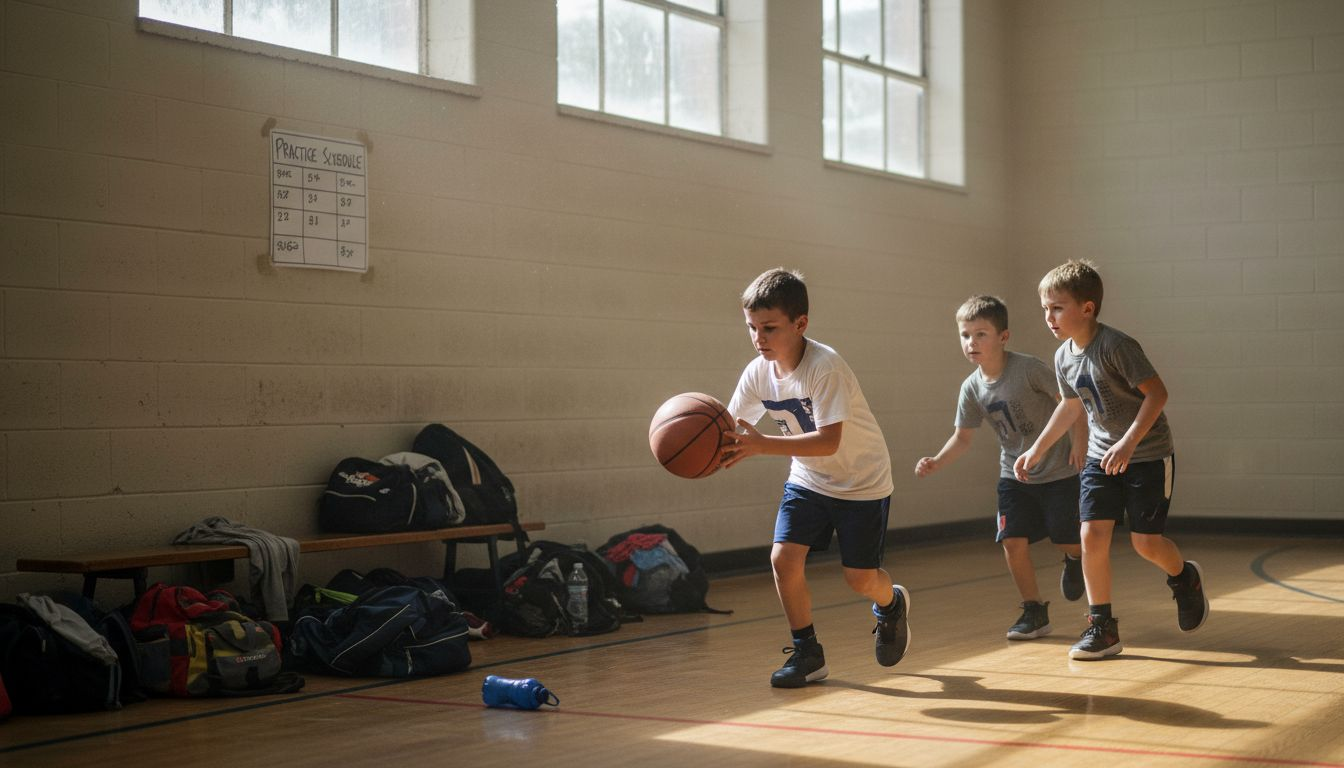
Successful youth basketball development goes beyond individual skill mastery. It involves creating an environment that nurtures learning, encourages experimentation, and maintains player engagement. By breaking down complex skills into manageable components and providing consistent, constructive feedback, coaches can help young athletes build a solid technical and strategic foundation.
Pro tip: Design practice drills that combine multiple skill categories to enhance player adaptability and create more dynamic, engaging training experiences.
Progression Models and Skill Benchmarks by Age
Systematic youth basketball development requires moving beyond rigid age-based categorizations toward individualized progression models that recognize each player’s unique developmental trajectory. Modern coaching approaches emphasize mastery-based advancement, where skill acquisition and cognitive readiness take precedence over chronological age.
The developmental stages typically include:
- Active Start (Ages 6-8): Fundamental movement skills
- Fundamentals (Ages 8-10): Basic basketball techniques
- Learning to Train (Ages 10-12): Technical skill refinement
- Training to Compete (Ages 12-14): Complex tactical understanding
- Training to Win (Ages 14-16): Advanced strategic implementation
Research examining youth basketball development reveals systematic increases in training complexity across age categories, demonstrating that skill progression must align with both physical maturation and cognitive development. Coaches must design training environments that challenge players incrementally, introducing more sophisticated tactical concepts as athletes demonstrate readiness and comprehension.
Effective progression models prioritize holistic athlete development, balancing technical skill acquisition with psychological growth. This approach requires coaches to assess individual player capabilities, create personalized development pathways, and maintain flexibility in skill advancement strategies. Key benchmarks should evaluate not just physical performance, but also decision-making abilities, team communication, and mental resilience.
Pro tip: Conduct regular individual skill assessments that measure both technical proficiency and cognitive understanding to create truly personalized development plans.
Effective Methods for Teaching Basketball Skills
Effective basketball skill instruction requires a sophisticated approach that combines evidence-based pedagogical techniques with individualized learning strategies, moving beyond traditional one-size-fits-all coaching methodologies. Coaches must develop comprehensive teaching frameworks that address technical skill development, cognitive understanding, and player motivation simultaneously.
Key instructional methods include:
- Demonstration: Precise visual modeling of correct techniques
- Progressive Practice: Gradual skill complexity advancement
- Individualized Feedback: Targeted, constructive player guidance
- Repetition with Variation: Consistent skill reinforcement through diverse drill designs
- Game-Realistic Scenarios: Contextual skill application training
Experimental research comparing basketball instructional approaches reveals that tailored teaching strategies significantly enhance player performance, motivation, and skill retention. Successful coaches understand that skill development transcends mechanical repetition, requiring a holistic approach that considers each player’s unique learning style, physical capabilities, and psychological readiness.
Effective skill teaching demands continuous adaptation and sophisticated observation. Coaches must remain flexible, continuously assessing player progress, adjusting instructional strategies, and creating training environments that challenge athletes while maintaining psychological safety. The most successful approaches integrate technical instruction with emotional support, helping young players build confidence alongside their basketball skills.
Pro tip: Design practice sessions that blend structured technical drills with player-driven exploration, allowing athletes to develop creativity within a guided learning framework.
Avoiding Common Mistakes and Misconceptions
Basketball skill development demands nuanced understanding, yet coaches frequently encounter persistent misconceptions that can significantly derail player progress. These common errors often stem from oversimplified approaches that fail to recognize the complex, multidimensional nature of athletic skill acquisition.
Critical coaching misconceptions include:
- Age-Based Limitations: Assuming players cannot develop advanced skills before certain ages
- One-Size-Fits-All Training: Applying identical techniques across different player personalities
- Overemphasizing Physical Attributes: Prioritizing physical size over technical skill development
- Neglecting Mental Skills: Focusing exclusively on physical techniques while ignoring psychological preparation
- Inconsistent Feedback: Providing sporadic or non-specific coaching instructions
Successful youth basketball coaching requires challenging these ingrained misconceptions by implementing holistic, individualized development strategies. Coaches must recognize that skill progression is not linear, and each athlete represents a unique combination of physical capabilities, cognitive understanding, and psychological readiness. The most effective approaches view skill development as a dynamic, interconnected process that balances technical instruction with personal growth and motivation.
Navigating these developmental challenges demands coaches remain adaptable, patient, and committed to understanding each player’s individual learning journey. This means creating supportive environments that encourage experimentation, tolerate mistakes, and provide constructive, specific feedback that helps athletes understand not just how to perform a skill, but why certain techniques are more effective than others.
Here is a comparison of key coaching misconceptions and recommended solutions:
| Common Misconception | Impact on Athlete | Recommended Solution |
|---|---|---|
| Age-Based Limitations | Stunts skill development | Focus on readiness, not age |
| One-Size-Fits-All Training | Low engagement, stagnation | Personalize drills for each player |
| Overemphasizing Physical Traits | Ignores skill potential | Prioritize balanced skill training |
| Neglecting Mental Skills | Incomplete preparation | Integrate mental drills routinely |
| Inconsistent Feedback | Slows improvement | Provide regular, specific guidance |
Pro tip: Regularly video record player performances and conduct collaborative review sessions, allowing athletes to self-analyze and develop critical self-awareness about their skill development.
Practical Tools for Tracking Player Development
Basketball player development tracking requires sophisticated tools that provide comprehensive, nuanced insights beyond traditional statistics. Modern performance monitoring platforms enable coaches to capture detailed player progression metrics through advanced data collection and analysis technologies, transforming subjective coaching observations into objective, actionable intelligence.
Essential tracking tools typically encompass several key measurement categories:
- Performance Statistics: Points, rebounds, assists, shooting percentages
- Physical Metrics: Speed, agility, vertical leap, endurance
- Technical Skills: Shooting accuracy, dribbling efficiency, defensive capabilities
- Psychological Indicators: Motivation levels, team interaction, mental resilience
- Comparative Benchmarks: Age-group and skill-level performance comparisons
Advanced tracking platforms now offer professional-grade solutions for comprehensive player profile management, enabling coaches to verify age and grade eligibility while analyzing long-term performance trends. These tools go beyond simple number tracking, providing contextual insights that help coaches develop personalized training strategies tailored to each athlete’s unique developmental trajectory.
Successful player development tracking requires a holistic approach that balances quantitative data with qualitative observation. Coaches must interpret statistical information through the lens of individual player potential, recognizing that raw numbers tell only part of an athlete’s developmental story. The most effective tracking systems combine technological insights with experienced human interpretation, creating a comprehensive understanding of player growth.
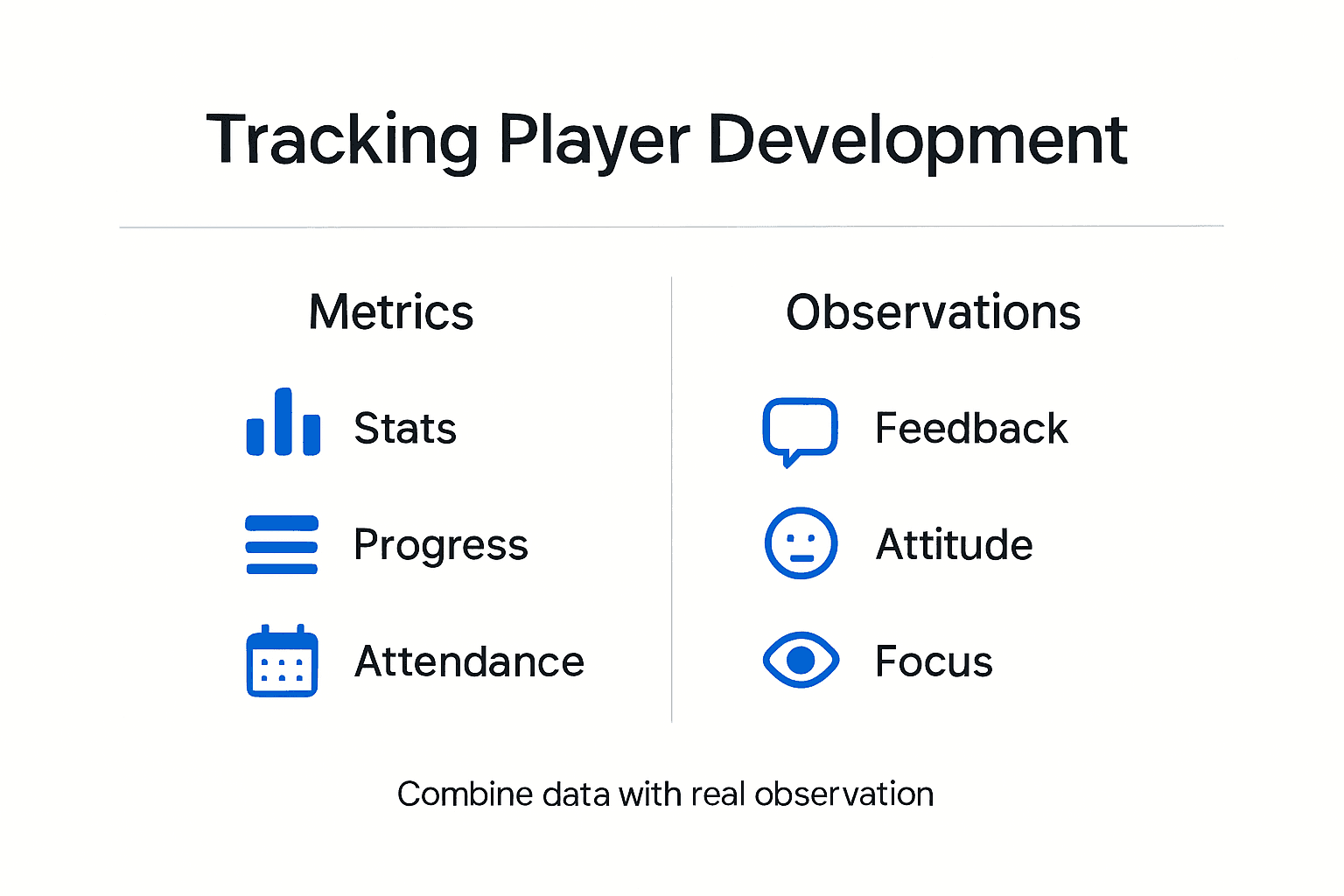
The table below summarizes useful basketball player development metrics:
| Metric Type | Example Metric | Why It Matters |
|---|---|---|
| Performance Statistics | Points per game | Tracks in-game contribution |
| Physical Metrics | Vertical leap | Monitors athletic progress |
| Technical Skills | Dribbling efficiency | Shows foundational skill |
| Psychological Indicators | Motivation survey score | Assesses mindset and effort |
| Comparative Benchmarks | Peer group ranking | Evaluates relative progress |
Pro tip: Implement a quarterly player development review process that combines statistical data with direct observation and player self-assessment to create a 360-degree view of athletic progression.
Unlock Youth Basketball Potential with Proven Coaching Resources
Coaches face the challenge of breaking down complex basketball skills into manageable parts while balancing technical training, tactical understanding, and mental preparation. This article highlights key pain points such as the need for individualized progression, consistent feedback, and comprehensive skill tracking. At Hoop Mentality, we provide practical solutions to these challenges through expertly crafted Basketball Drills and Basketball Templates designed to simplify practice planning and ensure progressive skill development.
Ready to elevate your youth coaching and help players master fundamentals efficiently? Explore our resources at Hoop Mentality today to save time, enhance communication, and implement structured training plans that deliver real results. Start building confident, skilled players with tools trusted by coaches worldwide.
Frequently Asked Questions
What is a basketball skill breakdown?
A basketball skill breakdown is a systematic approach used by coaches to analyze and develop individual player capabilities by dissecting athletic movements, technical skills, and cognitive strategies to enhance performance.
Why is physical conditioning important in youth basketball coaching?
Physical conditioning is critical in youth basketball coaching as it tailors athletic development to the specific demands of the sport, helping players improve their strength, agility, and overall athletic performance, which are essential for mastering basketball skills.
How can coaches effectively teach basketball skills to young players?
Coaches can effectively teach basketball skills by using methods such as demonstration, progressive practice, individualized feedback, and incorporating game-realistic scenarios. This approach helps players understand correct techniques while adapting to their unique learning styles.
What are some common misconceptions about youth basketball skill development?
Common misconceptions include believing that age determines ability, using one-size-fits-all training methods, overemphasizing physical traits over skill development, neglecting mental preparation, and providing inconsistent feedback. Addressing these misconceptions can enhance player growth.