

TL;DR:
- Most coaches view high ball screens solely as tools for creating scoring opportunities, but they also generate advantages through screen assists, off-ball movement, and defensive reads. When executed correctly, high ball screens pressure all defenders and open multiple scoring and passing options, with success heavily influenced by defense coverage. Focusing on proper teaching, pattern recognition, and tracking screen impacts enhances overall offensive efficiency and develops a strong screening culture.
Most coaches think a high ball screen is just about freeing the ball handler for a drive or a pull-up jumper. Run the pick-and-roll, get a mismatch, score. Simple enough. But that view leaves a lot of offense on the table. The reality is that high ball screens create advantages across the entire floor, and the best coaches track those advantages beyond just points scored. Screen assists, off-ball movement, defensive coverage reads, and foul rate all factor into whether your ball screen actions are actually working. This guide breaks down everything you need to teach and implement high ball screens effectively at the youth or high school level.
Table of Contents
- What is a high ball screen and why does it matter?
- How high ball screens create advantages: Beyond the ball handler
- Factoring in defense: How coverages dictate screen effectiveness
- Practical tips: Teaching high ball screens to youth and high school teams
- The overlooked truths most coaches miss about high ball screens
- Take your ball screen offense to the next level
- Frequently asked questions
Key Takeaways
| Point | Details |
|---|---|
| Screen assists matter | High ball screen value is often found in freeing teammates, not just scoring. |
| Defensive coverage defines results | Effectiveness of the high ball screen changes based on how the defense reacts. |
| Team execution is crucial | Teaching timing, angles, and purpose leads to more successful ball screen actions. |
| Track team-oriented stats | Measuring screen assists and points-per-possession offers real feedback on screen impact. |
What is a high ball screen and why does it matter?
A high ball screen (also called a high pick-and-roll) is an on-ball screen set above the three-point line or at the top of the key. The screener (usually a big or a forward) plants a legal screen on the ball handler’s defender, forcing the defense to make a decision. The ball handler then uses that screen to attack the basket, pull up for a jumper, or pass to a cutting or spacing teammate.
High ball screens are common at every level because they are simple to call, easy to read, and hard to defend well. They fit into nearly any offensive system, including motion offense, set plays, and ball screen offense for youth teams just learning concepts.
Here is what makes them especially valuable:
- They force two defenders to communicate and make a decision instantly.
- They create mismatches when defenders switch assignments.
- They generate driving lanes when the screener’s defender goes under or drops.
- They free up shooters off the ball when the defense collapses.
“High-level screening is often evaluated via screen assists and screening impacts and the ability to get teammates open, not just scoring off rolls.” This point from a detailed breakdown of how NBA screens control games reframes the entire conversation around what good screening actually looks like.
A screen assist is different from a regular scoring assist. A scoring assist means the ball was passed directly to the player who scored. A screen assist is credited when the screen itself freed a teammate who then scored, even without a direct pass from the screener. This distinction matters. It means your best screener might not show up in a box score at all, but their impact on the offense is very real and very measurable.
Pro Tip: Start tracking screen assists in practice. Even a simple tally on the whiteboard tells your screeners their work is seen and valued.
Understanding the types of basketball screens coaches should know is the foundation for teaching any ball screen action correctly. High ball screens are just one piece of the puzzle.
How high ball screens create advantages: Beyond the ball handler
The most common mistake coaches make is designing their ball screen actions entirely around the ball handler. The ball handler gets the glory. The screener and the other three players often just stand and watch. That is wasted offense.
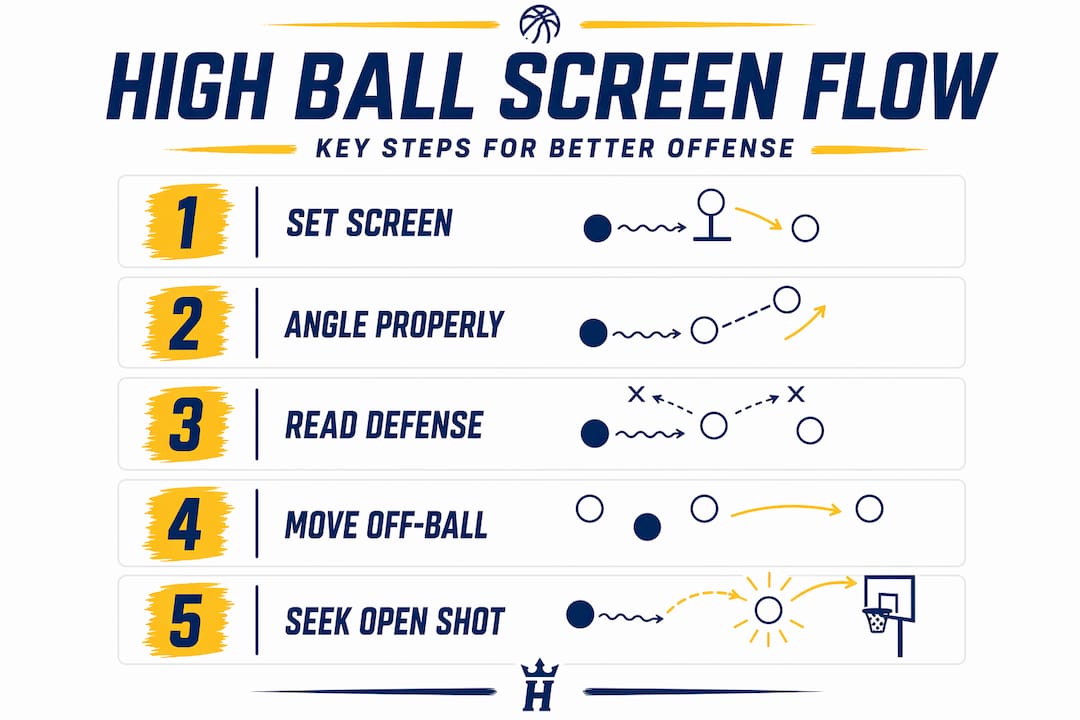
A well-run high ball screen puts pressure on all five defenders simultaneously. Here is what can happen on a single high ball screen action:
- The ball handler attacks off the screen for a layup or mid-range pull-up.
- The screener rolls or pops to the basket or perimeter for an open look.
- The weak-side corner shooter relocates to take advantage of a collapsing defense.
- A wing cuts backdoor when their defender overhelps on the ball handler.
- A second big sets a secondary screen away from the ball.
Screen assists as a metric capture much of this value. When your screener frees a corner shooter who hits a three, that is a screen assist. When a backdoor cut happens because two defenders are occupied with the ball screen, that is a direct result of your screening action.
Proper screen angle and timing are critical for freeing teammates, not just the ball handler. The screener should angle their body to maximize the defender’s path disruption. A flat screen is easy to fight through. A screen set at the correct angle to the defender’s path forces a detour that creates time and space for multiple players.
| Outcome type | Who benefits | What creates it |
|---|---|---|
| Ball handler scores | Ball handler | Screen forces a coverage gap |
| Screener scores | Screener | Roll or pop after setting screen |
| Teammate scores | Off-ball player | Defense collapses, leaving shooter open |
| Foul drawn | Ball handler or screener | Defender forced into illegal contact |
Pro Tip: Coach your screeners to immediately look for their own scoring opportunity after the screen. A screener who just stands there is wasting half the action. Teach the roll, the pop, and the slip.
Good off-ball movement is what converts a decent ball screen into a great offensive possession. Your other three players need to read the defense and move with purpose every single time the screen is set.
Factoring in defense: How coverages dictate screen effectiveness
Here is where a lot of coaches get confused. They run the same ball screen action every game and get wildly different results. Sometimes the ball handler gets to the rim easily. Sometimes the play breaks down completely. The reason is almost always the defensive coverage.
Ball screen effectiveness shifts significantly based on how the defense covers the action. The four most common coverages are:
| Coverage type | What the defense does | Best offensive counter |
|---|---|---|
| Drop | Screen defender drops to paint, ball handler’s defender fights over | Pull-up jumper at top of key |
| Switch | Defenders swap assignments at the screen | Attack the mismatch immediately |
| Hedge | Screener’s defender steps out hard to cut off the ball handler | Quick pass to rolling screener |
| Blitz | Two defenders trap the ball handler hard | Skip pass to open corner shooter |
Separating effectiveness by coverage rather than looking at ball screens as a single universal action is the analytical shift that makes ball screen offense much smarter. Points per possession (PPP) changes dramatically depending on the coverage, the shot selection, and whether fouls and turnovers are kept low.
Here is a numbered process for teaching players to read and react to coverage:
- Identify the coverage before the screen is set. Watch how the screener’s defender is positioned. Are they sagging toward the paint (drop) or standing up flat (switch or blitz)?
- Set the screen at the right angle. The screener adjusts based on where the defender is standing to maximize the disruption.
- Ball handler reads the first defender. Is the defender going over or under the screen? That answer determines whether to attack or pull up.
- Screener reads the second defender. If that defender steps out hard (hedge), the roll to the basket is open. If they stay, the pop or slip may be better.
- Off-ball players react. As the two defenders engage the screen, three other players relocate based on where the help defense comes from.
Understanding ball screen defense from the other side actually makes you a better offensive coach. When you know why a hedge ball screen defense is designed to take away the roll, you can coach your players to recognize it and counter it faster.
Practical tips: Teaching high ball screens to youth and high school teams
Teaching high ball screens effectively comes down to progressions. Do not start with five-on-five. Build the skill layer by layer.
Core teaching cues for screeners:
- Set your feet before the defender arrives. Moving screens are a waste of a possession.
- Make shoulder contact. A screen your defender can step around easily is not a screen.
- Chin up, hands in. Legal screening position prevents fouls and keeps the action clean.
- After contact, move immediately. Roll hard, pop wide, or slip early if the defender telegraphs the switch.
Progressions for introducing the high ball screen:
- Walk-through at half speed with no defense. Ball handler and screener only. Build the footwork and angles before adding defenders.
- One-on-one shadowing drill. Defender tries to fight over the screen. Ball handler reads the gap created.
- Two-on-two ball screen drill. Add the screener’s defender. Teach the roll and pop based on how the second defender reacts.
- Three-on-three with a corner shooter. Now the ball handler has to decide: attack, pass to the roll, or kick to the corner.
- Five-on-five with the full read. All players execute their assignments based on where the defense helps.
Tracking progress beyond scoring:
This is where you separate good coaches from great ones. Use a simple tracking sheet during film sessions. Count screen assists, note the coverage type for each ball screen, and track shot quality (layup, open three, contested mid-range). Over several games, patterns emerge that tell you exactly which actions are working and which need adjustment.
Building a skills development workflow that includes ball screen progressions gives your practice plans structure and keeps players improving week to week. If you want a full system, continuity ball screen offense builds on these same principles into a repeating offensive structure.
Pro Tip: Celebrate screen assists out loud during practice. When a screener frees a shooter who hits a three, acknowledge it directly. Players will start competing to set the best screens on the team.
High-level screening evaluation focuses on screening impacts and getting teammates open, not just direct scoring. Teach your players this mindset early and your ball screen actions will be far more effective.
The overlooked truths most coaches miss about high ball screens
Here is an uncomfortable fact: most teams that add high ball screens to their offense do not immediately get better. The plays get called. The screens get set. And the results are mediocre for weeks. Coaches usually blame the players. The real issue is almost always the implementation.
Running a high ball screen is not a system. It is an action. And actions only work when everyone on the floor understands their role and reacts correctly. The ball handler does not just run off the screen and hope. The screener does not just set the pick and wait. The three off-ball players are not spectators.
Too many coaches treat the screen as a magic button. Push it and points appear. But screen effectiveness depends entirely on how teammates move, how defenses are read, and how well the execution holds up against pressure. At the youth and high school level, this means patience. It means running the same two-on-two drill 50 times before putting it into a game situation.
Screening is also a culture issue. Players who set great screens do not usually lead the team in scoring. They do not get highlight clips. Coaches have to build a culture where screening is genuinely valued. That means tracking screen assists, calling them out in the film room, and making screeners feel like they are as important as the scorers. Because they are.
Euro ball screen strategies offer a useful perspective here. International basketball culture treats screening as a skill that requires serious development, not just a physical action anyone can do. Bringing that mindset to your program changes how players approach every screen they set.
The frequency of your ball screen calls matters far less than the quality of your execution. Three perfectly read high ball screens per game will do more for your offense than 20 broken possessions built around the same action.
Take your ball screen offense to the next level
You now have a clear picture of how high ball screens work, what the analytics say, and how to teach them step by step. The next move is putting better tools in your hands.
Hoop Mentality has resources built specifically for coaches who want to implement ball screen systems with confidence. The Big Man Dual Action Drill gives your screeners a focused, progressive training tool that develops both roll and pop reads out of ball screen actions. For broader preparation, the Game Preparation Guide includes weekly practice plans structured to build team concepts like ball screen offense from the ground up. Both resources are practical, ready to use, and built from real coaching experience.
Frequently asked questions
What is a screen assist in basketball?
A screen assist is credited when a screen directly leads to a made basket by freeing a teammate, even if the screener never touches the ball. High-level screening is evaluated through this metric because it captures impact that scoring stats miss entirely.
How do defenses usually guard high ball screens?
Common coverages include drop, switch, hedge, and blitz, each changing the offensive outcome and shot quality significantly. Ball screen effectiveness must be analyzed by coverage type to get an accurate picture of what is working.
Why don’t high ball screens always lead to easy buckets?
Smart defenses adapt, and high-quality shots require timing, off-ball movement, and correct defensive reads working together. Ball screen value depends on how the defense covers the action, not just whether the screen gets set.
How can I track my team’s progress using high ball screens?
Focus on screen assists, shot quality by coverage type, and turnovers or fouls that come directly out of ball screen actions. PPP by coverage and foul rate give you a much more accurate read than total points scored off ball screens alone.