

TL;DR:
- Most coaches believe the Euro ball screen is only suitable for elite professionals, missing its broad potential across all levels.
- It is a structured, flow-based offense built on ball screens, spacing, and multiple read options that adapt to defensive strategies.
- The system promotes player reading, movement, and versatility, making it difficult to predict and highly effective in developing team cohesion.
Most coaches assume the Euro ball screen is reserved for professional rosters with elite playmakers. That assumption leaves a lot of value on the table. The Euro ball screen offense is a continuity/flow system built around ball screens, spacing, and side-to-side motion, with wing pick-and-rolls, high-low reads, and backdoor options. It scales from youth leagues to pro basketball, and it generates problems for defenses at every level. This article breaks down how it works, what makes it effective, and how you can start using it with your team.
Table of Contents
- What is the Euro ball screen offense?
- Key features and advantages of the Euro ball screen
- How the Euro ball screen operates in real game scenarios
- Common challenges and solutions when teaching the Euro ball screen
- Why the Euro ball screen rewards adaptable coaching
- Bring the Euro ball screen to life in your practices
- Frequently asked questions
Key Takeaways
| Point | Details |
|---|---|
| Continuity and flow | The Euro ball screen offense uses constant movement and options to challenge defenses. |
| Universal teachability | This system can be taught and executed by teams from youth leagues to professionals. |
| Variety of counters | With over 30 counters and 7 entries, it’s nearly unscoutable if coached well. |
| Solving common pitfalls | Proper spacing, communication, and adaptability are key for successful execution. |
What is the Euro ball screen offense?
The Euro ball screen offense is not a single play. It is a structured system that keeps the ball moving, spaces the floor, and creates read opportunities on every possession. Understanding that distinction is the first step to coaching it well.
At its core, the continuity ball screen offense is designed so that actions flow from one option into the next. If the first read is taken away, the second read is already in motion. There is no stopping, resetting, and calling another play. The offense breathes on its own.
The Euro ball screen system is built around these core principles:
- Wing ball screens set along the perimeter to create drives, pull-ups, and kick-outs
- Side-to-side motion that shifts the defense and opens gaps on both sides of the floor
- High-low reads where big men read each other based on how the defense positions
- Backdoor cuts triggered when defenders overplay or cheat on the perimeter
- Off-ball movement from players not involved in the screen, keeping the defense occupied
What makes this system difficult to guard is the combination of spacing and flow. Defenses cannot simply load up on one side or double the ball screen, because the offense has built-in counters that punish those decisions. The ball screen offense for youth teams is entirely achievable because the base reads are simple. Players learn two or three decisions, and the system does the rest.
“The Euro ball screen offense is a continuity and flow system built around ball screens, spacing, and side-to-side motion, with high-low reads and backdoor countercut options that keep defenses guessing on every possession.”
Key terms every coach should know before installing this system:
- Continuity: The offense loops and restarts without a full reset
- Counter: A built-in adjustment triggered by a specific defensive action
- Off-ball action: Movement by players not handling the ball, creating secondary reads
- Wing screen: A screen set on or near the wing, typically used to free a ball handler
- High-low: A read between two post players based on where the defense positions
Key features and advantages of the Euro ball screen
With a strong grasp on what the Euro ball screen is, let’s explore why coaches at all levels find it so effective and how it compares to other systems.
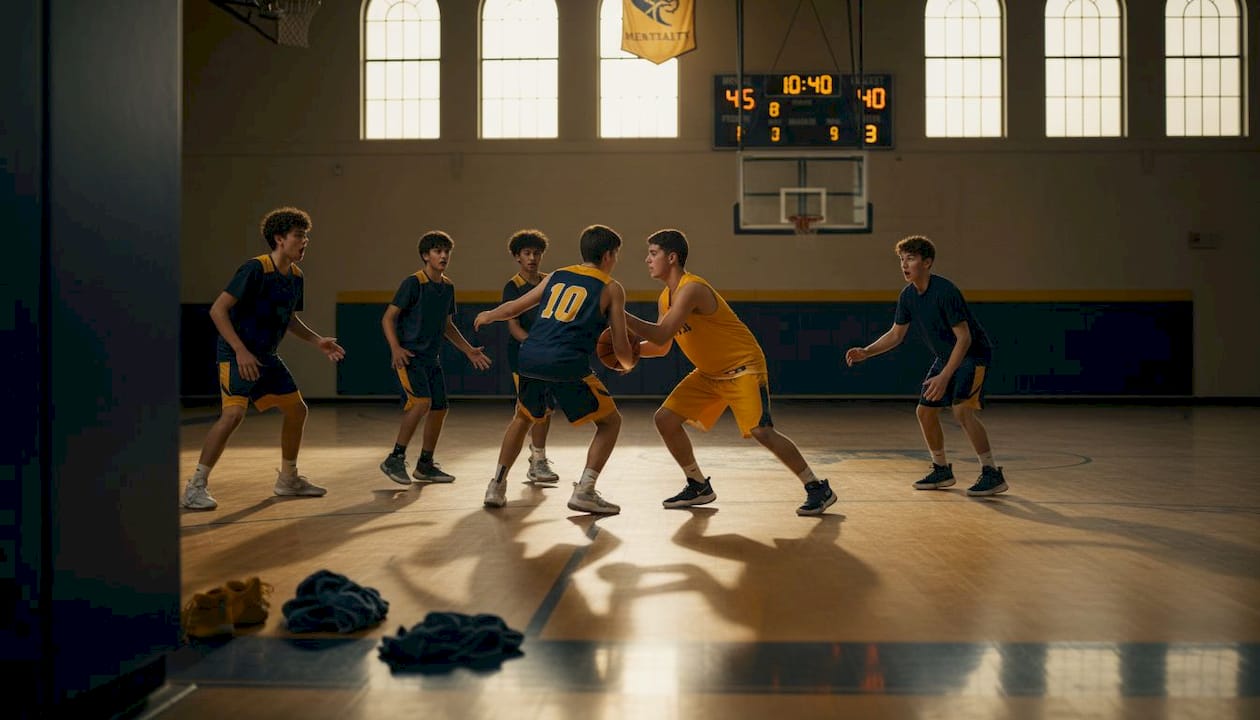
The Euro ball screen stands out from most offensive systems because it offers structure without rigidity. You install the framework, and your players learn to read within it. That flexibility makes it one of the few systems that genuinely works from a youth practice setting through to professional competition.
One of the most significant selling points is the volume of built-in options. The system features 32 counterplays and 7 entry sets, which means scouts and opposing coaching staffs have a very hard time preparing a reliable game plan against it. You are not running variations of the same action. You are running genuinely different options that stress different parts of the defense.
Here is how the Euro ball screen compares to two other common systems:
| Feature | Euro ball screen | Standard pick-and-roll | Motion offense |
|---|---|---|---|
| Continuity | High | Low | Medium |
| Counters available | 32+ | 3 to 5 | Variable |
| Teachability | Youth to pro | Intermediate to pro | Youth to pro |
| Defensive predictability | Very low | Medium to high | Low to medium |
| Spacing requirement | Structured | Structured | Flexible |
| Off-ball involvement | High | Low | High |
The comparison makes one thing clear. The Euro ball screen gives you the off-ball engagement of a motion offense, the structured spacing of a traditional pick-and-roll, and the counter depth that neither system can match on its own.
Pro Tip: Start by teaching just two counters. Your players do not need to know all 32 right away. Build the base offense, run it until it is automatic, and then layer in one counter per week based on what defenses are doing to you.
Key advantages for your team:
- Harder to scout because the variety of options shifts from game to game
- Keeps all five players active and involved on every possession
- Teaches players to read defense rather than follow a script
- Works with traditional rosters and modern spread lineups
- Creates easy shots through spacing, not just individual skill
Knowing the types of basketball screens your players can set and use will directly improve how cleanly the Euro ball screen runs. Similarly, if your team already runs a motion offense, the transition to Euro ball screen principles is shorter than you might expect.
How the Euro ball screen operates in real game scenarios
Understanding the features and advantages is only part of the equation. Knowing how to actually run the Euro ball screen on the court is what transforms your team.
Let’s walk through a basic possession step by step.
- Entry: The point guard enters the ball to the wing. The weakside forward begins moving to the high post or cuts baseline based on the defensive setup.
- Wing screen set: The screener comes from the elbow or high post and sets a ball screen on the wing for the ball handler.
- Primary read: The ball handler reads the defense. If the defender goes under the screen, pull up for the mid-range. If they hedge hard, drive to the lane.
- Secondary read: The screener rolls or pops based on how their defender reacted. A hard hedge means the screener rolls to the rim. A drop coverage means the screener pops to the perimeter.
- High-low activation: If neither the ball handler nor the screener has a clear advantage, the ball is reversed. The high-low read activates with the big men, and the play continues without stopping.
- Backdoor trigger: If the weakside defender cheats toward the ball, the weakside cutter goes backdoor. The reversal pass hits them in stride for a layup.
This is what the continuity flow system looks like in practice. One action leads directly into the next. The defense must make a new decision on every pass, and each decision opens a different option.
Here is a quick reference table of common defensive schemes and how the Euro ball screen responds:
| Defensive scheme | Euro ball screen counter |
|---|---|
| Hedge and recover | Roll to rim, slip the screen early |
| Drop coverage | Pop for mid-range or three-point shot |
| Switch | Mismatch isolation or quick post entry |
| Blitz/trap | Skip pass to weakside shooter |
| Overplay wing | Backdoor cut with direct pass |
Pro Tip: Film your opponents’ ball screen defense before the game. Identify whether they hedge, drop, or switch, and walk your team through which counter to prioritize in the scouting session. Your players will run the offense with far more confidence when they already know what the defense is likely to do.
Getting motion offense implementation right before layering in the Euro ball screen principles is a practical approach. It builds the reading habits your players need. Equally, investing time in basketball spacing fundamentals pays off immediately when running this system, because the entire offense depends on correct floor positioning.
Common challenges and solutions when teaching the Euro ball screen
With practical scenarios in mind, it is critical for coaches to anticipate and solve the common issues that arise during implementation.
The Euro ball screen runs smoothly when players trust the system. Most breakdowns happen when individuals force decisions or abandon their reads too early. Here are the most common issues and direct solutions.
Players forcing the action
This is the most frequent problem. A ball handler sees the screen and immediately tries to score instead of reading the defense. The solution is simple. Drill the reads in isolation. Run the wing screen action in practice with no scoring option available unless the correct read is made. Players learn quickly when the decision is the drill.
Poor spacing
If two players drift to the same area, the offense collapses. Spacing is not automatic. It must be taught and reinforced. Use tape on the court in practice to mark floor positions. Every player should know exactly where they are supposed to be when the ball screen is set. If they are in the wrong spot, stop practice and reset.
Predictable timing
When players run the actions at the same speed every time, the defense adjusts. Vary screen timing. Have your ball handler wait an extra beat before using the screen. Have the screener delay by one step. Small timing variations make the offense look completely different even when the action is identical.
Off-ball players standing still
The Euro ball screen depends on off-ball movement to keep the defense honest. When weakside players stand and watch, defenders can sag and help without cost. Teach your off-ball movement principles as a separate session before running the full offense.
Confusion against switching defenses
Switching can frustrate teams that are not prepared for mismatches. Teach your players to recognize a switch immediately and call it out. The response is simple: the smaller player posts up, and the bigger player spaces to the perimeter. Understanding ball screen defense strategies from the opponent’s point of view helps your players anticipate switches before they happen.
“The Euro ball screen is only as effective as the players running it. When run correctly, it is simple, flexible, and genuinely tough to defend. The breakdowns are almost always in the reads, not the design.”
Key solutions at a glance:
- Use read-based drills with no scoring until the correct decision is made
- Mark floor positions in practice with tape until spacing is automatic
- Vary screen timing deliberately during walkthroughs
- Run off-ball movement sessions as standalone practice segments
- Teach your players how switching defenses work so they can spot and exploit mismatches
Why the Euro ball screen rewards adaptable coaching
Most articles about the Euro ball screen treat it as a fixed playbook. Install it, run it, win. That framing misses what actually makes the system powerful.
The real value of the Euro ball screen is that it gives you a foundation to build from, not a script to follow. Coaches who get the most out of it are the ones who take the core structure and adjust it for their specific roster. A team with two shooters and a dominant playmaker runs different counters than a team built around two versatile big men and three athletes. Same system. Completely different emphasis.
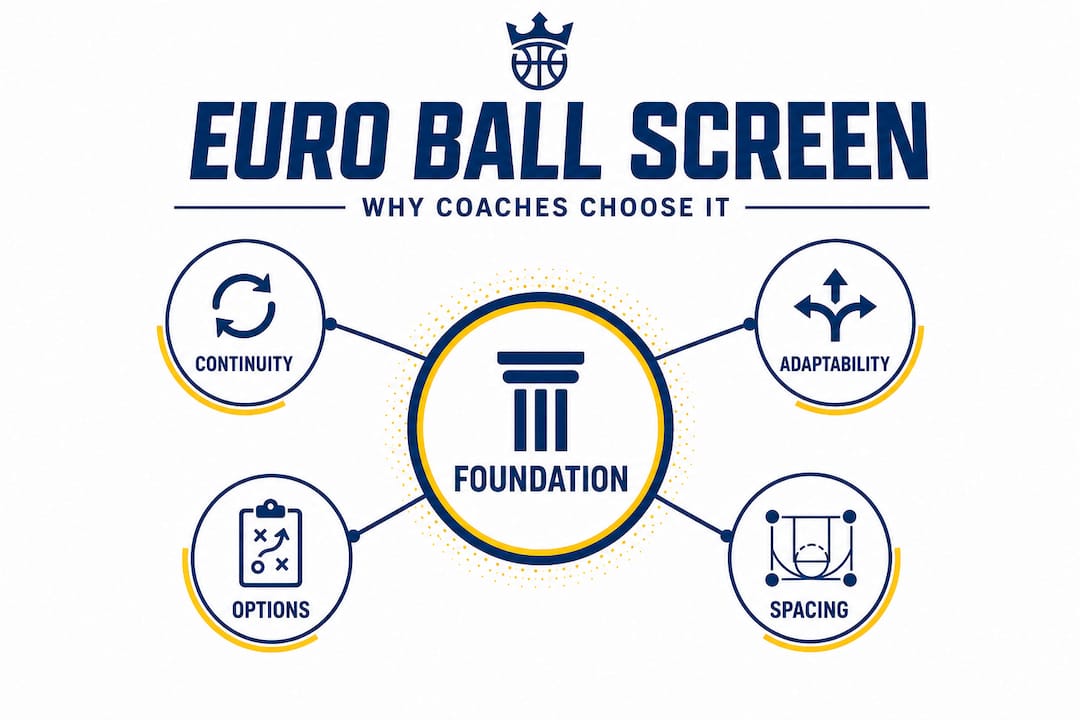
The 32 counters are not meant to all be installed at once. They exist so you can pick the ones that fit your personnel and your opponents. That is the design intent. The offense is meant to evolve with your team from week to week and season to season. If you are using the same five counters in March that you used in November, you are leaving options unused.
There is also a teaching lesson here. The motion offense expertise you build early in a program creates players who read the floor rather than follow instructions. The Euro ball screen rewards that kind of player development investment. Teams that spend time building reading habits get exponential returns when they layer in the Euro ball screen structure.
The uncomfortable truth is that some coaches resist adapting the offense because it feels like admitting the original plan was wrong. It is not. Adjustment is the job. The Euro ball screen is designed to be adapted. Coaches who embrace that mindset find the system gives them more and more options as the season progresses.
Bring the Euro ball screen to life in your practices
Ready to take the Euro ball screen from concept to court? Start with the right tools.
Hoop Mentality has the resources to support every stage of your implementation. The Big Man Dual Action Drill is built for developing the high-low reads and screen actions that make the Euro ball screen work. If you want a structured weekly plan that fits all of this into your practice schedule, the game preparation guide gives you a complete framework. Both resources are practical, ready to use, and built from real coaching experience.
- Browse drills, playbooks, and practice plans at hoopmentality.com
- Find tools designed for every level, from youth programs to varsity and beyond
Frequently asked questions
What is the main difference between a Euro ball screen and traditional pick-and-roll offenses?
The Euro ball screen uses continuous side-to-side movement with multiple built-in options, making it far less predictable than standard pick-and-roll sets that reset after each action.
Can youth teams successfully run the Euro ball screen offense?
Yes. The system is designed for all levels, offering simple reads and entry plays that youth players can learn and execute without advanced skill sets.
What are the essential counters in the Euro ball screen system?
The system includes more than 30 counterplays and 7 entry sets, giving teams the ability to adjust to any defensive scheme during a game.
Why is the Euro ball screen considered hard to defend?
Its flow and option variety make it tough to defend consistently, especially when spacing and timing are executed correctly by all five players on the floor.