

TL;DR:
- Continuity ball screen offense creates a repeating, structured system that challenges defenses with constant decision-making.
- Success relies on precise timing, spacing, role clarity, and players’ ability to read defenders.
- Consistent practice, patience, and understanding of roles turn the system into an effective, game-changing offense.
Most coaches know the pick-and-roll. But knowing one action and knowing how to build a system around repeating screen actions are two very different things. Continuity ball screen offense gives your team a structured, repeating framework that forces defenses to make hard choices on every possession. This guide breaks down exactly what continuity ball screens are, how each player fits into the system, which defensive strategies they disrupt, and how you can teach them effectively in practice starting this week.
Table of Contents
- Understanding the continuity ball screen offense
- Essential parts and player roles in continuity ball screens
- How continuity ball screens disrupt modern defenses
- Implementing the continuity ball screen: Drills, teaching points, and mistakes to avoid
- Why most coaches underestimate the power of continuity ball screens
- Take your ball screen offense to the next level
- Frequently asked questions
Key Takeaways
| Point | Details |
|---|---|
| Continuity screen defined | It is a repeatable offensive action that uses structured ball screens to consistently break down defenses. |
| Nail cut importance | The nail cut helps keep the paint uncluttered and complicates defensive switching and denial. |
| Key player roles | Every position has a critical responsibility, from screeners to cutters, that must be executed with timing and awareness. |
| Practical implementation | Using targeted drills and emphasizing proper spacing and reads is crucial for success. |
Understanding the continuity ball screen offense
A continuity ball screen offense is not just a play. It is a structured system where similar ball screen actions repeat through a sequence of options and player positions. The ball keeps moving. Players rotate through roles. The defense never gets a chance to settle.
This is the key difference from a one-off pick-and-roll. In a standard pick-and-roll, the ball handler uses one screen, and if the action does not produce a shot, the play resets from scratch. In a continuity system, the action flows directly into the next screen opportunity. Defenders must make decisions repeatedly and quickly, which creates mistakes and open looks.
Understanding continuity offense basics helps you see how this fits into a broader offensive system. The structure depends on three pillars:
- Timing: Screeners must arrive as the ball handler reaches the right spot. Early or late screens kill the action.
- Spacing: Players off the ball must hold their positions until their cue, keeping the lane clear for cutters and drivers.
- Role clarity: Every player knows their job within each repetition of the action.
Two concepts that define modern continuity ball screen systems are the burn cut and the nail cut. The burn cut is when an off-ball player cuts sharply through the lane toward the ball side. The nail cut adjusts this movement to the “nail” spot, which is the middle of the lane at the free throw line area. This keeps cutters from crowding the rim and ruining spacing.
In continuity ball screen structures, teams refine the cutter’s burn cut into a nail cut concept to preserve rim spacing and directly affect defensive switch and deny rules.
The nail cut is not just a positional adjustment. It is a read. The cutter reacts to where the defender is positioned, either sealing or clearing through based on what the defense gives. This read-and-react element is what separates teams that run continuity ball screens on paper from teams that actually execute them in games. Knowing the types of ball screens available gives you more tools to build out these actions within your system.
Essential parts and player roles in continuity ball screens
With a firm definition in mind, let’s break down who does what in a typical continuity ball screen.
Every player on the floor has a specific job. The offense breaks down when even one player ignores their role. Here is how each position fits into the system:
| Player role | Primary responsibility | Key action |
|---|---|---|
| Ball handler (PG) | Initiate the screen action, read coverage | Use the screen, attack or kick |
| Screener (Big) | Set legal, well-timed screen | Roll, pop, or relocate after screen |
| Nail cutter | Make nail cut, read defender | Cut to nail or cut through |
| Weak-side shooter | Hold spacing on weak side | Relocate on reversal or kick-out |
| Weak-side screener | Set next screen in the continuity | Prepare next screen action |
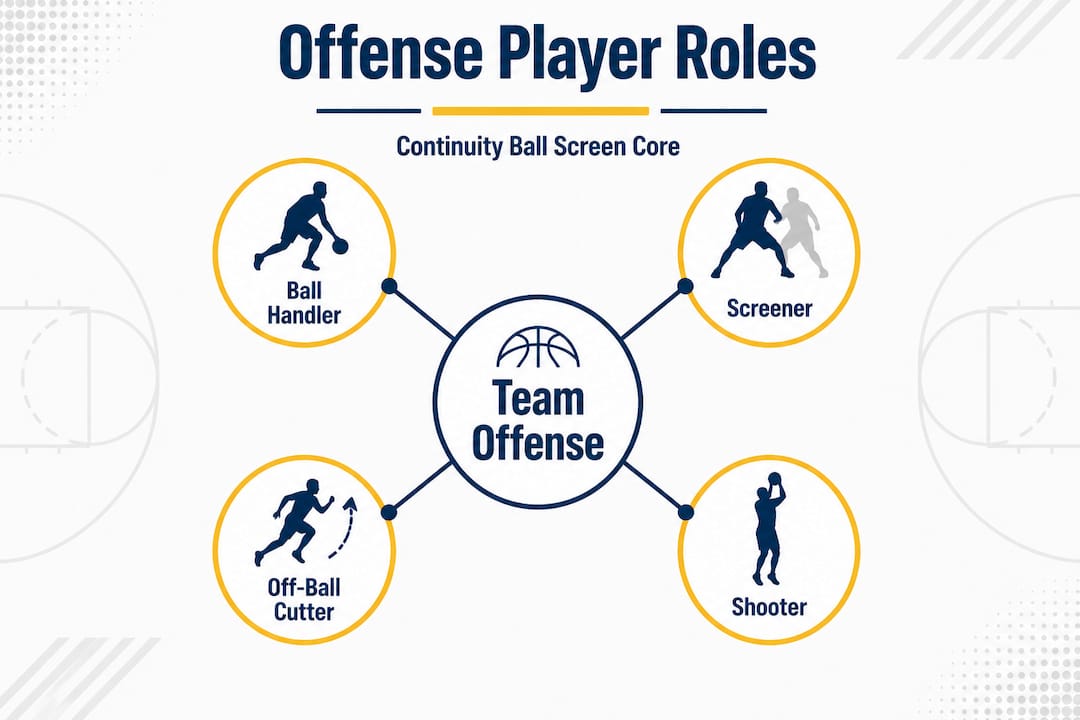
The continuity works because each player’s action triggers the next. When the ball handler uses the screen, the nail cutter moves. When the cutter clears, the weak-side screener sets the next screen. The sequence never stops.
Common actions within the continuity ball screen system include:
- Side pick-and-roll: Ball handler attacks the sideline off a screen from the big.
- Burn cut: Cutter moves aggressively through the lane, looking for a quick pass.
- Nail cut: Cutter adjusts to the free throw line area, preserving rim spacing and creating a passing option.
- Ball reversal: Ball swings to the weak side to reset and initiate the action again.
- Screen the screener: After one screen action, a player sets a screen for the original screener relocating.
Teams using ball screen offense for youth can simplify these roles while still teaching the core concept of continuous action and reading defenders.
The off-ball movement is just as important as what happens at the ball. Weak-side players who stand flat and watch kill the offense. Every player should be scanning and moving, making it impossible for help defenders to find a comfortable position.
Pro Tip: Teach players to react to the nail defender specifically. If the nail defender cheats toward the ball handler, the nail cutter should seal and look for the pass. If the nail defender sinks to protect the rim, the cutter should clear through quickly and let the ball handler attack the open lane. This one read creates two different high-value scoring opportunities from the same action. Good spacing in ball screen offenses comes from players making these reads consistently, not just running to spots.
How continuity ball screens disrupt modern defenses
Understanding each player’s responsibilities, we can now explore how these actions put real pressure on sophisticated defenses.
Modern defenses are smart and well-organized. They have specific rules for handling ball screens: switch everything, hard hedge and recover, or ice the ball handler toward the sideline. Continuity ball screens are built to attack every one of these coverages.
Here are the three primary defensive strategies and how continuity ball screens counter each:
-
Switching defense: When defenders switch every screen, the continuity system creates repeated switch opportunities. More switches mean more mismatches. The nail cut specifically attacks switching teams because the nail cutter can seal a smaller defender who switches onto them, demanding a post entry or an open mid-range look.
-
Hedge and recover: When the screener’s defender steps out to cut off the ball handler, the screener rolls immediately to the basket against a slow-recovering big. The nail cutter also clears the lane so the rolling screener has a clear catch-and-finish opportunity. The defense must choose: slow the ball handler or protect the roll.
-
Deny coverage: When the defense tries to front or deny the nail cutter, it opens a direct drive lane for the ball handler coming off the screen. The cutter’s movement forces a decision. Help or follow.
Burn and nail cuts in continuity ball screen structures are specifically designed to exploit the switch and deny rules that modern defenses rely on most heavily.
This is why continuity ball screens are so hard to defend consistently across a full game. A defense might handle one action well. But handling the same action repeated 20 times in a game, with slight variations based on personnel and reads, is a different challenge entirely. Study ball screen defense adjustments from the defense’s perspective. Understanding how your opponents think helps you design the continuity actions that punish their decisions most directly.
How the nail cut manipulates switch and deny coverage specifically:
- Forces the switching defender to communicate faster under fatigue
- Creates a sealing opportunity for the cutter against a mismatched defender
- Keeps the rim available for roll actions by clearing help defenders
- Occupies the nail defender, leaving the corner shooter or weak-side action open
Pro Tip: Use simple three-man shell progressions in practice before you run the full five-on-five continuity. Start with the ball handler, screener, and nail cutter only. Walk through each defensive coverage slowly, then speed it up. Players who understand why the action works will read the defense correctly in games. Building team chemistry during these small-group reps creates trust that transfers directly to game execution.
Implementing the continuity ball screen: Drills, teaching points, and mistakes to avoid
We’ve covered strategy. Now let’s get practical with specific ways to bring continuity ball screens to your gym.
Here is a comparison of popular continuity ball screen drills and how they fit different team needs:
| Drill name | Primary purpose | Skill focus | Team level |
|---|---|---|---|
| 3-man nail cut read | Teach nail cut decision-making | Cutting, passing, spacing | All levels |
| 5-on-0 continuity walk-through | Install the full sequence | Timing, roles, flow | Beginner to intermediate |
| 3-on-3 ball screen live | Attack specific coverages | Reading defense, attack angles | Intermediate to advanced |
| 5-on-5 continuity scrimmage | Full system integration | Communication, decision-making | Advanced |
| Pick-and-roll with constraint | Force specific read outcomes | Ball handler reads, roll timing | All levels |
Step-by-step approach for introducing the continuity ball screen in practice:
- Teach spacing rules first. Before any screening, show players where each position must stand. Use floor markers or cones. Players cannot run the system if they do not know where to be.
- Introduce the nail cut in isolation. Run three-man reps: ball handler, passer, and cutter. Walk through each defensive scenario slowly. Burn cut versus nail cut. Show why the nail preserves space.
- Add the screener. Now run four-man actions with a live screener. Focus on screen timing and the roll or pop read after the screen.
- Run 5-on-0 continuity. Walk the full sequence at half speed. Emphasize that each player’s action triggers the next. Check spacing after every action.
- Add token defense. Put two defenders on the ball-side only. Let offense read and react. Introduce coverage concepts gradually.
- Progress to full five-on-five. Now introduce all three defensive coverages. Let offense identify the coverage and execute the correct counter.
“The nail cut is valuable because it keeps the scoring area clear and helps create counters to switching defenses.”
Common mistakes to correct early:
- Over-dribbling: Ball handlers who take extra dribbles before using the screen give defenders time to recover and communicate.
- Poor screen timing: Screeners who arrive too early or too late create illegal screens or dead action.
- Ignoring weak-side action: Players who watch the ball instead of preparing their role in the next action collapse the offense.
- Abandoning the system under pressure: Teams often revert to isolation or freelance when the offense stalls. Trusting the continuity is a discipline issue as much as a skill issue.
Pro Tip: Emphasize verbal communication on every repetition. Ball handlers should call out defensive coverages. Screeners should signal their roll or pop decision. Cutters should call “nail” or “through” based on their read. Coaches working on advanced screen strategies will find that teams who communicate better execute ball screen offense far more efficiently than talented but silent teams.
Why most coaches underestimate the power of continuity ball screens
Here is the uncomfortable truth: most coaches know what a continuity ball screen is, but very few coach the details that actually make it work.
Coaches watch film. They draw up the action. They install it in practice. Then the first time a defense switches and the offense stalls, they call a timeout and run something else. The continuity never gets a real chance.
The problem is not the system. The problem is the gap between knowing the action and trusting it under pressure. Continuity ball screen offense requires patience. It takes repetitions before players stop thinking about what to do and start reading what the defense is giving them. That transition from mechanical to instinctive is where most programs give up.
Hard-won truths from coaches who have made continuity ball screens work:
- Players must own their roles before the system owns the game. You cannot skip the fundamentals and expect the continuity to run itself.
- The system needs patient repetition, not creative variation. Adding new wrinkles before the base is automatic creates confusion, not flexibility.
- Buy-in is earned through understanding, not authority. Players who understand why the nail cut works will execute it correctly. Players who were just told to cut there will freelance when the game speeds up.
- Defense determines your adjustments, not the other way around. Teach your players to read first, then react. The reads come from understanding the defense’s rules.
“Great ball screens don’t just happen. They are built with attention to subtle details like the nail cut, the timing of the roll, and the weak-side spacing that keeps options alive.”
Coaches who run implementing dynamic motion offense principles alongside their ball screen work often find that players develop better instincts for both systems because the reads overlap. The ability to see the defense and respond correctly is a skill that transfers across offensive concepts.
The teams that thrive with continuity ball screens do one thing consistently: they keep running it. Even when a possession fails. Even when the first two repetitions produce nothing. The third repetition breaks the defense because the defenders have already made two adjustment decisions and one of them will be wrong.
Take your ball screen offense to the next level
Continuity ball screens are a system worth building, and building them right takes quality tools. Hoop Mentality has resources designed specifically for coaches who want to move beyond basic ball screen concepts and install proven systems with structure and precision.

Start with the Big Man Dual Action Drill to develop your screeners’ footwork, roll timing, and decision-making in targeted reps. Pair it with a structured practice plan template to organize your installation process and make sure every practice session moves your team closer to full continuity execution. These tools are built from real coaching experience and are ready to use in your gym immediately.
- Structured drills for screeners, ball handlers, and cutters
- Practice plan templates that support progressive installation
- Strategy guides for attacking specific defensive coverages
Frequently asked questions
What is the main goal of a continuity ball screen offense?
The main goal is to create repeated ball screen actions that exploit defensive weaknesses and maintain constant player and ball movement. As Slappin’ Glass notes, teams build on actions like the nail cut concept inside continuity structures to preserve spacing and force defenders into repeated hard decisions.
How is a continuity ball screen different from a motion offense?
A continuity ball screen uses recurring, patterned screen actions that repeat through a defined sequence, while a motion offense emphasizes free-flowing movement and player-initiated reads without a fixed pattern.
Why is the nail cut important in ball screen offenses?
The nail cut clears the scoring area near the rim, making it harder for help defenders to protect the basket while also creating mismatch opportunities against switching defenses.
Can youth teams run continuity ball screens effectively?
Yes. With proper teaching, clear role assignments, and emphasis on spacing, youth teams can run the core actions of a continuity ball screen system successfully.
What is the most common defensive counter to a continuity ball screen?
Switching defenders is the most common response. The nail cut and the continuous nature of the action are specifically designed to exploit switch and deny rules that switching teams rely on to disrupt ball screen offense.