

TL;DR:
- Hedging ball screens is a teachable, effective defensive tactic suitable for all levels.
- It disrupts the ball handler’s momentum, forces difficult decisions, and improves team defense.
- Successful hedging depends on communication, proper timing, and tailoring to personnel and game situation.
Most coaches assume hedging ball screens is a tactic reserved for high-level programs with experienced bigs and elite athleticism. That assumption is holding teams back at every level. The truth is that a well-taught hedge is one of the most teachable, repeatable defensive tools you can add to your system. Whether you coach a middle school program or a competitive travel team, understanding how and when to hedge ball screen defense can change the way your team protects the basket, limits ball handler momentum, and communicates on the floor.
Table of Contents
- What is hedging a ball screen?
- The strategic advantages: Why hedge ball screens?
- Common pitfalls and how to avoid them
- When and how to implement hedging in your defense
- Our experience: What most coaches miss about hedging
- Take your defensive strategies further with Hoop Mentality
- Frequently asked questions
Key Takeaways
| Point | Details |
|---|---|
| Hedging defined | Hedging is when a defender steps out to slow the ball handler coming off a screen and then quickly recovers. |
| Strategic benefits | Hedging can disrupt opponents’ offense and elevate your team’s overall defensive performance. |
| Common mistakes | Poor communication and timing can undermine hedging, but smart coaching minimizes these errors. |
| Implementation tips | Evaluate your team’s strengths and run age-appropriate drills to teach effective hedging. |
What is hedging a ball screen?
A ball screen occurs when an offensive player sets a legal screen on the defender guarding the ball handler. The goal is to free the ball handler for a drive, pull-up jumper, or open pass. Defenses have several ways to respond, and hedging is one of the most active and demanding of those responses.
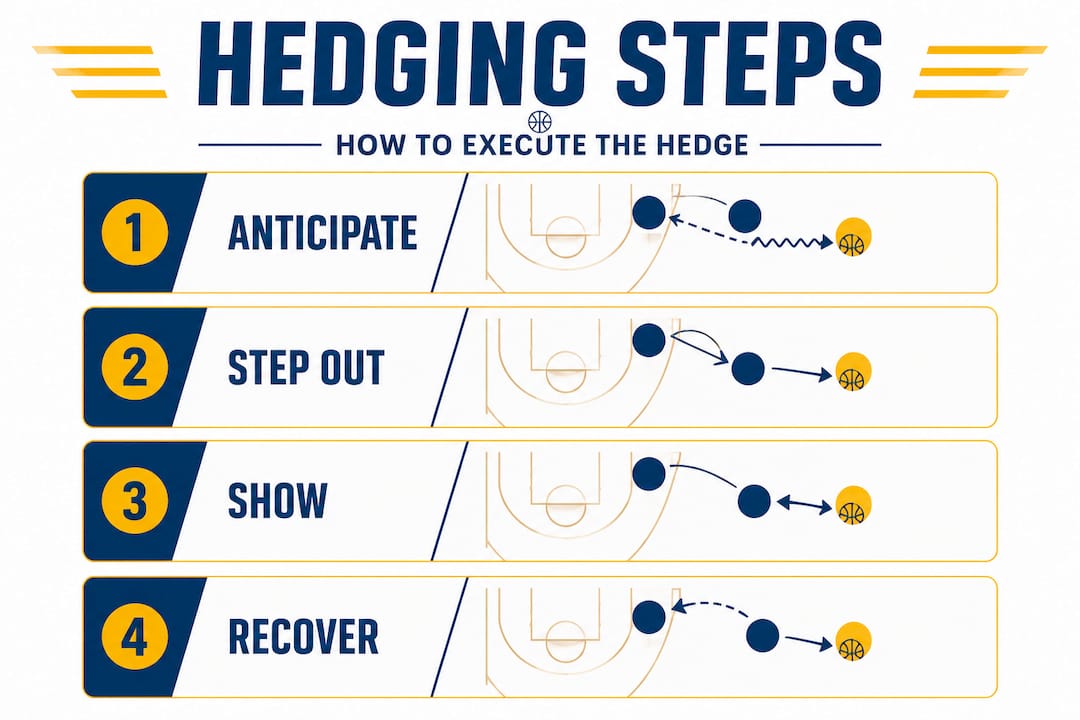
When you hedge, the big man (the defender guarding the screener) steps out aggressively to cut off the ball handler’s path after the screen is set. The hedge is not a switch. The hedger does not take over on the ball handler permanently. Instead, they jump out into the ball handler’s lane, force a redirect or hesitation, and then recover back to their own assignment. Meanwhile, the on-ball defender fights over or around the screen and gets back in front of their player.
This type of screen coverage differs from other options in a few key ways:
- Switching: Both defenders exchange assignments permanently. Simple but requires similar size and skill.
- Dropping: The big drops back toward the paint, protecting the rim but conceding the mid-range.
- Hedging: The big steps up aggressively, then recovers. High disruption. Requires coordination and athleticism.
The primary objectives of hedging are clear: disrupt the ball handler’s momentum, force a difficult decision, and buy time for the on-ball defender to recover their position.
Basic hedging mechanics:
- Big reads the screen and prepares to step out before contact
- Big plants outside foot and shows a wide stance to cut off the drive lane
- On-ball defender fights through or around the screen at the same moment
- Big recovers back to their assignment the moment the ball handler is slowed
- Weak side defenders rotate and stay connected to the overall defensive structure
Pro Tip: When introducing hedging to younger or less experienced players, simplify the cue. Tell your bigs: “Step, show, recover.” Three words. Run it until the movement is automatic before adding complexity.
The strategic advantages: Why hedge ball screens?
Now that we know what hedging is, let’s explore the strategic reasons that make it a game-changer for team defense.
The most obvious benefit is ball handler containment. Elite guards build their entire games around turning the corner off screens. When your big meets them at that corner with a wide, active hedge, the guard loses their momentum, their timing, and often their first option. The play breaks down before it starts.
Proper pick and roll counter strategies also show that hedging forces the ball handler to make split-second decisions under pressure, which increases turnover rates and leads to unplanned shots. Teams that implement hedging consistently see fewer easy layups and more contested mid-range attempts from their opponents.
“Ball screen defense built around active hedging limits the angles elite guards need. It turns your defense into an organized problem-solving unit rather than a collection of individual matchups.” Based on team performance data, structured hedging systems improve defensive efficiency by forcing offenses into lower-percentage possessions.
Here is how the three main ball screen coverages compare:
| Coverage | Primary goal | Strength | Risk |
|---|---|---|---|
| Hedging | Disrupt ball handler | Contains guards, forces turnovers | Screener slips to basket |
| Switching | Simplify assignments | Reduces confusion | Mismatch exposure |
| Dropping | Protect the paint | Limits layups | Opens pull-up jumper |
Situations where hedging is most effective:
- Defending an elite ball handler who thrives on turning the corner
- Protecting the paint against a fast point guard
- When your big is mobile enough to recover quickly
- Against teams that rely on the pick and roll as their primary set
- When the screener is not a reliable outside shooter
- Late game situations where you need to force a turnover or a tough shot
Hedging is not a universal answer, but for the right matchups, it is the sharpest tool in your defensive kit.
Common pitfalls and how to avoid them
Recognizing the advantages is only half the battle. Avoiding common missteps is what turns theory into effective in-game execution.
Coaches who add hedging to their system without addressing these mistakes often find the tactic creates more defensive breakdowns than it prevents. Here are the most frequent errors and how to fix them:
-
Poor timing from the big. If the big hedges a half-second too late, the guard has already turned the corner. The hedge becomes a reach-and-foul situation. Fix it by drilling the read in practice. The big must react to the screen being set, not to the guard already accelerating.
-
Lack of communication between the on-ball defender and the big. Hedging is a two-man coordination. If the on-ball defender fights over the wrong side of the screen, they run directly into their own big’s hedge and the coverage collapses. Introduce verbal and visual communication cues in every drill repetition. “Big! Ball! Recover!” Simple language builds habits.
-
Overcommitting on the hedge. Some bigs get aggressive and chase the ball handler too far out of position. Now they are 15 feet from the basket, the screener slips, and there is no one protecting the rim. Teach your bigs to hedge with purpose and stop. The goal is disruption, not a second assignment.
-
Failure to rotate weak side defenders. When the big hedges and the on-ball defender recovers, the screener often flashes to the rim or a corner shooter opens up. If your weak side players do not rotate to cover those gaps, one hedge creates two open offensive players. Build rotation reads into every hedge drill from day one.
These pick and roll teaching tips also recommend slowing drills down at first so players understand the why behind each step. Speed comes after the logic clicks. Rushed teaching creates sloppy habits. Additionally, resources like Advanced Ball Screen Strategies for Coaches lay out detailed progressions that address each of these pitfalls with specific corrections and drill setups.
Pro Tip: Use video in practice. Film a scrimmage, pull three or four hedge reps, and show the team together. Players learn faster when they see themselves. Point out the big’s foot position on the hedge and the on-ball defender’s path around the screen. Visual feedback is faster than verbal correction.
When and how to implement hedging in your defense
With common errors addressed, it’s time to focus on the nuanced decisions: when hedging is the right call and how to teach it step by step.
Hedging is not always the correct choice. The decision to hedge should be based on personnel, opponent tendencies, and matchup realities. Here is how to evaluate your situation:
- Assess your big’s lateral speed. A slow-footed big cannot recover after a hedge. Hedging with that player becomes a liability. Consider dropping or switching instead.
- Scout the opposing screener. If the screener is a strong shooter, hedging leaves them open when the big steps out. Adjust your coverage or use a different scheme for that matchup.
- Match your coverage to the score and game situation. Hedging requires energy and coordination. In foul trouble situations, or when protecting a lead late in a game, simpler coverages may reduce risk.
- Build your system around what your players can actually execute. A hedge run poorly is worse than a drop run well. Know your roster. Play to their strengths while expanding their skills over time.
- Consider on-ball defensive skills as part of your evaluation. Hedging only works if the on-ball defender can actually fight through or around the screen. Players who get stuck on screens make the hedge impossible to complete.
Here is a sample progression table for teaching hedging by experience level:
| Experience level | Phase | Focus area | Timeline |
|---|---|---|---|
| Beginner | 1 | Stance and foot positioning | Weeks 1 to 2 |
| Beginner | 2 | Two-man read drills (no defense) | Weeks 3 to 4 |
| Intermediate | 3 | Live hedge and recover drills | Weeks 5 to 6 |
| Intermediate | 4 | Weak side rotation added | Weeks 7 to 8 |
| Advanced | 5 | Film review and live scrimmage application | Weeks 9 to 10 |
This progression is drawn from ball screen offense principles applied in reverse, understanding how the offense tries to exploit screens helps you teach the defense to stop it. Integrating hedging into your overall system also means running it in conjunction with your other coverages, so opponents cannot predict what is coming. Keep them guessing by mixing hedge calls with occasional drops or switches based on personnel.
Our experience: What most coaches miss about hedging
Here is what the playbooks and highlight reels do not always show you.
Coaches spend hours perfecting the footwork on the hedge. They drill the big’s stance, the angle of the step-out, and the timing of the recovery. Then they get into a game and the whole thing falls apart. Not because the mechanics were wrong. Because nobody talked.
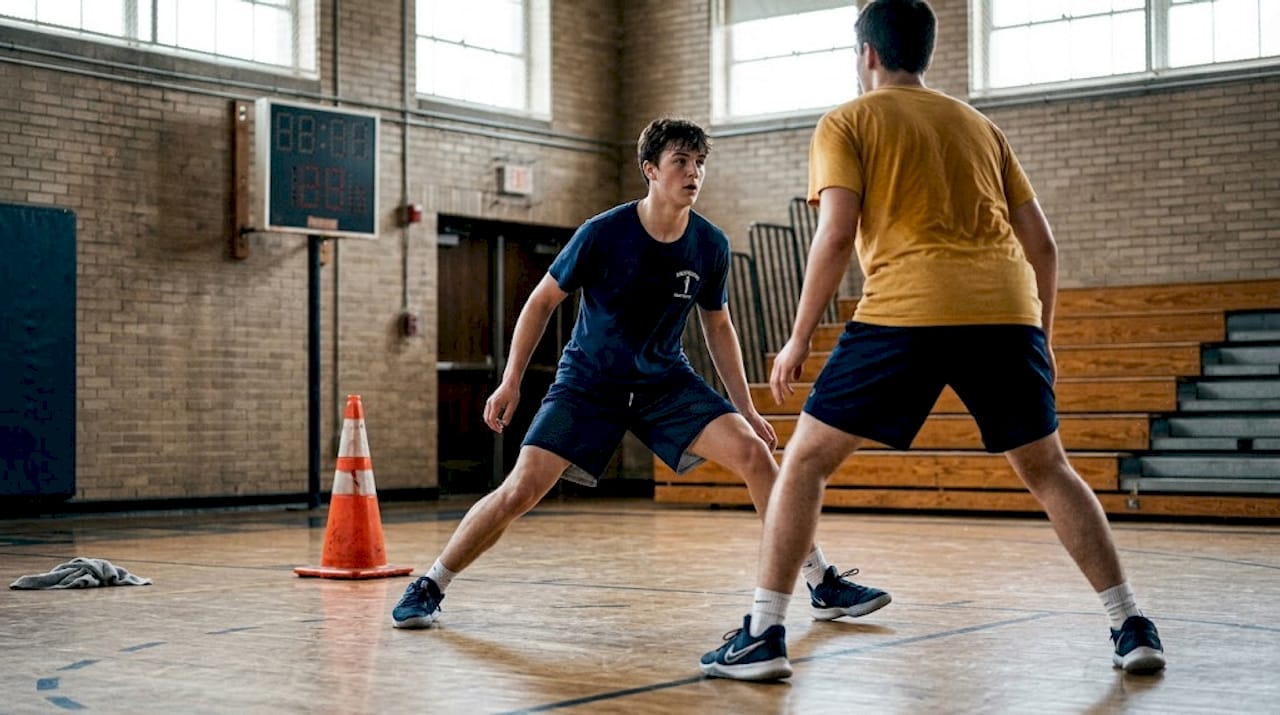
Hedging is a communication system as much as it is a footwork technique. The teams that execute it best are not necessarily the most athletic. They are the most connected. Bigs who call out screens early. On-ball defenders who respond to those calls. Weak side players who shift before they are needed to. That chain of communication is what makes a hedge work in real time. Flawless footwork without that communication is just well-drilled failure.
We have also seen this at the pro level. Even elite teams get burned on hedges when they become too rigid or too predictable. A team that hedges every single ball screen with the same timing and the same angle is easy to attack. Offenses will design plays to manipulate that predictability, using slip screens, pop actions, or quick reversal passes to punish the overcommitted big.
The better approach is adaptability. Teach the mechanics. Then teach your players to read the offense and adjust. A hedge that is 80 percent technically sound but reads the situation correctly is more effective than a perfect hedge applied to the wrong action.
The deep dive on ball screen defense makes this clear: defense is a system, not a collection of individual techniques.
Pro Tip: For youth and undersized teams, scale the hedge. Teach a “soft hedge” where the big shows but does not fully commit. This limits the risk of the screener slipping to the basket while still slowing the ball handler. As players grow and develop, you can add more aggression to the hedge.
Take your defensive strategies further with Hoop Mentality
Coaches ready to build a structured ball screen defense system need more than diagrams. You need tools that translate concepts into practice.

Hoop Mentality resources are built for exactly that. The Big Man Dual Action Drill gives you a ready-to-run drill that trains bigs to read, hedge, and recover in realistic game situations. Pair it with the Practice Plan Template to organize your defensive progressions across a full practice block, session by session. These tools are practical, structured, and built from real coaching experience. Use them to save time, build consistency, and put your team in a stronger defensive position every game.
Frequently asked questions
What is the main purpose of hedging on a ball screen?
Hedging on a ball screen helps slow or stop the ball handler, allowing your defense time to recover and prevent easy scoring opportunities. It is designed to disrupt offensive timing before the ball handler gains momentum off the screen, as team performance data consistently shows.
When should you NOT hedge a ball screen?
If your bigs are slow-footed or the opposing screener is a strong shooter, consider alternative coverages instead of hedging. These coverage adjustments help you match your scheme to your personnel rather than forcing a tactic that creates more problems than it solves.
What’s the difference between hedging and switching on defense?
Hedging momentarily stops the ball handler and then the defender recovers to their original assignment, while switching exchanges defensive assignments permanently between two defenders. Each pick and roll response has different risk profiles depending on the matchup.
Can youth teams effectively hedge ball screens?
With clear teaching progressions and consistent drill work, youth teams can successfully learn to hedge and improve their team defense significantly. Start with simplified cues and youth-focused ball screen principles before advancing to full game-speed execution.