

TL;DR:
- The pick and roll is a versatile and effective offensive play that creates high-quality scoring opportunities. Teaching its roles and decision-making processes at each level improves spacing, timing, and player development. Consistent practice, clear communication, and film review are crucial for mastering the play and avoiding common mistakes.
Your offense stalls. Players dribble into traffic. Easy buckets disappear. Most teams hit this wall at some point, and the fix is often simpler than coaches expect. The pick and roll, a two-player action where a screener sets a screen on the ball handler’s defender and then rolls to the basket or pops out, is one of the most reliable ways to generate high-quality shots at any level. This guide walks you through definitions, preparation steps, practice drills, and level-specific adjustments so you can teach it with confidence.
Table of Contents
- What is the pick and roll and why teach it?
- Preparation: Building skills and teaching progressions
- Step-by-step guide: Executing pick and roll in practice
- Adjustments by level: Youth, high school, and elite
- A coach’s take: What makes pick and roll teaching truly stick
- Take your pick and roll teaching to the next level
- Frequently asked questions
Key Takeaways
| Point | Details |
|---|---|
| Clear definitions matter | Players and coaches must know each role and option in the pick and roll for success. |
| Progressions build results | Start with skill basics, then gradually add defenders and scenarios for effective learning. |
| Film and reps drive improvement | Regular video review and focused practice boost decision-making and execution. |
| Adapt to team level | Tailor drills, terminology, and complexity to your players’ age and experience. |
What is the pick and roll and why teach it?
The pick and roll is a two-player action. One player sets a screen (the screener). The other uses it to attack the defense (the ball handler). After setting the screen, the screener either rolls hard to the basket or pops out to an open spot. Simple concept. Endless options.
What makes it so effective is the built-in advantage it creates. The pick and roll creates a 2-on-2 advantage and remains timeless because it adapts to any personnel or defensive scheme. Whether your team runs motion offense or a structured set, this action fits.
The numbers back it up. In elite women’s EuroLeague play, 71.8% of pick and rolls ended in a shot, with the most successful sets involving the screener finishing near the basket. That efficiency does not happen by accident. It comes from repetition, clear roles, and good reads.
Here is a quick breakdown of each role:
- Ball handler: Uses the screen, reads the defense, decides to attack, pull up, or pass.
- Screener: Sets a legal screen, reads the defense, rolls or pops based on the coverage.
- Both players: Communicate before the action and react to what the defense gives.
For coaches explaining pick and roll concepts to new players, starting with these two roles keeps things clear and manageable.
Why teach it at every level?
| Benefit | Youth teams | High school | Elite/college |
|---|---|---|---|
| Creates open shots | Yes | Yes | Yes |
| Builds decision-making | Foundational | Intermediate | Advanced reads |
| Adaptable to personnel | Simple reads | More options | Full counters |
| Teaches spacing | Basic | Structured | Precision timing |
The pick and roll is not just an offensive tool. It teaches players to read defenders, communicate, and make decisions under pressure. Those are skills that transfer everywhere on the court.
Preparation: Building skills and teaching progressions
Before you run a pick and roll in practice, players need individual skills in place. Rushing to 2-on-2 before players can handle the ball under pressure or set a legal screen creates bad habits fast.
A solid teaching progression follows this order:
- Individual skill work (ball handling, footwork, screening technique)
- 1-on-1 vs. a coach to practice reads
- 2-on-2 live with no help defense
- 3-on-3 with a help defender added
- 5-on-5 integration with film review
Each step builds on the last. Do not skip ahead. Players who skip step two often struggle to read the defense in live play because they never practiced the decision without a teammate to lean on.
Ball handler skills to build first:
- Change of pace and direction dribbling
- Reading a defender’s positioning before the screen arrives
- Footwork to set up the screen angle correctly
Screener skills to build first:
- Setting a wide, legal, stationary screen
- Reading the ball handler’s movement before rolling
- Finishing at the rim with contact
Review your skill progressions before introducing the action to make sure players have the foundation. If basketball fundamentals like footwork and body control are shaky, address those first.
| Stage | Focus | When to move on |
|---|---|---|
| Individual | Screening form, dribble reads | Consistent technique |
| 2-on-2 | Action timing, basic reads | Correct decision 7 out of 10 reps |
| 3-on-3 | Help defense recognition | Players identify coverage |
| 5-on-5 | Full integration | Smooth execution in flow |
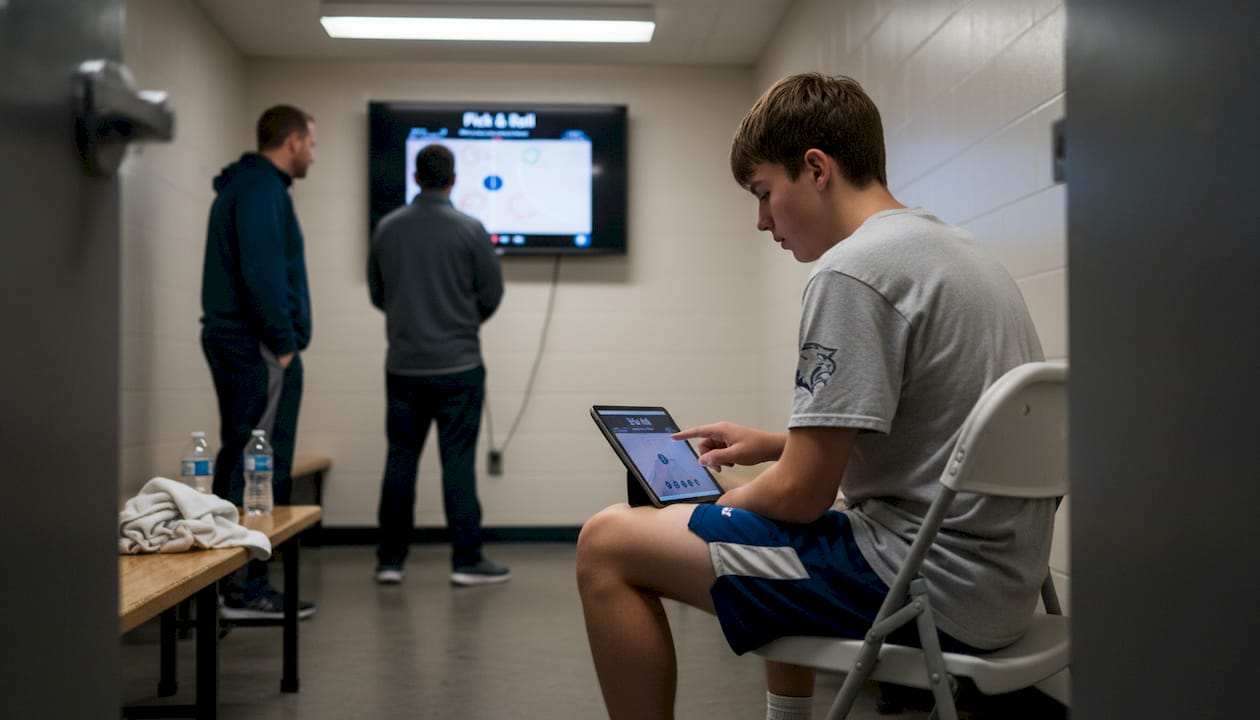
Pro Tip: Film one rep per player during 2-on-2 work. Watching themselves make the wrong read is more effective than any verbal correction you can give on the sideline.
Step-by-step guide: Executing pick and roll in practice
Once players have the individual skills, you can move into structured pick and roll reps. Here is a session sequence that works at most levels.
Step 1: Walk-through without defense No defenders. Coach calls out each step. Ball handler sets up the defender, angles toward the screen, uses it. Screener sets the screen, holds, then rolls.
Step 2: Add a token defender on the ball The defender plays soft and predictable. Ball handler practices reading one coverage. Keep it simple: go over the screen or reject it.
Step 3: Add a defender on the screener Now both players must read two defenders. This is where real decision-making starts.
Step 4: Live 2-on-2 with consequences Score or stop. Keep score. Competitive reps build faster habits than drill-only work.
Key mechanics for the ball handler include setting up the defender, using the screen angle and speed, reading the defense, and deciding on the action. For the screener, the focus is on setting a legal screen and rolling or popping based on what the defense shows.
Common mistakes to correct early:
- Ball handler uses the screen too early before the screener is set
- Screener rolls before the ball handler engages the defender
- Ball handler dribbles away from the screen instead of into it
- Screener rolls to the wrong spot based on where the defense is
- Both players fail to communicate before the action starts
For a structured drill that covers multiple pick and roll scenarios in one rep, the combo drill is a practical option. You can also review a skills development workflow to map out how this fits into your broader practice plan.
Pro Tip: Use verbal cues consistently. When the screener calls “screen,” the ball handler knows to set up the defender. Consistent language speeds up timing and reduces confusion in live play.
Adjustments by level: Youth, high school, and elite
The pick and roll looks different depending on who you are coaching. The core action stays the same. The complexity, language, and expectations change.
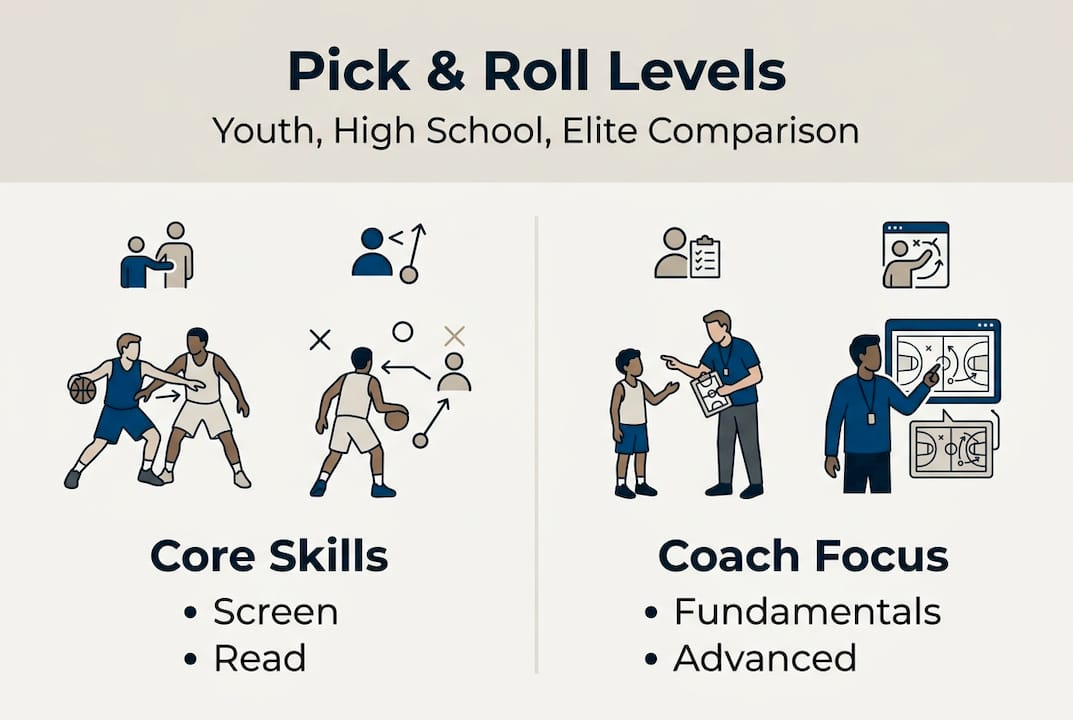
Youth teams (ages 8 to 13)
Keep it simple. Focus on one coverage and one response. Youth players benefit from simple coverage recognition and basic reads rather than multiple options. Over-scheming at this age creates confusion, not skill.
- Teach one screen type (high ball screen)
- Use simple language: “use it” or “reject it”
- Focus on screener finishing near the rim
- Limit defensive coverages to one or two
High school teams
Introduce more decision-making. Players can handle two or three defensive coverages and begin to recognize help defenders. Add the pop option for shooters. Start using film to review reads.
- Introduce hedge, drop, and switch coverages
- Add the screener pop for players with shooting range
- Use 3-on-3 and 4-on-4 to build recognition
- Review film after live reps
Elite and college teams
Spacing, timing, and counters become the focus. Players read the defense before the screen is set. Screeners know when to slip early. Ball handlers know when to reject and attack.
“Teach one base progression but adapt to defense and avoid over-scheming for youth.” This principle holds at every level. Build depth only when the base is solid.
For a youth offense guide that fits this approach, or to explore ball screen offense for youth in more detail, those resources map directly to what is covered here.
A coach’s take: What makes pick and roll teaching truly stick
Here is what most coaching articles skip: the pick and roll does not fail because of bad plays. It fails because of inconsistent language and skipped reps.
Coaches add counters before players master the base. They run 5-on-5 before the 2-on-2 reads are automatic. The result is players guessing instead of reacting.
The screener is the most overlooked piece at the youth level. Ball handler development gets most of the attention. But research consistently shows that screener finishes near the basket drive the highest efficiency. Developing your screener’s footwork, roll timing, and finishing ability pays off faster than adding new plays.
Film study matters more than most coaches think. One session of reviewing two or three pick and roll reps per player builds pattern recognition faster than ten more live reps without feedback. Pair that with consistent cue words and a routine practice structure, and habits form quickly.
For more on this approach, the player development tips at Hoop Mentality cover how to build these habits systematically across a full season.
Take your pick and roll teaching to the next level
You have the framework. Now put it into practice with tools built for coaches.
Hoop Mentality offers drills and resources designed around real coaching needs. The Big Man Dual Action Drill focuses specifically on screener development, covering roll timing, finishing, and reads in a structured format. For full practice organization, the practice plan guide gives you a weekly structure that integrates pick and roll work into a complete preparation system. Both resources are ready to use. No setup required. Explore them and build a more efficient offense today.
Frequently asked questions
What are the most common mistakes coaches make when teaching the pick and roll?
Coaches often skip breaking down each role individually and rush to 5-on-5 before players master the basics. Isolated skill work must come before complex play or players develop bad habits that are hard to fix later.
How do you help players read the defense during the pick and roll?
Design drills that use defenders playing different schemes so players see multiple coverages in practice. Reps and film study are the fastest way to build quick, accurate reads in live situations.
Should youth teams focus more on the ball handler or the screener?
Teach both roles from the start, but give extra attention to screener development. Screener finishes near the basket are the most efficient outcomes at every level, making screener skill a high-return investment for developing teams.
How do you integrate the pick and roll into existing team offense?
Start with one high-frequency set and build recognition through repetition before adding variations. Teaching one base progression and adapting to the defense keeps players from getting overwhelmed, especially at younger levels.