

TL;DR:
- Offensive sets are pre-designed plays that coordinate player positioning, movement, and screening to generate scoring opportunities. Coaches should teach formation, trigger, and read to enable players to read defenses and react accordingly, fostering adaptable offensive execution. Emphasizing conceptual, trigger-based offense and vocabulary improves team performance and decision-making against diverse defenses.
Offensive sets are pre-designed play structures that coordinate player movement, spacing, and screening to create consistent scoring opportunities against organized defenses. The term “offensive sets” is used broadly by coaches, but the recognized industry term is set plays, referring to scripted sequences initiated from specific formations. Modern teams like those in the NBA and college programs rely on both set plays and conceptual offense systems to keep defenses off balance. Coaches who understand how to explain offensive sets to their players gain a direct competitive advantage. This guide breaks down the mechanics, the most effective formations, and how to install them with your team.
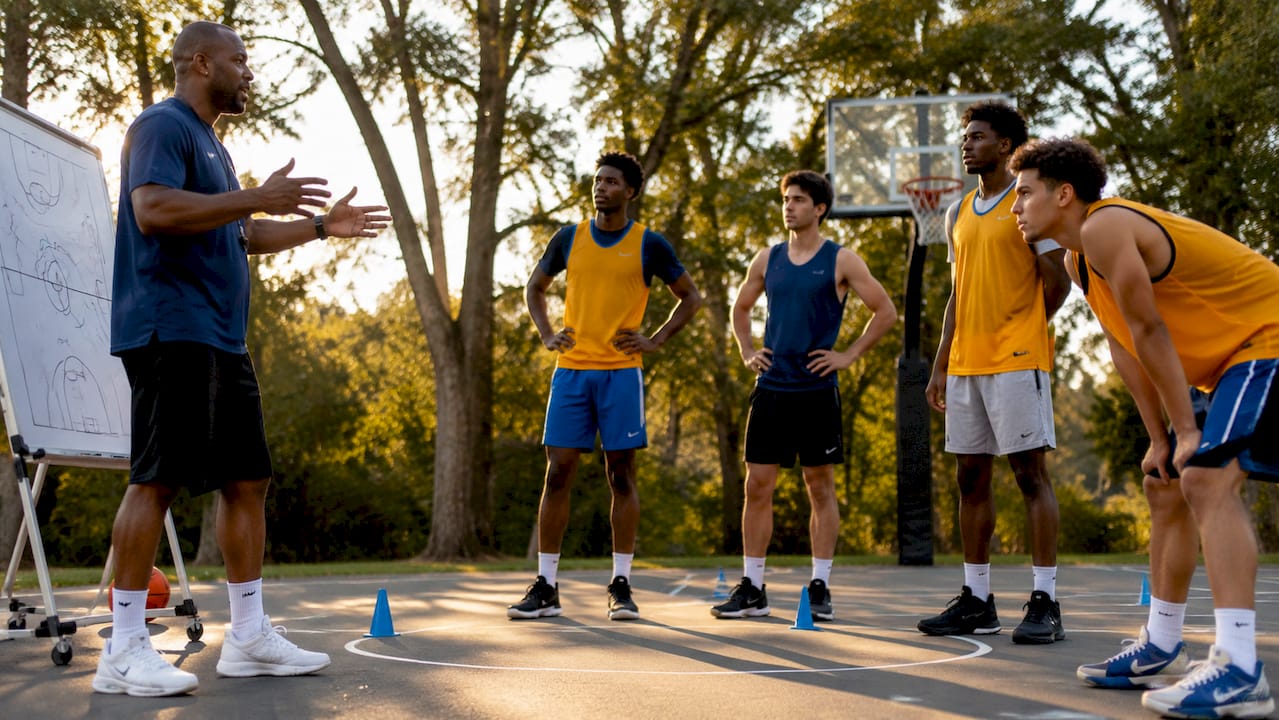
What does “explain offensive sets” actually mean for coaches?
Offensive sets are defined by three elements working together: formation, trigger, and read. The formation tells players where to stand. The trigger tells them when to act. The read tells them how to react based on what the defense gives. Without all three, a set play becomes a memorized sequence that breaks down the moment the defense adjusts.
Balanced spacing is the foundation of every effective set. Shooters occupy corners and wings while bigs work at the elbows or blocks, which opens driving lanes and forces the defense to communicate across the floor. When spacing collapses, the entire set fails regardless of how well the screening action is executed.
Screening actions are the engine inside most sets. Pindowns, flares, and ball screens each serve a different purpose. A pindown frees a shooter cutting up from the block. A flare screen pushes a player away from the ball for a catch-and-shoot. A ball screen attacks the pick-and-roll coverage directly. Coaches who understand offensive plays at this level can mix and match actions within a single set to create multiple reads from one formation.
Pro Tip: Before installing any set, teach the screening action in isolation first. Players who understand why a screen is set in a specific spot will execute it correctly under game pressure.
Which popular offensive sets should every coach know?
Two sets appear consistently across high school, college, and professional programs: Horns and Quads. Both are worth understanding in detail because they represent opposite philosophies on how to attack a defense.
Horns: the elbow-based attack
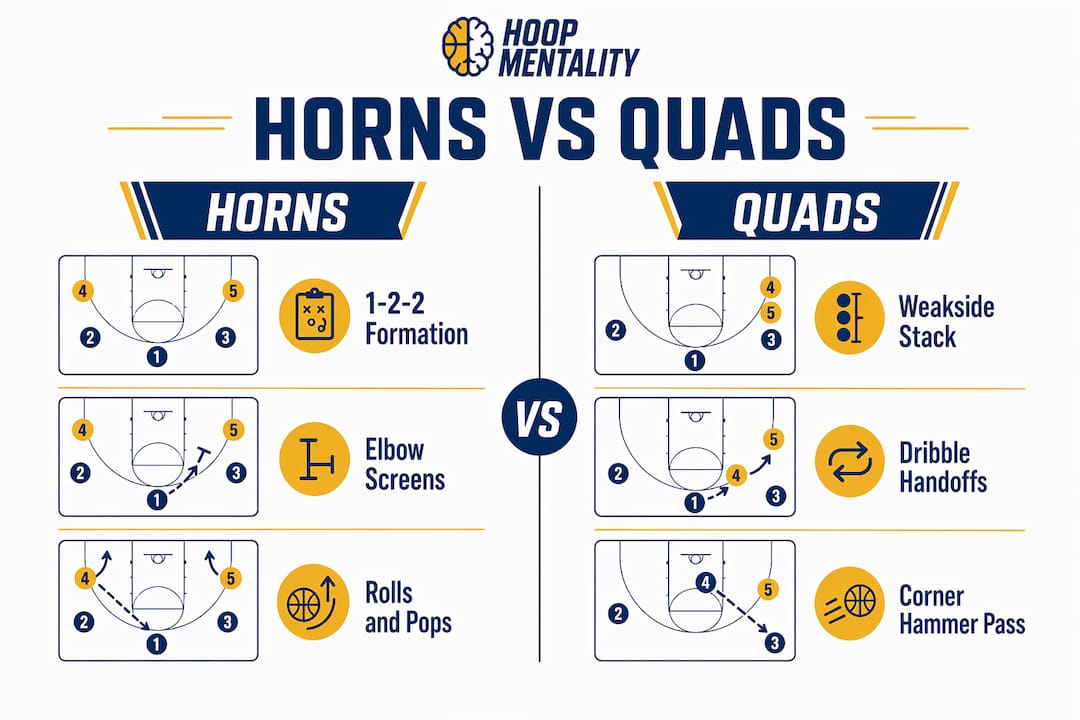
The Horns offense uses a 1-2-2 formation with two bigs positioned at the elbows and two shooters in the corners. The ball handler operates at the top of the key with multiple immediate options. Key actions include:
- Double ball screen: Both bigs set a simultaneous screen, forcing the defense to choose a coverage and exposing the weaker side.
- Elbow entry: The ball handler passes to one big at the elbow, shifting playmaking to the high post and triggering off-ball movement from the opposite wing and corner.
- Split action: After the elbow entry, two players cut off the big in opposite directions, creating a layup read or a kick-out three.
One screener rolls to the basket while the other pops to the perimeter, maintaining spacing and forcing the defense to make two decisions simultaneously. This is what makes Horns so difficult to guard. The defense cannot cheat toward one option without surrendering the other.
Quads: the weakside overload
The Quads offense starts with four players stacked on the weakside and the ball handler isolated on the strongside wing. This overload forces the defense to guard a formation before any action begins, which is the core tactical advantage. As Max Hoover notes, sets like Quads bend the defense pre-action by forcing them to guard the formation itself rather than a memorized play sequence.
Built-in actions within Quads include dribble handoffs, blind pig cuts, cross screens, and hammer passes to the corner. Each action addresses both man and zone defenses, making Quads adaptable without requiring a new set call.
Pro Tip: Use Quads against teams that overplay passing lanes. The weakside stack naturally draws help defenders away from the ball, leaving the strongside wing with space to attack.
Horns vs. Quads: a direct comparison
| Feature | Horns | Quads |
|---|---|---|
| Starting formation | 1-2-2 with bigs at elbows | 4 players weakside, 1 strongside wing |
| Primary threat | Ball screen and elbow entry | Weakside overload and handoffs |
| Best against | Man defense with switching | Man and zone defenses |
| Key scoring actions | Roll, pop, split cut | Hammer pass, blind pig, DHO |
| Spacing demand | High (corners and wings must shoot) | Moderate (overload creates space) |
How do coaches implement offensive sets effectively?
Installing offensive sets requires a deliberate sequence. Coaches who try to teach the full set on day one create confusion. The players memorize positions without understanding the reads, and the set breaks down in the first live possession.
- Start with the formation only. Put players in their spots and walk through the spacing without any movement. Players need to feel where they should be before they learn where to go.
- Introduce one action at a time. Teach the ball screen first. Run it against a stationary defense, then a passive one, then a live one. Add the elbow entry only after the ball screen reads are automatic.
- Teach defensive coverages alongside the action. Players who practice against simulated coverages learn to read the defense in real time instead of running a memorized sequence. Show them what a hedge looks like, what a drop looks like, and what a switch looks like, then let them react.
- Add counters before adding new sets. Every action has a counter. If the defense takes away the roll, the pop is open. If they take away the pop, the roll is open. Teach counters within the same set before moving to a new formation.
- Run the set in competitive drills. Three-on-three and four-on-four drills isolate specific actions within the set and force players to make reads under pressure without the complexity of five-on-five.
- Review film with players. Show them what the correct read looks like and what the wrong read costs. Film review accelerates the learning curve faster than any drill.
Player buy-in determines whether a set survives contact with a real defense. Coaches who explain the why behind each action get better execution than coaches who simply demand compliance. When a player understands that the flare screen creates a corner three because it pulls the help defender out of the lane, they set the screen harder and the shooter relocates faster.
Pro Tip: Build a offensive sets workflow document for your team that maps each set to its primary read, secondary read, and counter. Players who can reference this between practices retain information faster.
What are the emerging trends in offensive sets for 2026?
The most significant shift in offensive strategy over the past several years is the move away from rigid play calls toward conceptual, trigger-based offense. Modern offensive strategy relies on domino mechanics where the primary goal is triggering small advantages that chain into subsequent reads, rather than forcing immediate layups. This approach keeps the defense guessing because no two possessions look identical even when the formation is the same.
William Love’s framework for understanding possessions uses three color-coded phases. As Love explains, possession phases determine when and how players initiate actions:
“Green is transition, where the offense has a numbers advantage and should attack immediately. Yellow is a neutral possession where a trigger is needed to create an advantage. Red is a dead-ball situation where a set play is called and executed with precision.”
This framework gives players a decision-making structure instead of waiting for a coach to call a play from the sideline. Teams that internalize the Green-Yellow-Red system avoid rigid playcalling and maintain offensive flow even when the primary action breaks down.
Conceptual offenses also assign roles based on floor spots rather than fixed positions. A guard in the corner reads the same cues as a forward in the corner. This flexibility allows coaches to implement motion offense principles within structured sets, creating a system that is both organized and adaptable. For coaches tracking basketball strategy trends in 2026, trigger-based offense is the direction the game is moving at every level.
Key takeaways
Effective offensive sets combine formation, trigger, and read. Coaches who teach all three build offenses that adapt to any defense rather than breaking down when the primary action is taken away.
| Point | Details |
|---|---|
| Formation sets the foundation | Place players in correct spots before teaching any movement or screening action. |
| Spacing is non-negotiable | Shooters in corners and wings keep driving lanes open and force defensive communication. |
| Horns and Quads cover most situations | Horns attacks man defense through elbow entries; Quads overloads the weakside against man and zone. |
| Teach reads before counters | Players must recognize defensive coverages before they can execute the correct counter action. |
| Trigger-based offense is the future | Color-coded possession phases help players initiate actions without waiting for sideline calls. |
Why I stopped calling plays and started teaching reads
Most coaches I know spend the offseason drawing up new sets. I spent one offseason tearing them all down. After years of watching players freeze when a play broke down, I realized the problem was not the sets. It was that players had memorized positions without understanding the principles behind them.
The shift to trigger-based thinking changed everything for my teams. Once players understood that a Yellow possession means “find a trigger to create an advantage,” they stopped waiting for me to call something from the sideline. The ball moved faster. Spacing held longer. And when the primary action got taken away, they found the counter on their own.
The hardest part of teaching conceptual offense is the early discomfort. Players who have spent years running set plays feel exposed when you ask them to read and react. The first few weeks look messy. Stick with it. The payoff is a team that can score against any defense without needing a timeout to reset.
One more thing: do not underestimate the value of basketball alignment terminology. Players who know what a Quads formation means, what a pindown does, and why a flare screen works in that spot execute faster and communicate better. Vocabulary is not a luxury. It is the foundation of every read.
— Dejan
Build your offensive system with Hoopmentality
Hoopmentality has the tools to help you install and practice offensive sets from day one. The basketball practice plan template gives you a structured framework for teaching spacing, screening actions, and defensive reads in the right sequence. For coaches preparing for competition, the game preparation guide maps your weekly practice plan to your opponent’s defensive tendencies, so your sets are ready when the game starts. Both resources are built from real coaching experience and designed to save you time while improving how your team executes on offense.
FAQ
What is an offensive set in basketball?
An offensive set is a pre-designed play structure that coordinates player movement, spacing, and screening from a specific formation. The goal is to create a scoring opportunity by forcing the defense into a disadvantageous position.
What is the difference between Horns and Quads?
Horns uses a 1-2-2 formation with bigs at the elbows and attacks through ball screens and elbow entries. Quads overloads the weakside with four players and isolates the ball handler on the strongside wing to create mismatches and handoff actions.
How do you teach offensive sets to players?
Start with the formation and spacing, then introduce one action at a time against simulated defensive coverages. Players who understand why each action is set in a specific spot execute it correctly under game pressure.
What is a trigger in a conceptual offense?
A trigger is a specific action or read that initiates offensive flow based on the defensive coverage. Common triggers include identifying mismatches, executing screens like Zoom or pistol actions, and reacting to the defense’s positioning without waiting for a sideline call.
How many offensive sets should a team run?
Most teams operate effectively with two to three primary sets and one or two counters per set. Depth of execution matters more than volume. A team that runs two sets perfectly will outscore a team that runs eight sets poorly.