

TL;DR:
- Horn sets are a versatile basketball formation that strategically stretch defenses through precise spacing and multiple scoring options. Coaches should emphasize understanding the formation’s logic, teach consistent spacing, and adapt actions based on defensive reads to maximize effectiveness. Tracking team-specific data and encouraging improvisation within the system help sustain success across different levels of play.
Horn sets show up in film sessions from youth gyms to the NBA, yet many coaches still struggle to explain exactly why they work. The term gets thrown around, diagrams get drawn on whiteboards, but the real depth of the formation stays buried. Horns sets feature a point guard at the top of the key, two bigs at the elbows, and shooters in the corners, forming a 1-2-2 structure that stretches the defense and opens multiple scoring windows. This guide breaks down everything you need to run horn sets confidently, from the basic formation through advanced reads and troubleshooting for your roster.
Table of Contents
- What is a horn set? Understanding the core formation
- Essential horn set actions and variations
- Advanced coaching: Timing, roles, and defensive reads
- Troubleshooting and adapting horn sets for your team
- Beyond the basics: What most horn set guides miss
- Grow your team’s offensive game with Hoop Mentality
- Frequently asked questions
Key Takeaways
| Point | Details |
|---|---|
| Horn sets create spacing | The horns formation positions players to stretch defenses and open scoring lanes. |
| Multiple scoring actions | Variations like Twist, Flare, and Split give coaches options versus any defense. |
| Emphasize timing and reads | Success depends on teaching players how and when to make decisions, not running scripted plays. |
| Adapt to your roster | Personalize entries, actions, and PPP tracking for your team’s age and strengths. |
What is a horn set? Understanding the core formation
The name itself tells you the shape. Two post players stand at the elbows, the high post areas on either side of the lane. From above, those positions look like a pair of horns. The point guard sits at the top of the key, and two wing players or shooters occupy the corners. That is your 1-2-2 alignment.
According to Horns Offense in Basketball, this 1-2-2 formation stretches the defense and provides multiple scoring options simultaneously. The spacing is the foundation. When your bigs are at the elbows and shooters are wide in the corners, you force the defense to cover the entire half court. Closeouts become longer. Help rotations take more time. That extra half second is where scoring opportunities live.
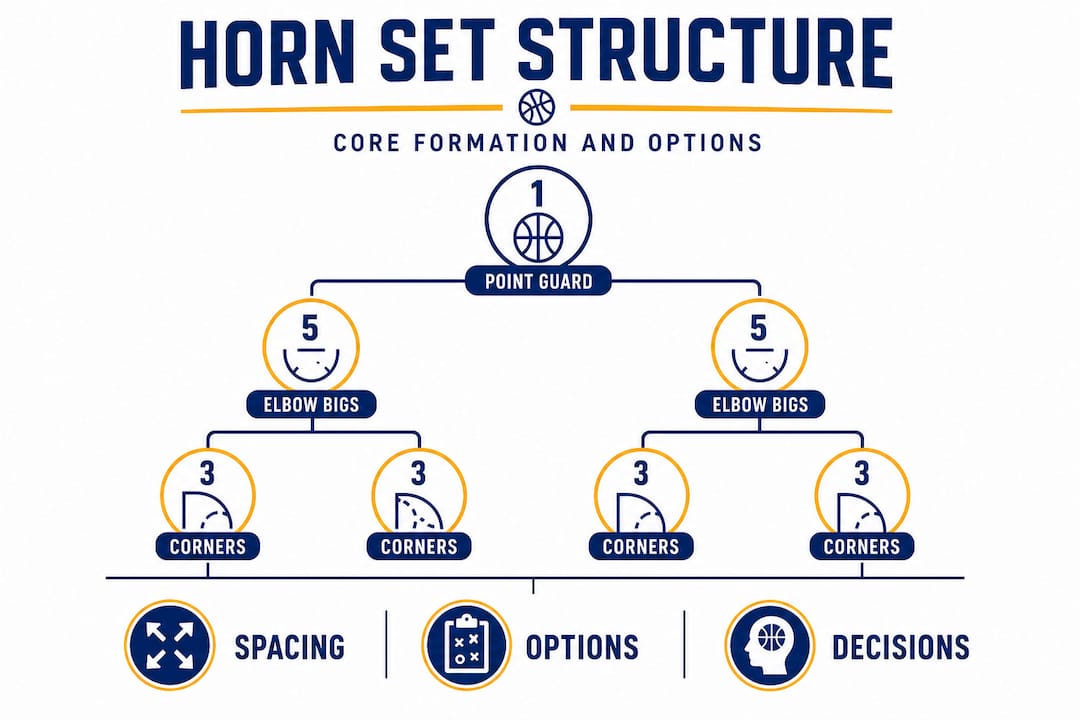
Here is a breakdown of each position and its primary job:
| Position | Location | Primary responsibility |
|---|---|---|
| Point guard (1) | Top of the key | Initiates action, makes first read |
| Big 1 (4) | Ball-side elbow | Sets ball screen, rolls or pops |
| Big 2 (5) | Weak-side elbow | Sets away screen, dives or flares |
| Wing 1 (2) | Ball-side corner | Spacing, catch-and-shoot threat |
| Wing 2 (3) | Weak-side corner | Spacing, weakside action trigger |
The essential horns offense tips you need to teach this formation start with one rule: spacing cannot be compromised. If players collapse toward the ball, the entire advantage disappears. Corners stay wide. Bigs stay at the elbows until their action begins.
“The horns set is not just a play. It is a system. The moment players understand why each spot exists, they start making better decisions within it.”
Understanding what is a horns play goes beyond memorizing positions. It means understanding the logic behind the spacing. The elbows create a natural decision point. The point guard receives a screen from either big and gets to choose between a ball screen action toward the basket or a pass to the corner to initiate secondary offense. Every defense has a different answer. Your players need to read that answer and respond correctly.
Key spacing rules to reinforce daily:
- Corners stay at or beyond the three-point line
- Bigs set screens with flat angles, not side-on
- Point guard reads the first defender’s reaction before committing
- Wing players hold spacing until the ball moves, then react
Essential horn set actions and variations
With the formation established, the next step is building your action menu. Horn sets are not a single play. They are a framework that houses multiple actions, each designed to attack a different defensive scheme.
The four most common actions are the Twist, Flare, Split, and Pick-and-Roll. Each targets a specific defensive weakness. Here is how they compare:
| Action | Best against | Primary scorer | Key read |
|---|---|---|---|
| Twist | Switching defenses | Ball handler | Does the defender switch or fight over? |
| Flare | Help-side overload | Corner shooter | Is the help defender sagging? |
| Split | Passive or soft defense | Either big | Are bigs being left open at elbow? |
| Pick-and-Roll | Drop coverage | Guard or rolling big | Is the big left open in roll lane? |
The horns twist breakdown is one of the most detailed resources available on running this action correctly. Key methodologies emphasize 12-15 feet spacing between players, with shooters in corners and read-and-react principles built around defensive rotations like switches, hedges, and drops. Players learn to anticipate rather than just react.
Here is a numbered flow from entry to secondary action:
- Point guard dribbles to one side to initiate, calling out the action
- Ball-side big sets the primary screen at the elbow
- Weak-side big sets a simultaneous away screen for the corner shooter
- Point guard reads the ball screen coverage (switch, hedge, drop, or iceout)
- If the drive is not open, kick to the corner off the flare
- If the corner is covered, the weak-side big slips to the paint as a secondary option
- If all primary options are closed, reset and flow into pick-and-roll continuity
This flow connects to the offensive sets workflow that helps teams build connected offense rather than isolated play calls.
The horns flex play set adds another layer by blending horn set entry actions with flex screen continuity on the weak side. This creates a self-renewing offense that does not stall if the first action is stopped.
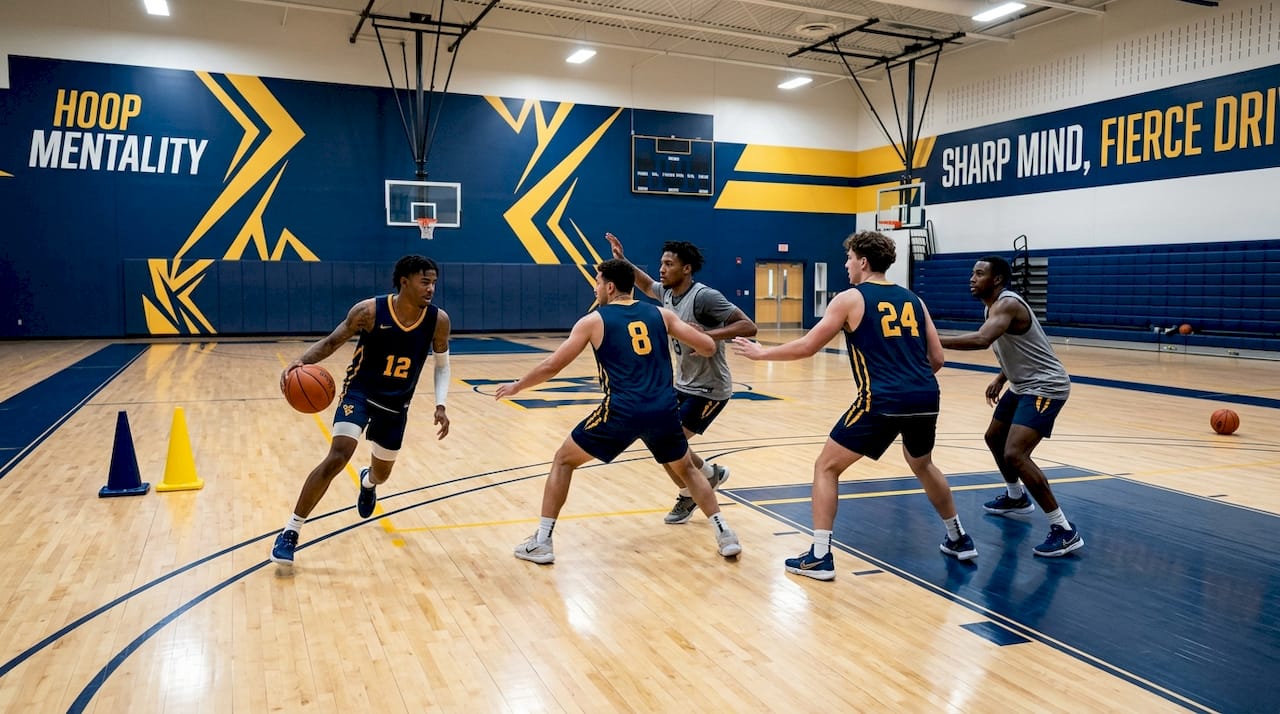
Pro Tip: Teach weakside rules before you teach the primary actions. When corner players know their job on every possession, your offense becomes unpredictable. Corner 45-degree cuts, slot lifts, and shake fakes keep weak-side defenders occupied and open lanes for the ball-side action to work cleanly.
Advanced coaching: Timing, roles, and defensive reads
Knowing the actions is one thing. Coaching them at game speed under defensive pressure is a different skill entirely. This section gives you the practical tools to build timing, assign roles clearly, and teach your players to read defenses.
Start with drills. The most effective practice structures for horn sets are small-sided. Use 2-on-2 twist drills where one guard and one big work through every coverage type against live defenders. Add a 3-on-3 weakside drill where you add a corner shooter and run the flare read simultaneously. These drills build the habit of reading before moving.
Core practice drills for timing and spacing:
- 2v2 Twist drill: Guard and one big vs. two defenders. Run all four coverage reads in sequence. Do not let players pre-decide; force them to react.
- 3v3 weakside drill: Add a corner player. Run twist and flare simultaneously. Practice the kick pass under defensive pressure.
- 5v0 walk-through: Full formation, no defense. Focus on footwork, screen angles, and spacing corrections. Run at half speed first, then full speed.
- 5v5 live: Add a rule that forces the ball through the horn set entry before the team can run any other action.
Expert nuances confirm that film study for defensive tendencies belongs in every horn set prep cycle. Watch how opponents guard the elbow screen. Do they switch? Hedge hard? Drop under? Each answer tells you which action to call in the game.
Role assignments matter as much as the actions themselves. Guards need to read patiently and not rush the drive. Bigs must commit to their screens, then finish the roll or pop cleanly. Corner players have to maintain depth and hold until the moment to cut or relocate arrives.
Adapting entries also creates mismatches. If your bigs are significantly faster than the opposing bigs, use wing screen entries to get them the ball in motion. If your point guard is your best scoring threat, run the twist action repeatedly and track which coverage the defense uses most.
Pro Tip: In late shot clock situations, the horn set is a reliable structure. The point guard can call the set, get into a quick ball screen, and the formation naturally generates a roll or corner look within three seconds. Practice a dedicated “quick horn” variation with a two-second entry decision rule.
The offensive concepts guide covers how horn sets fit within a broader offensive system, helping coaches connect set plays to motion principles and half-court structure.
Tracking points per possession (PPP) in practice is a direct coaching tool. Run sets in controlled scrimmages, track every possession that initiates from horns, and record the outcome. Over two weeks, you will know which actions work against which coverages for your specific roster. That data shapes your game plan more than any general recommendation.
Troubleshooting and adapting horn sets for your team
Even with solid drills and a clear action menu, real teams hit common snags. Here are the most frequent breakdowns and how to address them.
Common mistakes coaches see when horn sets stall:
- Spacing errors: Players drift toward the ball, collapsing the spacing that makes the formation work. Fix this by marking floor spots in practice and holding players to them.
- Timing breakdowns: The guard drives before the screen is set, or the corner player cuts too early. Run the 2v2 twist drill at full speed until timing becomes automatic.
- Telegraphed passes: The point guard looks directly at the corner before passing, alerting the defense. Teach eyes-up dribble habits and use eyes-on film review.
- Rushing reads: Players make the first move without reading the defense. Add a “freeze” rule in practice where the guard must pause one beat before initiating.
- Weak-side inactivity: Corner and weak-side players stand and watch instead of moving. Add weakside accountability to every drill by tracking their positioning.
Adapting for different levels requires honest assessment of your roster.
“There is no universal PPP benchmark for horn sets. Track your own team’s numbers and set a realistic target based on your roster’s strengths. Your data is more useful than any general stat.”
This connects to what coaching observation reveals: no published empirical benchmarks exist for horn set efficiency. Build your own benchmarks from your own practice data.
The why run offensive sets resource gives context for how set plays like horn sets serve a structural purpose within a full offensive system, helping coaches justify the time investment to their players and staff.
Beyond the basics: What most horn set guides miss
Most horn set breakdowns stop at the diagram. Here is what gets left out, and why it matters.
Teams that run horn sets strictly as drawn get stopped once a good scout finds the pattern. Defenses adjust. The set that worked in week one gets taken away by week four. The coaches who sustain success with horns are the ones who treat the formation as a starting point for improvisation, not a script to follow.
The real value of horn sets is that they create a familiar structure within which players can make decisions. When your guard knows both bigs are at the elbows and both corners are filled, they have a mental map. From that map, they can improvise within the reads. That combination of structure and freedom is what separates teams that score consistently from teams that run good-looking plays that stall at the wrong moment.
Empower your players to call audibles within the set. If the point guard sees that the defender is cheating toward the twist, let the guard skip to the corner immediately. If the rolling big sees the lane is clear before the screen is fully set, give them permission to slip early. These decisions come from players who understand the logic of the formation, not just the diagram.
Tracking your own data matters more than any pro-level reference point. Your team’s PPP from horn set actions, tracked over a month of practice and games, tells you exactly which actions to call against which defenses. Build that habit early in the season. Review it weekly. Adjust your action menu based on what the numbers show.
The coach’s horns tips resource supports this mindset by giving coaches practical implementation angles beyond the basic diagram.
Horn sets are not magic. They are a tool. The coaches who use them best understand the spacing logic deeply enough to teach it, adjust it, and let their players own it.
Grow your team’s offensive game with Hoop Mentality
Ready to move from understanding to implementation? Hoop Mentality has the tools to help you build horn sets into your practice routine right away.
The Big Man Dual Action Drill is built specifically for developing the screen-and-roll and screen-and-pop reads your bigs need to make horn sets work under pressure. Pair it with the practice plan template to structure sessions that build horn set timing and spacing progressively across your season. Both resources are ready to use and designed around real coaching practice. Browse the full collection at Hoop Mentality and find the tools that match your team’s needs.
Frequently asked questions
What is the main advantage of using horn sets in basketball?
Horn sets provide spacing and multiple scoring options from a single formation, making them hard to predict for defenses because each action looks identical at the point of entry.
How do you teach horn sets to youth players?
Start with the basic 1-2-2 alignment and one primary action, then use 2v2 timing drills to build spacing habits before adding reads or secondary options.
Do horn sets work against zone defenses?
Yes. By using weakside actions like 45-degree cuts, slot lifts, and corner shakes, horn sets can attack zone rotations just as effectively as man-to-man coverage.
Is there data on horn sets’ effectiveness in games?
No public PPP benchmarks exist for horn sets, so coaches should track their own team’s points per possession across practices and games to build accurate, roster-specific targets.