

Most American basketball fans do not realize that more than 60 percent of teams rely on structured offensive sets to outsmart opponents. Understanding offensive sets is crucial for any coach or player aiming to move beyond basic street ball and compete at a higher level. If you want to see how American teams turn teamwork into a scoring advantage, discovering these strategies will help you recognize smart play and appreciate the game’s complexity.
Table of Contents
- Defining Offensive Sets In Basketball
- Key Types Of Offensive Sets Explained
- How Offensive Sets Enhance Team Play
- Coaching Benefits Of Structured Sets
- Common Pitfalls When Using Offensive Sets
Key Takeaways
| Point | Details |
|---|---|
| Importance of Offensive Sets | Offensive sets provide strategic frameworks that enhance team coordination and offensive effectiveness. |
| Adaptability and Flexibility | Successful offensive sets must allow for real-time adjustments to prevent predictability and encourage player decision-making. |
| Player Matching | Coaches must align offensive sets with individual player strengths to maximize performance and minimize frustration. |
| Continuous Practice | Regularly practicing offensive sets builds muscle memory and promotes synchronization among players, enhancing overall team dynamics. |
Defining Offensive Sets in Basketball
In basketball, offensive sets represent strategic formations and predetermined movement patterns designed to create scoring opportunities. These structured approaches help teams systematically break down defensive alignments by establishing clear player positioning, scripted actions, and intentional spacing. Basketball offensive concepts reveal how teams can transform raw athletic talent into coordinated offensive execution.
At their core, offensive sets function like choreographed plays where each player understands their specific role, movement trajectory, and potential scoring options. Unlike spontaneous individual plays, these sets provide a framework that maximizes team coordination and minimizes defensive disruption. Teams utilize different offensive sets based on their personnel strengths, opponent defensive strategies, and game situational requirements.
Competitive basketball demands more than individual brilliance. Offensive sets create predictable yet adaptable patterns that force defenses to make difficult decisions. By establishing multiple scoring options within a single set, teams can exploit defensive weaknesses, create mismatches, and maintain offensive unpredictability. Basketball systems overview demonstrates how structured offensive approaches transform seemingly complex team dynamics into executable strategies.
Pro Coach Tip: Practice offensive sets repeatedly during training to build muscle memory and improve player synchronization. Focus on understanding not just individual movements, but how each player’s action influences the overall team offensive strategy.
Key Types of Offensive Sets Explained
Basketball coaches employ multiple offensive set strategies to create scoring opportunities, each designed to exploit specific defensive weaknesses. Triangle offense techniques demonstrate how strategic formations can transform team performance by establishing dynamic scoring pathways.
The Flex Offense represents a sophisticated patterned strategy that emphasizes continuous player movement and systematic screening. Continuous player movement allows teams to generate open shots by creating complex cutting patterns and maintaining strategic spacing. This approach works particularly well against man-to-man defensive alignments, forcing defenders to navigate constant motion and intricate player exchanges.

Another prominent offensive strategy is the Dribble Drive Motion offense, which focuses on spreading players across the perimeter to create expansive driving lanes. Dribble penetration strategies challenge defenses by establishing multiple scoring threats simultaneously. Players position themselves to enable quick dribble penetration, kick-out passes, and rapid ball movement that keeps defensive units constantly adjusting and reacting.
Here’s a comparison of two popular basketball offensive sets and their core characteristics:
| Offensive Set | Key Feature | Best Used Against | Primary Objective |
|---|---|---|---|
| Flex Offense | Continuous player movement | Man-to-man defense | Create open shots via screens |
| Dribble Drive Motion | Wide perimeter spacing | Aggressive defenses | Enable dribble penetration |
Pro Coach Tip: Evaluate your team’s individual strengths when selecting offensive sets. Choose strategies that complement your players’ skills and create natural scoring opportunities based on their athletic abilities and basketball intelligence.
How Offensive Sets Enhance Team Play
Offensive sets transform individual basketball talent into synchronized team performance by establishing predictable yet adaptable movement patterns. Basketball offensive techniques demonstrate how strategic positioning can convert raw athletic potential into coordinated scoring opportunities that maximize team effectiveness.
These structured approaches create multiple strategic advantages by fostering enhanced communication, anticipation, and collective decision-making. Players develop a shared understanding of spatial relationships, learning to read each other’s movements and react instantaneously. This collective intelligence allows teams to break down complex defensive strategies, creating scoring opportunities that transcend individual player capabilities. By establishing clear roles and expected movements, offensive sets reduce individual uncertainty and build team confidence.
Moreover, offensive sets provide coaches with a powerful tactical framework for managing game dynamics. They enable rapid adjustments based on defensive configurations, allowing teams to exploit specific matchup advantages. Different offensive sets can be deployed strategically depending on opponent weaknesses, player strengths, and game situations. This flexibility transforms offensive play from a reactive process to a proactive, controlled approach that keeps defensive units constantly guessing and adapting.
Pro Coach Tip: Develop offensive sets that align with your team’s unique strengths. Customize formations that highlight individual player skills while promoting collective team synergy and unpredictability.
Coaching Benefits of Structured Sets
Structured offensive sets provide coaches with powerful strategic tools for developing team performance and player potential. Basketball practice structure reveals how systematic approaches can transform raw individual talents into cohesive team dynamics that maximize competitive effectiveness.
By implementing structured offensive sets, coaches gain multiple developmental advantages. These strategic frameworks create opportunities for players to understand complex basketball concepts, improve spatial awareness, and develop advanced decision-making skills. Coaches can use these sets as teaching tools that go beyond simple play execution, helping players learn to read defensive alignments, anticipate teammate movements, and make intelligent real-time adjustments. This approach builds basketball intelligence that extends far beyond memorizing specific play patterns.
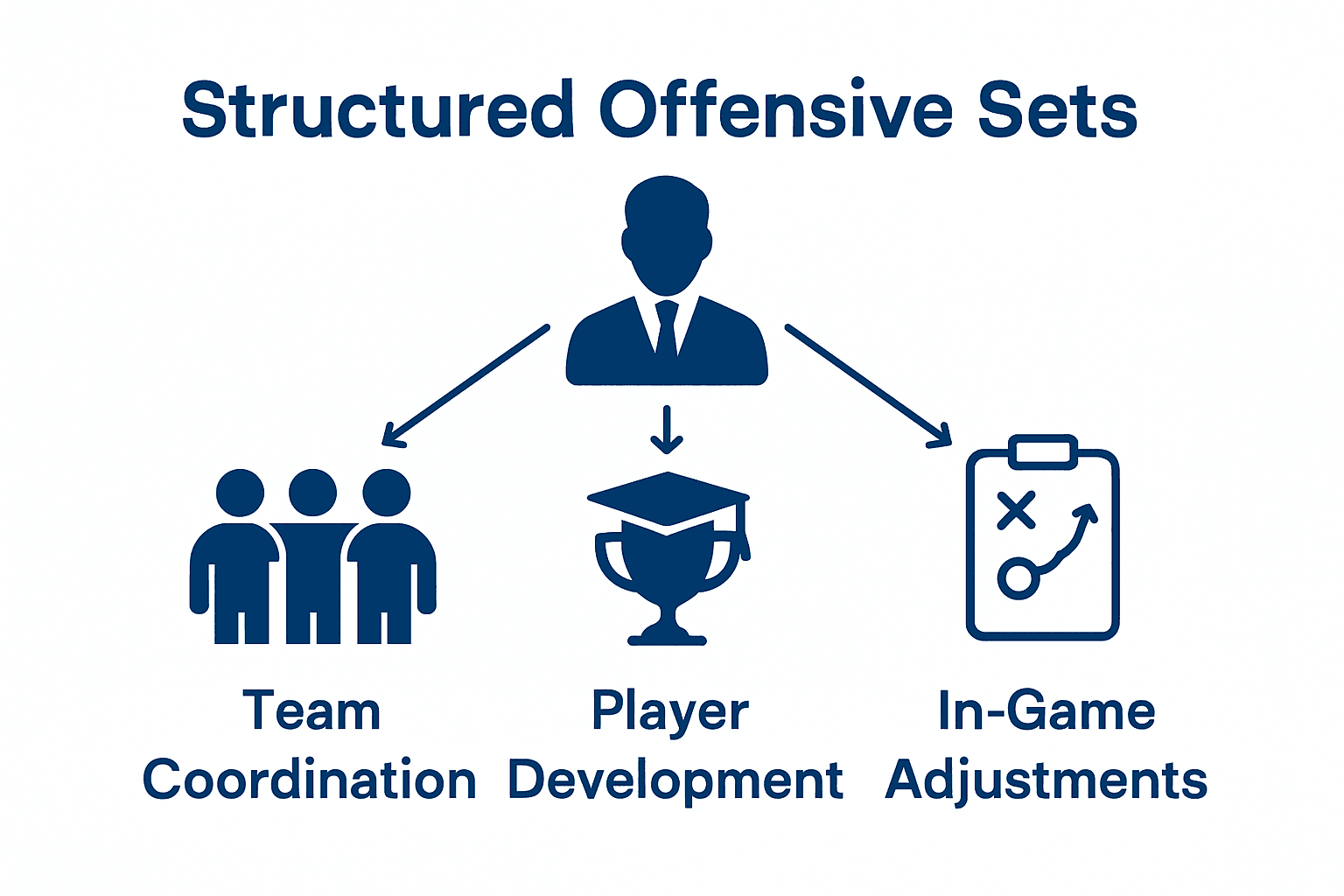
Moreover, structured sets enable coaches to manage player development more systematically. Different offensive configurations allow coaches to experiment with player roles, test individual capabilities, and identify optimal team compositions. By rotating players through various positions and responsibilities within structured sets, coaches can develop more versatile athletes who understand multiple aspects of team play. This approach creates players with broader basketball understanding and increased tactical flexibility, ultimately producing more adaptable and intelligent team performances.
Pro Coach Tip: Design offensive sets that challenge players mentally and physically. Create variations that force athletes to think critically, communicate effectively, and develop a deeper understanding of team dynamics beyond basic play execution.
Common Pitfalls When Using Offensive Sets
Coaches frequently encounter significant challenges when implementing offensive sets, often stemming from oversimplification or rigid tactical approaches. Defensive adjustment strategies highlight the critical importance of understanding how offensive sets can inadvertently create vulnerabilities if not carefully designed and executed.
One fundamental pitfall is over-reliance on predetermined patterns. Many coaches mistake structured sets for inflexible scripts, forcing players to follow exact movements regardless of defensive configurations. This mechanical approach eliminates player creativity, reduces adaptive decision-making, and makes offensive strategies predictable. Successful offensive sets should provide a framework that allows players to make intelligent real-time adjustments, not restrict their natural basketball instincts.
Another common mistake involves poor player personnel matching. Coaches sometimes implement offensive sets without considering individual player strengths, skill sets, and psychological dynamics. Each set requires specific athletic attributes, basketball intelligence, and positional understanding. Misaligning players with inappropriate offensive roles can lead to decreased team performance, player frustration, and reduced overall offensive effectiveness. Successful implementation demands a nuanced understanding of each player’s capabilities and potential within the chosen offensive strategy.
This summary highlights common pitfalls in using offensive sets and offers proactive solutions:
| Pitfall | Impact on Team | Recommended Solution |
|---|---|---|
| Over-reliance on predetermined patterns | Predictable offense | Encourage adaptive decision-making |
| Poor player-role matching | Reduced player effectiveness | Align sets with player strengths |
Pro Coach Tip: Develop offensive sets as flexible guidelines, not rigid scripts. Create adaptable frameworks that empower players to make intelligent decisions while maintaining structured team principles.
Build Winning Offensive Structure with Proven Coaching Tools
Creating effective offensive sets is challenging. Coaches struggle with balancing structured playbooks and allowing player creativity while maximizing team synchronization and adapting to defensive pressure. This article highlights the vital role of offensive sets in transforming individual talent into cohesive strategies that generate consistent scoring opportunities.
If you want to master these key concepts and implement adaptable offensive systems that fit your team’s unique strengths, explore our Basketball Playbooks - Hoop Mentality.
Unlock your team’s full offensive potential by using professional coaching resources designed to simplify practice planning and boost player decision-making. Start improving your offense today with easy-to-use tools from Hoop Mentality. Discover advanced drills, strategy guides, and structured frameworks that help coaches save time, improve communication, and focus on what really matters—developing your team and winning games.
Frequently Asked Questions
Why are offensive sets important in basketball?
Offensive sets are crucial because they provide structured frameworks for player movements, enhance team coordination, and optimize scoring opportunities. By using predefined formations, teams can effectively break down defensive alignments and create mismatches.
How do different offensive sets impact a team’s performance?
Different offensive sets cater to specific player strengths and encourage adaptability against various defensive strategies. For example, the Flex Offense emphasizes continuous movement, while the Dribble Drive Motion creates driving lanes, allowing teams to exploit defensive weaknesses effectively.
What are some common pitfalls when implementing offensive sets?
Common pitfalls include over-reliance on predetermined patterns, which can make a team’s offense predictable, and poor alignment of player roles within the sets. Coaches should ensure flexibility in their offensive strategies to allow players to make intelligent decisions based on real-time game situations.
How can coaches effectively implement offensive sets with their teams?
Coaches can effectively implement offensive sets by practicing regularly to build muscle memory, aligning sets with player strengths, and creating adaptable frameworks that encourage decision-making and teamwork. This way, players can understand their roles while improving overall team dynamics.
Recommended
- Basketball Offensive Concepts: A Modern Guide For Coaches – Hoop Mentality
- 7 Basketball Playbook Must-Haves for Coaches – Hoop Mentality
- 10 Essential Basketball Offense Techniques Every Player Should Master – Hoop Mentality
- Basketball Systems Overview: Complete Coaching Guide – Hoop Mentality
- The Essentials of Making a Cricket Bat With Artistry – Cricket Bats Com