

TL;DR:
- The horns play is a versatile offensive setup used at all levels of basketball.
- Success relies on precise timing, spacing, footwork, and players understanding reads.
- Adapting the system to team strengths and teaching recognition over memorization is crucial.
The horns play has a reputation for being complicated. Many coaches assume it belongs only in college programs or the NBA, where players can memorize complex sets and execute under pressure. That assumption sells the horns play short. It is one of the most versatile offensive formations in basketball, used successfully at the youth, high school, college, and professional levels. This article breaks down exactly what the horns play is, how each player fits into it, and how you can start implementing it with your team right away, regardless of your roster’s experience level.
Table of Contents
- Understanding the horns play setup
- Core actions and options within the horns set
- The importance of timing, footwork, and spacing
- Adapting the horns play to your team’s strengths
- A coach’s perspective: What most horns play overviews miss
- Sharpen your offense with Hoop Mentality
- Frequently asked questions
Key Takeaways
| Point | Details |
|---|---|
| Flexible formation | The horns play sets your offense up with adaptable scoring options and great spacing. |
| Emphasize timing and reads | Success depends on footwork, timing, and players reading the defense instead of memorizing steps. |
| Adapts to your team | Top programs adjust horns actions to best fit their current roster for maximum effectiveness. |
| Common pitfalls | Avoid crowding, static movement, and rigid scripts to maximize the play’s potential. |
Understanding the horns play setup
The horns play is a half-court offensive set defined by its distinctive starting shape. Two post players stand at the elbows, which are the spots where the free-throw line meets the lane lines on each side. Two wing players set up near the three-point line on each side of the floor, and one ball handler starts at the top of the key. When you look at it from above, the two post players at the elbows and the ball handler form a shape that resembles a bull’s horns, which is where the name comes from.
Every player in this set has a clear role. The ball handler reads the defense and initiates action. The post players at the elbows set screens, roll, pop, or feed the post. The wings space the floor and stay ready to attack or shoot. Basketball spacing is the foundation that makes all of this work. Without it, the whole set collapses.
The expert horns offense tips you will find most useful all trace back to one core principle: the horns play emphasizes perfect timing, footwork, and 12-15 foot spacing between players.
Player positions and roles in the horns setup
| Position | Spot on court | Primary role |
|---|---|---|
| Ball handler (PG) | Top of the key | Initiates action, reads defense |
| Post 1 (Big) | Left elbow | Sets screen, rolls, pops, or feeds |
| Post 2 (Big) | Right elbow | Sets screen, rolls, pops, or feeds |
| Wing 1 (SG/SF) | Left wing, near three-point line | Spaces floor, cuts, catches and shoots |
| Wing 2 (SF/PF) | Right wing, near three-point line | Spaces floor, cuts, catches and shoots |
Core horns terminology to know:
- Horns set: The overall formation with bigs at both elbows
- Elbows: Where the free-throw line meets the lane lines
- Wings: Positions near the three-point arc on each side
- Screen execution: When a post player uses their body to free a teammate
- Ball handler: The player who starts the action from the top
Core actions and options within the horns set
Once your players understand their spots, the horns set opens up a wide range of actions. The beauty of it is that many options can flow from the same starting look, so defenses cannot easily predict what is coming next.
The entry pass is the first decision. The ball handler can attack off a ball screen, pass to either elbow, or skip to a wing. From there, the actions branch out quickly. The key read is whether the post player should roll or pop after setting a screen. A roll and pop decision depends entirely on what the defense gives you. If the defender goes under the screen, the pop big gets an open mid-range look. If the defense hedges hard, the roller has a clear path to the basket.
This is exactly why teaching read-and-react matters more than memorizing a script. Players who understand the why behind each action will make better decisions at game speed than players who only remember the next step in a sequence. Check out understanding basketball screens to build that foundation first.
Horns play core options, in order of entry:
- Pick-and-roll off the ball screen
- Pick-and-pop for a mid-range or three-point look
- High-low action between elbow and post
- Stagger screens for wings cutting baseline
- Flare screens for shooters spotting up on the perimeter
Roller vs pop big: comparison
| Action | Best use case | Ideal player type |
|---|---|---|
| Roller | Defense hedges or switches | Athletic big, rim finisher |
| Pop big | Defense sags or drops | Stretch big, three-point shooter |
The off-ball movement tips for your wings are just as important here. Standing flat on the perimeter does not create enough pressure. Wings need to stay active with cuts and relocations to keep the defense honest.
The importance of timing, footwork, and spacing
You can draw up the perfect horns action on a whiteboard. But if your players are a half-second late setting a screen or standing two feet too close to the lane, the whole thing falls apart. Perfect timing and footwork differentiate elite horns execution, and spacing allows optimal movement for every player on the floor.
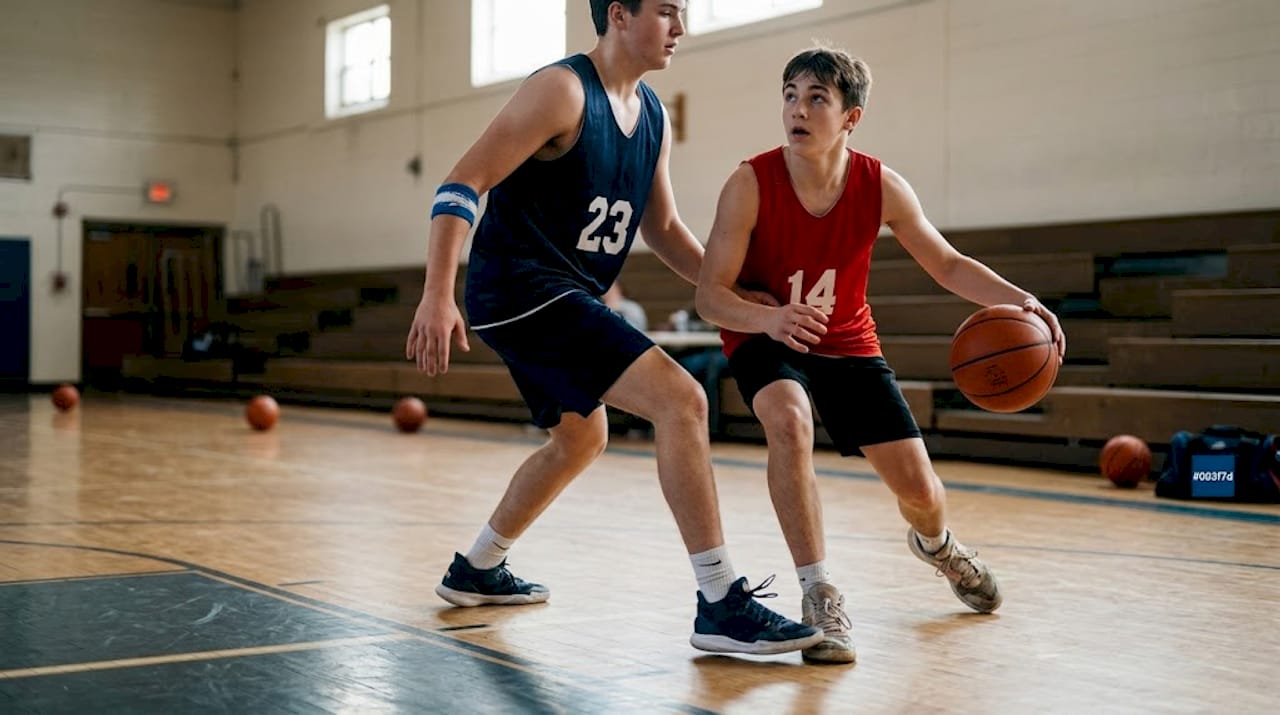
Spacing between players needs to stay in that 12-15 foot range. That distance forces defenders to make hard choices. Cover the ball handler and leave the elbow man open? Help on the roller and give up a corner three? Good basketball spacing is what creates those dilemmas in the first place.
Common mistakes to fix in practice:
- Crowding: Players drifting too close together, shrinking the defense’s coverage problem
- Standing still: Wings and cutters who do not move put zero pressure on defenders
- Rushing screens: A screen set too early or too fast does not give the cutter time to use it
Pro Tip: Film one horns possession per practice session and review it with your team. You will spot spacing and timing errors faster on video than you ever will on the fly during a drill.
“The horns play is built on precision. When every player is in the right spot at the right time, the offense almost runs itself. When one player is out of position, the entire read chain breaks down.”
Footwork is just as important as spacing. Post players must use a proper angle step when setting screens so they do not get called for moving screens. Ball handlers need a quick first step off the screen to force the defense to make a real decision. These details are worth drilling repeatedly before you use the set in a game.
Adapting the horns play to your team’s strengths
Mastering the basics is vital, but what sets successful teams apart is adapting the offense to fit their specific strengths. The horns set is not a one-size-fits-all system. It is a flexible framework that rewards coaches who know their roster.
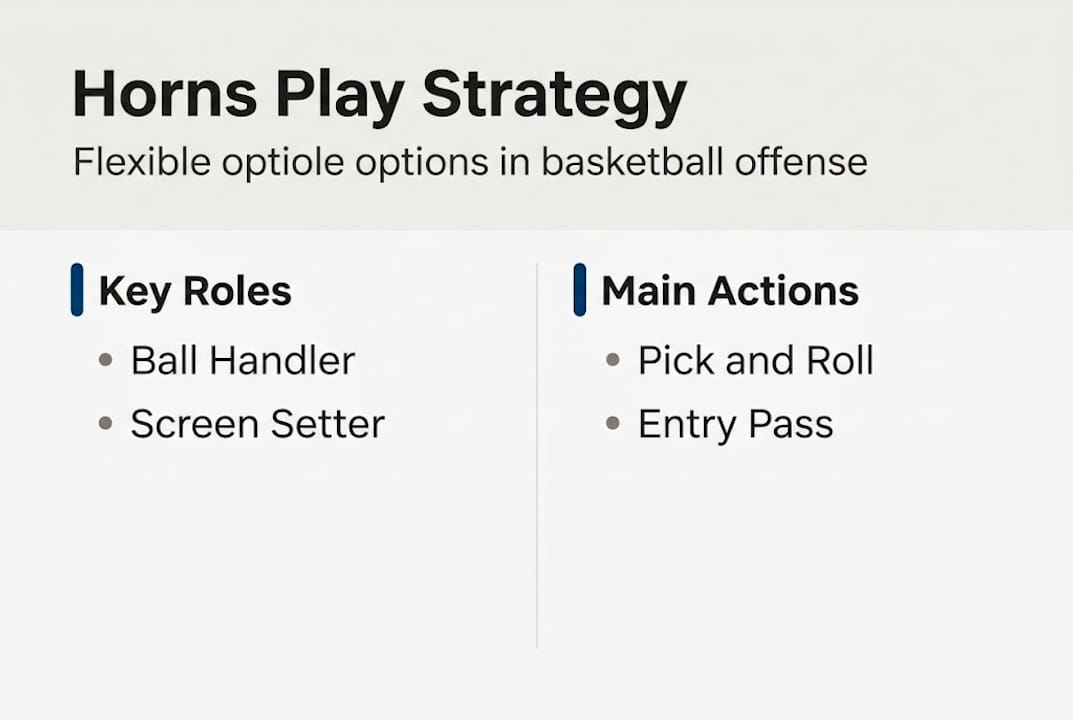
If your bigs can shoot from the elbow, you emphasize the pick-and-pop more often. If your guards are quicker than most opponents, you push the pace off horns actions to generate transition looks. If you have a true post scorer, you run high-low options to feed them deep. The formation stays the same. The actions shift.
A strong real-world example comes from the Texas Longhorns horns offense. In the 2025-26 season, Texas used a tailored horns system to rank in the top five in adjusted efficiency, hold the number one free throw rate at 47.6 percent, and generate elite offensive rebounding numbers, all by channeling horns actions toward their personnel strengths rather than forcing a generic system.
Stat callout: Texas Longhorns 2025-26 season, top-8 adjusted efficiency, #1 FT rate (47.6%), and a deliberate mid-range and post focus built around their roster’s best skills.
Pro Tip: Identify your team’s top two mismatches before installing horns actions. Then design your first three options to force those mismatches early in the shot clock. You will see results faster.
The complete horns playbook at Hoop Mentality gives you a ready-built resource to adapt these concepts quickly for any roster type.
A coach’s perspective: What most horns play overviews miss
Most articles give you the formation and list the options. That is useful. But here is what rarely gets said: the hardest part of coaching the horns play is not drawing it up. It is getting players to improvise correctly within the structure.
Players who memorize steps will freeze when the defense takes away option one. Players who understand reads will find option three without thinking twice. That shift from memorization to recognition takes time and it takes reps at game speed. Walkthroughs alone will not get you there.
Simplicity wins early. Start with two options off the horns set. Run those two until your team executes them without thinking. Then layer in a third. Coaches who install six actions in week one tend to get average execution across all six. Coaches who install two and master them before expanding tend to build real offensive identity.
Buy-in matters too. Players need to understand why each action works, not just what to do. When a point guard knows that the pop big is open because the help defender had to step to the roller, that player makes the right read without a timeout. Check out advanced horns tips to build on this foundation once your team has the basics locked in.
Pro Tip: Start every horns practice with a two-option, no-defense walkthrough at half speed. Let players call out what they see before you add live defense.
Sharpen your offense with Hoop Mentality
You have the framework. Now you need the tools to run it on your court.
Hoop Mentality has resources built specifically for coaches installing sets like horns. Use the practice plan template to structure your sessions around horns installation without wasting time. Add the big man drill to sharpen your post players’ screen-and-roll and screen-and-pop execution. Every resource at Hoop Mentality is built from real coaching experience, so you get tools that work in actual practice environments, not just on paper.
- Practice plan templates
- Position-based drills for bigs and guards
- Full horns playbooks and strategy guides
Explore the full catalog and find what your team needs next.
Frequently asked questions
What is the main advantage of running a horns play?
The main advantage is that the horns set creates multiple scoring options from one flexible formation, using spacing and screening to generate quality looks against any defense.
How can youth or high school teams benefit from using the horns play?
Horns plays are adaptable for all levels, teaching young players spacing, decision-making, and teamwork through a structure that works with limited personnel experience.
Which teams use the horns play at a high level?
College programs like the 2025-26 Texas Longhorns use adapted horns concepts to generate top-5 adjusted efficiency and the nation’s best free throw rate, and many NBA teams run variations regularly.
What are the most common mistakes coaches make with horns sets?
The most common issues are poor spacing, rushed screens, and teaching players to memorize actions instead of reading the defense and reacting to what they see.