

Over 80 percent of American basketball coaches rely on coded play names to communicate strategies on the court. This system streamlines complex instructions into quick, memorable words that players can follow when seconds count. For both new teams and established squads, understanding why and how play names work can make the difference between confusion and fast, decisive action. Discover how these names build a shared language that elevates teamwork and on-court performance.
Table of Contents
- Defining Basketball Play Names And Their Purpose
- Types Of Basketball Plays And Naming Conventions
- How Play Names Enhance Team Communication
- Real-World Examples Of Play Naming Systems
- Common Pitfalls In Naming Basketball Plays
Key Takeaways
| Point | Details |
|---|---|
| Effective Play Names Enhance Communication | Play names simplify complex strategies into concise signals, enabling quick understanding and execution during games. |
| Naming Conventions Influence Strategy | The choice between numerical and descriptive naming impacts players’ ability to grasp tactical concepts quickly. |
| Clear Systems Prevent Miscommunication | Standardized and logical naming reduces confusion, allowing players to respond efficiently under pressure. |
| Simplicity is Key | Play names should be memorable and straightforward to facilitate rapid recall during high-stress situations. |
Defining Basketball Play Names and Their Purpose
Basketball play names represent strategic communication systems that allow coaches to quickly communicate complex offensive and defensive instructions to players during a game. These coded names serve as shorthand methods for executing predetermined movement patterns, player positioning, and scoring strategies. Basketball play names transform abstract strategic concepts into actionable team instructions that can be communicated rapidly and precisely.
Play names typically incorporate specific keywords that signal unique tactical approaches. For instance, a play name might reference the primary ball handler’s movement, the initial screening action, or the intended scoring zone. Coaches develop these names to create a shared language that players can quickly interpret and execute without lengthy verbal explanations during high-pressure game situations. Some teams use numbered systems, while others employ descriptive terms like “Hawk,” “Stack,” or “Fist” that represent specific formation and movement patterns.
The primary purpose of basketball play names extends beyond simple communication. They represent a sophisticated tactical tool that enables teams to adapt quickly, maintain strategic flexibility, and respond to defensive challenges. By creating a standardized nomenclature, coaches can modify plays mid-game, substitute players seamlessly, and build a comprehensive strategic framework that transcends individual player capabilities. Well-designed play names become a form of tactical shorthand that bridges complex strategic thinking with split-second athletic execution.
Pro Coach Tip: Create play names that are memorable, concise, and intuitive for your specific team’s communication style and skill level. The most effective play names are those that players can instantly recall and execute under game pressure.
Types of Basketball Plays and Naming Conventions
Basketball plays are typically categorized into offensive and defensive strategies, each with unique naming conventions that communicate complex tactical information. Offensive plays range from structured set plays to more fluid motion-based systems. The pick and roll represents a classic example of a play named directly after the specific actions involved, where one player sets a screen for a ball handler and then moves toward the basket to receive a potential pass.
Defensive play names often describe player positioning and strategic approach. Zone defense configurations like the “2-3 zone” provide immediate visual understanding of defensive alignment, with two defenders positioned at the top of the key and three defenders positioned near the baseline. These naming conventions allow coaches and players to quickly communicate complex defensive strategies without lengthy explanations.
Play names can be structured through several distinct approaches. Some teams use numerical systems where each play corresponds to a specific number, while others employ descriptive terms that evoke specific imagery or movement patterns. Descriptive names might include terms like “Hawk” for a particular wing attack, “Stack” for a specific player alignment, or “Fist” to indicate a particular screening action. The most effective play names balance clarity, brevity, and intuitive understanding, enabling rapid communication during high-pressure game situations.
Here’s a comparison of common basketball play naming conventions:
| Naming Convention | Typical Use | Key Advantage | Example |
|---|---|---|---|
| Numerical System | Defense and offense | Quick to relay, easy to drill | “2-3 Zone” |
| Descriptive Terms | Offensive actions | Intuitive, visual cue for intent | “Pick and Roll” |
| Hybrid/Combined | Advanced teams | Encodes multiple tactical layers | “Fist 3 Hawk” |
| Position-Based | Player assignments | Clarifies who is involved | “1-4 High” |
Pro Coach Tip: Design play names that are easy to remember, communicate core strategic intent, and can be quickly understood by all team members during game-speed scenarios.
How Play Names Enhance Team Communication
Play names serve as a critical communication framework that transforms complex strategic instructions into concise, instantly comprehensible signals. The pick and roll exemplifies how a two-word name can succinctly convey a sophisticated offensive strategy, enabling players to coordinate actions seamlessly and adapt to defensive challenges in real-time. This linguistic efficiency allows teams to communicate intricate tactical movements with remarkable speed and precision.
Effective play names function as a shared language that bridges the gap between coaching strategy and player execution. By establishing a standardized communication protocol, teams can rapidly communicate positional changes, offensive patterns, and defensive shifts without breaking the flow of gameplay. Communication codes reduce verbal complexity, minimize misunderstandings, and create a cognitive shorthand that players can process almost instantaneously during high-pressure game situations.

The psychological benefits of well-designed play names extend beyond mere tactical communication. These coded instructions build team cohesion, create a sense of shared identity, and reinforce collective understanding. When players internalize play names, they develop a deeper strategic awareness, anticipating teammates’ movements and potential scenarios before they unfold. This intuitive communication system transforms individual players into a synchronized, responsive unit capable of adapting dynamically to changing game conditions.
Pro Coach Tip: Develop play names that are memorable, meaningful, and match your team’s unique personality and communication style. The most effective names will feel natural to your players and can be communicated clearly even in the most chaotic game moments.
Real-World Examples of Play Naming Systems
Professional and collegiate basketball teams employ diverse play naming strategies that reflect their unique tactical approaches. The classic pick and roll made famous by NBA legends like John Stockton and Karl Malone demonstrates how descriptive action-based names can capture complex offensive maneuvers. This naming approach allows players to instantly recognize the specific movement pattern and individual responsibilities within the play.
Defensive naming systems often utilize numerical configurations to communicate player positioning and responsibilities. Zone defense strategies like the “2-3 zone” provide an immediate visual and strategic blueprint for defensive alignment. These numerical names quickly communicate how many defenders occupy specific court areas, enabling rapid tactical adjustments without lengthy verbal explanations. Numerical naming systems allow coaches to communicate sophisticated defensive schemes through simple, intuitive codes.
Some advanced teams develop multilayered naming conventions that incorporate multiple strategic elements. These complex systems might combine action descriptors, player positions, movement patterns, and numerical indicators. For instance, a play name could simultaneously indicate the primary ball handler, initial screening action, potential passing lanes, and defensive read requirements. This sophisticated approach transforms play names from simple communication tools into comprehensive tactical blueprints that encode multiple layers of strategic information.
Pro Coach Tip: Create a consistent naming framework that balances complexity with clarity, ensuring every team member can quickly understand and execute the encoded strategic instructions.
Common Pitfalls in Naming Basketball Plays
Coaches frequently encounter significant challenges when developing play names that can compromise team communication and strategic execution. Inconsistent play terminology creates substantial risks, particularly when players transition between teams or encounter different coaching systems. The lack of standardized naming conventions can lead to misunderstandings, hesitations, and breakdowns in critical game moments when split-second decision making is crucial.
Complexity traps represent another major pitfall in play naming systems. Overly intricate or abstract names can overwhelm players, especially younger athletes or those new to complex tactical strategies. Names that require extensive mental processing during high-pressure game situations defeat the primary purpose of quick, intuitive communication. Coaches must strike a delicate balance between providing enough information and maintaining cognitive simplicity that allows players to react instantaneously.
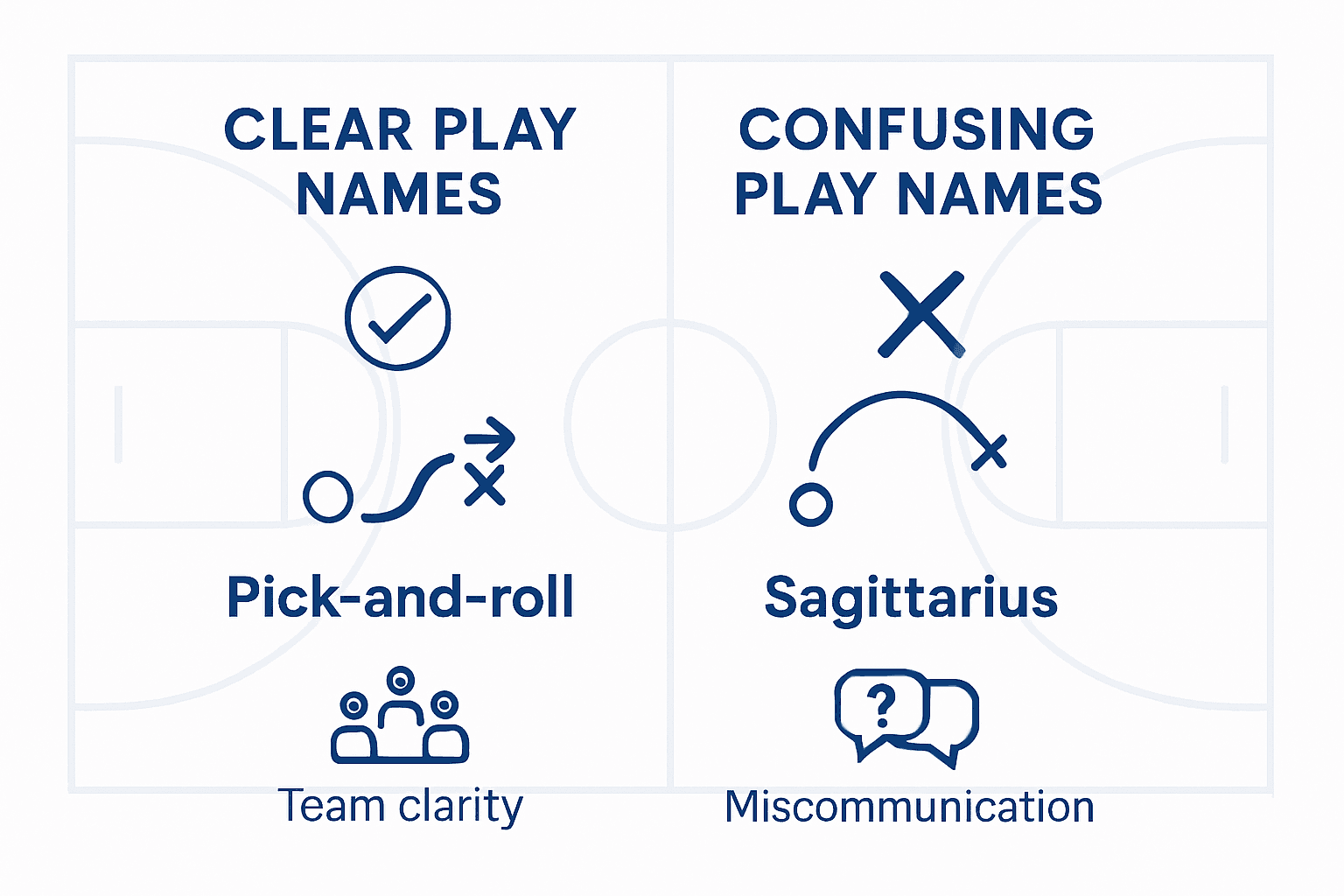
Another critical error involves failing to establish a consistent naming logic across offensive and defensive play systems. Successful teams develop a coherent linguistic framework where play names follow predictable patterns, making them easier to learn, remember, and execute. Randomness or excessive variation in naming can fragment team understanding, creating cognitive friction that slows down strategic implementation. Effective play names should feel like a natural extension of the team’s collective language and tactical approach.
Below is a summary of key pitfalls and recommended solutions in basketball play naming:
| Pitfall | Negative Effect | Recommended Solution |
|---|---|---|
| Inconsistent terminology | Miscommunication and confusion | Use standard language team-wide |
| Overly complex names | Slows reaction, increases errors | Keep names simple and memorable |
| Lack of logic in system | Difficult to learn and recall | Develop clear, predictable patterns |
Pro Coach Tip: Develop a naming system with clear, memorable patterns that reflect your team’s unique personality and strategic philosophy. Test your play names with players to ensure they can be quickly and accurately recalled under game pressure.
Master Clear Basketball Play Names with Expert Tools
A clear and consistent naming system is crucial to avoid misunderstandings and improve communication on your team. This article highlights how complex or inconsistent basketball play names can slow down decision making and cause confusion during critical game moments. Coaches like you need a straightforward way to create memorable and effective play names that match your team’s unique style and skill level.

Unlock your team’s full potential today with our Basketball Playbooks - Hoop Mentality designed to help you organize and communicate plays effectively. Complement your play naming system with proven Basketball Drills - Hoop Mentality that reinforce these strategies in game-like situations. Visit Hoop Mentality now and gain access to professional coaching resources that save you time, enhance clarity, and empower your team to execute plays flawlessly under pressure.
Frequently Asked Questions
What are basketball play names?
Basketball play names are strategic labels that coaches use to communicate complex offensive and defensive instructions to players quickly. They simplify strategic concepts into actionable terms that players can understand and execute in high-pressure game situations.
How do basketball play names enhance team communication?
Play names serve as a shorthand language that allows coaches and players to communicate intricate tactical movements easily. This efficiency minimizes misunderstandings, builds team cohesion, and allows players to react swiftly to changing game conditions.
What types of naming conventions are used for basketball plays?
There are several naming conventions for basketball plays, including numerical systems that correlate plays to specific numbers, descriptive terms that evoke imagery or actions, and hybrid systems that combine both approaches to convey complex strategies effectively.
What are common pitfalls to avoid in naming basketball plays?
Common pitfalls include inconsistent terminology, overly complex names, and a lack of logical patterns across the naming system. These can lead to miscommunication and hinder player performance, so it’s essential to establish clear, memorable names that follow predictable structures.