

TL;DR:
- Basketball alignment terminology provides a shared language for players and coaches to precisely describe positioning and movements on the court. Mastering core terms like strong side, nail, and slot enhances communication, spacing, and decision-making during live play. Implementing consistent vocabulary early improves team execution, reduces errors, and elevates performance in tight game situations.
Basketball alignment terminology is the shared language coaches and players use to describe where players stand, how they space the floor, and how they move in relation to the ball. Without this vocabulary, even well-designed plays break down because players interpret positioning differently. Terms like strong side, nail, slot, and corner depth are not abstract concepts. They are precise reference points that anchor every offensive formation and defensive rotation your team runs.
What is basketball alignment terminology and why does it matter?
Basketball alignment terminology is a decision framework built on the ball’s location plus fixed reference points like the nail and slot to prevent confusion during shifting player movement. That definition matters because it reframes alignment as a live, dynamic tool rather than a static diagram on a whiteboard.
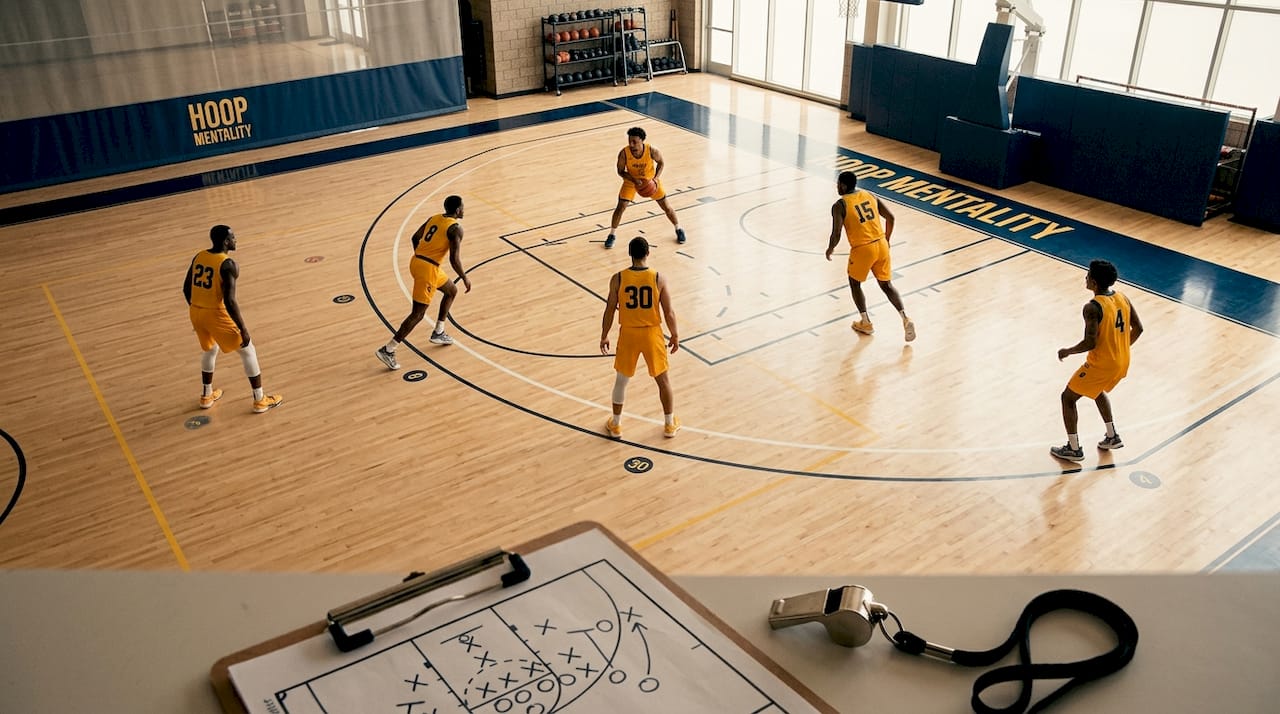
Here are the core terms every coach and player must know:
- Strong side: The half of the court where the ball is located. Strong side positioning serves as baseline language for spacing and play reads before any action develops. Knowing which side is “strong” tells every player on the floor where help defense will come from and where driving lanes will open.
- Weak side: The opposite half from the ball. Weak side players are responsible for spacing away from the action, staying ready for skip passes, and providing defensive balance. This is where most off-ball cuts and relocations originate.
- The nail: An imaginary spot at the center-top of the free-throw circle. Coaches use the nail as a reference point for help defense positioning and rotations. A defender at the nail can threaten both sides of the lane simultaneously, which is why it is the most contested spot in half-court defense.
- The slot: The area between the wing and the corner. The slot and corner depth directly impact spacing strategies and defensive coverage. A player in the slot occupies a passing lane that forces the defense to choose between covering the corner and covering the wing.
- Corner depth: How close a player positions themselves near the baseline corner. Corner depth positioning affects defensive geometry by influencing whether defenders cover multiple areas or get pulled out, dynamically shaping driving lanes.
- Dunker spot: The low block area on the strong side, typically occupied by a cutter or post player to threaten the defense near the rim.
- Paint touch window: The brief moment when a ball-handler enters the paint, triggering specific reactions from off-ball players. Missing this window collapses spacing and kills offensive flow.
Pro Tip: Teach the nail and strong/weak side first. Once players internalize those two reference points, every other alignment term becomes easier to layer in.
How do common basketball alignments shape offensive and defensive strategies?
Alignment formations like 5-out, 4-out-1-in, and 3-out-2-in each shift the balance between perimeter space and interior presence to exploit different defensive weaknesses. Choosing the right formation is not a stylistic preference. It is a strategic decision based on your personnel and the defense you are attacking.
| Formation | Perimeter players | Interior players | Best used when |
|---|---|---|---|
| 5-out | 5 | 0 | You have five players who can shoot and handle; maximizes driving lanes |
| 4-out-1-in | 4 | 1 | You have one dominant post player who needs space to operate |
| 3-out-2-in | 3 | 2 | You have two interior threats and want to dominate the paint |
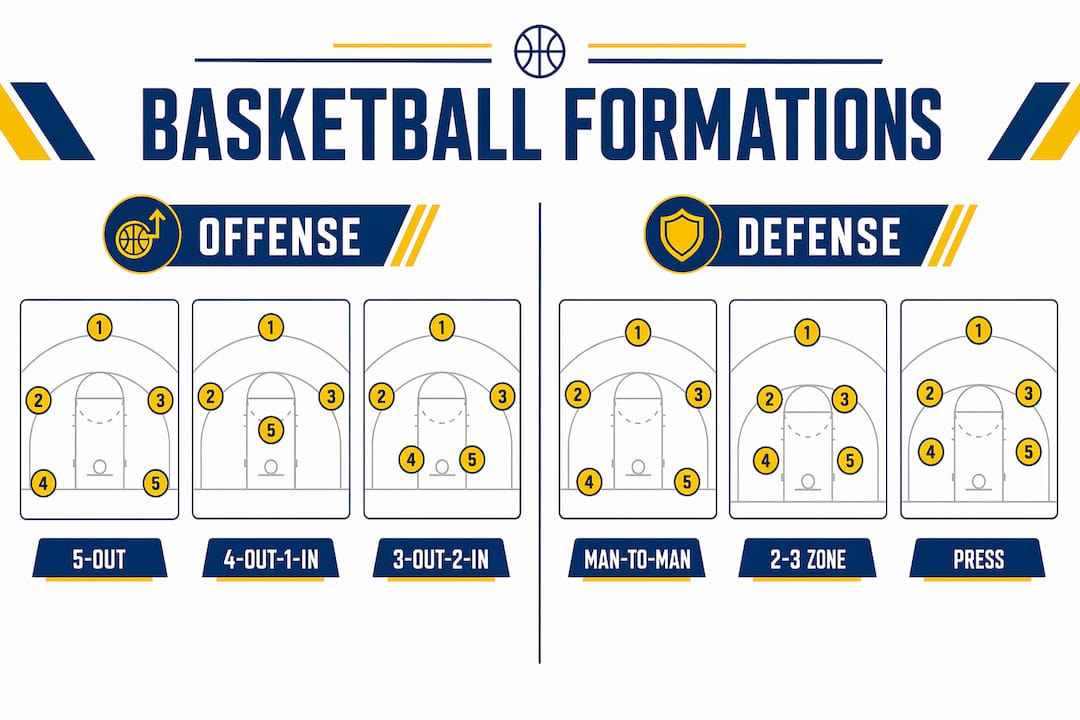
The 5-out formation creates the widest possible spacing, forcing all five defenders to guard the perimeter and leaving the lane open for drives. The 4-out-1-in is the most common alignment in modern basketball because it balances spacing with a post presence. The 3-out-2-in is a power formation that works when your bigs can score in the paint and your guards can make reads off two-man actions.
On the defensive side, basketball formation definitions extend beyond offense. In a 2-3 zone defense, base alignment players shift with the ball using slide and bump rules. “Slide” means a defender shifts laterally to cover a passing lane. “Bump” means a defender steps up to stop ball movement at a specific spot. These terms give defenders a shared map for rotating without verbal confusion during live play.
Man-to-man defense uses its own alignment language. Terms like “on-ball,” “one pass away,” and “two passes away” describe how far a defender is from the ball and how much they should sag toward the paint. This language connects directly to strong/weak side concepts, creating a unified system across both offense and defense.
Pro Tip: When installing a new formation, drill the alignment without any defense first. Players need to feel the spacing before they can read and react within it.
What are the critical movement rules and timing concepts in alignment terminology?
Alignment terminology does not just describe where players stand. It describes when and how they move. Movement rules like lift, shake, and 45-cut from the slot area create opportunities by manipulating defensive reactions and opening passing lanes. Here is how each concept works in practice:
- Lift: A player in the corner moves up toward the slot when the ball-handler drives baseline. This lifts the corner defender out of the driving lane and creates a passing outlet above the break.
- Shake: A quick jab step or change of direction from the slot position to freeze a defender. The shake creates just enough separation for a catch-and-shoot opportunity or a drive to the nail area.
- 45-cut: A diagonal cut from the slot toward the basket at a 45-degree angle. This cut exploits the gap between a help defender at the nail and a corner defender, and it is most effective during a paint touch window.
- Exit screen: A screen set by an off-ball player to free a teammate relocating after a drive or pass. Exit screens maintain alignment by getting players back to their spacing spots quickly.
- Relocation: The act of moving to a new spot on the floor after a pass or screen. Relocation keeps the formation intact and prevents the defense from recovering to a static set.
Timing is the element most coaches underteach. A 45-cut that arrives a half-second before the ball-handler enters the paint is useless. The cut must coincide with the paint touch window to force the defense into a two-on-one decision. Alignment terms represent timing and coverage stress points in pick-and-roll angles, which means understanding them facilitates communicating reads, not just positions.
Pro Tip: Use video review to show players the exact paint touch window in game footage. Seeing the timing gap makes the concept click faster than any diagram.
How does alignment terminology improve team communication and decision-making?
Teams with shared alignment terminology have better spacing awareness and communication, reducing misalignment errors under pressure. This is the practical payoff of learning the vocabulary. When a point guard calls “nail stunt” or “bump the corner,” every player on the floor knows exactly what to do without a timeout.
Here is how shared basketball tactical language translates into real-time benefits:
- Faster rotations: When defenders know the slide and bump rules by name, they rotate without hesitation. Hesitation is what turns a recoverable defensive breakdown into an open layup.
- Cleaner spacing: Poor alignment leads to congestion and disruption of offensive flow. When players know the slot, corner, and nail by feel, they self-correct their spacing without needing a coach to call it out.
- Better reads: Alignment terms communicate reads, not just positions. When a player hears “strong side drive,” they immediately know whether to lift, cut, or relocate based on their spot in the formation.
- Reduced cognitive load: Basketball positions labeled 1 through 5 give players a universal shorthand. Combining position numbers with alignment terms like “4 at the nail” or “5 at the dunker” compresses complex instructions into two-word calls.
- Psychological safety: When players share a common language, they feel confident making calls on the floor. Research on team communication in sports shows that shared vocabulary reduces anxiety and increases decision speed under pressure.
The most underrated benefit is error correction. When a player is out of position, a teammate can fix it with one word. “Slot!” or “Nail!” is faster and clearer than “Hey, move over there a little.” That precision is what separates teams that execute under pressure from teams that fall apart.
Key takeaways
Mastering basketball alignment terminology gives coaches and players a precise, shared language that directly improves spacing, timing, and decision-making on both ends of the floor.
| Point | Details |
|---|---|
| Core terms anchor all alignment | Strong side, weak side, nail, slot, and corner depth are the foundation every other term builds on. |
| Formations define spacing strategy | 5-out, 4-out-1-in, and 3-out-2-in each create different spacing and interior presence to attack specific defenses. |
| Movement terms describe timing, not just position | Lift, shake, and 45-cut are timed actions tied to paint touch windows, not just directional cues. |
| Shared language reduces errors | Teams that use consistent alignment vocabulary self-correct faster and rotate with less hesitation under pressure. |
| Defense has its own alignment system | Slide, bump, and nail stunt are defensive alignment terms that coordinate rotations the same way offensive terms coordinate spacing. |
Why alignment language is the most undercoached skill in basketball
I have worked with teams at multiple levels, and the pattern is consistent. Coaches spend hours on plays and drills, then wonder why execution breaks down in games. The answer is almost always the same: players do not share a common spatial language. They know the play, but they do not know the reference points that make the play work when the defense disrupts the initial action.
The biggest mistake I see is treating alignment terms as advanced vocabulary. Coaches introduce them late, after players have already built habits around vague descriptions like “get to your spot.” That phrase means nothing without a named spot to reference. When you teach the nail and the slot in the first week of practice, every subsequent drill has a spatial anchor. Players stop guessing and start reading.
The second mistake is using alignment language only on offense. Defensive alignment vocabulary, specifically slide rules, bump concepts, and nail positioning, is just as important. A defense that communicates in the same spatial language as the offense can anticipate actions rather than react to them. That is the difference between a team that bends and a team that breaks.
My advice: build a one-page glossary of your team’s alignment terms before the season starts. Post it in the locker room. Quiz players on it. Make it part of your team communication system from day one. The teams that master this vocabulary early are the ones that execute late in close games.
— Dejan
Build alignment awareness into every practice
Hoopmentality’s resources are built for coaches who want to move beyond diagrams and install systems that players actually execute.
The Game Preparation Guide with Weekly Practice Plan from Hoopmentality gives you a structured framework for teaching alignment concepts progressively across a full week of practice. It includes drill sequences that reinforce spacing terms, communication cues, and formation reads in live situations. You can also explore the complete spacing guide for a deeper breakdown of how alignment terms connect to offensive flow and defensive coverage. Both resources are built from real coaching experience and designed to save you preparation time.
FAQ
What is basketball alignment terminology?
Basketball alignment terminology is the vocabulary coaches and players use to describe player positioning, spacing, and movement on the court. It includes terms like strong side, weak side, nail, slot, and corner depth.
What does “the nail” mean in basketball?
The nail is the imaginary spot at the center-top of the free-throw circle. It is a primary reference point for help defense positioning and is used to coordinate rotations in both zone and man-to-man schemes.
What is the difference between 5-out and 4-out-1-in alignment?
5-out places all five players on the perimeter to maximize driving lanes, while 4-out-1-in keeps one player in the post to combine spacing with interior scoring presence. The choice depends on your personnel and the defense you are attacking.
How does alignment terminology improve team communication?
Shared alignment vocabulary gives players precise reference points for spacing and movement, which reduces hesitation during rotations and allows teammates to correct positioning with single-word calls during live play.
What is a paint touch window in basketball?
A paint touch window is the moment when a ball-handler enters the paint, triggering specific off-ball reactions like lifts, 45-cuts, and relocations. Timing these movements to the paint touch window is what creates open looks rather than contested shots.