

Think basketball terminology never changes? Think again. The language coaches use to communicate strategies and plays evolves every 3 to 5 years, mirroring shifts in tactics, player roles, and global playing styles. In 2026, mastering contemporary basketball terminology isn’t just about sounding current. It’s about boosting communication clarity, reducing in-game errors, and executing strategies with precision. Understanding modern terms helps you connect with players, adapt to international coaching environments, and stay competitive at every level.
Table of Contents
- Introduction To Contemporary Basketball Terminology
- Why Updated Terminology Matters For Coaches
- Common Misconceptions About Basketball Terminology
- Comparative Framework: Classic Vs. Modern Basketball Terms
- Practical Applications: Teaching And Implementing Terminology
- Global Variations And Cultural Considerations In Terminology
- Conceptual Framework For Organizing And Mastering Basketball Terminology
- Conclusion: Enhancing Coaching Effectiveness Through Mastery Of Basketball Terminology
- Enhance Your Coaching With Tailored Resources
- Frequently Asked Questions About Basketball Terminology In 2026
Key takeaways
| Point | Details |
|---|---|
| Updated terminology improves clarity | Standardized terminology increases communication clarity by 30%, cutting errors and sharpening performance. |
| Terminology evolves regularly | Basketball terms change every 3 to 5 years to match tactical trends, pace shifts, and strategic innovations. |
| Misconceptions hinder coaching | Believing terminology is static or confusing similar terms like switch defense and zone defense limits effective communication. |
| Classic vs. modern frameworks clarify shifts | Comparing fixed position terms with dynamic spacing concepts reveals how the game has transformed strategically. |
| Practical application enhances development | Teaching terminology systematically across game phases improves player execution speed and team cohesion. |
Introduction to contemporary basketball terminology
Basketball terminology is the standardized language coaches use to communicate plays, strategies, and tactical adjustments. It forms the foundation for clear interaction between coaches and players, ensuring everyone understands roles, movements, and objectives during practice and competition. Without shared vocabulary, even the best game plan falls apart under pressure.
The evolution from classic to modern terminology reflects fundamental changes in how basketball is played. Decades ago, terms centered on fixed positions like power forward, shooting guard, and man to man defense. Today’s game emphasizes versatility, spacing, and pace, giving rise to terms like positionless basketball, pace and space offense, and switch heavy defense. These shifts mirror tactical innovations driven by analytics, global talent, and evolving coaching philosophies.
In 2026, basketball terminology includes several defining concepts:
- Positionless basketball: Players rotate across multiple roles based on matchups and situations, not fixed positions.
- Pace and space offense: Systems prioritizing fast transitions, perimeter shooting, and floor spacing to create scoring opportunities.
- Switch heavy defense: Defensive schemes where players swap assignments on screens, relying on versatility over rigid man coverage.
- Drop coverage: A pick and roll defense where the big defender retreats to protect the rim rather than pressuring the ball handler.
- Five out offense: All five offensive players positioned beyond the three point arc to maximize spacing and driving lanes.
These terms directly impact in-game communication and strategy execution. When coaches call for a five out set, players instantly know to clear the paint and spread the floor. When a defense switches, every player understands their new assignment without hesitation. Terminology also reflects global developments, as international leagues and competitions introduce concepts that cross borders and influence coaching worldwide. Understanding basketball tactical trends helps you stay ahead of these shifts and apply them effectively.
Why updated terminology matters for coaches
Using contemporary terminology dramatically improves coaching performance and reduces mistakes. Standardized basketball terminology increases communication clarity by 30%, cutting errors during high pressure moments and sharpening overall team execution. When everyone speaks the same language, players react faster, adjust more fluidly, and execute strategies with confidence.
Consistent language minimizes in-game confusion and miscommunication. Imagine calling for a drop coverage during a timeout, but half your team interprets it as hedging on screens. The result is defensive breakdowns, open shots for opponents, and frustrated players. Updated terminology eliminates these gaps, creating a shared mental model that aligns everyone from starters to bench players.

Player understanding and execution speed improve significantly when terminology is clear and current. Players spend less time decoding instructions and more time reacting to game situations. This speed advantage is critical in transition moments, late game scenarios, and against well prepared opponents. Modern terms also empower players to communicate with each other, calling out switches, rotations, and adjustments without waiting for coaching input.
Outdated or inconsistent terminology creates several barriers:
- Confusion during high stakes moments: Players hesitate or guess at instructions, leading to defensive lapses or missed offensive opportunities.
- Slower learning curves: New players take longer to integrate into team systems when terminology is unclear or unfamiliar.
- Miscommunication across coaching staff: Assistants, head coaches, and trainers may use different terms for the same concepts, creating mixed signals.
- Disconnect with modern scouting reports: Opposing teams and analysts use current terminology, making it harder to translate insights if your language is outdated.
Pro Tip: Schedule quarterly terminology reviews with your coaching staff and players to update language, clarify misunderstandings, and introduce new concepts that match evolving tactics. Implementing communication strategies basketball coaches rely on ensures everyone stays aligned and prepared.
Common misconceptions about basketball terminology
Many coaches operate under misconceptions that limit their effectiveness and create communication pitfalls. Addressing these myths head on clears the path for better teaching and execution.
Myth 1: Terminology is static and never changes.
Reality: Basketball terminology evolves constantly to reflect tactical innovations, player development, and global influences. What worked in the 1990s doesn’t capture the nuances of modern schemes. Coaches who cling to outdated terms risk confusing players and missing strategic opportunities. The game’s pace, spacing emphasis, and defensive versatility demand updated language that matches current realities.
Myth 2: Switch defense is the same as zone defense.
Reality: These are fundamentally different concepts. Switch defense involves players exchanging defensive assignments, typically on screens, while maintaining man to man principles. Zone defense assigns players to guard specific areas of the court, not individual opponents. Confusing these terms leads to misaligned defensive schemes and exploitable weaknesses. Understanding the distinction is critical for teaching defensive systems effectively.
Myth 3: More terminology overcomplicates coaching unnecessarily.
Reality: Modern terminology actually simplifies communication by providing precise labels for complex concepts. Instead of lengthy explanations during timeouts, coaches can call a single term like ice defense or horns set and players instantly understand the entire scheme. The key is teaching terminology systematically so it becomes second nature, not overwhelming players with jargon all at once.
Terminology evolves to improve clarity, not complicate it. As playing styles shift toward positionless basketball and hybrid defenses, language must adapt to capture these changes. Coaches who embrace updated terminology position themselves and their teams for success in a rapidly changing game.
Comparative framework: classic vs. modern basketball terms
Comparing classic and modern terminology reveals how strategic thinking has shifted over decades. Classic terms focused on fixed positions, rigid man to man coverage, and limited spatial concepts. Players were pigeonholed into roles like center, point guard, or shooting guard, with clearly defined responsibilities that rarely overlapped.
Modern terminology emphasizes spacing, versatility, and dynamic defensive schemes. Today’s game values players who can switch across multiple positions, shoot from distance, and defend various matchups. Terms like stretch four, wing player, and small ball lineup reflect this fluidity. Defensively, concepts like blitzing pick and rolls, switching one through five, and drop coverage showcase the adaptability required to counter diverse offensive attacks.
| Classic Term | Modern Term | Strategic Implication |
|---|---|---|
| Power forward | Stretch four | Modern bigs space the floor with shooting, not just post play. |
| Man to man defense | Switch heavy defense | Defenses prioritize versatility and seamless screen navigation over rigid assignments. |
| Isolation play | Drive and kick offense | Emphasis shifts from one on one scoring to creating open threes through penetration. |
| Low post offense | Five out spacing | Offenses clear the paint to maximize driving lanes and perimeter shooting. |
| Help defense | Gap defense | Modern schemes emphasize positioning between ball and basket, not just reacting to drives. |
These changes reflect the evolving game pace and player roles. Faster transitions, increased three point attempts, and global talent infusion have reshaped how coaches design systems. Modern terms capture these realities, giving coaches precise language to teach complex schemes efficiently. Exploring basketball systems overview guide provides deeper insight into how these terminological shifts align with strategic frameworks.
Organizing terms by game phase creates a useful mental model:
- Offense: Pace and space, motion offense, horns set, dribble handoff, Spain pick and roll.
- Defense: Switch all, drop coverage, ice defense, gap help, scramble defense.
- Transition: Numbers advantage, early offense, rim run, trailer three, leak out.
This categorization helps coaches teach terminology systematically and ensures players understand context for each term.
Practical applications: teaching and implementing terminology
Introducing terminology effectively requires a stepwise approach aligned to game phases. Start with fundamental offensive, defensive, and transition terms during preseason, then layer in advanced concepts as players demonstrate understanding. This progression prevents overwhelm and builds a solid foundation.
- Begin with core game phase terms: Teach basic offensive sets, defensive coverages, and transition actions. Use visual aids, whiteboard diagrams, and video clips to reinforce definitions.
- Integrate terminology into daily drills: Label every drill with relevant terms. For example, during shell drill, call out switch, help, and recover to reinforce defensive vocabulary.
- Use repetition and context: Repeat terms consistently across practices, film sessions, and games. Players learn through repeated exposure in varied contexts.
- Simplify for youth and scale complexity upward: Youth coaches should prioritize 5 to 10 essential terms and introduce advanced concepts gradually as players mature. High school and college coaches can expand vocabulary to match tactical sophistication.
- Adapt terms for cultural and regional differences: International teams may use different labels for the same concepts. Harmonize terminology early, provide translations if needed, and encourage players to ask clarifying questions.
Consistent integration into playbooks and practice plans cements terminology as part of team culture. When players see the same terms in written materials, hear them in huddles, and apply them on the court, retention skyrockets. Essential tips first-time basketball coaches emphasize this consistency as a pillar of effective teaching.
Pro Tip: Conduct monthly terminology quizzes or verbal walkthroughs where players explain terms in their own words. This reinforces understanding and surfaces gaps before they become problems in games.
Global variations and cultural considerations in terminology
Basketball is a global game, and terminology varies across regions, leagues, and cultures. European coaches may use different labels for pick and roll defenses than American coaches. Australian teams might emphasize terms influenced by their local playing style. These variations can create confusion when coaching international or multicultural teams.
Examples of regional differences include:
- Pick and roll defense: European coaches often use hedge, while American coaches may say show or ice depending on the coverage.
- Fast break: Some regions call this transition offense or early offense, reflecting different tactical priorities.
- Zone defense: International teams may use numbered zone references like 2-3 or 3-2, while some coaches describe zones by action like matchup zone.
These differences impact team communication and strategy execution. When players trained in different systems join a team, they may interpret the same term differently or use unfamiliar labels. This creates hesitation, miscommunication, and defensive breakdowns.
Challenges in international and multicultural settings include language barriers, varying basketball education backgrounds, and resistance to changing familiar terminology. Coaches must navigate these carefully to build cohesive teams.
Strategies to harmonize terminology and foster inclusive communication:
- Create a team glossary: Document all key terms with definitions, diagrams, and examples. Distribute this to players and staff as a reference.
- Facilitate open dialogue: Encourage players to share terms from their backgrounds and discuss differences without judgment.
- Use visual demonstrations: Show video clips or whiteboard illustrations to clarify terms when language barriers exist.
- Be patient and flexible: Allow time for players to adjust and be willing to adapt terminology if it improves team understanding.
Cultural sensitivity matters. Respect players’ backgrounds and acknowledge that different approaches can be equally valid. Building a shared vocabulary takes effort, but the payoff in team cohesion and performance is substantial.
Conceptual framework for organizing and mastering basketball terminology
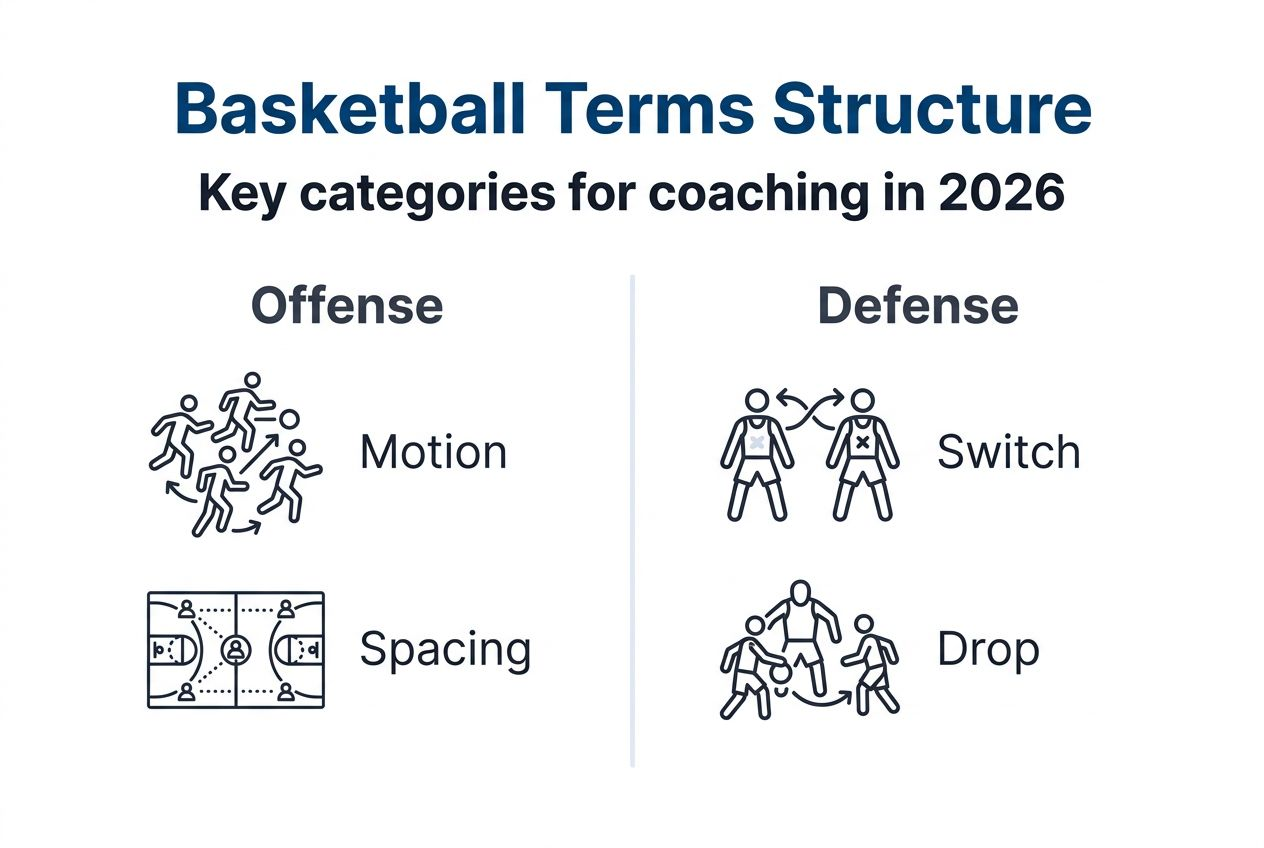
A structured framework helps coaches and players categorize, learn, and retain terminology efficiently. The three tier framework organizes terms by game phase: offense, defense, and transition. This structure mirrors how basketball unfolds in real time and provides intuitive mental anchors for learning.
Benefits of structured learning include faster retention, easier recall under pressure, and clearer teaching progressions. When players understand that terms cluster around offense, defense, or transition, they can mentally file new vocabulary into existing categories rather than treating each term as isolated information.
| Category | Term Examples | Application Context |
|---|---|---|
| Offense | Motion offense, horns set, dribble handoff, elevator screen, Spain pick and roll | Half court scoring systems, set plays, and offensive actions. |
| Defense | Switch all, drop coverage, ice defense, gap help, scramble defense | Pick and roll coverages, help rotations, and defensive schemes. |
| Transition | Numbers advantage, early offense, rim run, trailer three, leak out | Fast break opportunities, early offense actions, and defensive recovery. |
Case studies show improved coaching outcomes using this framework. A high school coach in Texas implemented the three tier model during preseason and reported 40% faster terminology retention compared to previous years. Players could recall and apply terms under game pressure because the framework gave them mental structure. College programs using similar categorization see reduced miscommunication and faster adjustment to opponent scouting reports.
Guidelines for ongoing terminology updates:
- Review terminology quarterly: Assess whether current terms still match your system and playing style.
- Incorporate new concepts from scouting: When you identify effective opponent tactics, add relevant terminology to your glossary.
- Solicit player feedback: Ask players if any terms are confusing or if they encounter different labels in camps or clinics.
- Align with coaching staff: Ensure all assistants use the same terminology to avoid mixed signals.
For coaches seeking deeper guidance, essential tips first-time basketball coaches, basketball play names coaching, and basketball strategic planning success offer complementary frameworks for building cohesive coaching systems.
Conclusion: enhancing coaching effectiveness through mastery of basketball terminology
Mastering contemporary basketball terminology in 2026 directly enhances coaching effectiveness, team communication, and competitive performance. Updated language reduces errors, speeds execution, and aligns everyone around shared strategic goals. Terminology isn’t static. It evolves with the game, and coaches who stay current position themselves for long term success.
The link between precise terminology and strategy execution is undeniable. When you call a five out set or switch heavy defense, players must understand instantly and act without hesitation. This clarity becomes the difference between winning and losing tight games. Reduced miscommunication translates to fewer defensive breakdowns, smoother offensive flow, and better in-game adjustments.
Actively adopt and update terminology as part of your coaching routine. Review terms quarterly, integrate them into practice plans, and teach systematically using structured frameworks. Encourage players to engage with the language, ask questions, and reinforce learning through repetition and context.
Final tips for continuous learning and adaptation: consume coaching content regularly, attend clinics and workshops, study professional and international games, and collaborate with fellow coaches to share insights. The game never stops evolving, and neither should your vocabulary. Strengthening coach communications guide basketball skills ensures you lead with confidence and clarity.
Impact on team cohesion and performance is profound. Shared language builds trust, reduces confusion, and empowers players to communicate independently on the court. Invest in mastering terminology today, and watch your coaching effectiveness soar.
Enhance your coaching with tailored resources
Mastering basketball terminology is just the beginning. Translating that knowledge into effective practice plans, drills, and game strategies requires the right tools. Hoop Mentality’s basketball practice plan template streamlines how you integrate terminology into daily sessions, ensuring players see consistent language across every drill and scrimmage. For coaches emphasizing modern big man versatility, the Big Man Dual Action Drill reinforces spacing and pick and roll concepts using contemporary terminology.

Explore comprehensive resources at Hoop Mentality to improve team communication, sharpen strategy execution, and develop players with clarity and structure. Every resource is built by coaches for coaches, focusing on what matters most: developing your team and winning games.
Frequently asked questions about basketball terminology in 2026
What are the most important new basketball terms coaches should learn in 2026?
Focus on positionless basketball, pace and space offense, switch heavy defense, drop coverage, and five out spacing. These terms capture current tactical trends emphasizing versatility, perimeter shooting, and defensive adaptability. Mastering them keeps your communication aligned with modern playing styles.
How can I help players adapt to evolving basketball terminology quickly?
Introduce terms systematically using the three tier framework: offense, defense, transition. Integrate terminology into every drill, label plays in your playbook, and conduct monthly reviews to reinforce understanding. Visual aids and repetition accelerate retention and application.
Are there resources to stay updated on basketball terminology changes?
Yes. Follow coaching clinics, professional league broadcasts, and reputable basketball websites. Hoop Mentality offers guides on tactical trends, communication strategies, and strategic planning that keep you current with evolving terminology and coaching best practices.
How do I address terminology differences in international teams?
Create a team glossary documenting all key terms with definitions and diagrams. Facilitate open dialogue where players share their backgrounds and discuss differences. Use visual demonstrations to bridge language gaps and be patient as players adjust to unified vocabulary.
Can simplified terminology be effective for youth coaching?
Absolutely. Youth coaches should prioritize 5 to 10 essential terms and introduce advanced concepts gradually as players mature. Simplified language reduces overwhelm, builds foundational understanding, and sets the stage for more complex vocabulary as skills develop.