

Prioritize concise, process-focused feedback (KP) paired with autonomy-supportive prompts over blunt outcome-only instruction. This combination drives faster skill retention and stronger player buy-in. Before your next practice, try one line: instead of “you missed the box out,” ask “what did you notice about your positioning before the shot went up?” That single shift sets up everything below. Copy-ready scripts and templates follow.
TL;DR:
- Providing autonomy-supportive prompts and focused feedback improves long-term skill retention, especially when correcting specific movement errors with performance-based cues.
- Using a triage approach to feedback, emphasizing fewer but higher-impact corrections, prevents dependency and encourages players to rely on their own internal feeling.
- Building daily routines like personal check-ins, public recognition, and rotating leadership establishes trust and relational routines that enhance communication effectiveness.
- Adjusting coaching language and body language based on cultural background and emotional state makes feedback more impactful across diverse rosters.
- Tracking observable changes in players’ responses, technical repetition, and peer coaching over time helps refine communication strategies and measure relational progress.
Table of Contents
- Executive Coaching Communication Skills Coaches Actually Need
- Scripts and Drills You Can Use at Tonight’s Practice
- How Often Should Coaches Give Feedback?
- Building a Team Culture Where Communication Actually Works
- How Can Coaches Practice Active Listening on the Bench?
- What Your Body Language Tells Your Team
- Strategies for Managing Difficult Conversations With Players
- Why Emotional Intelligence Separates Good Coaches From Great Ones
- Cross-Cultural Communication on Diverse Rosters
- Author’s Take: What to Track Once You Start Changing How You Talk
- Get Your Scripts and Templates Ready to Use Tonight
- Sources
- FAQ
Executive Coaching Communication Skills Coaches Actually Need
Coaching communication runs on three separate tracks, and most coaches only ever consciously work one of them. Get clear on all three and you stop guessing which tone to use in a given moment.
Instructional feedback splits into two types: knowledge of results (KR), which tells a player what happened (“that shot was short”), and knowledge of performance (KP), which tells them what to fix in the movement itself (“your elbow drifted out on release”). Motor-learning research shows KP typically produces more durable skill changes than KR alone because it gives the athlete something to adjust rather than just a verdict to absorb, a concept well illustrated in the role of coaching in tennis matches. Use KP whenever you want a correction to stick past this week’s practice.
Motivational language draws from Self-Determination Theory, which holds that people perform and retain skills better when three needs are met: autonomy, competence, and relatedness. Autonomy-supportive coaching swaps commands for prompts that invite observation (“what did your defender give you there?”) instead of orders (“drive left every time”). It sounds like a small wording change. It changes whether a player is executing your plan or starting to build their own basketball IQ.
Relational communication is the daily infrastructure. FIBA’s coaching guidance stresses that coaches should define roles clearly, hold players accountable to those roles, and acknowledge good performance so the right behaviors get reinforced instead of ignored.
Here is how to choose which mode to use in the moment:
- Crisis or safety issue: Direct instruction, short and clear. No open-ended questions when someone could get hurt.
- Learning moment during a drill: KP feedback plus an autonomy-supportive question.
- End-of-practice or film session: KR context first, then KP correction, then a relatedness check-in.
- Ongoing skill plateau: Shift almost entirely to autonomy-supportive prompting. Telling has stopped working; asking might not have been tried yet.
Pro Tip: Keep a mental three-second rule before correcting a mistake: ask yourself whether this is a “tell” moment or an “ask” moment. If the player already knows the answer, asking teaches them to self-correct faster than you telling them ever will.
For a deeper look at how these layers interact across a full season, a detailed guide to coaching communication breaks down the theory-to-practice bridge in more detail.
Scripts and Drills You Can Use at Tonight’s Practice
Theory only helps if it turns into something you can say out loud in the next ten minutes. Here is language and structure you can lift directly into your practice plan.
1. The pre-practice script (30 to 60 seconds). Open practice by naming the day’s focus, naming a role, and inviting input:
“Today we’re locking in defensive rotations. [Player name], you’re calling out screens on the weak side. Everyone else, watch your help-side spacing. What’s one thing you want to clean up from Tuesday?”
That last question matters more than it looks. It hands players a stake in the session instead of just handing them a task list.
2. Three feedback scripts for different moments.
- On-floor quick KP cue (mid-drill, five words or fewer): “Elbow in on release.” “Feet set before catch.”
- Post-drill KR plus fix: “That possession ended in a turnover. Watch your pivot foot, it’s dragging on the catch. Run it again.”
- Autonomy-support question (used when a player has run a drill enough times to reflect): “What did you notice about your spacing on that last rep?”
3. The five-minute rotating captain drill. Pick a small-sided drill (3v3 works well) and assign a different player each round to call the offensive set and make one in-game adjustment out loud. Rotate every two possessions. This forces quieter players to practice verbal leadership in a low-stakes setting, and it gives you direct evidence of who is ready for more responsibility.
4. Template placeholders for your practice plan. Block out space in your written plan for: pre-practice script, three feedback moments per drill, and one rotating-leadership rep. If you would rather not build these from scratch every week, available basketball template bundles for coaches include editable scripts and full practice agendas built around this structure.

How Often Should Coaches Give Feedback?
More feedback is not automatically better feedback. The guidance hypothesis in motor learning holds that when coaches correct every single repetition, players start relying on the coach’s voice instead of their own internal sense of the movement. Reduced-frequency feedback schedules, roughly half the number of repetitions rather than every single one, tend to produce better long-term retention once the correction has landed once or twice.
That means your job after an error is triage, not commentary. Pick the one or two highest-leverage corrections and let the rest go for now. Trying to fix a player’s footwork, hand placement, and eye level in the same possession overloads their attention and none of it sticks.
A workable timing structure looks like this:
- In-drill cue: One short KP phrase, delivered immediately, only on the highest-leverage error.
- Mid-session correction: A slightly longer fix (10 to 15 seconds) once a pattern of the same mistake shows up twice.
- End-of-day KP summary: Five minutes, covering the two or three corrections that mattered most, not everything you noticed.
- Weekly one-on-one: Fifteen minutes, structured around one strength, one growth area, and one question you ask the player rather than tell them.
Pro Tip: If you find yourself giving feedback on every rep of a drill, that’s a signal the drill is too advanced or too easy for where the player currently sits, not a signal to talk more.
A useful breakdown of feedback strategies for youth development walks through age-specific adjustments to this same triage approach.
Building a Team Culture Where Communication Actually Works
Communication skills only work inside a culture that supports them. A brilliant feedback script delivered into a locker room with no trust just bounces off. FIBA’s coaching framework points to relational routines, not one-off speeches, as the mechanism that makes technical correction land without a defensive reaction.
A few daily habits do most of the work:
- Thirty-second personal check-ins before practice starts, unrelated to basketball. Ask about a test, a job, a sibling’s game.
- Public recognition of role behaviors, not just stats. Calling out a player’s screen assist in front of the group reinforces the exact behavior FIBA’s guidance recommends rewarding.
- A standing “irritants” agenda item in weekly meetings, where players can flag a small frustration before it festers into a bigger one.
Rotating leadership without undermining your veterans takes a specific script, not just good intentions. Try: “[Veteran name], you’ve got the game plan handled. [Younger player], I want you calling out the switch on defense this week, and [veteran] is going to back you up if you miss it.” That framing gives the younger player real responsibility while keeping the veteran’s status intact as the safety net, not the replacement.
Predictable feedback windows, the same weekly one-on-one slot, the same end-of-practice summary format, build the psychological safety that lets players expect correction instead of dreading it. A guide on player-coach relationships covers more of these trust-building routines in depth, and a piece on coaching leadership traits goes deeper on spotting which players are ready to rotate into a captain role.
How Can Coaches Practice Active Listening on the Bench?
Active listening in coaching means confirming you understood a player before you respond, not just waiting for your turn to talk. Open dialogue and genuine listening build the trust that lets corrective feedback land instead of triggering defensiveness.
In practice, that looks like a few specific habits. Repeat back what a player said before answering it: “So you’re saying the switch call came too late, not that you missed the rotation.” That single sentence tells the player you actually processed their point instead of just hearing noise while you planned your response.
Ask one follow-up question before offering a fix. Most coaches jump straight to the solution. Pausing to ask “what were you seeing right before that happened?” often surfaces a different problem than the one you assumed.
Watch for the players who go quiet in group settings. Active listening isn’t just about the loudest voice in the huddle. A thirty-second one-on-one after practice, asking a quieter player what they noticed, often gets you information the group setting never would.
Resist the urge to fill silence. When a player pauses mid-explanation, let the pause sit for two or three seconds before jumping in. That extra beat frequently produces the real answer.
What Your Body Language Tells Your Team
Players read your posture, arms, and facial expression faster than they process your words, and a mismatch between the two undercuts your message every time. A coach who says “great effort” with arms crossed and a flat expression is communicating disappointment, not praise, no matter what the words claimed.
A few cues matter more than coaches tend to assume:
- Eye contact during correction. Looking at the player, not the clipboard, signals that a comment is worth their attention.
- Physical proximity during praise versus correction. Standing close for encouragement and stepping back slightly for a tough correction gives players a nonverbal cue about the emotional register of what’s coming.
- Hands and arms. Crossed arms during a timeout read as closed off, even if your words are supportive. Open palms during instruction tend to read as collaborative rather than punitive.
- Facial expression during mistakes. A visible eye roll or sigh after a turnover teaches a player to hide mistakes from you rather than bring them to you, which is the opposite of what you want.
Sideline demeanor during games sends the loudest nonverbal message of the season. A coach who stays visibly composed after a bad call or a blown possession signals to the bench that panic is not the appropriate response, and players tend to mirror whatever emotional state they see from the sideline. That mirroring effect is often stronger than anything said in a timeout huddle.
Strategies for Managing Difficult Conversations With Players
Difficult conversations, benching a starter, addressing an attitude problem, delivering a cut, go badly for one predictable reason: coaches open with the conclusion instead of the context. Reversing that order changes almost everything about how the conversation lands.
Start by naming the topic plainly and inviting the player’s perspective before you state your decision. “I want to talk about your role in the rotation. Before I share where my head’s at, tell me how you think the last few games have gone.” That sequence, listen first, decide out loud second, keeps the conversation from feeling like a verdict handed down.
Separate the behavior from the person in your language. “You’ve missed shootaround twice this month” is a fact a player can respond to. “You don’t care about this team” is an accusation they can only defend against. The first opens a conversation; the second closes one.
Give the player a path forward, not just a consequence. Every difficult conversation should end with a specific, observable next step: “Show up on time for the next two weeks and we revisit your rotation spot.” Vague asks like “just be better” leave the player with nothing concrete to act on.
Pick your location deliberately. A hallway conversation before practice signals urgency and privacy. Pulling someone into your office after a loss signals something heavier. Match the setting to the actual weight of the conversation, not just whatever room happens to be open.
Why Emotional Intelligence Separates Good Coaches From Great Ones
Emotional intelligence in coaching comes down to reading your own reaction before you speak and reading the player’s emotional state before you decide how to phrase your response. Skipping either step is how a fixable mistake turns into a bigger conflict.
Self-awareness in the moment means noticing your own frustration rising during a bad quarter and choosing your next sentence deliberately rather than reactively. A coach who recognizes “I’m annoyed right now” before speaking tends to deliver a sharper, more useful correction than one who speaks straight through the frustration.
Reading player emotion matters just as much. A player who just got benched needs a different tone than one who just committed an unforced turnover in the third quarter of a close game. The words might be similar; the delivery has to shift based on what state that player is actually in when you approach them.
Emotional regulation under pressure, timeouts, technical fouls, a referee’s bad call, sets the tone for everyone watching the bench. Coaches who can name their own frustration internally (“that call is frustrating, and I need thirty seconds before I say anything to the team”) tend to avoid the kind of outburst that damages trust for weeks afterward. This connects directly to the active-listening and nonverbal skills covered above: emotional intelligence is what makes those other skills usable under real pressure instead of only in calm practice settings.
Cross-Cultural Communication on Diverse Rosters
Basketball rosters, especially at the college and international club level, increasingly bring together players from different countries, language backgrounds, and cultural norms around authority, feedback, and directness. A communication approach that works for one player can land completely wrong for another.
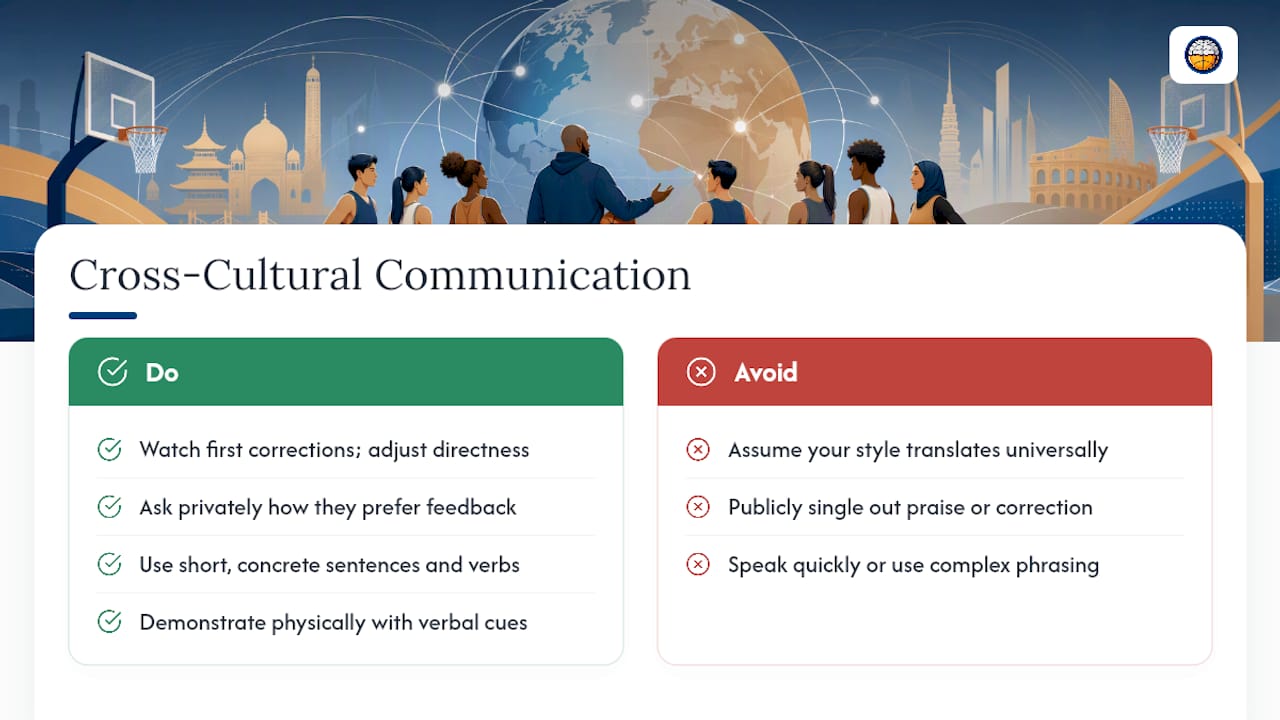
Directness norms vary widely. A blunt correction that a player raised in one cultural context takes in stride might read as disrespectful or overly harsh to a player raised in a context where feedback is typically delivered more indirectly, through suggestion rather than command. Watch how a player responds to your first few corrections and adjust your directness level based on that response, rather than assuming your default style translates universally.
Comfort with public praise or public correction also differs by background. Some players thrive on being singled out in front of the team; others find public attention, positive or negative, genuinely uncomfortable and process it better in a private one-on-one. Ask quietly, early in a relationship with a new player, whether they prefer feedback in front of the group or after practice.
Language fluency affects how instructions should be structured, independent of basketball IQ. Shorter sentences, concrete verbs, and physical demonstration alongside verbal cues help a player who is still building fluency in English process a correction as fast as a fluent teammate would. Slowing down your language is not talking down to a player. It is removing an unnecessary barrier between your instruction and their execution.
Author’s Take: What to Track Once You Start Changing How You Talk
Here’s a template worth adapting for your own notes: situation, script used, observable result. Write down what happened, what you actually said, and what changed in the next few possessions or the next few days. Do this for two weeks and patterns show up fast, which players respond to autonomy-supportive questions and which need more direct cues right now.
Skip the vague sense of “communication is going better.” Watch three specific things instead: whether players can restate their role without being reminded, whether the same technical error keeps repeating in a drill you’ve already corrected, and whether players are prompting each other on the floor without waiting for your voice. That third one is the real tell. When peers start coaching peers, your relational leadership work is paying off, not just your instructional feedback.
— Dejan
Get Your Scripts and Templates Ready to Use Tonight
Everything in this article works better with the actual language written down where you can grab it mid-practice, not reconstructed from memory in the middle of a drill. That gap can be closed with downloadable resources including editable practice agendas, pre-practice scripts, feedback templates, and rotating-leadership drill formats built around the KP-plus-autonomy approach covered above.
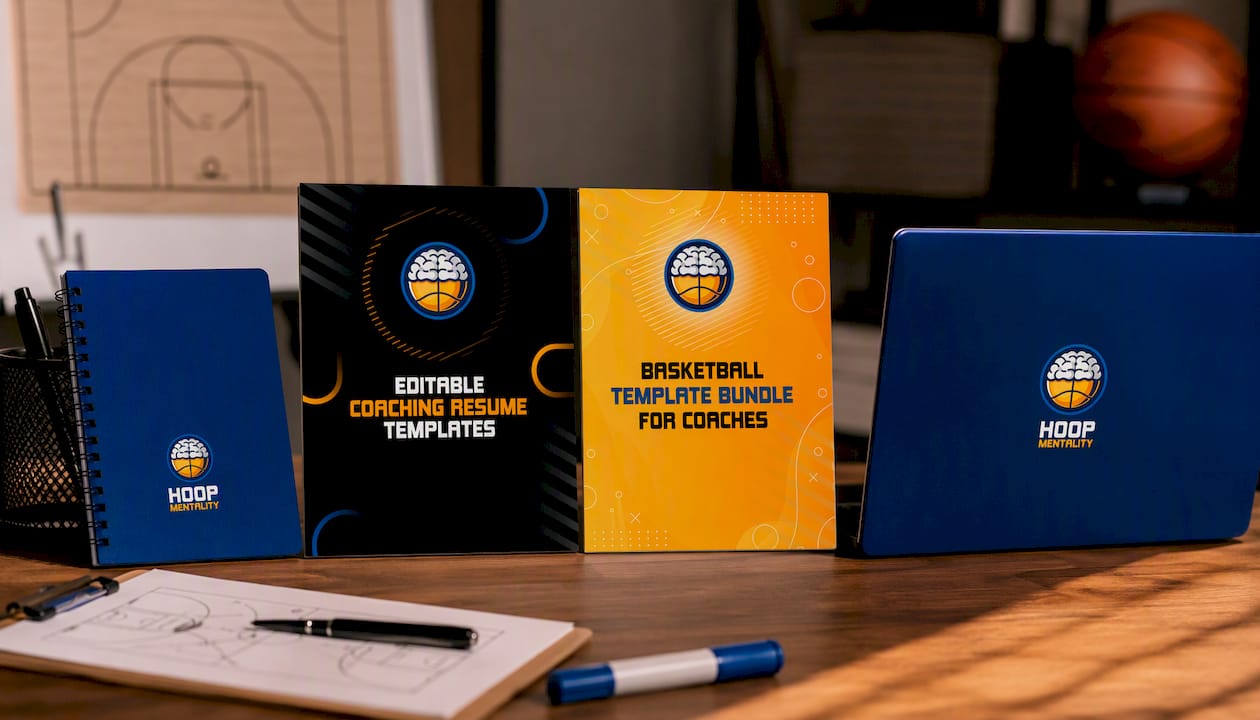
Basketball template bundles map directly onto the scripts and timing structures in this piece, so you can drop them into next week’s plan instead of writing them from scratch. For coaches updating professional materials for a staff opening or a head coaching role, editable basketball coaching resume templates are also available to present coaching philosophy and communication approach clearly in paper form. Both types are offered as instant downloads, ready to edit and use the same day of purchase.
Sources
- Sports Coaching Communication Skills: Feedback, Motivation, and Team Dynamics | Sports Coaching Authority
- FIBA coaching manual (level 3)
- Effective Basketball Player to Coach Communication | BasketballTrainer
FAQ
What Is the Difference Between KP and KR Feedback?
KP (knowledge of performance) tells a player what to fix in their movement, while KR (knowledge of results) tells them the outcome. KP typically produces more durable skill retention because it gives the athlete something specific to adjust.
How Often Should I Give Feedback During a Drill?
Correct on roughly half the repetitions rather than every single one once a player has grasped a skill. Constant correction can create dependency on the coach’s voice instead of the player’s own feel for the movement.
What Are Autonomy-Supportive Prompts?
They are questions that invite a player to observe and problem-solve, such as “what did you notice about your spacing?” instead of direct commands. This style connects to Self-Determination Theory and tends to build stronger intrinsic motivation than blunt instruction.
How Do I Rotate Leadership Without Undermining Veteran Players?
Give a younger player a specific, visible responsibility while explicitly naming the veteran as the backup or safety net, not the replacement. This keeps the veteran’s status intact while giving the newer leader real practice speaking up.
Where Can I Find Ready-Made Scripts and Templates for These Techniques?
Hoop Mentality’s Basketball Template Bundle For Coaches includes editable scripts, practice agendas, and feedback templates built around the frameworks covered in this article, available as an instant digital download.