

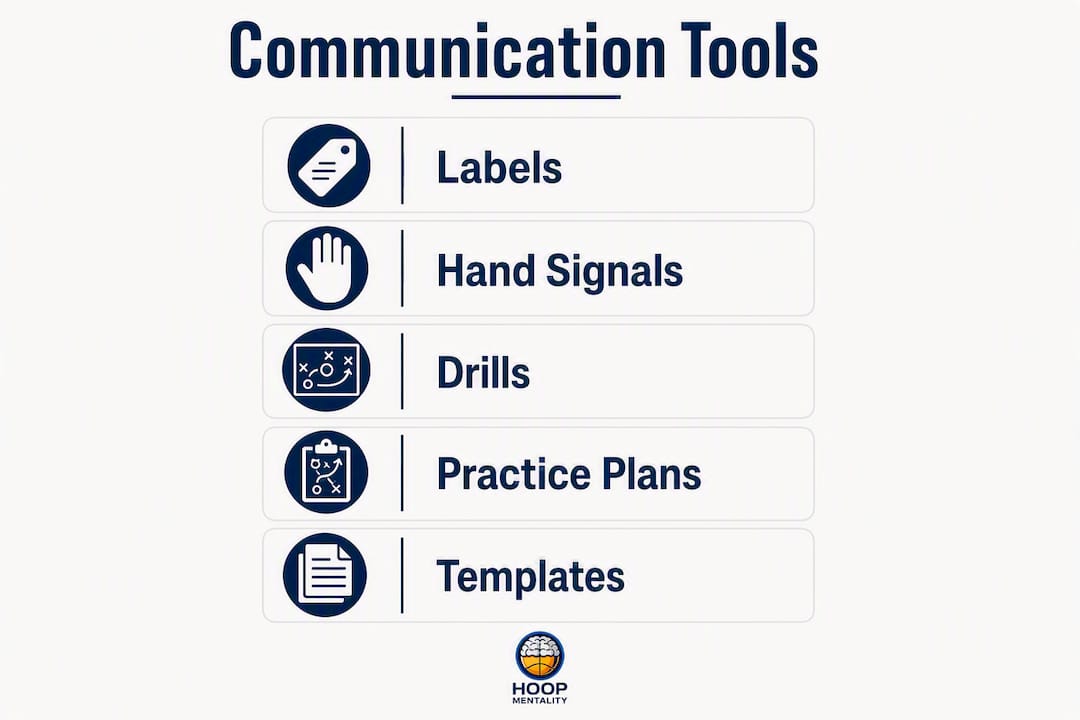
The best team communication tools for basketball coaches are a concise play-calling system, a compact label set, hand and visual signals, targeted communication drills, and ready-made practice plans and scouting templates. Together, these resources cut reaction time, reduce cognitive load, and give your players a shared language they can use under pressure.
Space equals time. A player who hears “corner!” knows exactly where to move. A player who hears “I’m open on the wing, come here” has already cost the possession. Concise labels buy time on every play — that is the entire case for building a communication system.
Your shortlist at a glance:
- Play-calling system — a short set of labels that cover your core offensive and defensive concepts
- Hand and visual signals — one-action signals that work when gym noise drowns out voice
- Communication drills — shell drill with verbal cues, silent scrimmage, blind-screen guidance, read-and-react passing
- Practice plan template — a timed 90-minute structure that places communication work in every block
- Meeting and scouting templates — pre-game scouting sheets and meeting agendas that align your staff before tip-off
Table of Contents
- What do “team communication tools” actually mean for basketball coaches?
- What are the core tools every coach needs on the court?
- Which drills build communication skills fastest?
- How do you design a play-calling system coaches can teach in one week?
- Which ready-made templates save the most prep time?
- How long does it take to embed a communication system?
- What mistakes do coaches make when introducing a new communication system?
- Key Takeaways
- The part most coaches skip
- Hoop Mentality has the resources ready to go
- Useful sources and downloads
- FAQ
What do “team communication tools” actually mean for basketball coaches?
In this context, the phrase has nothing to do with workplace messaging apps. The best team communication tools for basketball are coaching resources: play calls, label sets, hand signals, drills, practice plan templates, and scouting forms. They solve an on-court problem, not an office one.
The core principle behind all of them is space equals time. When a teammate receives a short, instructional label (“switch,” “corner,” “seal”), they react faster than when they receive a description of what someone else is doing. Instructional communication tells a player what to do. Narrational talk describes what the speaker is doing. The first reduces reaction time; the second wastes it.
Instructional vs. narrational talk: Labels like CAP, FLIP, and TWIST tell a teammate what action to take next. Descriptions like “I’m driving baseline” tell them what you are already doing — too late to help.
How to pick the right mix for your team:
- Varsity / advanced: — Full 10–15 label system, scouting templates, and a shared staff practice plan.
What are the core tools every coach needs on the court?
Play-calling system
A play-calling system is a short set of labels that name your offensive sets, defensive reads, and transition actions. Each label replaces a longer verbal instruction. The coaching outcome is reduced cognitive load: players stop processing and start moving. Best for high school varsity and up, though a trimmed version works at any level. Staff time to introduce: one 20-minute meeting plus daily reinforcement for five days.
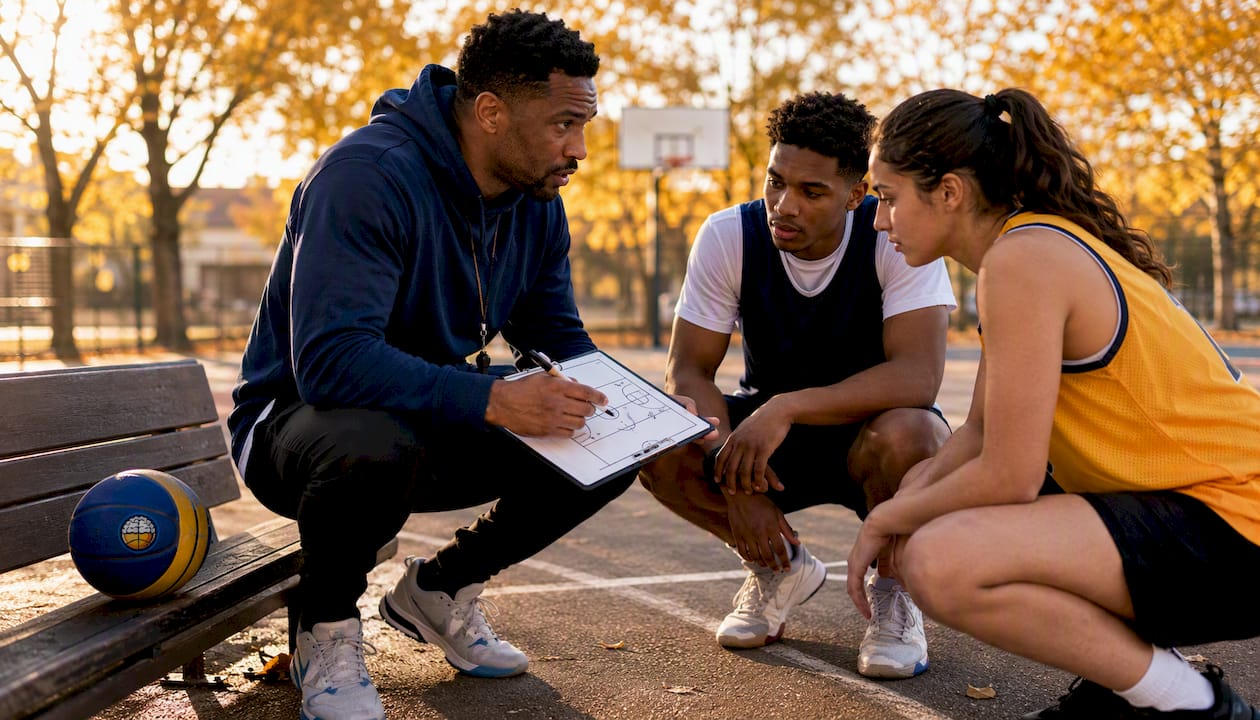
Compact label set
Labels work only when they are short and action-oriented. One-syllable labels like “take corner” or “send here” produce faster teammate responses than vague coverage terms. Design labels around what you want the receiver to do, not what the caller is doing.
Pro Tip: Write every label on a 3x5 card and read them aloud. If any label takes more than one breath to say at full sprint, cut it.
Hand and visual signals
Hand signals cover the moments when crowd noise makes voice communication impossible. One signal, one action. A closed fist for “set,” an open hand for “go,” a point for “corner.” Non-verbal drills like silent scrimmage and pass-and-look build the visual fluency players need to read signals in real game conditions.
Communication drills
Drills are where the language gets learned; for example, NextGen Coxing’s AI-powered coxswain training offers insights into advanced communication coaching techniques that can enhance these drills. Layering communication drills into existing practice blocks — warmup, skill stations, team concept, live play — is more effective than running them as stand-alone sessions.
Practice plan and meeting templates
Templates reduce staff prep time and standardize messaging across assistants and players. A shared practice plan means every coach on your staff knows the rotations, the timing, and the coaching points before anyone steps in the gym.
Which drills build communication skills fastest?
Four high-impact drills
- Shell drill with verbal cues — 4-on-4 half-court shell where defenders must call every screen, cut, and ball movement out loud. No call, play stops. Coaching point: volume and timing, not just accuracy. Progression: add a fifth offensive player.
- Blind-screen guidance — one player closes their eyes; a teammate guides them to a spot using only one-word labels. Builds trust in instructional talk. Progression: increase speed of movement.
- Read-and-react passing — 5-on-0 passing sequence where no pass is allowed unless the receiver calls their own name first. Adding verbal requirements to traditional drills normalizes talk without adding extra practice time.
- Silent-signal scrimmage — full 5-on-5 with voice communication banned for two-minute stretches. Players must use hand signals only. Tracks signal fluency and exposes gaps.
Sample 90-minute practice plan
| Time | Block | Focus | Communication task |
|---|---|---|---|
| — | Warmup | Dynamic stretch + ball handling | Pair players; each pair calls labels aloud |
| — | Skill work | Shooting stations | No pass unless name is called |
| — | Team concept | Shell drill | Verbal cues required on every screen |
| — | Live play | 5-on-5 scrimmage | Two silent-signal intervals (2 min each) |
| — | Review | Micro-debrief + post-huddle echo | Players repeat the key message back |
Track cue frequency and correct calls during the shell drill and scrimmage. Post-drill micro-debriefs and post-huddle echo verify comprehension before you move to the next block.
How do you design a play-calling system coaches can teach in one week?
Step-by-step checklist
- List the main offensive and defensive concepts your team runs most often.
- Assign a one-syllable label to each. Prioritize action words: “corner,” “seal,” “switch,” “push.”
- Pair each label with one hand signal. Test signals at arm’s length in a noisy gym.
- Write a one-page reference card. Give every player a copy on Day 1.
- Run the blind-screen guidance drill on Day 1 to introduce instructional talk.
- Add verbal requirements to one existing drill per day for Days 2–5.
- Run a silent-signal scrimmage on Day 5 as a verification check.
Example compact label set
Offense: Corner, Seal, Push, Flare, Dive, Reset
Defense: Switch, Drop, Tag, Deny, Help
Five-day implementation timeline
| Day | Goal | Verification task |
|---|---|---|
| 1 | Distribute reference cards; introduce labels | Players recite 3 labels correctly |
| 2 | Add verbal cues to warmup drill | Coach counts cue frequency |
| 3 | Shell drill with full verbal requirements | No silent possessions |
| 4 | Blind-screen guidance drill | Correct label used on every guide |
| 5 | Silent-signal scrimmage | Staff counts correct signal reads |
Which ready-made templates save the most prep time?
Hoop Mentality offers five products that cover every communication need from practice to game day.
| Product | What’s included | Best for |
|---|---|---|
| Basketball Starter Pack For Coaches | Play-calling templates, basic practice plans, quick-start drills | Coaches building a system from scratch |
| Basketball Template Bundle For Coaches | Editable practice plans, scouting sheets, meeting agendas | Staffs standardizing workflows |
| Basketball Shooting Bundle For Coaches | Shooting stations with communication cues and cueing guidelines | Adding verbal requirements to skill work |
| Editable Scouting Report Template | Customizable scouting form for sideline notes and opponent tendencies | Staff and volunteer coordinators |
| Basketball Scouting Report Template | Ready-to-use scouting form for timeout huddles and game planning | Quick pre-game staff alignment |
How to integrate them: Drop the practice plan template into your weekly schedule on Sunday. Use the scouting report the day before a game. Run the shooting bundle’s communication stations during your skill block. Shared staff views in practice plan templates eliminate the pre-practice scramble and keep assistants aligned on rotations and timing.
Free vs. paid: Free resources (blog posts, drill descriptions) cover the basics. A paid bundle pays off when you need editable, print-ready formats your whole staff can use without rebuilding from scratch each week.
How long does it take to embed a communication system?
| Phase | Duration | Staff time | What to track |
|---|---|---|---|
| Teach-in | 5–7 days | daily reinforcement for five days | Label recall, cue frequency |
| Habit formation | 4–6 weeks | 10 min/day | Correct calls in live play |
| Verification | Season checkpoints | 1 review/month | Silent scrimmage signal reads |
Cost ranges: free blog resources cover the teach-in phase. Paid bundles from Hoop Mentality run from low to mid-hundreds of dollars and deliver editable templates your staff can reuse every season. The ROI measure is simple: fewer miscommunications per game, faster rotations, and less pre-practice prep time for your staff.
Use assistant coaches to run the verbal-cue checks during skill stations. Brief pre-practice runs of two to three minutes on the label set keep the language fresh without cutting into drill time.
What mistakes do coaches make when introducing a new communication system?
- Too many labels at once. Cut to a reasonable maximum number of labels. Too many labels mean slower recall under pressure.
- Labels that are too long. Replace any two-syllable label with a one-syllable version.
- Practicing only in quiet conditions. Rotate vocal leaders during drills and huddles and add crowd noise (music, clapping) to simulate game conditions.
- Inconsistent enforcement. Stop play every time a label is missed. Consistency in the first week sets the standard for the season.
- Skipping non-verbal practice. Silent scrimmage is not optional. Hand signals fail in games if they are never practiced.
- No verification step. Run a post-huddle echo after every team concept block. Players repeat the key message back before returning to live play.
- Keeping the same vocal leaders. Quieter players disengage when the same two players call everything. Rotate the role.
- No post-practice check. Run a 60-second debrief: “How many correct calls did we hear? What label do we still miss?”
End every practice with one question: “Did every player use at least one label in live play today?” If the answer is no, that is your focus for tomorrow.
Key Takeaways
The most effective communication system for basketball coaches combines concise labels, hand signals, layered drills, and shared templates — all introduced in a structured five-to-seven-day teach-in and reinforced through the season.
| Point | Details |
|---|---|
| Start with labels | Build a 10–15 label set using one-syllable, action-oriented words before adding signals. |
| Layer drills daily | Place communication drills inside existing blocks — warmup, skill work, live play — not as stand-alone sessions. |
| Use a timed practice plan | A timed template keeps communication work in every block and ends practice on time. |
| Verify with echo | Run a post-huddle echo after every team concept block to confirm players absorbed the key message. |
| Hoop Mentality resources | The Basketball Starter Pack For Coaches delivers play-calling templates, practice plans, and drills in one ready-to-use package. |
The part most coaches skip
Most coaches spend the first week teaching labels and then move on. The real work starts in weeks two through six, when the language has to survive game speed, crowd noise, and fatigue. That is where coaches who only taught the system lose it. The ones who keep it are running silent scrimmages, rotating vocal leaders, and stopping live play every time a label gets dropped.
The other thing worth saying: templates are not a shortcut to avoid thinking. They are a way to stop rebuilding the same document every Sunday night. A shared practice plan that your assistants can open before they walk in the gym is not a luxury. It is the difference between a staff that is aligned and one that is improvising.
Build the language. Practice it under pressure. Give your staff the same plan you are running.
Hoop Mentality has the resources ready to go
Coaches who want a plug-and-play communication system without building every piece from scratch can start with the Basketball Starter Pack For Coaches. It includes play-calling templates, practice plans, and quick-start drills — everything you need to run the five-day teach-in described above.
For staffs that need the full workflow, the Basketball Template Bundle For Coaches adds editable scouting sheets and meeting agendas. If your priority is skill work with built-in communication cues, the Basketball Shooting Bundle covers that block. New to building a system? Start with the Starter Pack. Running a full program with multiple assistants? The Template Bundle is the right call. Browse all resources at Hoop Mentality and pick up the pack that fits your team’s level and schedule.
Useful sources and downloads
- Basketball communication methods: enhance team dynamics — practical techniques for integrating labels and signals into regular practice.
- Team Communication Tips for Basketball Coaches — drill modifiers to increase vocalization; apply directly to your skill block.
- The Role of Communication Drills in Basketball Coaching — timed practice plan structure and drill placement guide.
- 7 Effective Communication Strategies Basketball Coaches Use — rotating vocal leaders and huddle role assignments.
- Basketball Starter Pack For Coaches — download the starter pack to get play-calling templates and practice plans immediately.
- Basketball Template Bundle For Coaches — full editable template set for staffs standardizing their weekly workflow.
FAQ
What are the best team communication tools for basketball?
The five core tools are a play-calling system (10–15 labels), a hand-signal set, communication drills, a timed practice plan template, and scouting and meeting templates. Together they cover on-court and off-court communication needs.
How long does it take to teach a new play-calling system?
A five-to-seven-day teach-in covers label introduction and basic signal fluency. Full habit formation takes four to six weeks of daily reinforcement in practice.
What is the difference between instructional and narrational communication?
Instructional talk tells a teammate what to do (“switch,” “corner”). Narrational talk describes what the speaker is doing. Instructional labels reduce reaction time; narrational talk does not.
Which Hoop Mentality product should a new coach buy first?
The Basketball Starter Pack For Coaches is the right starting point. It includes play-calling templates, practice plans, and quick-start drills in one package.
Do hand signals replace verbal calls in basketball?
No. Hand signals complement verbal calls, especially when crowd noise makes voice communication unreliable. Both systems should be practiced together, including through silent scrimmage drills.