

TL;DR:
- Effective coaching leadership relies on deliberate behaviors like active listening, emotional intelligence, and consistent goal-setting to develop players and build trust. Structured models such as GROW and regular check-ins foster growth, psychological safety, and accountability throughout the season. Successful NBA examples demonstrate that relationship building and adaptability are essential for inspiring player ownership and high performance.
Coaching leadership traits are the specific behaviors and skills basketball coaches use to develop players, build trust, and drive team performance. These are not personality types or vague qualities. They are practiced, repeatable behaviors: active listening, emotional intelligence, goal setting, adaptability, and consistent follow-through. The coaches who develop these traits deliberately, from youth programs to the NBA, create environments where players grow faster, compete harder, and take ownership of their development.
1. Active listening and powerful questioning
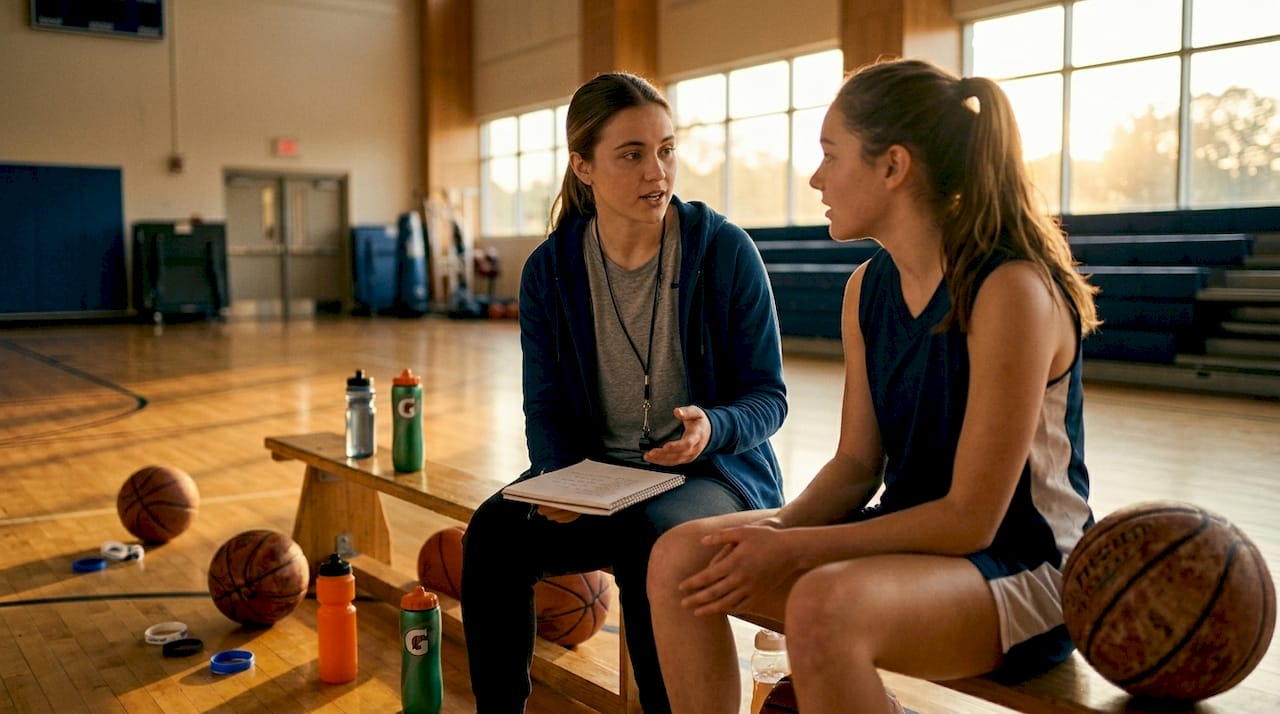
Active listening is the foundation of every effective coaching leadership trait. It means giving a player your full attention, processing what they say, and responding to the meaning behind their words, not just the surface content. Active listening and powerful questioning are listed among the 12 foundational coaching skills for effective leadership. That matters because players who feel heard are more likely to commit to the goals you set together.
Powerful questioning goes hand in hand with listening. Instead of telling a player what went wrong, you ask: “What did you see on that play?” or “What would you do differently?” This shifts ownership to the player and builds problem-solving habits that carry into games when you are not on the floor with them.
Pro Tip: Replace one piece of direct feedback per practice with a question. Over a season, this habit builds players who self-correct without waiting for instruction.
2. Emotional intelligence and relationship building
Emotional intelligence is the ability to recognize your own emotional state and read the emotional state of your players accurately. Coaches with high emotional intelligence know when a player needs a direct conversation and when they need space. This skill is what separates coaches who get compliance from coaches who get commitment.
Relationship building is the practical output of emotional intelligence. J.B. Bickerstaff’s approach with the Detroit Pistons demonstrates this clearly. His willingness to switch between coach, mentor, and listener created psychological safety that allowed players to discuss personal matters beyond basketball. The result was a team turnaround built on trust, not just tactics.
3. Building trust and psychological safety
Trust is not built through speeches. It is built through consistent behavior over time. Players need to know that their coach will be honest, fair, and predictable. When that trust exists, players take risks, admit mistakes, and ask for help. When it does not, they hide problems until those problems become crises.
Psychological safety is the team-level version of trust. It means players feel safe to speak up, disagree, and make mistakes without fear of humiliation or punishment. NBA coaching leadership at its best blends emotional intelligence, role flexibility, and relationship building to create exactly this kind of environment. For basketball coaches at any level, the practical step is simple: respond to mistakes with questions, not punishment.
4. Goal setting and alignment
Goal setting in coaching is not about writing down season targets. It is about creating shared clarity between coach and player on what development looks like, what success means, and what the next step is. Without that alignment, players work hard in the wrong direction and coaches get frustrated by gaps they never clearly defined.
Effective coaching leadership is more about facilitating problem-solving and ownership than giving direct advice. When players help set their own goals, they invest in achieving them. A coach’s job is to structure that conversation, not dominate it. This is where leadership development in basketball becomes a daily practice rather than an end-of-season review.
5. Adaptability in coaching style
No two players respond to the same approach. A high-confidence player who needs challenge will disengage if you only offer support. A player working through a confidence dip will shut down if you push too hard. Adaptability means reading each player accurately and adjusting your style to fit their current needs, not your preferred default.
This is one of the most demanding coaching leadership traits to develop because it requires self-awareness as much as player awareness. Coaches who default to one style, whether that is authoritative, supportive, or analytical, will consistently lose certain players. The GROW model directly supports adaptability by giving coaches a flexible structure that shifts from teaching to facilitating based on where the player is in their development.
6. How the GROW model structures coaching conversations
The GROW model stands for Goal, Reality, Options, and Will. It is a structured framework that guides a coaching conversation from defining what the player wants to achieve, through an honest assessment of where they are now, into exploring possible paths forward, and finally to a specific commitment to action.
- Goal: What does the player want to achieve in this conversation or this season?
- Reality: What is actually happening right now? What obstacles exist?
- Options: What are the possible ways forward? What has the player not yet tried?
- Will: What specific action will the player commit to, and by when?
GROW sessions can be conducted in 20 to 30 minutes, making the framework practical for busy in-season schedules. That efficiency matters because coaches who lack a repeatable structure tend to default to reactive conversations after mistakes rather than proactive development sessions.
A meta-analysis of 22 empirical studies found the GROW model has a moderate effectiveness with an effect size of 0.43 in competency development across contexts. An effect size of 0.43 is meaningful in applied settings, indicating consistent, real-world improvement in the skills coaches are trying to build.
“Coaching leadership requires moving beyond being merely supportive to structuring conversations so players identify goals and commit to actions.” — Google Re:Work
7. NBA examples that illustrate coaching leadership traits in action
The NBA provides some of the clearest real-world evidence of coaching leadership traits at work under pressure.
- J.B. Bickerstaff and the Detroit Pistons: Bickerstaff’s role flexibility, moving between coach, mentor, and listener depending on what a player needed, created the psychological safety that drove the Pistons’ turnaround. His emotional intelligence was not a soft add-on. It was the mechanism that made his tactical decisions stick.
- Joe Mazzulla and the Boston Celtics: Mazzulla’s coaching style balances directness with humility. He offers players autonomy with clear accountability, and he builds trust through one-on-one outreach during leadership transitions. His approach proves that empowering players does not mean removing standards.
- The accountability principle: Effective coaching leadership engages players with empowerment balanced by clear expectations. Without that balance, empowerment feels like neglect. With it, players perform at a higher level because they understand both their freedom and their responsibility.
These examples translate directly to youth and college basketball. The scale differs. The principles do not. You can read more about applying these key leadership skills at every level of the game.
8. Practices that sustain coaching leadership traits over a full season
The biggest risk for any coach is treating leadership development as a one-time event rather than a recurring habit. Coaching as a habit with scheduled check-ins, accountability, and feedback leads to better performance than reactive, occasional coaching. This is not a minor distinction. It is the difference between players who grow steadily and players who plateau.
Here are the practices that keep coaching leadership traits active across a full season:
- Scheduled one-on-ones: Set a recurring time with each player, even 10 minutes every two weeks. Consistency signals that development is a priority, not an afterthought.
- Accountability follow-ups: After every GROW conversation, follow up on the commitment the player made. This closes the loop and reinforces that commitments matter.
- Self-reflection prompts: Ask players to assess their own performance before you give your assessment. This builds the self-awareness that makes feedback land harder and stick longer.
- Feedback balance: Pair direct, specific feedback with questions that invite the player’s perspective. Direct feedback without dialogue creates dependency. Questions without direction create confusion.
Pro Tip: Keep a simple log of each player’s GROW commitments. Review it before your next one-on-one. Players notice when you remember what they said they would do.
| Reactive coaching | Proactive coaching |
|---|---|
| Happens after mistakes | Scheduled regardless of performance |
| Focuses on what went wrong | Focuses on what the player wants to develop |
| Coach-driven agenda | Player-driven agenda with coach structure |
| Inconsistent timing | Regular cadence throughout the season |
The coaching feedback strategies that work long-term are the ones built into your practice routine, not pulled out in crisis moments.
Key takeaways
Effective coaching leadership traits are built through consistent, structured behaviors, not natural talent or personality, and the coaches who practice them deliberately produce better players and stronger teams.
| Point | Details |
|---|---|
| Active listening drives ownership | Players who feel heard commit more fully to shared goals and self-correct faster. |
| GROW model structures development | Use Goal, Reality, Options, Will in 20-30 minute sessions to turn vague goals into specific commitments. |
| Psychological safety enables growth | Trust built through consistent, fair behavior allows players to take risks and admit mistakes. |
| Adaptability is non-negotiable | Adjust your coaching style to each player’s current needs, not your default preference. |
| Coaching must be a habit | Scheduled check-ins and accountability follow-ups outperform reactive, mistake-driven coaching every time. |
What I’ve learned about coaching leadership that most guides skip
Most articles on coaching leadership traits list the skills and stop there. What they miss is the sequencing problem. You cannot build accountability before you build trust. You cannot ask powerful questions if the player does not believe you are genuinely listening. The traits are not a checklist. They are a sequence, and skipping steps is why so many coaches feel like their leadership efforts are not landing.
The second thing I have seen coaches consistently get wrong is only coaching after mistakes. It feels natural because that is when the need is most visible. But players start to associate one-on-one conversations with something going wrong. Over time, they dread those conversations instead of valuing them. Scheduling regular check-ins, even brief ones, reframes the relationship entirely.
The third insight is about empowerment. Giving players autonomy without defining the standards attached to that autonomy does not feel like trust to the player. It feels like being left alone. Joe Mazzulla’s approach with the Celtics works because the autonomy is concrete and the accountability is explicit. Both sides of that equation have to be present, or the whole thing falls apart.
The coaches I respect most are the ones who can sit with a player in silence after a tough loss, ask one question, and then actually listen to the answer. That is not a soft skill. That is the hardest skill in the building.
— Dejan
Build your coaching system with Hoopmentality
Strong coaching leadership traits need practical tools to back them up. Hoopmentality provides resources built from real coaching experience to help you put these principles into structured practice.
The Big Man Dual Action Drill develops player skill in a format that reinforces decision-making and accountability on the floor. Pair it with the Basketball Practice Plan Template to build sessions where leadership development is built into the structure, not added as an afterthought. Both resources are designed to save you time and give your players a clear, repeatable system to grow within.
FAQ
What are the most important coaching leadership traits?
Active listening, emotional intelligence, trust building, goal setting, and adaptability are the core coaching leadership traits identified across expert sources including Slack’s coaching skills guide. These behaviors, practiced consistently, produce stronger player development and team performance.
How does the GROW model help basketball coaches?
The GROW model gives coaches a repeatable structure for development conversations, moving from goal setting through honest reality assessment to specific commitments. Sessions run in 20 to 30 minutes and are effective enough for in-season use.
How do NBA coaches demonstrate effective leadership traits?
J.B. Bickerstaff builds psychological safety by switching between coach, mentor, and listener roles. Joe Mazzulla pairs player autonomy with clear accountability. Both approaches show that elite coaching leadership combines relationship building with defined standards.
How often should coaches hold one-on-one development sessions?
Scheduled check-ins every one to two weeks per player outperform reactive coaching that only happens after poor performances. Consistency is what builds the trust and habit that makes development conversations effective.
Can coaching leadership traits be developed, or are they innate?
Coaching leadership traits are learned behaviors, not fixed personality traits. Frameworks like GROW, deliberate practice of active listening, and consistent feedback habits all build these skills over time regardless of a coach’s natural style.