

A coaching philosophy is a defined set of values, beliefs, and principles that guides how a coach makes decisions, treats athletes, and defines success. It works as a filter, not a slogan: every rotation, timeout, and hard conversation runs through it. Coaches who write one down make faster, more consistent calls and build more trust with players and parents. The rest of this guide breaks down the parts, shows real examples, and gives you a process to draft your own this week.
TL;DR:
- A coaching philosophy must include specific core values, beliefs about learning, a clear mission, ranked objectives, and observable behaviors to be practical.
- Writing the philosophy before the season and testing it during practice ensures it guides decisions consistently and aligns with professional standards.
- Avoid conflating philosophy with tactics or copying others’ statements; instead, focus on framing guiding principles that directly influence behavior and responses.
- The philosophy should be an evolving, testable framework, not a static document, and it needs to manifest in daily practice plans and decision-making processes.
- A well-crafted philosophy provides clarity during high-pressure situations, helping coaches make consistent decisions aligned with their stated priorities.
Table of Contents
- Coaching Philosophy Meaning: What It Includes and What It Isn’t
- Why a Coaching Philosophy Matters More Than a Playbook
- The Core Components Every Coaching Philosophy Statement Needs
- Coaching Philosophy Examples You Can Adapt Today
- How to Create Your Own Coaching Philosophy in a Week
- Common Mistakes Coaches Make With Their Philosophy
- What Research and Coaching Bodies Actually Say About Coaching Philosophy
- My Take: A Philosophy Only Matters When It Changes a Real Decision
- Turn Your Philosophy Into a Practice Plan This Week
- Sources
- FAQ
Coaching Philosophy Meaning: What It Includes and What It Isn’t
A coaching philosophy is defined in peer-reviewed research as “a comprehensive, intentional framework of values, beliefs, and principles” that shapes a coach’s decisions, interactions, and objectives, according to research published in the Japanese Journal of Physical Education, Health and Sport Sciences. That framework has five working parts.
- Values. What you refuse to compromise on, win or lose. Effort, honesty, respect.
- Beliefs. Your assumptions about how people improve and what motivates them.
- Mission. The purpose of your program in one or two sentences.
- Objectives. What you’re actually prioritizing this season, ranked.
- Pedagogy. How you teach. Discovery-based reps or direct instruction, and when you use each.
Coaching philosophy is not the same as coaching style or tactics. Style is your personality on the sideline, animated or calm, vocal or quiet. Tactics are your answers to a 2-3 zone or a late-game inbounds play. Both change constantly. Philosophy doesn’t. Coach-education guidance from England Football Learning draws this line clearly: tactics answer “how,” philosophy answers “why,” and confusing the two is the most common mistake new coaches make. A philosophy is the reason you bench a starter for missing curfew even in a championship game. The tactic is just what defense you run afterward.
Why a Coaching Philosophy Matters More Than a Playbook
A written philosophy changes behavior before it changes anything on paper. Coaches without one tend to make decisions reactively, based on mood, score, or who’s watching. Coaches with a documented philosophy tend to make the same call in September that they make in March, whether the team is 12-0 or 0-12.
That consistency does three concrete things:
- It makes your communication with parents and athletes predictable, so nobody is blindsided by a benching or a role change.
- It gives you a defensible answer when a decision gets questioned, because the reasoning existed before the situation did.
- It aligns your coaching with professional standards of care rather than personal impulse.
Pro Tip: Write your philosophy down before the season, not after a controversial decision. A philosophy invented to justify a choice you already made isn’t a philosophy. It’s a rationalization.
Professional coaching bodies treat this seriously. The International Coaching Federation’s Code of Ethics frames a defined philosophy as part of maintaining a consistent standard of care for the people a coach works with, not an optional add-on for coaches who like journaling. That standard applies whether you’re coaching a U12 rec team or a Division I roster. The stakes differ. The obligation to be consistent does not.
The Core Components Every Coaching Philosophy Statement Needs
A usable coaching philosophy statement names five things explicitly. Vague language (“I want kids to have fun and get better”) fails the test because it gives you no actual guidance when fun and improvement conflict, which they eventually will.
- Core values, named specifically. Not “hard work.” Instead: “Players who dive for loose balls play, regardless of talent gap.” Specific values are testable. Generic ones aren’t.
- Beliefs about learning and capability. State plainly whether you believe skill develops mostly through repetition, through game-speed decision-making, or through a mix, and at what age you shift the balance.
- A mission statement in one sentence. What is this program actually for? Developing varsity-ready players, building lifelong habits, or winning a league title this year? Pick one primary answer.
- Ranked objectives. Development and performance both matter, but when they collide, say now which one wins.
- Daily behaviors and boundaries. The concrete, observable actions that prove the philosophy is real: how you run water breaks, how you handle a blown call, what gets a player benched.
Pro Tip: Test each value with one question: “Would I still hold this line if we were losing by twenty?” If the honest answer is no, it’s a preference, not a value.
A team-identity framework built around philosophy can help you see how these five pieces connect to what shows up on the floor, from substitution patterns to how timeouts get used.
Coaching Philosophy Examples You Can Adapt Today
Concrete language beats abstract language every time a philosophy actually gets used under pressure. Below are four short examples that show different priorities, followed by a template you can fill in this week.
| Coaching context | Sample philosophy statement (condensed) |
|---|---|
| Sport-agnostic, values-first | “We compete with respect for the game and each other. Talent earns opportunity; character earns trust.” |
| Youth development | “Every player gets meaningful minutes and skill reps. Wins matter less than habits that last past this season.” |
| Performance-focused | “We chase wins through preparation and discipline, never at the cost of a player’s dignity or safety.” |
| Executive or life coaching | “The client sets the destination. I provide structure, honest feedback, and accountability to get there.” |
Each of these works because it names a trade-off, not just an aspiration. “Talent earns opportunity, character earns trust” tells you exactly what to do when your best scorer skips a study hall session.
A minimal template needs four prompts: Values (three, max), Mission (one sentence), Pedagogy (how you teach, one paragraph), and Behaviors (three things you always do, three you never do). A short template like this moves coaches from abstract values to real commitments far faster than a long essay does. For sport-specific starting points, sample statements built for basketball programs give you actual language to edit rather than a blank page.

How to Create Your Own Coaching Philosophy in a Week
Developing a coaching philosophy statement follows a sequence that coach-education literature backs consistently: understand yourself first, then prioritize, then write, then test. Human Kinetics’ framework outlines this as a five-step process, and it holds up whether you’re coaching your first season or your fifteenth.
- Reflect before you write. List the three coaches or mentors who shaped how you think about competition. What did they do that you want to repeat? What do you want to do differently? This surfaces values you didn’t know you were carrying.
- Turn values into behaviors. For each value, write one specific action it produces in practice or a game. “Respect” is useless until it becomes “no player talks over a teammate during film review.”
- Rank your objectives. Development, fundamentals, winning, culture. Put them in order for this specific team and season. The order can change next year. It cannot be undefined this year.
- Draft a one-page statement and test it in a single practice. Pick one value, design one drill and one communication script around it, then run the session and watch what happens.
- Collect feedback and revise. Ask an assistant coach or a veteran player whether what you said matched what they saw. Adjust the language, not the value, unless the value itself was wrong.
Pro Tip: Share your written philosophy with players and parents at the start of the season, out loud or on paper. A philosophy nobody has heard functions as private opinion, not a program standard, and it won’t hold up the first time you have to enforce it.
This process pairs well with a leadership-traits framework for basketball coaches, since the behaviors you commit to in step two usually trace back to specific leadership habits worth naming individually.
Common Mistakes Coaches Make With Their Philosophy
Most coaching philosophies fail for the same handful of reasons, and every one is fixable.
- Treating philosophy as a tactical playbook. A philosophy that lists zone defenses and out-of-bounds plays isn’t a philosophy. It’s a scouting report wearing a costume.
- Copying someone else’s statement word for word. A philosophy borrowed from a famous coach you admire will collapse the first time it conflicts with your actual values, because it was never yours.
- Writing it once and never using it. A philosophy that sits in a drawer isn’t tested against real decisions, which means you don’t actually know if it works.
- Ignoring the context you coach in. A philosophy written for a well-funded travel program doesn’t automatically transfer to an under-resourced rec league, and pretending it does creates friction with players and parents.
A guide focused on building winning teams around a stated philosophy is useful here specifically because it shows philosophy adapting to context rather than existing as a fixed script.
What Research and Coaching Bodies Actually Say About Coaching Philosophy
Not everyone agrees that “coaching philosophy” is a clean, settled concept. A 2025 critical review argues the term can be ambiguous in practice, sometimes functioning less as a genuine guide to behavior and more as a kind of professional badge, language coaches recite to sound credible rather than principles that actually shape decisions, according to a peer-reviewed critique published in 2025. The researchers recommend coaches ask reflexive, context-specific questions rather than adopt generic statements wholesale.
A philosophy only earns the name when it survives contact with a real decision under pressure. Language that changes nothing about how a coach actually acts is rhetoric, not philosophy.
That critique doesn’t undercut the value of writing one. It sharpens the standard. England Football Learning’s coach-education guidance treats philosophy as an evolving framework, tested and revised each season, not a static document you write once at age 24 and never touch again. Templates exist to close the gap between that academic caution and daily practice: structured prompts that force specificity instead of slogans, built from real coaching sessions rather than theory alone.
My Take: A Philosophy Only Matters When It Changes a Real Decision
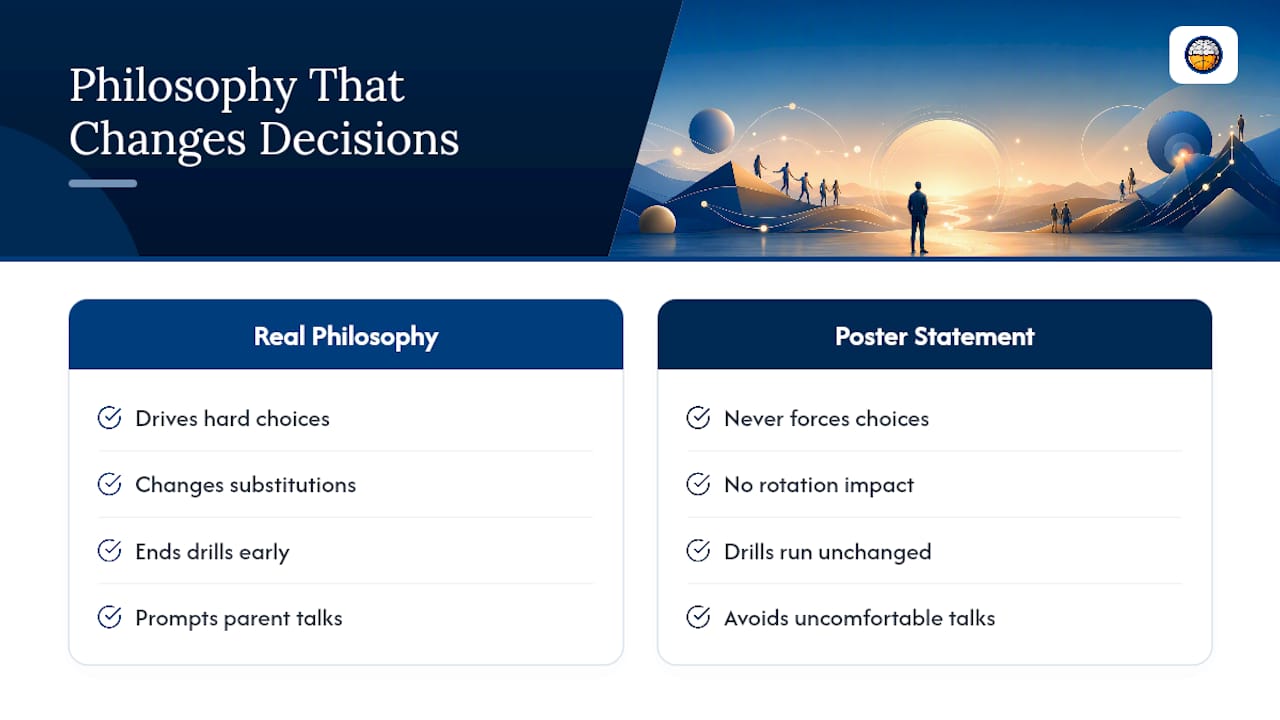
The test of a coaching philosophy isn’t how it reads. It’s what it costs you. If your stated values never once made you bench a talented player, cut a drill short, or have an uncomfortable conversation with a parent, you haven’t written a philosophy. You’ve written a mission statement for a poster.
Basketball rewards this kind of clarity because the game moves too fast for improvisation to hold up under pressure. A documented set of priorities, shared with players before the season starts, removes the guesswork from substitution patterns and end-of-game rotations. Templates don’t replace that thinking. They just remove the blank-page problem so coaches spend their time on the decisions that matter instead of on formatting a document.
— Dejan
Turn Your Philosophy Into a Practice Plan This Week
A written philosophy is only half the job. It needs to show up in your practice plans, your scouting reports, and your defensive rotations, or it stays theoretical. A Basketball Template Bundle For Coaches includes editable practice plans, scouting templates, and communication tools designed to reflect various coaching values and objectives.

If your philosophy leans on discipline and structure on the defensive end, an Essential Defensive Bundle For Coaches offers progressive drills and session plans intended to align daily coaching behaviors with stated coaching priorities. Both bundles are ready-to-use PDFs you can adapt today, not blank templates that leave you starting from zero. Pick the bundle that matches what you ranked highest in step three, download it, and build your next practice plan around it tonight.
Sources
- What is a coaching philosophy? (peer-reviewed article)
- Coaching philosophy: critical review (2025 DOI)
- How to develop your coaching philosophy — England Football Learning
- ICF Code of Ethics (PDF)
FAQ
How Do I Write My Coaching Philosophy?
Start by listing three values you won’t compromise on, then write one sentence for each describing the specific behavior it requires, followed by a one-line mission statement and your top three objectives ranked in order.
What Are the Three Coaching Philosophies?
Definitions vary across sources, but three commonly discussed orientations are athlete-centered (development and autonomy first), coach-centered (structure and direct instruction first), and performance-centered (results and competitive outcomes first). Most effective coaches blend elements of all three depending on context.
Is a Coaching Philosophy the Same as a Coaching Style?
No. Philosophy is your stable set of values and priorities; style is how your personality expresses itself day to day, and it can shift season to season while the philosophy underneath stays constant.
How Long Should a Coaching Philosophy Statement Be?
One page is enough. A concise statement with named values, a one-sentence mission, and a short list of behaviors gets used far more than a long essay that nobody rereads before game day.
Can a Coaching Philosophy Change Over Time?
Yes, and it should. Coach-education guidance treats a philosophy as an evolving framework that gets tested each season and revised based on what actually worked with real players in real practices.