

TL;DR:
- Blitzing the pick and roll involves trapping the ball handler immediately to create chaos and force mistakes.
- It requires precise rotations, communication, and scouting to avoid exposing open shots or easy scores.
Your defense works hard. Your players communicate. You rotate on time. But the opposing point guard runs a pick and roll on every possession and still gets exactly what he wants. Sound familiar? Many coaches face this exact problem and start wondering if aggressive blitz coverage could be the answer. Blitzing the pick and roll is both one of the most disruptive schemes in basketball and one of the easiest to exploit. This guide breaks down the mechanics, timing, rotations, and drills you need to make it work.
Table of Contents
- What is blitzing the pick and roll?
- Why and when do coaches choose to blitz?
- The backbone: Rotations and communication in blitz defense
- Common counters and how to measure the blitz’s impact
- Training and drills for reliable blitz execution
- Editorial perspective: The uncomfortable truth about blitzing the pick and roll
- Take your pick and roll defense further with advanced resources
- Frequently asked questions
Key Takeaways
| Point | Details |
|---|---|
| Blitz disrupts the ball-handler | Blitzing the pick and roll forces offensive mistakes by applying aggressive pressure and disrupting the handler’s decision-making. |
| Rotations are critical | The success of blitz defense depends on fast, accurate rotations and clear communication among all defenders. |
| Beware of counters | Smart offenses can exploit the blitz with short-roll passes, slips, or screen rejections if your rotations break down. |
| Track outcomes with PPP | Use short-roll points per possession as the best metric to measure if your blitz is working. |
| Drill to build execution | Consistent practice with live scramble and communication training is essential for making blitz defense reliable. |
What is blitzing the pick and roll?
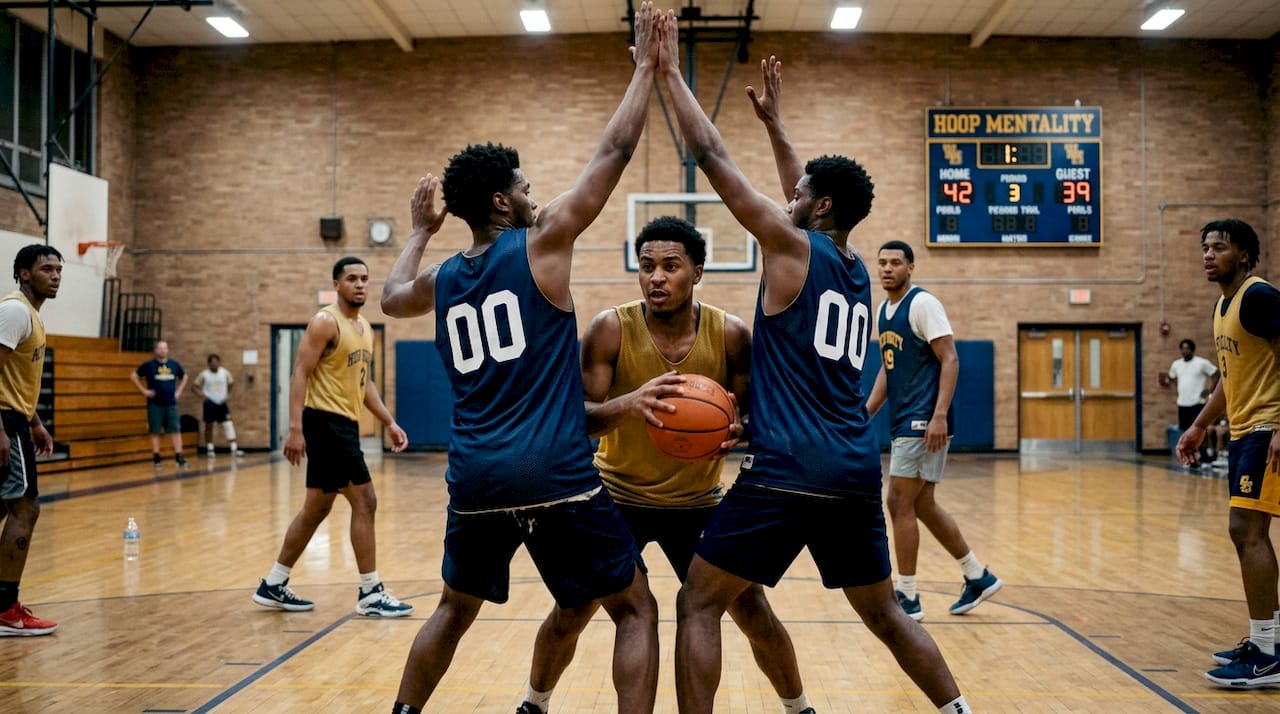
The blitz is a specific pick and roll defensive coverage. It means both defenders immediately trap the ball handler the moment he uses the screen. The on-ball defender fights over the screen. The screen defender (usually your big) steps up hard and meets the ball handler on the other side. Together, they create a two-man wall.
This is different from every other common coverage. Understanding pick and roll basics helps clarify the contrast. Here is a quick breakdown:
| Coverage | On-ball defender | Screen defender | Goal |
|---|---|---|---|
| Drop | Goes over/under screen | Drops back into paint | Protect the rim |
| Hedge | Goes over screen | Hard show, then recovers | Slow ball handler |
| Switch | Switches man | Switches man | Eliminate angles |
| Blitz | Traps ball handler | Also traps ball handler | Force a bad pass |
The key difference with blitz is that both defenders commit to the ball. As noted in a complete coverage breakdown, teams blitz because it forces high-pressure, low-time decisions, aiming to make the ball handler throw a bad pass or deviate into predictable reads. That is the goal. Create chaos. Force a mistake before the offense can react.
Blitzing creates several instant advantages:
- The ball handler has almost no time or space to make decisions
- Turnovers and five-second calls become real threats
- The offense must execute quickly under physical pressure
- Rhythm is disrupted, especially early in possessions
But committing two defenders to one spot leaves three other defenders to cover four offensive players. That math matters. It means the blitz only works when the rest of your defense executes perfectly behind it. Consider also the Spain pick and roll variations that offenses use specifically to attack aggressive defensive coverages.
Why and when do coaches choose to blitz?
Choosing to blitz is a tactical decision, not a default setting. It is a high-risk, high-reward approach where both defenders converge aggressively on the ball handler to force a turnover or bad pass. That framing matters. High-risk, high-reward means you must have a reason to accept the risk.
Here are the most common situations where blitz becomes the right call:
- Facing an elite pick and roll guard. When the opponent’s best player is a pull-up shooter who punishes every drop or hedge, blitzing takes the ball out of his hands before he can act.
- The roller is a non-shooter. If the offensive big man cannot knock down jumpers from the short-roll area, the defense can cheat toward him with less fear of open threes.
- Poor passing team. Blitz forces the ball handler to make a quick decision. If the opponent struggles to make accurate reads under pressure, that becomes a direct weapon.
- Momentum shifts. A well-timed blitz trap mid-game can disrupt a team’s offensive rhythm and swing the energy of a close game.
- Tactical surprise. Using blitz occasionally keeps the offense guessing, even if you do not plan to run it every possession.
Blitz usage is often chosen to attack specific offensive strengths, such as stopping a star guard who feeds pull-up jumpers, but it can be exploited when opponents slip screens or beat the blitz with reject-drives. This means timing and scouting are everything.
One useful measurement is Short-Roll Points Per Possession (PPP). When your blitz works, the roller catches in a compromised position and your rotations limit his options. Track how many points the opponent scores when the roller catches in the short-roll area. A high PPP there signals your blitz rotations are breaking down. A low PPP confirms your scheme is winning that battle.
Pro Tip: Before running blitz as a primary coverage, review game film on your next opponent’s pick and roll tendencies. Note their passing speed, their roller’s shooting range, and how quickly they make decisions under pressure. That scouting work tells you if blitz is a weapon or a liability against this specific team.
Use defensive adjustment tips to build a process for making these decisions systematically before each game, not in the middle of the action.
The backbone: Rotations and communication in blitz defense
Here is the uncomfortable part. Most blitz failures have nothing to do with the trap itself. They happen behind the trap. When two defenders collapse on the ball handler, three defenders must rotate to cover four offensive players. That math problem only has one solution: predetermined assignments and fast communication.
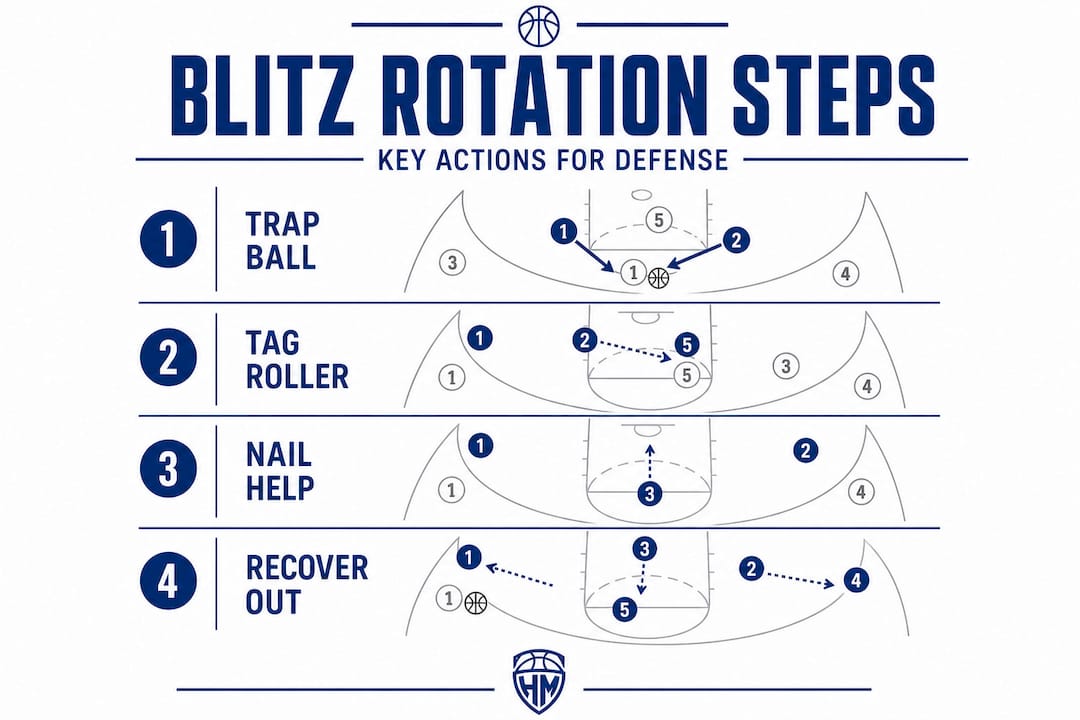
The rotation chain in blitz defense works like this:
- The nail defender is positioned at the free throw line extended, between the ball and the weak-side threats. This player reacts first and dictates the rotation. His reads set everything else in motion.
- The weak-side tag is the defender responsible for the rolling big. He must sprint to deny a clean catch in the short-roll area the moment the trap is set.
- Corner defenders rotate using x-out rules. That means the nearest corner defender slides to the most dangerous open shooter, and the far corner defender adjusts based on where the skip pass is most likely to go.
A key requirement for blitzing is the rotation system behind the trap. The weak side must tag the roller and then recover to shooters. Without that sequence, the scheme’s inherent risk shows up quickly. One missed assignment leads directly to a layup or corner three.
“Blitzing without a rotation system is not a defense. It is just a gamble.”
Teaching the trap as part of a top-down rotation with predetermined communication roles, such as the nail defender reacting first, plus x-out rules for corner assignments, is what separates a functioning blitz scheme from a broken one.
The communication layer is just as important as the physical rotation. Every player needs a call. Here is what that looks like in practice:
- “Blitz!” called by the on-ball defender the moment a screen is set
- “I got roller!” from the weak-side tagger
- “Corner right!” or “Corner left!” from the help-side defenders
- “Ball!” from the nail defender as he reads the pass direction
Pro Tip: Build a communication script and drill it without a ball first. Walk through each call in a walk-through, then add the ball, then add offensive players. Players need to own the language before they can execute the rotation at game speed.
Understanding defensive rotations at a foundational level helps players understand why each call matters and what breaks down when they miss it. Coaches looking for a complete system can also reference rotation strategies that integrate blitz within a broader defensive structure.
Common counters and how to measure the blitz’s impact
Smart offenses have answers to the blitz. Knowing those counters ahead of time lets you adjust your rotation assignments and scouting.
Here are the main ways offenses attack the blitz:
- Short-roll release. When the defense commits two to the ball, the roller can receive cleanly between defenders and create numerical and geometric advantages. This is the most common and dangerous counter. The roller catches in space with one or two defenders out of position.
- Screen rejection. The ball handler rejects the screen entirely, driving the opposite direction before the blitz can fully form. Your trap never materializes, and the defense is momentarily over-rotated.
- Slip screen. The screener never sets a full screen. He peels toward the basket early, catching the defense mid-trap with no one home near the rim.
- Skip pass to the corner. A disciplined ball handler reads the blitz immediately and fires a skip pass to an open corner shooter. If your x-out rules are slow, this becomes a wide open three.
- Reject and attack the trapping big. The ball handler drives under the screen, directly attacking the screen defender who stepped up to blitz. This is especially effective when the screen defender is a slow-footed center.
To measure your blitz scheme’s actual effectiveness, track these numbers game to game:
- Short-Roll PPP: Points per possession when the roller catches in the short-roll zone. Under 0.8 PPP is a solid target.
- Turnover rate on blitz possessions: Are you generating the turnovers that justify the risk?
- Corner three attempts allowed: If this number spikes when you blitz, your x-out rotations need work.
- Rim attempt rate after blitz: A high number signals that slips and rejections are breaking through.
These measurements give you real data to evaluate whether the blitz is helping or hurting. Without numbers, you are coaching on feeling. With numbers, you can make targeted adjustments at halftime or in the next practice.
Training and drills for reliable blitz execution
The blitz’s ceiling is almost entirely determined by execution quality. As noted in a complete coverage playbook, if you cannot consistently enforce the trap trigger and then rotate correctly to tag the roller and close shooters, the rotation load makes it easy to score on. That quote should drive how you approach practice.
Here is a structured approach to building blitz execution:
- 2-on-2 trap drill. Start with just the ball handler and the screener against your on-ball and screen defenders. No rotations yet. The only goal is clean trap mechanics, proper angles, and not getting beat off the dribble.
- 3-on-3 with nail defender. Add the nail defender. The offense adds a weak-side wing. Now the nail defender must read the ball handler and react to the first pass after the trap. This builds the single most important rotation habit.
- 4-on-4 scramble drill. Add a corner shooter for the offense. The offense is allowed to use the short-roll and skip pass. The defense practices full scramble rotations in real time.
- 5-on-5 live blitz. Only now run it full strength. Call which possessions use blitz so players are mentally triggered and prepared to execute the scheme.
Pro Tip: Layer complexity gradually across a one to two week installation period. Start at 2-on-2, master each layer, then add another offensive player. Rushing to 5-on-5 before the fundamentals are clean produces bad habits that are hard to fix.
Using defensive drills that are specifically structured around pick and roll scenarios will accelerate your team’s development. Also review defense tips for coaches that address the mental and communication habits blitz demands.
The pick and roll defense principles resource covers coverages in detail and gives you the full framework for building a blitz scheme within a broader defensive system.
Editorial perspective: The uncomfortable truth about blitzing the pick and roll
Most coaches who struggle with the blitz are not struggling because the scheme is wrong. They are struggling because they underestimate how much it demands from the three defenders who are not in the trap. The blitz gets all the attention. The scramble behind it does all the actual work.
Here is what we see repeatedly at every level. A coaching staff installs the blitz because it looks great on film. Two defenders trap. Ball handler panics. Turnover. It works twice, maybe three times. Then the offense makes one correct short-roll pass, scores easy, and suddenly the scheme feels broken. The staff adjusts back to drop coverage, and the cycle repeats.
The real problem is not the scheme. It is that teams practice the trap and neglect the rotation chain. They spend thirty minutes drilling the two-man wall and five minutes on what happens after. That ratio needs to flip.
Blitzing is also not a roster-neutral decision. If your team lacks athletic, communicative guard-level players who can rotate quickly and close out hard, the blitz will bleed points. Forcing a complex scheme onto a roster that cannot execute the scramble is a losing strategy regardless of how good the trap looks in isolation.
The most honest version of this advice is simple. Track your in-depth defense principles and Short-Roll PPP every single game. If that number is above 1.0, your blitz is a liability. Stop running it until the rotation chain is fixed. If it is below 0.8, keep it. Let the data guide the decision, not your gut or the fact that it looked good twice.
The best defensive coaches we know blend coverages based on scouting, situation, and roster. They use blitz as a weapon, not a system. That distinction is everything.
Take your pick and roll defense further with advanced resources
You now have the framework. The next step is implementation.

Hoop Mentality has the tools to help you install this scheme faster and with more precision. The Big Man Dual Action Drill trains your screen defenders in the exact footwork and decision-making required for blitz coverage. The Game Preparation Guide gives you a structured weekly practice plan so you can layer blitz installation properly without wasting reps. Both resources are built for real coaching environments. Explore them now and put your defense to work.
Frequently asked questions
What are the risks of blitzing the pick and roll?
Blitzing exposes your team to open shots if rotations are slow or miscommunicated, especially on short-roll or skip-pass opportunities. One slow rotation can leave opponents with easy scoring opportunities.
Against what type of offenses is the blitz most effective?
The blitz works best against teams with average passers or those who lack disciplined spacing after the screen. Blitzing is often effective against poor passers but less effective against offenses with quick, correct short-roll or skip-pass execution.
How can coaches evaluate the success of their blitz scheme?
Track the points per possession allowed on short-roll releases to objectively judge if your blitz is creating the outcomes you want. Short-Roll PPP provides a clear benchmark for whether blitzing is helping or hurting your defense.
What is the main communication cue in a blitz rotation?
Assigning and training a nail defender to react first ensures coordinated scramble and prevents open shooters. The nail defender as rotation quarterback and x-out rules assign corner defenders on skip and rotation outcomes.
Should youth teams use blitz as a primary pick and roll defense?
Due to complexity and risk, blitz is usually reserved for advanced teams or tactical surprises, not as a constant coverage for youth. Youth players benefit more from learning foundational coverages like drop and hedge before adding blitz to the toolkit.