

TL;DR:
- The Spain pick and roll adds a back screen, creating multiple offensive options and confusing defenses.
- It forces defenders to handle two threats simultaneously, disrupting standard coverage strategies.
- Proper decision-making and timing training are critical for maximizing its effectiveness.
Most coaches treat the pick and roll as a two-player action. Ball handler. Screener. Read the defense. That’s it. But the moment you add a third layer to that action, everything changes. The Spain pick and roll is one of the most effective offensive weapons in modern basketball precisely because it turns a familiar action into a multi-threat situation that defenses genuinely struggle to handle. Whether you coach at the youth level or work with advanced players, understanding this play gives your team a real edge.
Table of Contents
- Breaking down the Spain pick and roll
- Spain pick and roll vs. traditional pick and roll
- Why the Spain pick and roll works: Offensive advantages
- Implementing and defending the Spain pick and roll
- What most coaches miss about the Spain pick and roll
- Take your playbook to the next level
- Frequently asked questions
Key Takeaways
| Point | Details |
|---|---|
| Three-player coordination | The Spain pick and roll requires precise execution from the ball handler, screener, and back screener. |
| Creates confusion | Its structure challenges defenses by adding a back screen to classic pick and roll action. |
| Multiple scoring options | Players can attack with a roll, pop, or pass, making the defense choose which threat to stop. |
| Adapt or defend | Coaches must teach both offensive execution and defensive counters for team success. |
Breaking down the Spain pick and roll
The Spain pick and roll is not just a fancier version of the standard ball screen action. It is a coordinated three-player sequence that layers a back screen on top of the traditional pick and roll, creating defensive confusion at multiple levels of the court simultaneously.
The action originates from Euroleague basketball, where Spanish and European programs used it to attack switching defenses and generate open looks against packed paint defenses. NBA teams began importing it heavily through the mid-2010s, and today it appears in the playbooks of nearly every elite program.
Here is how the play works from start to finish:
- The ball handler initiates. The point guard or primary ball handler dribbles toward the screener, who is positioned around the mid-range area or elbow. This draws the defense toward the ball.
- The screener sets the ball screen. The big man or screener sets a standard ball screen on the ball handler’s defender. This is the traditional pick and roll action that defenders already know how to read.
- A third player sets the back screen. Simultaneously, a third offensive player (often a wing or stretch big) sets a back screen on the screener’s defender. This is the Spain element. The screener’s defender is now caught between protecting against the roll and fighting through the back screen.
- The screener rolls or pops. As the screener’s defender tries to recover, the screener dives hard to the basket or pops to the perimeter. The back screen buys just enough separation to create a clean look.
- The ball handler reads and delivers. The ball handler must now read multiple defenders in real time, whether to attack the rim, hit the rolling big, find the back screener’s target, or skip to a shooter on the weak side.
The key difference between teaching pick and roll fundamentals and teaching the Spain action is that timing and sequencing are everything. If the back screen arrives too early, the defense adjusts. If it’s late, the screener loses the advantage.
“The Spain pick and roll turns one decision into three. The defense that is ready for the ball handler suddenly has to account for a free roller and a moving back screener at the same time.”
Pro Tip: Before running the Spain pick and roll in a live game, drill the timing of the back screen in isolation. The back screener should plant exactly as the ball screen is being set, not before and not after.
Spain pick and roll vs. traditional pick and roll
Understanding the technical details sets up a natural question: how does the Spain pick and roll stack up against more familiar options?
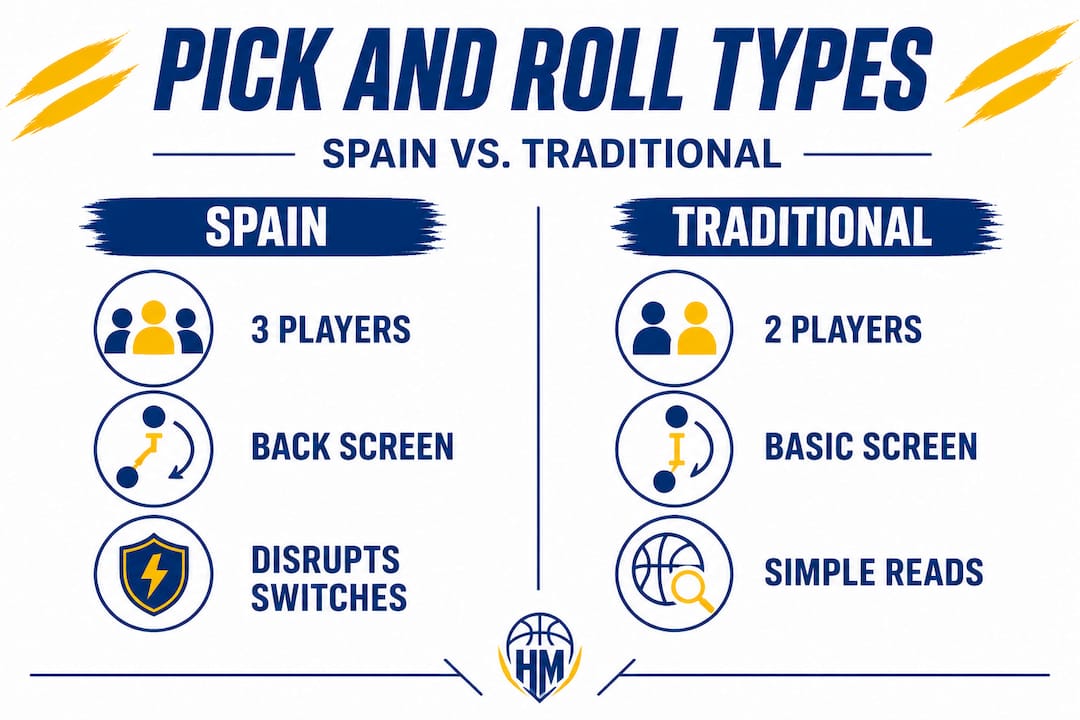
The standard pick and roll involves two players, one ball handler and one screener. The read is relatively contained. The defense focuses on the ball and the immediate roll or pop option. Coverage packages like “hedge and recover,” “switch,” or “drop coverage” are well-rehearsed at higher levels, which means defenses can take away the primary read if they are disciplined.
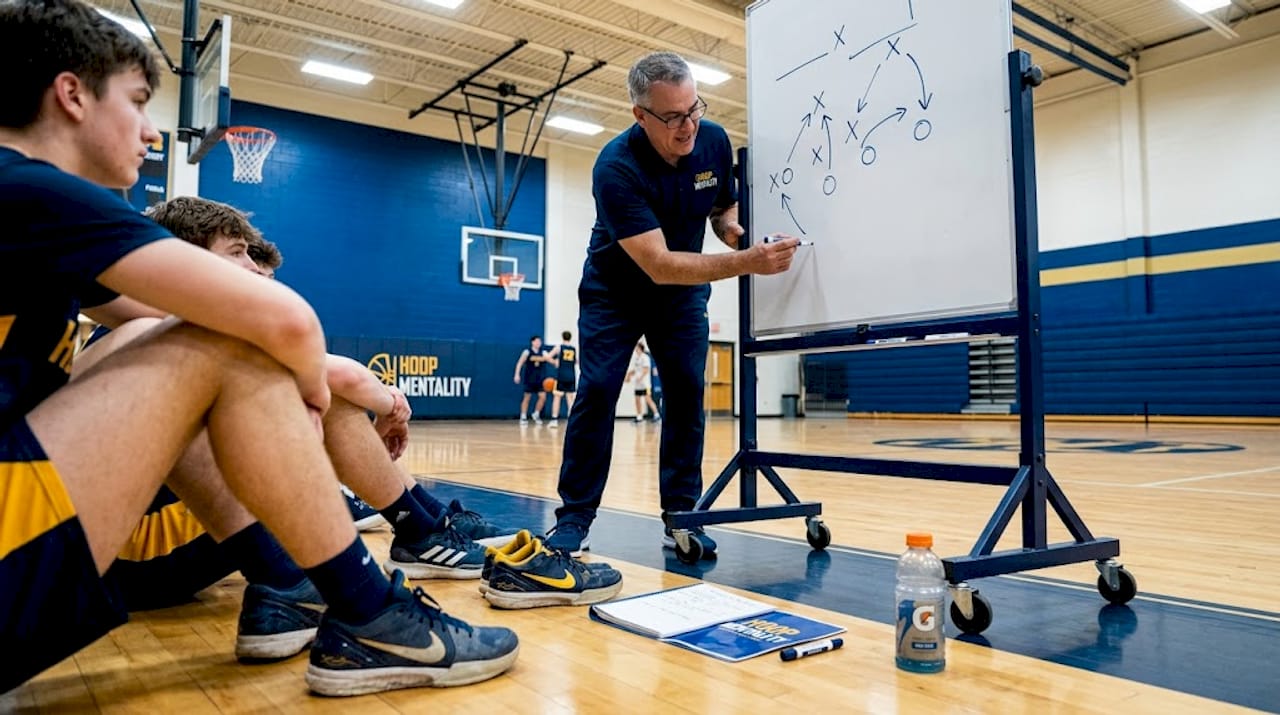
The Spain action disrupts those coverage packages because the screener’s defender now has two responsibilities at once. They have to fight over or under the ball screen while also reacting to the back screen. No standard coverage handles both cleanly.
Explore these pick and roll variations to understand the broader family of actions this play belongs to.
Here is a direct comparison:
| Feature | Traditional pick and roll | Spain pick and roll |
|---|---|---|
| Number of players | 2 | 3 |
| Primary defender targeted | Ball handler’s defender | Screener’s defender |
| Back screen involved | No | Yes |
| Defensive coverage options | Many standard packages | Limited clean options |
| Scoring windows | 2 primary | 4 or more |
| Complexity for offense | Low to moderate | Moderate to high |
| Best use case | General half-court sets | Attacking switching defenses |
When to use the Spain pick and roll:
- Against teams that switch everything
- When the screener’s defender is slower or undersized
- Late in shot clocks when you need a high-percentage look quickly
- Against zone-busting situations where a third mover disrupts coverage
- When your ball handler is a reliable decision-maker under pressure
When the traditional pick and roll may be better:
- Early in player development when roles are still being learned
- Against defenses that do not communicate well on the back screen
- When the third player needed for the Spain action is not a reliable screener
The comparing pick and roll actions breakdown makes it clear that each variation serves a specific purpose. The Spain pick and roll is not a replacement for simpler actions. It is an upgrade for situations where two-player reads are no longer enough.
Why the Spain pick and roll works: Offensive advantages
Now that the differences are clear, it’s important to understand why the Spain pick and roll so often leads to high-quality scoring chances for modern offenses.
The action works because it forces the defense to make a decision they have not fully rehearsed. Standard ball screen coverage assigns clear roles: one defender takes the ball handler, one covers the roll or pop. When a back screen enters the picture, the second defender has to do two things at once. That is physically and cognitively impossible to do cleanly every time.
Key offensive advantages:
- Creates defensive confusion. The screener’s defender cannot fully commit to either job, meaning one option will almost always be partially open.
- Forces help defenders to rotate early. Help defenders have to shift before the ball moves, which opens skip passes and weak-side threes.
- Generates multiple live scoring options. In a single action, you can attack with: the ball handler off the dribble, the rolling screener in the paint, the back screener slipping free, and the weak-side shooter off a skip pass.
- Punishes switching defenses specifically. When defenders switch, the screener rolling after the back screen often gets a smaller or slower defender on them, creating a clear mismatch in the paint.
- Compounds fatigue late in games. Defenders managing the back screen and ball screen in the same action tire out faster, making it more effective as the game progresses.
The Spain pick and roll playbook at Hoop Mentality outlines how elite teams pre-design their preferred option within the action so the ball handler has a primary read and a quick secondary read lined up before the play even starts.
Pro Tip: Teach your ball handler to prioritize the rolling big as their first read when facing a switching defense. That is almost always the highest-percentage option against a switch because the back screen creates a natural size mismatch.
The growing adoption of this action at elite team levels reflects how defenses have adapted over time. As teams got better at switching and hedging, offenses needed an action complex enough to break those schemes without needing an isolation superstar. The Spain pick and roll delivers exactly that.
Implementing and defending the Spain pick and roll
Knowing the “why” behind the play leads into the practical “how,” both for running this action and defending against it.
How to teach and implement it step by step:
- Start with the back screen in isolation. Before combining it with the ball screen, drill the back screener’s footwork and angle. The back screen must be set on a specific path to be legal and effective.
- Add the ball screen. Combine the ball screen with the back screen in a walk-through drill. Focus on timing. The back screener should be planting just as the ball screen lands.
- Add the ball handler. Bring in the ball handler and run the full three-player sequence slowly. Use a “ghost defense” (no live defenders) to reinforce positioning.
- Add live defense on the screener’s defender only. This isolates the toughest decision, helping the back screener and roller read how a live defender reacts.
- Run the full action 5-on-5. Now add full defensive coverage and make reads in real time.
The guidance available through advanced basketball plays emphasizes that breakdown drills are far more effective than jumping straight to full 5-on-5 work when installing a new action.
“Don’t run your Spain pick and roll in a game until every player knows their role and their first read. Confusion in a complex action is worse than a simple play run cleanly.”
Defensive countermeasures:
| Defensive strategy | How it works | Weakness to exploit |
|---|---|---|
| Switching | All three defenders switch assignments | Size mismatches on the roller |
| Pre-rotation | Help defender rotates early to the roll | Weak-side shooters become open |
| Hard hedge on ball screen | Ball handler’s defender traps | Back screener’s target dives free |
| Communication and bumping the screener | Defenders call out screens and slow screeners | Ball handler attacks before bump |
| Zone principles | Takes away primary reads | Ball movement and skip passes |
The most reliable defensive approaches against the Spain pick and roll are switching combined with strong communication. But even switching has clear weaknesses when the offensive team has a skilled roller.
One important caution for coaches working with younger teams: avoid overloading players with too much complexity early. If your players cannot yet read a basic two-man pick and roll cleanly, the Spain action will create as much confusion for your own offense as it does for the defense. Build the foundation first and add the back screen layer when players are ready for it.
What most coaches miss about the Spain pick and roll
Here is an opinion that might push back against what you see on YouTube coaching channels. Most breakdowns of the Spain pick and roll focus entirely on the diagram. They show the arrows, label the positions, walk through the sequence, and call it a day. That part is necessary but not sufficient.
The actual advantage of this action is not the design. It is the decision-making speed your players develop over time. A play diagram tells a player what is supposed to happen. It does not train them to read what is actually happening when a defender cheats early, when the back screener gets bodied up, or when the help rotation comes from an unexpected angle.
Teams that run the Spain pick and roll successfully do not script a single outcome. They teach multiple decision trees. The ball handler arrives at the read with two or three conditioned responses already loaded, so when the defense shows a specific coverage, the correct pass or drive feels automatic rather than calculated.
The common failure we see is teams that spend 80% of practice time on the diagram and 20% on live reads. That ratio needs to flip. The diagram should take ten minutes. The decision training should take the rest.
Another overlooked coaching approach is using Spain PnR progressions inside your existing offensive system rather than treating it as a standalone set piece. Mix it in as a secondary action off a dribble handoff or after a ball reversal. When defenses cannot predict when the back screen is coming, the action becomes significantly harder to prepare for.
Investing time in basketball playbook design helps coaches understand how to layer actions like the Spain pick and roll into a system rather than just adding plays to a list. That systemic thinking is what separates programs that execute under pressure from those that run pretty diagrams in practice and fall apart in games.
Take your playbook to the next level
The Spain pick and roll is one piece of a larger offensive system. Coaches who implement it most effectively do so within a well-organized playbook supported by structured practice plans and clear player communication.

Hoop Mentality offers resources built specifically for coaches at every level. The Spain pick and roll playbook provides detailed diagrams, player role breakdowns, and read progressions ready to use in practice. If you want to support that with structured session planning, the weekly practice plan gives you a complete framework for installing new concepts efficiently. Both resources are designed to save time and keep your players focused on execution.
Frequently asked questions
What are the three main roles in a Spain pick and roll?
The ball handler, the screener, and the third player who sets the back screen are the core roles in the action. Each player has a defined responsibility and a read to make based on how the defense reacts.
Is the Spain pick and roll suitable for youth teams?
With simplification, youth teams can use this action, but it works best for advanced youth players who have already developed reliable two-man pick and roll reads and can process multiple options quickly.
How can defenders counter the Spain pick and roll?
Switching, pre-rotating, and strong verbal communication between defenders are the most reliable approaches, though each has specific weaknesses that a prepared offense can exploit.
Why is the Spain pick and roll so effective at high levels?
The added back screen and built-in versatility generate defensive confusion by forcing the screener’s defender to manage two simultaneous threats, creating open scoring options that standard defensive packages cannot cleanly take away.