

TL;DR:
- Focus on three key teaching points per 10-20 minute film session to maximize engagement.
- Integrate analytics like points per possession to identify effective plays and lineups.
- Use targeted film clips to connect decision-making patterns to on-court improvement and tactical development.
Film study is one of the most powerful tools you have as a coach. But most sessions fall flat, not because coaches lack footage, but because they lack structure. Players zone out after 30 minutes of unguided replay. Coaches get lost chasing every mistake instead of teaching what matters. The result is wasted time and missed development opportunities. This article gives you a clear, actionable framework for running film sessions that actually improve player performance and sharpen your game strategy. From setting focused objectives to integrating analytics, every tip here is built for coaches who want results on the court.
Table of Contents
- Set clear objectives for every film session
- Integrate advanced analytics for deeper insights
- Focus on key actions and decision-making patterns
- Connect film study to practice routines and player development
- Why great film study is the difference-maker (not just the footage)
- Take your film study impact further with Hoop Mentality
- Frequently asked questions
Key Takeaways
| Point | Details |
|---|---|
| Focus each session | Limiting film meetings to three main teaching points prevents overload and boosts player retention. |
| Leverage analytics | Combining film with metrics and machine learning uncovers hidden patterns and improves tactical clarity. |
| Highlight high-value plays | Spotlight actions like post-pass cutting that statistically elevate team scoring and performance. |
| Bridge insight to practice | Translating film review into targeted drills consistently accelerates player development. |
| Adapt lessons for your team | Steal successful patterns from pros but tailor them to your players’ identity and needs. |
Set clear objectives for every film session
The biggest mistake coaches make in film study is trying to cover everything. One session becomes a tour of every turnover, every missed rotation, and every bad shot. Players stop listening. Nothing sticks.
The fix is simple: pick three teaching points before you press play. Focus on 3 main teaching points per session and keep sessions between 10 and 20 minutes for maximum engagement. That constraint forces you to prioritize what actually matters for your team right now.
Here is what a focused session looks like in practice:
- One defensive concept: Identify a specific breakdown, like a missed help rotation or a blown switch coverage.
- One offensive pattern: Highlight a play that worked or a sequence that needs adjustment.
- One individual teaching moment: Pull a clip of a player making a strong decision or a correctable mistake.
Balance is critical. If every session is about mistakes, players start dreading film. Mix in clips that show what your team did well. Celebrate the good read, the extra pass, the locked-in defensive possession. Players respond better when they see both sides.
“Film study should reinforce confidence as much as it corrects mistakes. Show players what winning looks like, not just what losing looks like.”
Always review film before practice, not after. Watching before gives players a mental framework they can immediately apply on the court. After practice, retention drops because players are tired and mentally checked out.
Pro Tip: Build a short clip reel of three to five plays the night before practice. Label each clip with the teaching point. Your session runs faster, stays focused, and players walk into the gym already thinking about the right things.
Strong film habits also reinforce confident coaching fundamentals by giving you a repeatable system. Pair your film objectives with a clear skills development workflow and you will start seeing faster player improvement across the board.
Integrate advanced analytics for deeper insights
Film alone shows you what happened. Analytics tell you why it matters. When you combine video with data, you move from observation to understanding.
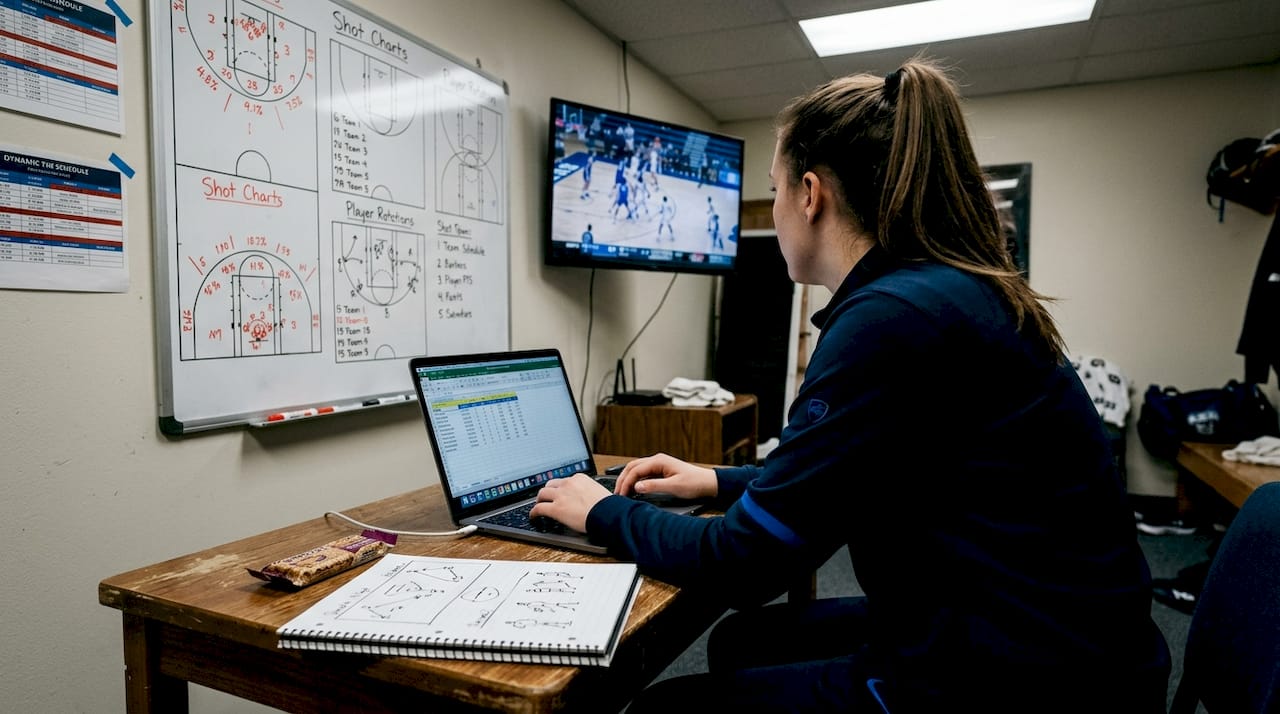
Start with efficiency metrics. Points per possession (PPP) is the most useful baseline metric for evaluating offensive and defensive effectiveness. It tells you how much value each possession generates, which helps you identify which plays and lineups are actually working.
Machine learning models achieve 82-85% accuracy in classifying defensive strategies from tracking data. That kind of precision means you can identify opponent tendencies before a game, not just react to them during one.
Here are the key actions to track during film review:
- Switches: How often does your defense switch, and what does it give up?
- Traps: Are traps forcing turnovers or creating open threes?
- Pass sequences: Which passing patterns lead to high-quality shots?
- Transition triggers: What actions consistently start your best fast break opportunities?
| Metric | What it measures | Why it matters |
|---|---|---|
| Points per possession | Offensive efficiency | Identifies best plays and lineups |
| Defensive rating | Points allowed per 100 possessions | Tracks defensive improvement over time |
| Assist-to-turnover ratio | Ball security and decision-making | Reveals playmaking quality |
| Rebounding rate | Percentage of available rebounds secured | Measures effort and positioning |
Integrating film with analytics gives you a real competitive edge. You stop guessing and start teaching with evidence.
Pro Tip: After each game, pull your top three possession types by PPP. Find one video clip for each in your film. Now you have a data-backed teaching reel that connects numbers to actions players can actually see and feel.
For a structured approach to tracking these numbers, use a basketball analytics checklist and connect your findings directly to player performance evaluation to track growth over time.
Focus on key actions and decision-making patterns
Not all plays are worth equal film time. Some actions generate far more value than others, and knowing the difference changes how you structure your sessions.
Post-pass cutting generates 1.58 PPP, making it one of the highest-value actions in basketball. Championship-level teams also average 2.3 more passes per possession than average teams. That is not a coincidence. Ball movement creates better shots, and film study is where you teach players to see that connection.
| Action | PPP / Value | Teaching focus |
|---|---|---|
| Post-pass cut | 1.58 PPP | Timing and read off the pass |
| Spot-up three | 1.05 PPP | Catch-and-shoot footwork |
| Pick-and-roll ball handler | 0.85 PPP | Decision speed and spacing |
| Isolation | 0.78 PPP | When to use vs. avoid |
When you study professional film with your players, the goal is not to make them copy what they see. Study decision-making, footwork, and separation, then adapt those patterns to fit your team’s identity and personnel.
Here is a practical breakdown for this type of film session:
- Watch the pro clip: Identify the decision made and why it worked.
- Break down the footwork: Where did the player’s feet go before the catch? After?
- Find the separation: What created the open look or the driving lane?
- Connect it to your team: Which of your players can run this action? What adjustment does it need?
This approach teaches players to think, not just react. Proper basketball footwork is often the difference between a good read and a wasted possession. When players understand the mechanics behind a decision, they can replicate it under pressure. Use film to boost basketball performance by connecting what players see on screen to what they practice on the floor.
Connect film study to practice routines and player development
Film study without a practice connection is just entertainment. The real value comes when your analysis directly shapes what happens on the court the next day.
Here is a step-by-step process for bridging film to practice:
- Identify the gap. After film review, write down the one or two actions your team needs to improve most.
- Design a drill. Match the drill directly to the film clip. If the film shows missed post-pass cuts, run a cutting drill that emphasizes timing off the pass.
- Give players context. Before the drill, replay the clip. Say, “This is what we are working on today and here is why it matters.”
- Repeat and measure. Run the drill across multiple practices. Track whether the film shows improvement in the next game.
- Close the loop. In your next film session, pull clips that show the improvement. Players need to see that the work is paying off.
Reviewing film before practice gives players a mental framework they carry into drills. It primes them to recognize situations on the floor because they have already seen them on screen.
“The best coaches do not just show film. They use film to build a shared language between what players see and what they do.”
Encourage open discussion during film. Ask players what they notice. Ask why they made a certain decision. When players articulate their thinking, they learn faster and retain more.
Pro Tip: Keep a short written log after each film session. Note the teaching points covered, the drills you plan to run, and the clips you will pull for the next review. This keeps your development process consistent and connected.
Explore skills and performance drills that align with your film findings, and build elite athlete routines that reinforce what players learn on screen. For a broader view, check out these player development tips built specifically for coaches.
Why great film study is the difference-maker (not just the footage)
Here is something most coaching articles will not tell you: the coaches who get the most out of film study are not the ones with the best software or the most footage. They are the ones who treat film as a teaching tool, not a review tool.
There is a real difference. A review tool replays what happened. A teaching tool builds understanding of why it happened and what to do differently. Most coaches default to the first. The best coaches live in the second.
Quantity is a trap. Watching more film does not make your team better. Watching the right clips with the right questions does. When you combine focused objectives, analytics-backed insights, and drill-connected follow-through, film study becomes a system for continuous improvement.
The coaches who win consistently are not just smarter about X’s and O’s. They are better at evaluating player performance and translating what they see into growth. That is the real edge film study provides, when it is done right.
Take your film study impact further with Hoop Mentality
You now have a clear framework for running film sessions that actually move the needle. The next step is putting those insights into action on the court.
Hoop Mentality offers practical resources built for coaches who want to connect analysis to results. The big man dual action drill is a great starting point for turning film insights into targeted skill work. For a complete system that bridges film review to game day, the game preparation guide with weekly practice plan gives you a structured, ready-to-use tool. Explore the full resource library and find what fits your team’s next development goal.
Frequently asked questions
How long should a basketball film session last for maximum effectiveness?
Keep sessions between 10 and 20 minutes to maintain player focus and ensure teaching points are actionable and retained.
What type of metrics should coaches track during film study?
Efficiency metrics like points per possession are most valuable, and machine learning achieves 82-85% accuracy in classifying defensive schemes from tracking data.
How can film study directly improve player development?
Film sessions followed by targeted drills help players connect what they see on screen to on-court decisions, accelerating skill growth and situational awareness.
What is the most valuable action coaches should highlight on film?
Post-pass cutting generates 1.58 PPP, making it the highest-value action to teach and reinforce through film and drill work.
How can analytics and film be combined to gain a strategic edge?
Combining video review with pattern recognition and efficiency metrics lets coaches integrate film with analytics to identify tendencies and teach strategy with evidence.