

Skill development gives players measurably better shooting, tighter assist-to-turnover ratios, and faster decision-making under pressure. Constraints-led training alone has produced a 3.3 percentage point jump in field goal percentage and an 18% improvement in assist-to-turnover ratio in just eight weeks. Paired with USA Basketball’s long-term development framework and structured coaching resources, that kind of gain is repeatable at any level you coach.
TL;DR:
- Constraints-led training can produce an 18% improvement in assist-to-turnover ratio and a 3.3 percentage point increase in field goal percentage within eight weeks.
- Key metrics to track include field goal percentage, assist-to-turnover ratio, turnovers per 100 possessions, rebounding rate, and free-throw rate, evaluated weekly.
- Using progressive drills like shooting sequences, decision-making videos, and small-sided constraint games accelerates skill acquisition and decision-making under pressure.
- Skill development enhances players’ confidence, on-court decision-speed, resilience, and team leadership, even if improvements don’t immediately reflect on the score sheet.
- Consistent, structured practice focusing on fundamental skills is crucial to long-term athlete health, performance, and avoiding overuse injuries.
Table of Contents
- The Advantages of Skill Development: What the Research Actually Shows
- Drills That Put These Advantages Into Practice
- Building Skill Work Into Your Weekly Practice Plan
- How to Measure Whether the Advantages Are Real
- Beyond the Box Score: Confidence, Decisions, and Opportunity
- Skill Development and Long-Term Athlete Health
- The Mental Side: Focus, Resilience, and Staying Coachable
- Skill Development, Team Chemistry, and Emerging Leaders
- What Gets in the Way, and How to Push Through It
- Turning Research Into Resources Coaches Can Actually Use
- Ready-to-Run Resources for Faster Skill Development
- Sources
- FAQ
The Advantages of Skill Development: What the Research Actually Shows
Coaches don’t need to guess whether skill work translates to wins. The data is specific, and it points to a handful of metrics that move the needle more than others.
The clearest evidence comes from a quasi-experimental study on collegiate athletes using constraints-led, game-based training. Over eight weeks, players saw a 3.3 percentage point gain in shooting efficiency and an 18% improvement in their assist-to-turnover ratio, and external-load engagement rose without any increase in perceived fatigue. That last part matters. Players worked harder and got better without burning out faster, which is the whole argument for training smarter instead of just training longer.
The numbers behind winning basketball: a video-analytical study of multiple matches found that field goal percentage, turnover rate, assists, and rebounds are the four statistical categories that most reliably separate winning teams from losing ones. If your practice plan doesn’t touch all four, you’re leaving performance on the table.
Small-sided games deserve a specific mention here because coaches often overuse or misuse them. A systematic review and meta-analysis found that small-sided games reliably improve agility, shooting, passing, and dribbling, but they show limited value for aerobic capacity, sprint speed, or jump performance. Run them two to three times a week as a technical and tactical tool, not as your conditioning program.
When you’re deciding what to prioritize on a whiteboard, these are the indicators worth tracking every week:
- Field goal percentage, broken down by shot type and location
- Assist-to-turnover ratio, tracked per possession, not just per game
- Turnovers per 100 possessions
- Offensive and defensive rebounding rate
- Free-throw rate, which reflects how often a player creates contact and draws fouls
Drills That Put These Advantages Into Practice
Research tells you what works. These three drills tell you how to run it tomorrow.
-
The versatile shooting progression. Start with a stationary spot-up rep, then add a screen action, then finish with a defender closing out under time pressure. This progression mirrors how Hoop Mentality’s Versatile 3 Player Shooting Drill structures game-representative shot practice, moving players from clean mechanics to contested, game-speed decisions in one continuous sequence. Run three rotations of eight shots per station, and track makes at each phase separately so you can see exactly where a shooter’s percentage drops under pressure.
-
The passing and decision-making station. Show players a short video clip of a live-game passing read before the rep, then have them execute a similar read live. A quasi-experimental study on young novice players found that a four-week, four-sessions-per-week video modeling program improved passing accuracy and several offensive team metrics compared to players who trained without it. Layer in a progressive constraint, like a two-second pass window, once players show consistency with the base read.
-
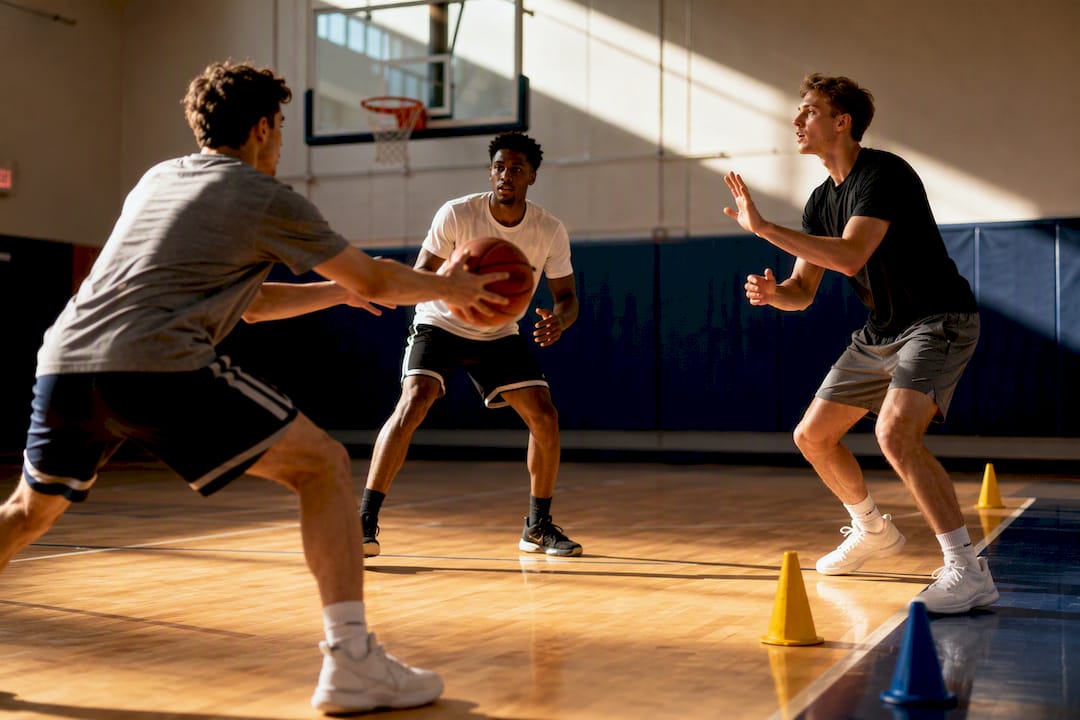
The small-sided constraints drill. Run 3v3 or 2v2 on a shortened court with a manipulated rule, such as no dribbling after the first pass or a mandatory reversal before a shot. Design constraints like court size and defender density force perception-action coupling, meaning players learn to read and react rather than execute a memorized pattern. This is where a structured resource like Hoop Mentality’s Skill Improving Infinite Loop Drills earns its keep, since it sequences these possession-based reps so ball touches stay high and rest periods stay short.
Scale each drill by adjusting space and time before you adjust complexity. A 10-year-old and a college sophomore can run the same passing read drill; the difference is court size, pass window, and defender speed.
Pro Tip: Never stack two high-perceptual-demand drills back to back in the same practice. A shooting progression followed immediately by a small-sided constraints game overloads decision-making fatigue before players get real repetition benefit from either one.
Building Skill Work Into Your Weekly Practice Plan
Knowing the drills is only half the job. The other half is scheduling them so gains compound instead of getting buried under game prep.
USA Basketball’s Player Development Curriculum recommends that foundational-stage players spend roughly 70% of training time on individual fundamental skills and 30% on competition, and it specifically advises against locking young players into fixed positions during this stage. That ratio shifts as players advance, but the underlying principle holds at every level: skill acquisition needs more repetition than most practice plans allow it.
A sample three-session micro-cycle might look like this:
- Session one: individual skill blocks (shooting progression, ball-handling under pressure) for 40 minutes, followed by a small-sided constraints game for 20 minutes.
- Session two: passing and decision-making stations with pre-session video review, followed by team system work tied to the same reads.
- Session three: competition-style scrimmage with in-game constraints, followed by film review of the previous two sessions.
Before you finalize the week, answer five quick questions: What’s the primary skill focus? Which drills carry over from last week? How much competition time balances the individual work? What’s the recovery status of your rotation players? And which metric will you check at the end of the week to confirm the plan worked?
A short recovery checklist helps here too: track total high-intensity minutes, flag any player reporting soreness beyond normal, and rotate constraint intensity so the same muscle groups aren’t overloaded three sessions running. For more on avoiding early specialization while building this structure, see Hoop Mentality’s guide to positionless basketball development.
How to Measure Whether the Advantages Are Real
Skill development only counts as an advantage if you can prove it happened. That means tracking the right numbers on a schedule, not just eyeballing improvement.
Track field goal percentage, assist-to-turnover ratio, turnovers per game, and rebounding rate weekly during the season, since these are the four categories most correlated with team success in video-analytical research. Free-throw rate is worth a monthly check since it moves more slowly.
A simple video workflow works better than expensive software for most programs: clip the possession, tag it by category (shot, turnover, assist, rebound), then compare tags week over week. Hoop Mentality’s guide on evaluating player performance walks through a version of this that doesn’t require anything beyond a phone and a spreadsheet.
Set a baseline in week one, then re-test at four and eight weeks. That window matches the timeline from the constraints-led training study, which recorded its 3.3 percentage point FG% gain over eight weeks. Expect variation, though. Competition level, sample size, and player load all confound the numbers, so don’t panic over a single bad shooting week, and don’t celebrate a single hot one either.
Beyond the Box Score: Confidence, Decisions, and Opportunity
Skill development pays off in ways that never show up in a game log. A player who has drilled a specific read hundreds of times walks onto the court with a different posture. That confidence changes how they play defense, how they communicate with teammates, and whether they attempt the tough pass instead of the safe one.
Decision-making improves specifically because skill training under constraints forces players to read situations rather than react on instinct alone. A player who has practiced passing reads against manipulated defensive pressure recognizes the same look in a live game half a second faster. That half second is often the difference between a live-ball turnover and an assist.
There’s a career dimension too, one coaches at the high school and college level see directly. Players who show consistent skill improvement over multiple seasons get more recruiting attention, more playing time, and more opportunities to play beyond their current level. Scouts and coaches at the next level look for demonstrated skill growth, not just current output, because it signals coachability and work ethic as much as talent.
None of this shows up on a stat sheet the week it happens. It shows up in how a player carries themselves in the fourth quarter of a tied game, and in whether a college coach calls back after watching film from two seasons ago compared to last week.
Skill Development and Long-Term Athlete Health
Better skill execution reduces the physical toll of playing basketball over a career, not just the mental toll. A player with poor footwork on a jump stop absorbs more force awkwardly, repeatedly, over thousands of reps across a season. Clean mechanics distribute that force more predictably.
This is one reason USA Basketball’s development curriculum pushes so hard against early positional specialization and toward broad fundamental skill work during the foundational years. A player who only ever practices one movement pattern, like a taller player who never learns to handle the ball or change direction, builds compensations that show up as overuse injuries later. Broad skill development spreads the physical demand across more movement patterns.
Small-sided games play a role here too, though within limits. They improve agility and change-of-direction skill, both of which relate to non-contact injury reduction. But the same meta-analysis that praised their technical benefits also found they don’t substitute for structured strength and conditioning work. Skill development and physical preparation are complementary, not interchangeable.
Coaches who treat skill training as a season-long, age-appropriate progression, rather than a rushed preseason cram, tend to see fewer chronic overuse issues in their rotation players by midseason. That’s not a guarantee against injury. It’s a reduction in one of the controllable risk factors.
The Mental Side: Focus, Resilience, and Staying Coachable
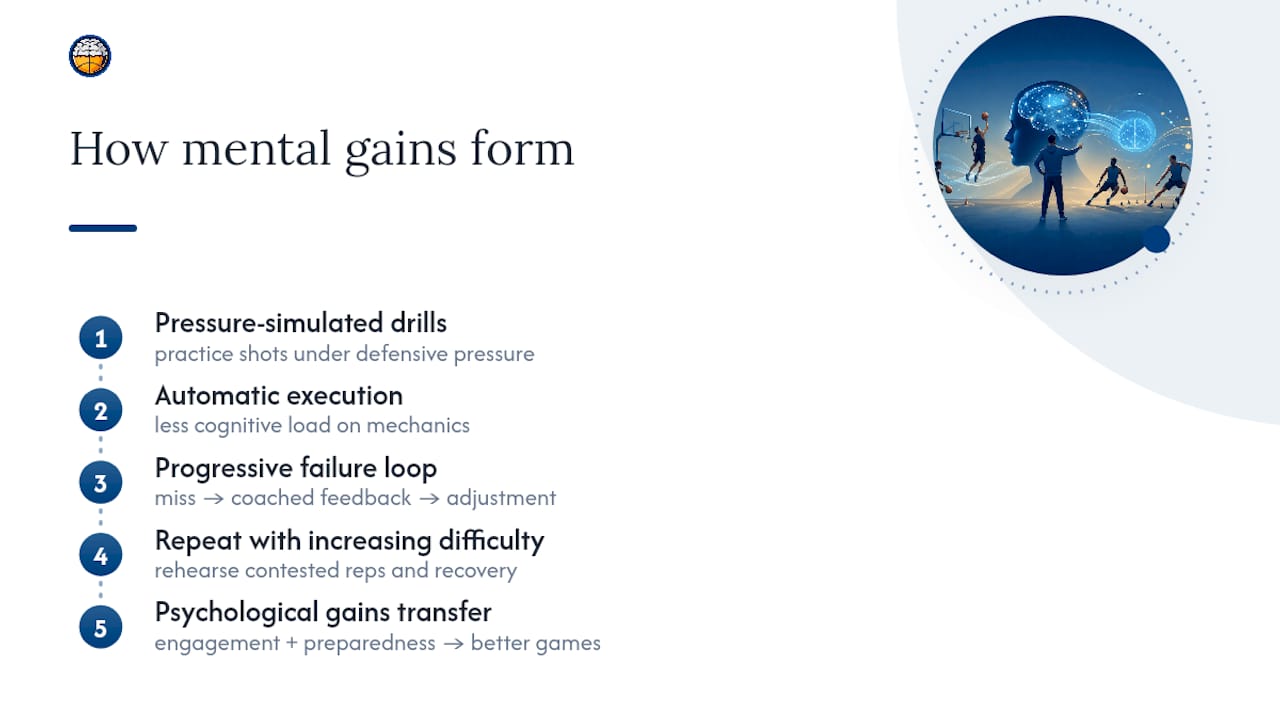
Skill development changes how players think under pressure, not just what they can physically do. A player who has drilled a shot a thousand times in practice, including under simulated defensive pressure, experiences less cognitive load executing that same shot in a close game. Their brain isn’t solving the mechanical problem anymore. It’s free to read the defense.
Research on constraints-led training backs this up in a specific way: the same study that measured shooting and assist-to-turnover gains also found that psychological readiness and enjoyment mediated the transfer of skill training to actual game performance. In plain terms, players who found the training engaging and felt prepared going into games improved more than players who went through the same drills without that mental buy-in. The training design itself, not just the repetitions, shapes the outcome.
Resilience builds the same way. A player who has failed and adjusted through progressive drill difficulty, missing the contested rep, getting coached on it, and trying again, develops a tolerance for failure that transfers directly to in-game mistakes. Players who only ever practice easy, uncontested reps tend to unravel faster after a live turnover because they’ve never rehearsed the recovery.
Focus improves through the same mechanism. Constraint-based drills that force a decision within a shrinking time window train attention under pressure in a way that static, repetitive drills simply don’t replicate.
Skill Development, Team Chemistry, and Emerging Leaders
Individual skill work shapes team dynamics in ways that are easy to overlook. When every player on a roster can competently pass, cut, and finish, positionless read-and-react offense becomes possible. When only two or three players have that skill level, the offense collapses into isolation basketball by necessity, regardless of what the playbook says.
Leadership tends to emerge from players who have put in visible skill work. Teammates notice who shows up early to get shots up and who has clearly improved their weak hand over an offseason. That visible commitment gives a player credibility that translates into vocal leadership during timeouts and film sessions, even for players who aren’t the most talkative by nature.
Skill-based small-sided games also force communication in a way full five-on-five scrimmages sometimes don’t. In a 3v3 possession game with a manipulated constraint, like a mandatory pass before a shot, players have to talk through cuts and reads in real time because there’s no space to hide a miscommunication. Coaches who run these constraint games regularly often report that on-court communication improves across the roster within a few weeks, not just for the players directly involved in a given drill.
What Gets in the Way, and How to Push Through It
The biggest obstacle to skill development isn’t talent. It’s inconsistency. Players who skip weeks of individual work during the season, or coaches who abandon skill blocks the moment game prep intensifies, lose the compounding effect that makes skill training worth doing in the first place.
Time is the second obstacle, and it’s a real constraint for youth and high school coaches who might only get two or three practices a week. The fix isn’t finding more time. It’s protecting a smaller, non-negotiable skill block, even 15 minutes, inside every practice rather than treating skill work as something that happens only when there’s time left over.
Plateaus frustrate players and coaches alike, and they usually happen when a drill’s difficulty stops matching a player’s current level. The solution is systematic progression: increase a constraint, shrink a time window, or add a defender before a player fully masters the previous step, so skill acquisition keeps pace with a moving target instead of stalling on a fixed one.
Buy-in is the last major hurdle, particularly with players who don’t see the connection between a passing drill and their playing time. Tying skill work explicitly to the metrics discussed earlier, showing a player their own assist-to-turnover trend over four weeks, does more to build buy-in than any pep talk. Players who see their own numbers move tend to trust the process.
Turning Research Into Resources Coaches Can Actually Use
Coaches don’t have time to read academic studies between practices, which is exactly the gap Hoop Mentality was built to close. Structured, progressive drill sequences translate directly into faster player development, and Hoop Mentality’s internal data shows drills organized into progressive plans accelerate development by roughly 30% compared to unstructured practice repetition. That number tracks with the broader research on blended learning, where combining digital resources with on-court application produces more consistent coaching outcomes than either approach alone.
Pick one drill from this article. Run it consistently for four to eight weeks, track the metric it’s designed to move, and see what changes. That’s the same window the constraints-led research used to document real gains, and it’s a realistic timeline for any coach to test on their own roster.
— Dejan
Ready-to-Run Resources for Faster Skill Development
You’ve seen the research. Now here’s how to skip the setup work and get these drills running at your next practice. Some coaching resource providers build their resources specifically so coaches spend less time designing sessions and more time coaching them.
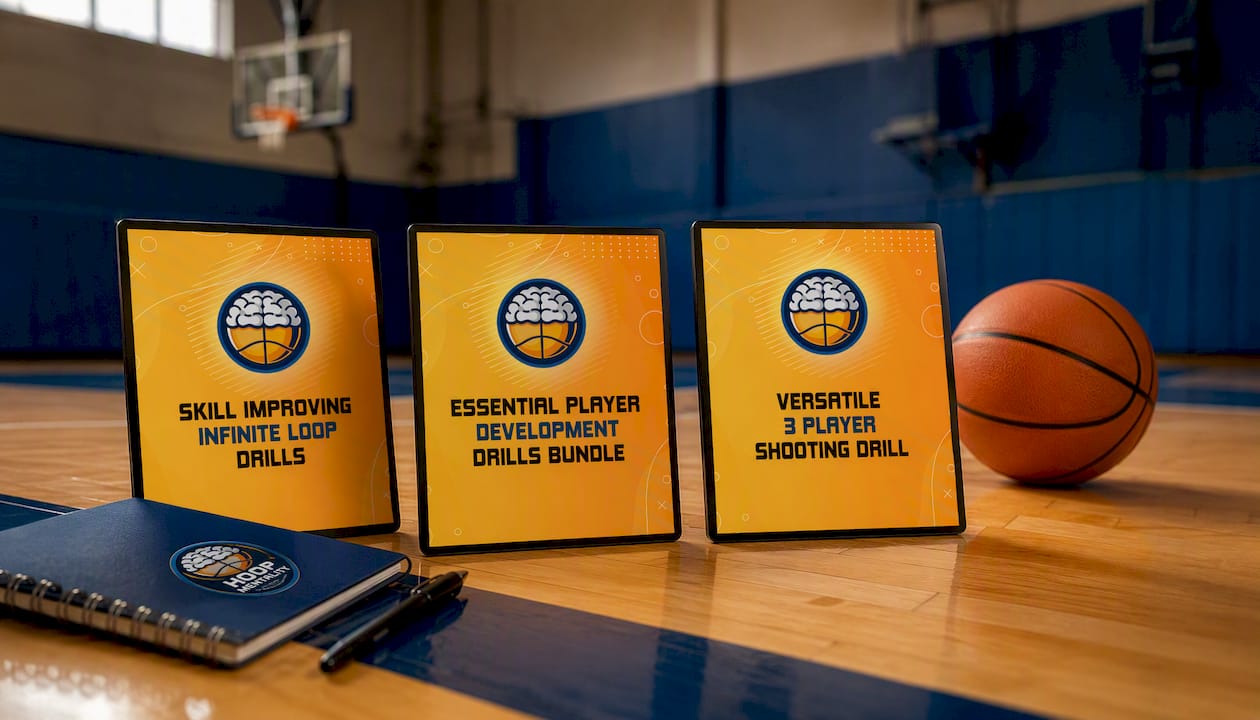
The Skill Improving Infinite Loop Drills package gives you continuous, progressive sequences built for the exact small-sided constraint work covered above, so you’re not building possession-based progressions from scratch. The Essential Player Development Drills Bundle hands you station-ready plans that slot directly into a weekly micro-cycle, which matters most for youth and high school coaches running practice with limited staff. And the Versatile 3 Player Shooting Drill gives you a game-representative shooting progression, from spot-up to pressure rep, ready to install this week.
Every resource is built around the same principle: structured, progressive practice beats unstructured repetition. For a deeper look at how that structure pays off over a season, read Hoop Mentality’s breakdown of essential coaching resources for basketball success. Download a sample plan, run it for one week, and see what changes in your next practice.
Sources
- Psychological readiness mediates performance transfer in constraints-led, game-based basketball training: evidence from a quasi-experimental study
- USA Basketball Player Development Curriculum
- Effectiveness of Video Modeling in Improving Technical Skills in Young Novice Basketball Players: A Quasi-Experimental Study
FAQ
What Are the Main Advantages of Skill Development in Basketball?
The clearest advantages are measurable gains in shooting percentage, assist-to-turnover ratio, and decision-making speed, with constraints-led training producing a 3.3 percentage point FG% increase and 18% AST/TO improvement in eight weeks.
How Much Practice Time Should Go to Individual Skill Work?
USA Basketball recommends foundational-stage players spend about 70% of training time on individual fundamental skills and 30% on competition, shifting gradually as players advance.
Do Small-Sided Games Replace Conditioning Work?
No. Small-sided games improve agility, shooting, passing, and dribbling but show limited benefit for aerobic capacity or jump performance, so they should complement, not replace, strength and conditioning.
How Long Before Skill Development Shows Up on the Scoreboard?
Plan for a four to eight week baseline-to-retest window, matching the timeline used in constraints-led training research, and track field goal percentage and assist-to-turnover ratio as your primary indicators.