

TL;DR:
- Early offense in basketball aims to attack before the defense becomes organized, emphasizing timing over speed. Proper execution creates high-quality scoring opportunities and increases team efficiency while tiring out defenders, but precision and decision-making are vital for success. Coaches should integrate structured drills and resources focused on timing, shot quality, and transition finishing to maximize early offense benefits.
Most coaches assume early offense in basketball is about speed. Run faster, push the tempo, beat the other team down the court. But that framing is exactly why so many teams fail to capitalize on it. The real reason to why run early offense has nothing to do with how fast your players move and everything to do with when they arrive. Timing targets a specific window of defensive vulnerability. Miss that window by two seconds and you face a set defense. Hit it right and you’re attacking disorganization. That difference is the entire point.
Table of Contents
- What is early offense and why timing matters
- The impact of early offense on team performance and pace
- Quality shot selection and decision-making in early offense
- Integrating early offense with transition and second-chance scoring
- Practical ways to implement early offense in your team
- Why mastering early offense timing is more valuable than raw speed
- Enhance your team’s early offense with Hoop Mentality resources
- Frequently asked questions
Key Takeaways
| Point | Details |
|---|---|
| Timing over speed | Early offense succeeds by reaching front court in 2-3 seconds, forcing defense to react rather than act. |
| Moderate pace shift | Increasing possessions by about 3-4% improves offense only if shot quality is maintained. |
| Disciplined decision-making | Running with purpose and avoiding reckless passes are essential for effective early offense. |
| Conversion matters | Creating scoring chances isn’t enough; teams must convert transition and second-chance opportunities. |
| Practical implementation | Popular early offense schemes include 1-4 high and spread sets, supported by targeted drills and practice plans. |
What is early offense and why timing matters
Early offense strategies share one core goal: get the ball into the front court before the defense can organize. Not before the defense can run, but before they can think and assign. There’s a difference.
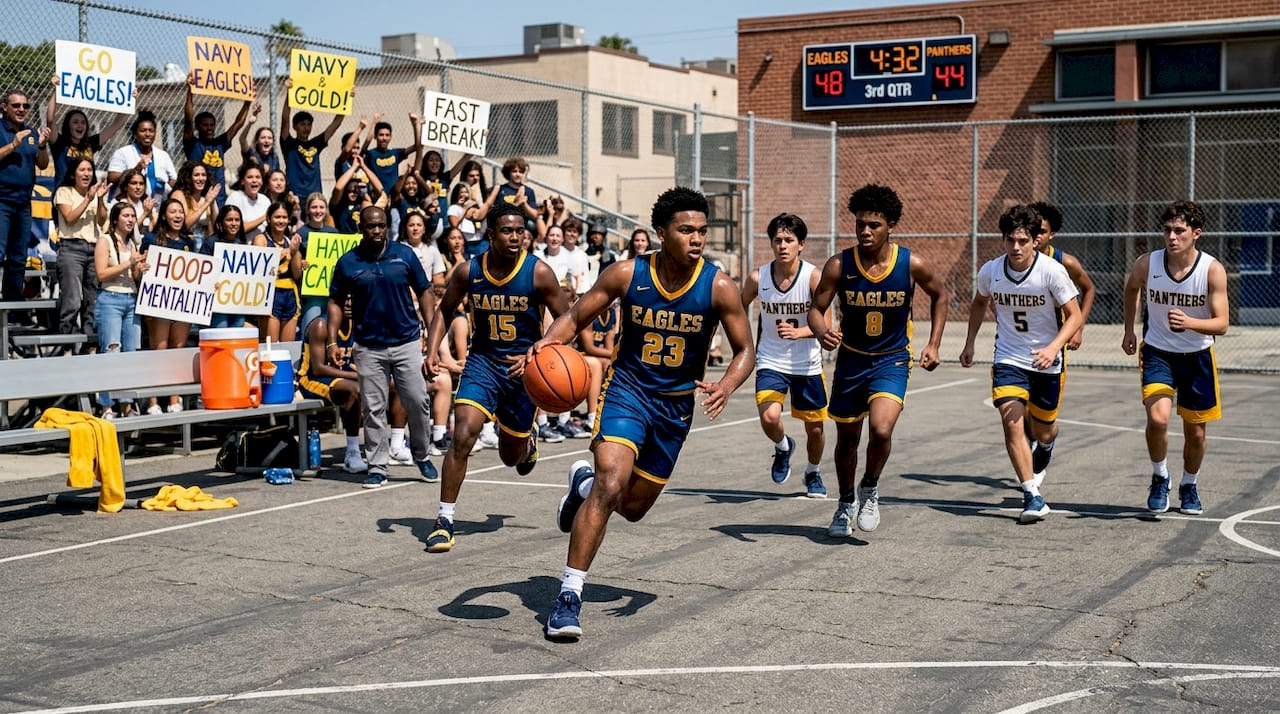
Early offense in basketball is used to attack before the defense is organized, forcing the defense to react rather than set, which increases the chance of getting high-quality shots such as penetration layups, quick jumpers, or kick-outs before the opponent can run its normal disruptive sets. That 2 to 3 second window after a change of possession is where the advantage lives.
When you walk the ball up the court, you give every defender time to sprint back, find their assignment, and get into position. The defense shifts from reactive to proactive. Now you’re running sets against a prepared opponent. That’s the hardest way to score.
Here’s what early offense actually produces when executed with timing:
- Layups and close-range shots before help defense rotates
- Quick pull-up jumpers when defenders are still closing out at full speed
- Kick-out threes when one defender tries to cover two offensive players
- High-low mismatches when bigs haven’t cleared back in time
- Free throw opportunities from contact during scrambled closeouts
Pro Tip: Track your front-court entry time in practice using a stopwatch. If your team consistently takes more than 4 seconds to cross half court after a rebound, your early offense window is already closed before a single decision gets made.
The impact of early offense on team performance and pace
Understanding timing sets the stage for something coaches care about deeply: whether early offense actually translates to more points. The short answer is yes, but only under a specific condition.
Pace shifts in European basketball link moderate increases in possessions (about 3 to 4% per game) with an offensive efficiency improvement of about 4 to 6 points per 100 possessions when teams maintain quality shot selection. That’s not a small number. Over a 30-game season, that margin separates playoff teams from bubble teams.
The critical phrase is “quality shot selection.” Teams that push pace without controlling what shots they take don’t see those gains. They see turnovers, rushed attempts, and chaotic offensive possessions that wear down player confidence.
| Pace increase | Shot quality maintained | Efficiency gain |
|---|---|---|
| 3 to 4% more possessions | Yes | +4 to 6 pts per 100 possessions |
| 3 to 4% more possessions | No | Neutral or negative |
| No pace change | Yes | Baseline efficiency only |
| Extreme pace push | No | Turnover-driven regression |
What the data tells you as a coach:
- Running early offense moderately is more valuable than running it at all costs
- Shot quality acts as the multiplier on pace benefits
- Opponents who face early offense tire faster trying to sprint back repeatedly
- Mismatches appear early in the shot clock before defenses can switch or communicate
- Your offensive sets workflow should account for early clock actions before defaulting to half-court sets
The pace benefit isn’t just about scoring more. It’s about making the other team work harder on every single possession. Twelve repetitions of sprinting back in a quarter adds up. By the fourth quarter, your early offense efforts compound into physical and mental fatigue for the defense.
Quality shot selection and decision-making in early offense
With pace benefits clear, the question becomes: how do you train players to make good decisions when the game is moving fast? This is where most teams fall short.
Turnover management and player training are the behavioral foundation of successful early offense. Specifically, players must learn to run with purpose, take high-quality early-clock shots, and avoid reckless passes. These aren’t vague ideals. They’re teachable behaviors.
Here’s a three-step decision framework you can install through repetition:
- Read the numbers advantage first. The moment a player receives the ball in transition, their first scan is the ratio. Is there a 2-on-1? A 3-on-2? Attack it immediately. Don’t wait for more players to fill lanes.
- Identify shot quality before shooting. A contested mid-range attempt in transition is not a “good early offense shot” just because it came early in the clock. Layups, open threes, and high-percentage mid-range attempts from your best shooters qualify. Everything else waits.
- Pass with a purpose, not a panic. Reckless passes in transition come from players who feel pressure but don’t have a clear read. Teach your players that if they can’t see a high-quality shot or a decisive pass, they reset into your motion offense implementation. That reset is not a failure. It’s discipline.
Pro Tip: Run a “green light drill” in practice where players must verbally call out “shot,” “drive,” or “pass” before they execute in transition. It slows the mental process briefly until the habit is automatic. Within two weeks most players make faster and better decisions without the verbal cue.
The man-to-man offense principles that apply in half-court settings, spacing, cutting, and reading the defense, apply in early offense too. The difference is the timeline. Players have one second to read rather than three. Train the reads, not just the running.
Integrating early offense with transition and second-chance scoring
Beyond creating chances quickly, finishing them is the part that separates good early offense teams from great ones. This is an area coaches underestimate.
One analytical breakdown of an NBA team’s transition and second-chance profile argues that a team can create “premium opportunities” but still underperform if conversion is weak, meaning coaching should cover both chance creation and conversion metrics and goals.
Think about what that means in practice. Your team pushes pace, gets into the front court in 2 seconds, and creates a 3-on-2. But your guard rushes the layup, or your wing misses a cut, and the possession ends in a missed shot with no offensive rebound. You created the premium opportunity. You did not convert it. That’s a wasted possession that looked like good offense from the bench.
Here’s how to close that gap:
- Teach finishing under contact. Early offense layups often come with late-arriving defenders. Players must practice finishing through traffic, not just open layups in a cone drill.
- Assign offensive rebounding roles in transition. Designate one player to trail every early offense possession and crash the glass. This isn’t optional. It’s a rotation.
- Track second-chance conversion rate in film review. If your team generates transition opportunities but your second-chance points are low, the problem isn’t chance creation. It’s execution.
- Use your early offense strategies to include kickout-then-attack actions. When a kick-out three misses, your corner rebounder should already be in position.
“Creating premium opportunities in transition is step one. Converting them is the actual goal. Teams that run early offense without emphasizing conversion are generating advantages they don’t cash in.”
Conversion training belongs in every early offense drill package. Creation without conversion is just controlled chaos.
Practical ways to implement early offense in your team
After understanding why early offense matters, here’s how you can bring it to your team with structure and purpose.
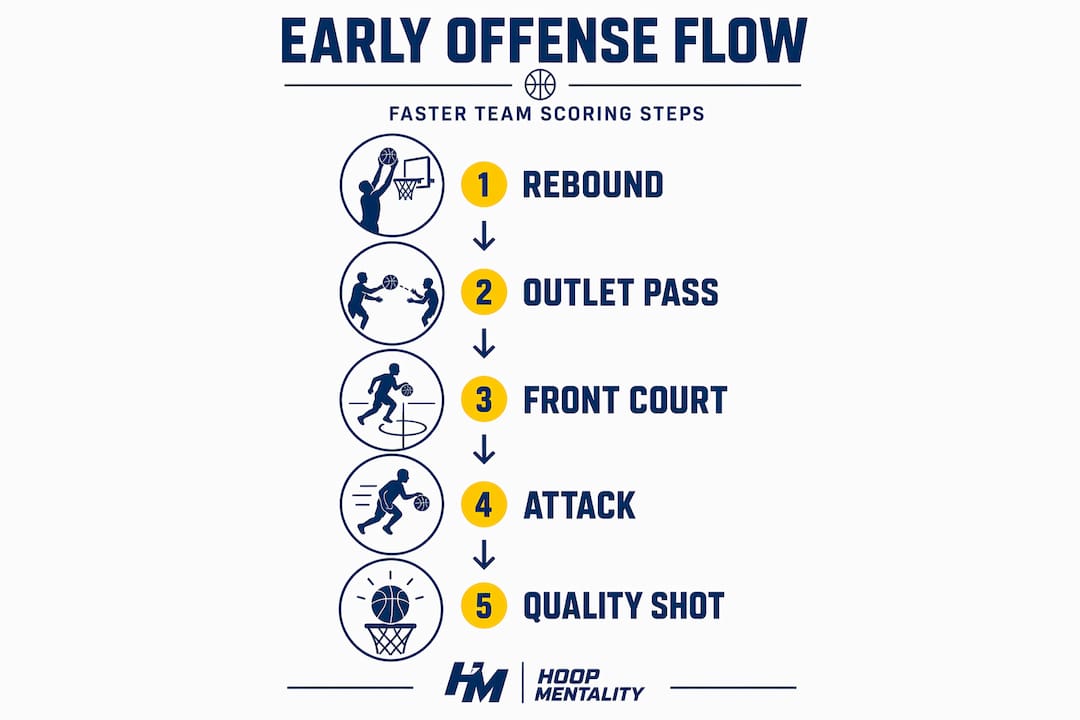
Start with this five-step process:
- Define your front-court entry target. Set a 2 to 3 second standard for getting the ball past half court. Time it in practice. Post the numbers.
- Install one early offense action first. Don’t try to run pistol action, 1-4 high, and a spread offense simultaneously in week one. Pick one action that fits your personnel.
- Run it off made baskets, not just misses. Many teams only push pace off defensive rebounds. Effective early offense also includes quick inbounds situations and press breaks that turn into early clock attacks. Popular schemes include 1-4 high, spread offenses, pistol action, and high ball screens.
- Film review one early offense possession per practice. Pick one good execution and one missed opportunity. Show both. Repetition of the visual pattern accelerates learning.
- Set a shot quality filter for early offense attempts. If a shot taken in early offense has under 50% expected value for that player in that situation, it doesn’t count as a successful early offense execution. Track makes and misses separately from early offense quality.
Here’s a quick comparison of popular early offense frameworks to help you choose the right fit:
| Scheme | Best for | Key action | Risk level |
|---|---|---|---|
| 1-4 high | Teams with skilled point guards | PG isolation or drive-kick | Low |
| Spread offense | Shooting-heavy rosters | Early catch-and-shoot threes | Medium |
| Pistol action | Athletic guards and bigs | Ball screen at top of key | Medium |
| High ball screen | Teams with versatile bigs | Pick-and-roll into early attack | Low to medium |
The types of motion offense used at different levels all connect to how early offense flows into half-court sets. Your early offense playbook should map that transition explicitly so players always know when to push and when to settle.
Pro Tip: Run a 3-minute early offense segment at the start of every practice, before any half-court work. It conditions the mindset before conditioning the body. Players learn that early offense is the first priority, not an afterthought.
Why mastering early offense timing is more valuable than raw speed
Here’s the part most coaching resources skip. Speed is overrated in early offense. Timing is everything.
Watch any team that runs what they call “up-tempo basketball” and loses turnovers in bunches. They’re moving fast. They’re not moving smart. The core principle behind early offense is timing: if your offense reaches the front court within 2 to 3 seconds, the defense is more likely reacting than acting, which leads to easier scoring. Two to three seconds. That’s the window. Not “as fast as humanly possible.”
A team of average athletes who consistently hit that 2 to 3 second window with disciplined reads will outscore a fast team that rushes every possession by halftime. The early offense timing insights that matter most to coaches aren’t about conditioning. They’re about targeting the exact moment the defense is most vulnerable.
Here’s the uncomfortable truth: coaches who train speed are building a habit that can work against them. When players are trained to run fast, they run fast even when the read isn’t there. They throw the ahead pass into a trap. They attack before the kick-out window opens. They create the illusion of early offense without the substance.
Train timing instead. Ask your players: “Was the defense organized when you attacked?” If yes, the possession wasn’t truly early offense, regardless of how quickly it happened. Discipline in hitting the right window, not raw pace, is what generates the advantages the data confirms.
Enhance your team’s early offense with Hoop Mentality resources
Translating early offense concepts from theory to practice takes structure. Hoop Mentality has the tools built for exactly that.

Start with the basketball practice plan template to build sessions that prioritize early offense timing drills before half-court work. Add the big man dual action drill to develop spacing and scoring contributions from your bigs in early offense situations. And use the complete early offense playbook to install schemes from 1-4 high to pistol action with clear progressions for any level. These resources are built from real coaching experience and designed to save you time while giving your players a repeatable system they can execute under game pressure.
Frequently asked questions
What exactly defines “early offense” in basketball?
Early offense refers to advancing the ball quickly into the front court, typically within 2 to 3 seconds of gaining possession, to attack before the defense is fully organized, creating easier scoring opportunities.
How does early offense improve team scoring efficiency?
By increasing possessions moderately and encouraging high-quality shot selection, early offense can boost offensive efficiency by 4 to 6 points per 100 possessions when executed with discipline.
Is rushing the ball the same as running early offense?
No. Rushing often leads to poor shot quality and turnovers. Early offense focuses on quick but purposeful movement, and coaches must train players to run with purpose, take high-quality early-clock shots, and avoid reckless passes.
How can coaches help players improve their early offense conversion rates?
By emphasizing both chance creation and finishing skills, including transition scoring drills and second-chance execution, since a team can create premium opportunities but still underperform if conversion is weak.
What are some popular early offense schemes to implement?
Common schemes include 1-4 high sets, spread offenses, pistol actions, and high ball screens, all designed to create spacing and quick scoring chances early in the shot clock.