

TL;DR:
- Defensive talk is real-time communication used to coordinate defense, reduce errors, and build trust. Coaches who emphasize it create psychologically safe environments that lead to more effective and resilient team defense. Building a culture of productive defensive communication takes patience, consistent practice, and modeling from coaches.
Defensive talk is the intentional, real-time communication among players designed to coordinate defense, reduce errors, and build trust under pressure. Coaches who understand why emphasize defensive talk as a core practice gain a measurable edge: psychological safety is the strongest predictor of team effectiveness, and it only exists where players feel safe speaking up. Without that foundation, even physically gifted defenders break down at critical moments. The standard industry term for this practice is defensive communication, and it covers every verbal cue, call, and confirmation players exchange to hold a defense together.
Why is defensive communication foundational to effective basketball defense?
Defensive communication is the connective tissue of any sound team defense. Physical skill determines what a player can do. Communication determines what the team actually does together. When players call out screens, switches, and rotations in real time, they eliminate the split-second confusion that leads to open layups and broken assignments.
Psychological safety enables this kind of open exchange. Research from Gallup and Google’s Project Aristotle identifies it as the single most critical factor in high-performing teams. A team that lacks psychological safety goes quiet under pressure, and a quiet defense is a vulnerable one.
Defensive talk also creates accountability without confrontation. When a player calls “ball screen left” and a teammate fails to react, the communication itself becomes the reference point. The breakdown is visible and correctable, not personal. That clarity shortens the feedback loop between error and adjustment.
“Shifting from defensive posturing to open dialogue transforms team tension into problem-solving and prevents the false consensus that kills competitive edge.”
The role of communication in coaching extends beyond X’s and O’s. Coaches who build communication habits in practice find those habits hold under game pressure, because the behavior is automatic, not chosen.
What causes defensiveness in team communication, and how can coaches manage it?
Defensiveness is a natural, self-protective response triggered when a player perceives a threat to their autonomy or self-image. The Gottman Institute classifies defensiveness as one of the “Four Horsemen” that predict dysfunction in relationships and teams. That classification matters for coaches because it reframes defensiveness from a character flaw into a predictable pattern with known solutions.
Defensive reactions are often non-conscious nervous system responses, not deliberate choices. A player who crosses their arms, goes silent, or deflects blame after a defensive breakdown is not being difficult. Their nervous system is protecting them from perceived failure. Coaches who recognize this shift from frustration to curiosity and get better results faster.
The following steps give coaches a repeatable process for managing defensiveness in the moment:
- Pause new information. Repeating points during defensiveness escalates the perceived threat. Stop adding content and let the player’s nervous system regulate before continuing.
- Validate before correcting. Validating a player’s perspective softens defensive posturing and opens the door to problem-solving. Say “I hear you, that rotation was tough to read” before explaining what went wrong.
- Use behavior-based language. Labeling someone as defensive shuts down the conversation because it functions as an identity attack. Replace “You’re being defensive” with “I noticed you turned away when I gave feedback. Can we talk about that?”
- Own part of the problem. Taking responsibility for even a small piece of a miscommunication signals collaboration, not blame.
- Offer a repair attempt. Calm, repeated offers to reconnect rebuild communication patterns over time.
Pro Tip: When a player goes silent after feedback, resist the urge to fill the silence with more explanation. That silence is regulation, not defiance. Wait it out, then re-engage with a question instead of a statement.
The emotional impact of defensive talk on a team is cumulative. Every interaction where a coach handles defensiveness well deposits trust into the team’s communication account. Every interaction where it escalates withdraws from it.
How can coaches build a culture of productive defensive talk?
Building a culture of productive defensive communication starts with the coach’s own behavior. Players mirror what they see. A coach who models softened start-ups and shared responsibility teaches those behaviors without a single lecture. The shift from “you missed the rotation” to “we need to tighten that rotation together” changes the entire emotional tone of a correction.
Supportive communication includes empathy and emotional presence. When players feel emotionally safe, they are more open to reflection and growth. That openness is what makes communication drills stick. Drills practiced in a low-trust environment produce mechanical responses. Drills practiced in a high-trust environment produce instinctive ones.
Coaches can use the following practices to build that culture consistently:
- Call-and-confirm drills. Run defensive shell drills where every switch, help, and rotation must be verbally confirmed before the drill counts. Silence is a reset, not a penalty.
- Film review with communication focus. Watch game film specifically for communication gaps, not just positional errors. Ask players “What were you saying here?” not “Why did you miss that?”
- Phrase libraries. Give players a short list of approved defensive calls: “ball,” “help,” “switch,” “I got ball,” “you got man.” Standardized language reduces hesitation.
- Post-practice debrief. End every practice with a two-minute open floor where players name one communication win and one gap. This normalizes honest dialogue.
The table below shows how communication behaviors map to defensive outcomes on the court.
| Communication behavior | Defensive outcome |
|---|---|
| Calling screens early | Fewer blown coverages on ball screens |
| Confirming switches verbally | Reduced mismatches in transition |
| Naming the help defender | Faster rotations on drive-and-kick plays |
| Acknowledging breakdowns calmly | Shorter recovery time after errors |
| Using repair attempts after conflict | Stronger communication in late-game pressure |
Pro Tip: Introduce a “communication grade” alongside a defensive grade in your post-game review. Players pay attention to what gets measured.
What are the measurable benefits of emphasizing defensive talk?
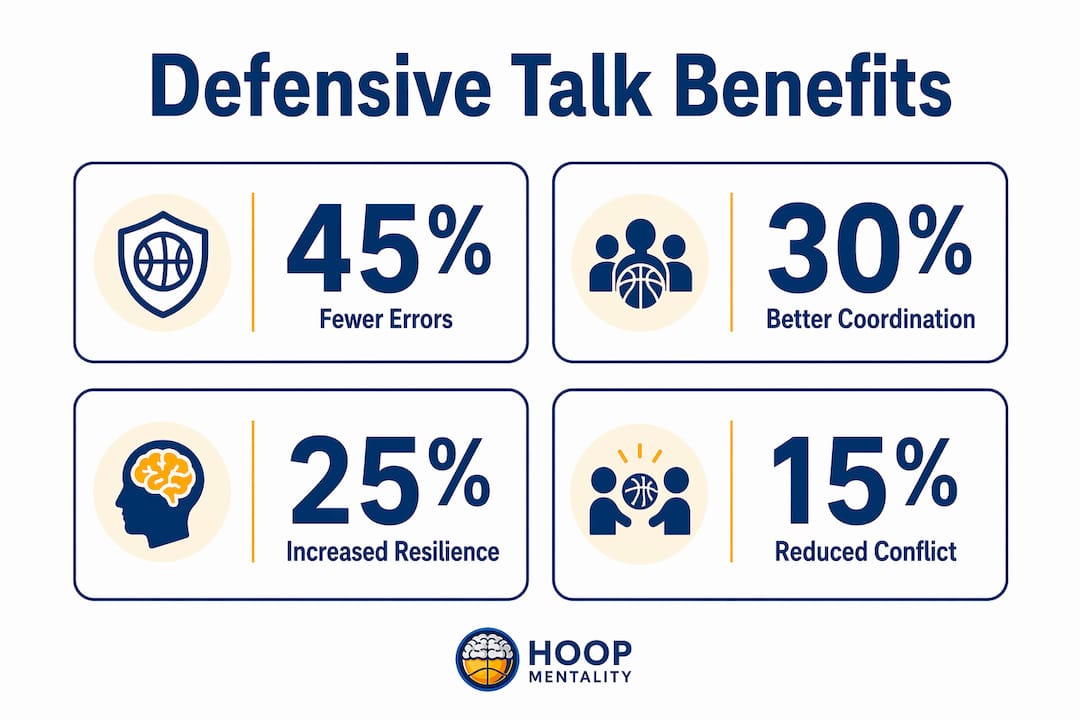
The benefits of defensive dialogue show up in concrete, observable ways during games. Teams with strong defensive communication make faster rotations because no player waits to see what a teammate will do. The verbal call removes ambiguity and triggers movement simultaneously across multiple defenders.
Player confidence rises when communication is clear. A defender who hears “I got help right” from a teammate takes a more aggressive on-ball stance. That confidence compounds: better on-ball defense forces more difficult shots, which leads to more misses, which leads to more transition opportunities.
“When coaches validate feelings before facts, defensive players soften and the door opens to collaboration.”
Shifting from defensive talk to dialogue also prevents false consensus, where players nod along without actually understanding the assignment. False consensus is invisible until a game situation exposes it. Strong defensive communication habits surface those gaps in practice, where they can be fixed.
Team resilience under pressure is another direct benefit. A team that communicates well during a run by the opponent can self-correct without a timeout. Players call adjustments, confirm coverage, and reset without waiting for a coach’s instruction. That independence is the mark of a defense that has internalized its system.
The importance of defensive communication also extends to reducing emotional conflict during games. When players have shared language and clear roles, blame has less room to take hold. Frustration still happens, but it resolves faster because the communication infrastructure is already in place.
Key Takeaways
Defensive communication is the single most direct path from individual defensive skill to coordinated team defense, and coaches who build it systematically outperform those who rely on talent alone.
| Point | Details |
|---|---|
| Psychological safety is the foundation | Players only communicate freely when they feel safe. Build trust before drilling talk. |
| Defensiveness is a nervous system response | Treat player defensiveness as a signal of misunderstanding, not resistance. |
| Behavior-based language prevents shutdown | Replace identity labels with observable behavior descriptions to keep dialogue open. |
| Softened start-ups lower tension | Owning part of a problem shifts the dynamic from blame to shared problem-solving. |
| Communication drills must be measured | Grading communication alongside defense makes it a real priority for players. |
What I’ve learned about defensive talk that most coaches overlook
The most common mistake I see coaches make is treating defensive talk as a skill to add on top of everything else. They run the shell drill, they teach the rotations, and then they say “communicate out there” as players take the floor. That instruction lands like a suggestion, not a system.
The coaches who get real results treat communication as the primary skill and everything else as secondary. They stop practice when the talk breaks down, not just when the positioning breaks down. That sends a message players remember.
The other mistake is confusing volume with quality. Loud teams are not always communicating well. A player who shouts “defense” repeatedly is filling space. A player who says “ball screen coming left, switch on contact” is actually coordinating. Teaching players the difference changes what they say and when they say it.
Patience matters more than most coaches expect. Building a culture of productive defensive dialogue takes a full season, not a week. The early weeks feel slow because players are self-conscious about talking. Push through that phase. By mid-season, the talk becomes automatic, and that is when the defense actually improves.
The shift from control to collaboration is the hardest part for coaches who are used to directing everything. Letting players call adjustments, correct each other, and own the communication builds something no amount of coaching from the sideline can replicate. It builds a defense that thinks.
— Dejan
Coaching resources that support defensive communication
Putting defensive communication into practice requires more than good intentions. It requires structure.

Hoop Mentality’s Basketball Starter Pack for Coaches includes practice plans, drill progressions, and communication frameworks built from real coaching experience. The Basketball Template Bundle for Coaches adds ready-to-use templates for defensive talk scripts, post-game reviews, and player feedback sessions. Both resources give you the structure to make defensive communication a measurable, repeatable part of your program, not just a talking point before tip-off.
FAQ
Why should coaches emphasize defensive talk over physical drills?
Defensive communication coordinates multiple players simultaneously, which no amount of individual physical training can replicate. Physical skill sets the ceiling; communication determines how close a team gets to it.
What is the most effective way to reduce player defensiveness during feedback?
Validate the player’s perspective before delivering a correction. This softens defensive posturing and makes the player receptive to problem-solving rather than self-protection.
How does psychological safety connect to defensive talk on the court?
Psychological safety is the condition that allows players to speak up, call errors, and correct each other without fear of embarrassment. Without it, players go silent under pressure and defensive communication collapses.
What language should coaches avoid when a player is being defensive?
Avoid labeling the player as defensive. Behavior-based language describes what you observed without attacking identity, which keeps the conversation open and productive.
How long does it take to build a defensive communication culture?
Building consistent defensive dialogue typically takes a full season of deliberate practice. Early weeks require patience as players overcome self-consciousness. By mid-season, the communication becomes automatic and the defensive improvement becomes visible.