


TL;DR:
- The dribble handoff is a deliberate offensive technique that creates mismatches and opens scoring opportunities. Proper mechanics, communication, and defensive responses are essential for its effectiveness in game situations. When integrated into complex offenses like Horns, it forces defenders into difficult choices and facilitates dynamic team play.
The dribble handoff looks simple. One player dribbles toward a teammate, hands the ball off while still moving, and the receiving player attacks. But what is a dribble handoff at a deeper level? It is a deliberate, choreographed action that forces defenses into split-second decisions they often get wrong. Used correctly, the DHO creates mismatches, opens shooters, and puts big men in impossible situations. This article breaks down the mechanics, the defensive responses, the advanced offensive sets built around it, and the drills that make it work in a real game.
Table of Contents
- Key Takeaways
- What is a dribble handoff and how it works
- Fundamental mechanics of the dribble handoff
- Defensive strategies against the dribble handoff
- Advanced offensive applications: Horns and elbow handoffs
- Coaching drills to build DHO competency
- My take on the dribble handoff after years of coaching
- Build better DHO execution with Hoopmentality
- FAQ
Key Takeaways
| Point | Details |
|---|---|
| DHO basics matter | The dribble handoff is a timed exchange that requires precise body positioning and communication to be effective. |
| Defense must communicate | Defenders need verbal calls and coordinated switches to stop the DHO from creating open shots or mismatches. |
| Horns offense relies on DHOs | Elbow handoffs in the Horns set force big men to guard in space, disrupting rim protection and shooter coverage. |
| Drills build real reads | Constrained drills that replicate live defensive pressure are the fastest path to DHO competency in games. |
| Discipline limits DHO success | Teams with organized defenses can neutralize DHOs by clogging lanes and staying home on shooters. |
What is a dribble handoff and how it works
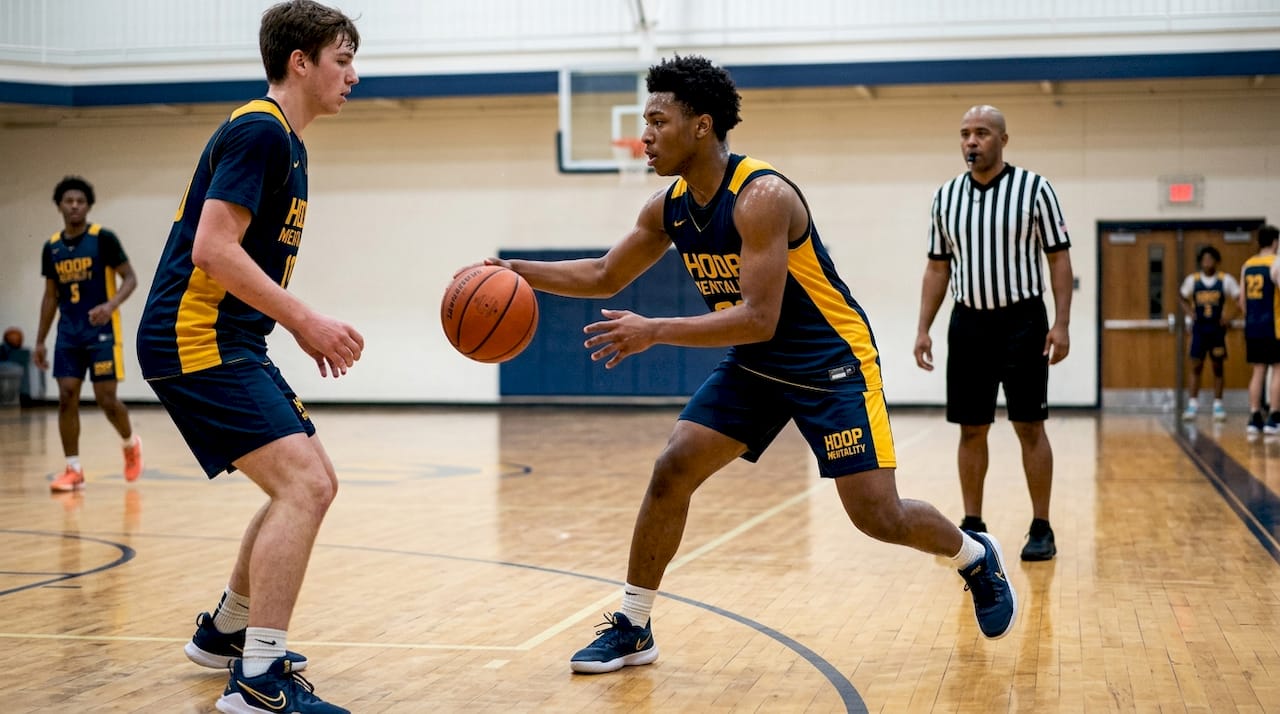
A dribble handoff is an offensive action where the ball handler dribbles directly toward a teammate, presents the ball, and the teammate takes it while the original handler becomes a screener or moves away. No pass is thrown. The ball transfers through direct contact while still in motion, which is what separates it from a standard handoff or a pass.
The key distinction is the screen element. The ball handler’s body naturally creates a barrier for the defender trailing the teammate receiving the ball. When done properly, that barrier is legal because the ball handler stops dribbling as the exchange happens. When done sloppily, it becomes a moving screen and a foul. This is why understanding the mechanics matters before you run it at game speed.
The dribble handoff belongs to a larger family of basketball dribble techniques that put defenses under pressure without requiring elite athleticism from every player. A 6-foot-8 big man standing at the elbow can run a textbook DHO and completely neutralize a quick guard defending him.
Fundamental mechanics of the dribble handoff
Getting the DHO right comes down to five repeatable steps. Rush any one of them and the play breaks down before the defense even has to work.
- Set your angle. The ball handler dribbles toward the teammate at a slight angle, not straight at them. Coming in straight compresses the space and makes the exchange awkward. A slight diagonal gives the receiver room to attack the lane.
- Read the gap. Before the exchange, the ball handler checks whether the defender on the receiver is playing high or low. That read dictates whether the play goes to a pull-up, a drive, or a kick-out.
- Protect the ball on the exchange. The ball handler keeps their body between the defender and the ball during the handoff. The receiver uses both hands to secure it cleanly.
- Stop the dribble. Timing and communication are critical here. The ball handler must stop their dribble at the moment of the exchange. Continuing to dribble after giving the ball off is a violation and a quick way to kill possession.
- Seal and move. After the handoff, the original ball handler sets their feet, seals the defender legally, and then either screens away, cuts back door, or relocates to the corner.
Common mistakes at every level include the ball handler moving sideways during the screen portion, which officials will call as an illegal moving screen. Poor spacing is the other killer. If the receiving player runs their route too close to the ball handler, there is no room to attack.
Pro Tip: Have the receiver give a subtle shoulder fake or take a half-step away before cutting toward the handoff. That tiny movement forces the defender to react and creates just enough separation to make the exchange clean and the subsequent attack uncontested.
Defensive strategies against the dribble handoff
Stopping the DHO consistently requires your defense to solve a two-person problem in real time. Most breakdowns happen because defenders are not on the same page before the action starts.
The two main defensive approaches are switching and gap containment. Switching on a DHO means the defender guarding the ball handler and the defender guarding the receiver call a switch the moment the action begins. Done early and loudly, this takes away the natural advantage of the screen. Done late, it creates a brief mismatch window that good offensive teams will exploit immediately.
Gap containment keeps defenders in their assignments but positions both of them to deny the attack angle. The off-ball defender stays higher in the gap with hands up to prevent back-cuts, while the on-ball defender steers the ball handler east-west rather than letting them attack the paint directly.
“Verbal calls and early communication are the difference between a switch that works and one that creates a wide-open three.” — Drew Valentine, Loyola University
Here is how the main defensive tactics compare:
- Switching. Quick and decisive. Removes the screen advantage entirely. Risk: size mismatches if a guard switches onto a bigger player.
- Gap containment. Keeps defenders with their assignments. Risk: requires elite timing and discipline, or the receiver attacks a small crease and draws a foul.
- Going over the handoff. The defender trails the receiver over the top of the exchange. Risk: gives up a step and can lead to a pull-up jumper or a quick drive.
- Going under the handoff. Effective against poor shooters. Risk: a capable shooter catches and fires with no contest.
Defensive communication is the variable that determines which tactic works. Disciplined defenses that clog passing lanes and call out actions early can completely shut down what looks like a perfect DHO set.
Advanced offensive applications: Horns and elbow handoffs
The DHO really shows its value when it sits inside a larger offensive system. The Horns offense is the best example. In a Horns set, two players start at the elbows and two are positioned in the corners. The point guard brings the ball up and initiates action at the top of the key.
Elbow handoffs in the Horns offense force the defensive big man guarding the elbow player to suddenly guard in open space, away from the paint. That is a problem for most traditional big men. They cannot guard the perimeter, so they either give up a shot or foul. Meanwhile, the help defender has to decide whether to stay home on the corner shooter or rotate toward the ball.
The Horns DHO series uses two primary entry types, each with a different purpose:
| Entry Type | How It Works | Key Advantage |
|---|---|---|
| Pass to Elbow | Guard passes to the elbow big, then cuts off the DHO | High-percentage play that loads the DHO from a stationary catch |
| Dribble Push | Guard dribbles at the elbow big and initiates the DHO in motion | Draws defenders toward the exchange and opens cuts and kick-outs |
The Pass to Elbow entry gives the big man time to set his feet and read the defense before the handoff. The Dribble Push entry is more aggressive. It creates scoring opportunities by pulling defenders toward the action, which opens back cuts and corner threes simultaneously.
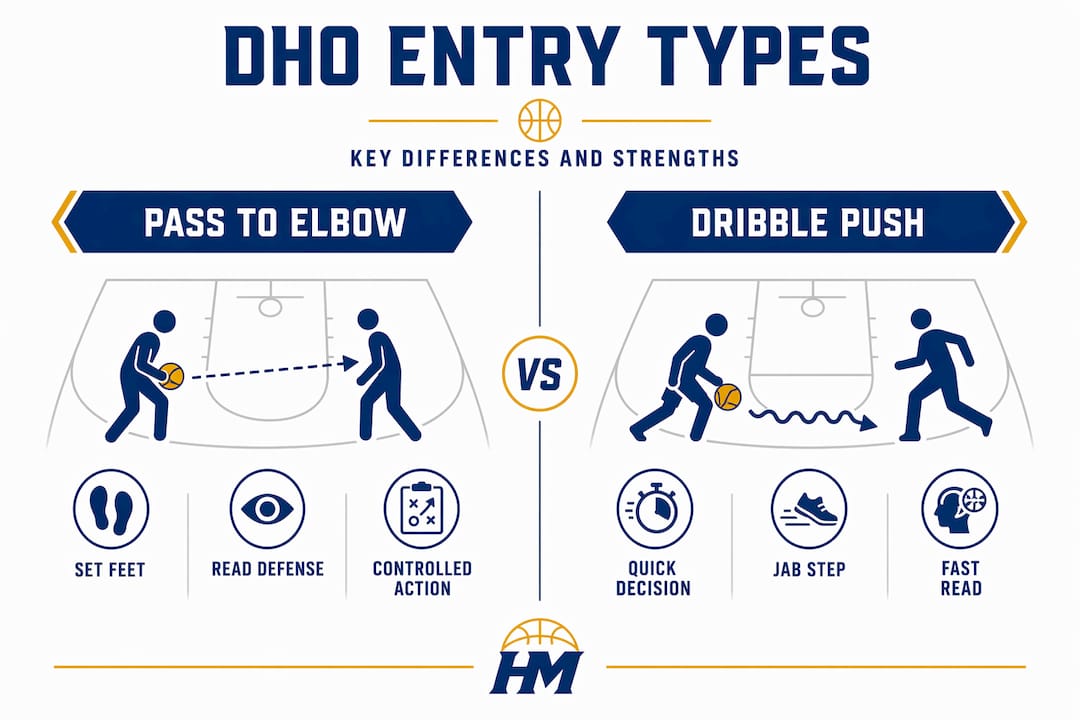
Pro Tip: When running a Dribble Push entry, have your big man take one hard jab step toward the paint just before the guard arrives. That one movement freezes the defending big and the helper, creating a half-second of indecision that is all a good offensive player needs.
The DHO acts as a hub for dynamic motion offense because it forces two or three defenders to make decisions at the same time. When one defender guesses wrong, the chain reaction opens a high-quality shot somewhere on the floor.
Coaching drills to build DHO competency
Teaching the dribble handoff in practice is about creating pressure that mirrors game conditions. Walking through it with no defense teaches the footwork. Putting defenders on the floor teaches the reads.
- 2-on-2 empty side DHO drill. Two offensive players run the handoff against two live defenders with no help available. Simulating situational constraints like forcing the defense to go over the handoff teaches the receiver to attack immediately. Focus: timing, first step, and kick-out reads.
- Elbow exchange drill. A big man stands at the elbow. A guard dribbles at them, completes the handoff, and the guard attacks. The big man reads the cut lane and either rolls, pops, or seals. Focus: big man footwork and guard attack angle.
- Constraint drill: force the switch. Defense is instructed to always switch. Offense must read the mismatch and attack it in two dribbles or less. Focus: post-switch exploitation and quick decision-making.
- 3-on-3 DHO series. Add a corner shooter to both the 2-on-2 formats. Now the ball handler after the exchange must read three options: drive, short roll pass, or kick-out three. Focus: offensive flow and reading multiple defenders.
Pro Tip: Run the empty side DHO drill without letting the defense communicate at first, then add full communication in the next rep. The contrast shows players exactly how much defensive talking affects their ability to attack. It makes the lesson stick.
Progress from no defense to shell defense to full live defense across a four-week block. Rushing to full live play before the footwork is locked in creates bad habits that take much longer to fix than the time it would have taken to build the skill correctly.
My take on the dribble handoff after years of coaching
I’ve watched coaches treat the DHO like a cheat code. Run enough of them, the thinking goes, and the defense will break down. What I’ve found is the opposite. Against a disciplined, well-coached defense, the DHO on its own generates nothing.
What the DHO actually does well is create context. It puts defenders in motion, forces decisions, and opens other actions on the floor. The teams I’ve seen get the most out of it use it as one piece of a connected system, not a standalone answer to a defensive problem.
I’ve also seen the moving screen problem end possessions at the worst moments. Players who practice the DHO slowly and cleanly during drills start rushing it when the game speeds up. The ball handler’s feet keep moving during the screen, the official calls it, and a great offensive sequence ends in a turnover. That is a timing and discipline failure, not a design failure.
My honest advice: build your DHO around your team’s strengths. If your big can shoot, use the Horns entry to get him a catch-and-shoot look. If your guard is faster than everyone, use the DHO to get him the ball in space. The play itself does not score. The players reading the defense after the exchange score.
— Dejan
Build better DHO execution with Hoopmentality
Ready to put this into practice? Hoopmentality has the resources to help.

The Big Man Dual Action Drill is built specifically for the kinds of decisions big men face in DHO actions. It covers reads, footwork, and roll-versus-pop choices that directly apply to the Horns sets covered above. If your big men are getting lost during handoff sequences, this drill gives them a clear decision framework.
For coaches who want a full system, the Game Preparation Guide with Weekly Practice Plan integrates DHO plays into a structured weekly schedule. You get practice plans, set plays, and a preparation framework that builds team-wide fluency over a full season. Both resources are available now at Hoopmentality.
FAQ
What does dribble handoff mean in basketball?
A dribble handoff is an offensive action where the ball handler dribbles toward a teammate and hands the ball off directly, using their body as a legal screen during the exchange. No pass is thrown.
How is a dribble handoff different from a regular pass?
In a dribble handoff, the ball transfers through direct physical contact while the handler is moving, not through the air. The handler’s body also creates a screening action that a regular pass cannot provide.
What is the most common defensive mistake against a DHO?
Late communication is the most common error. When defenders call a switch after the exchange has started, the receiver gets a free step to attack the paint or pull up for a mid-range shot.
Can a dribble handoff be used at every level of basketball?
Yes. The core mechanics apply from youth basketball through the NBA. Execution quality and the complexity of the sets built around it scale with player skill, but the basic exchange and screen concept works at any level.
Why does the Horns offense use so many dribble handoffs?
The Horns DHO series forces big men to guard away from the paint, creating simultaneous pressure on rim protection and perimeter coverage. Defenses cannot solve both problems at once without leaving someone open.