

TL;DR:
- Players who master basic mechanics with precision and aggression are more effective at attacking the rim than those relying on flashy moves.
- Consistent dribble penetration forces defenses to rotate, creates scoring opportunities, and enhances offensive efficiency, emphasizing fundamental skills over elaborate moves.
Most coaches assume their players need more moves. A better crossover. A smoother hesitation. A tighter in-and-out. But here’s what film sessions and practice data consistently show: the players who get to the rim most reliably aren’t the ones with the biggest bag of tricks. They’re the ones who execute the basics with precision and aggression. This guide breaks down exactly what dribble penetration means, why it works, how to teach the mechanics, and how to structure your practices so your team gets real results on game night.
Table of Contents
- What is dribble penetration and why it matters
- Fundamental mechanics for effective dribble penetration
- Comparing flashy moves to disciplined fundamentals
- Teaching and practicing dribble penetration in team settings
- Why disciplined fundamentals outpace highlight moves in real games
- Unlock your team’s dribble penetration potential with Hoop Mentality
- Frequently asked questions
Key Takeaways
| Point | Details |
|---|---|
| Value of penetration | Dribble penetration reliably breaks down defenses and creates high-percentage scoring chances. |
| Master the basics | Lower dribble, strong stance, and strategic body positioning are the cornerstone fundamentals for coaches to teach. |
| Fundamentals beat flash | Tight, mistake-free dribbling outperforms flashy moves in real-game settings at all levels. |
| Practice under pressure | Teaching and drilling penetration with live defenders prepares players for game-like situations and improves outcomes. |
What is dribble penetration and why it matters
Dribble penetration is the act of attacking the defense off the dribble with the goal of entering the paint. It forces defensive rotations, collapses coverage, and creates scoring opportunities at the rim or for open teammates. Simple definition. Massive impact.
When a ball handler drives into the lane, defenders must make choices fast. Does the help defender step up? Does the corner shooter’s defender collapse? Does the big man leave his assignment? Every rotation creates a gap. That gap becomes a layup, a kick-out three, or a dump-off to a cutter. The ball handler doesn’t even need to score. The penetration itself does the work.
Here’s what effective dribble penetration actually creates for your offense:
- Forces help defenders to rotate, opening shooters in the corners and on the wings
- Creates free throw opportunities through contact at the rim
- Puts the defense in a scramble mode, breaking their structure
- Establishes a threat that keeps defenses honest on set plays and actions
- Opens up secondary actions like lob passes and short roll opportunities
“The best penetration doesn’t come from a flashy first step. It comes from reading the defense and attacking the right gap at the right moment.”
Quality penetration isn’t about highlight-reel moves. Basic dribble-penetration mechanics include ball-height control, lower-bounce in traffic, and body positioning using the off-arm and body as a shield to reduce steals and keep the dribble live under defensive pressure. Understanding the dribble drive offense framework gives coaches important context for how penetration fits into a complete offensive system.
When you coach with this mindset, your players stop trying to create separation with tricks. They learn to read, attack, and execute.
Fundamental mechanics for effective dribble penetration
Once you understand why penetration matters, the next step is getting the mechanics right. This is where player development happens. Not in learning a new signature move, but in refining the physical habits that keep players in control when the defense gets physical.
Here are the core mechanical priorities every player must develop:
- Dribble height. Keep the dribble low, below the knee, when driving into traffic. A higher bounce gives defenders more time and more surface to strip the ball. Only raise the dribble height when spacing opens up and no defender is within arm’s reach.
- Athletic stance. Knees bent, chest tall, weight forward. This position gives players balance, explosion, and the ability to change direction quickly. Flat-footed players get stopped at the point of attack every time.
- Off-arm shield. The non-dribbling arm acts as a bumper. Coaches need to teach players to use the forearm and body as a legal shield to protect the ball from reaching hands. This is not about fouling. It’s about body control and spatial awareness.
- Ball placement in traffic. Keep the ball on the outside hip relative to the nearest defender. This reduces the angle for a steal and keeps the dribble under the player’s own center of gravity.
- Fingertip control. Pushing the ball with fingertip pads instead of the palm gives players precise touch. Palm dribbling is loose and unpredictable. Fingertips give you feel and control at speed.
“Low stance, low dribble, off-arm protection. Those three cues solve 80% of the turnover problems coaches face in penetration drills.”
You can find a complete basketball fundamentals checklist that covers these mechanical priorities in a structured coaching format. If you want to build these habits faster, organizing drills by type is equally important. Explore different ball handling drill types to sequence your practice progressions effectively.
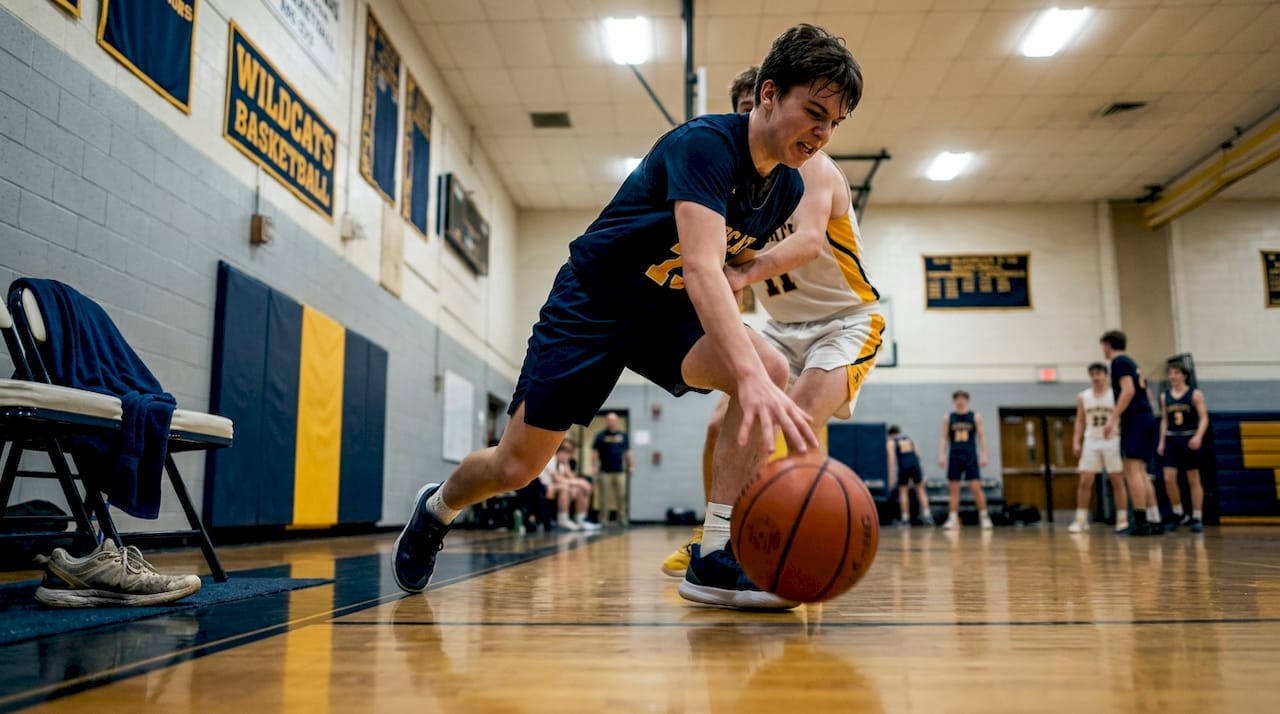
Pro Tip: These fundamentals must live in your breakdown drills AND your live action. If you only coach them in warmups, players won’t apply them under pressure. Build cues into your 1-on-1 and 3-on-3 scenarios so the habit transfers to games.
Comparing flashy moves to disciplined fundamentals
Here’s where it gets honest. Social media, training videos, and skill trainers often push elaborate ball-handling packages. Coaches watch players work on spin moves, Steph-style hesitations, and between-the-legs combos. It looks sharp. But what does it do for your offense in a competitive game?
The answer, too often, is not much. Fewer mistakes at speed and tighter fundamentals, like stance, touch, and timing, produce more real-game offensive value than adding new moves. That finding is consistent across multiple levels of play.
Here’s a side-by-side breakdown:
| Factor | Flashy moves | Disciplined fundamentals |
|---|---|---|
| Learning curve | High, takes months to build reliability | Low to moderate, builds quickly with reps |
| Turnover risk | Higher, especially under physical defense | Lower, consistent execution under pressure |
| Applicability | Situational, works best in space | Universal, works in traffic and tight coverage |
| Coachability | Difficult to correct mid-season | Easy to cue and reinforce in practice |
| Game value | Inconsistent, depends on defender reaction | Consistent, repeatable scoring opportunities |
| Team impact | Individual, limited assist creation | High, forces rotations and opens teammates |
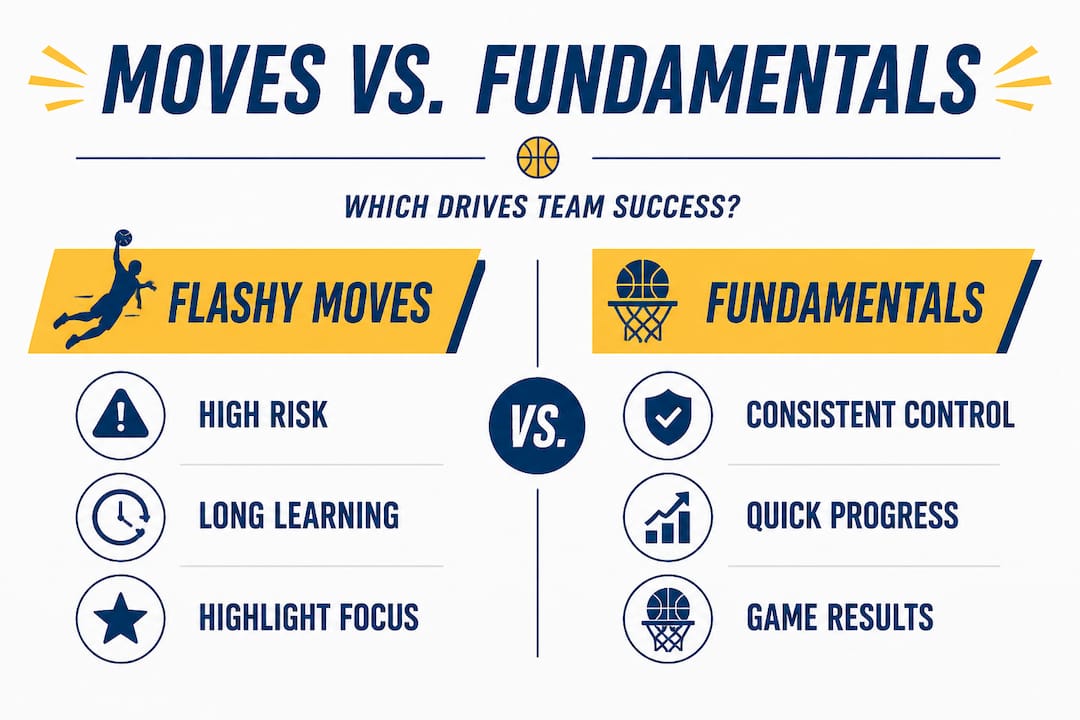
Review your offense techniques guide to see how fundamentals connect to broader offensive strategy. The coaches who succeed long-term at every level, from youth leagues to college programs, build their offensive identity around confident coaching fundamentals rather than skill packages that only work for one or two players on the roster.
Watch for these signs your players are over-relying on tricks instead of technique:
- They hesitate at the point of attack instead of attacking immediately
- Turnovers spike when defense adds physicality or ball pressure
- Players look for the “move” before reading the defense
- Drive attempts stall at the elbow instead of reaching the paint
- Decision-making slows down when defenders play honest
These are correctable patterns. But they require you to shift practice focus toward value metrics, not visual appeal. And understanding why basketball fundamentals matter at every age level is essential background for any coach committed to long-term player development.
Pro Tip: Track successful paint touches per possession, not highlight clips, as your primary measure of penetration success. If your players are reaching the paint more often, your offense is improving. If they’re getting stopped at the three-point line with a smooth hesitation, you’re practicing entertainment.
Teaching and practicing dribble penetration in team settings
Understanding the difference between moves and fundamentals is half the battle. The other half is building a practice structure that actually develops penetration skills at the team level.
Here’s how to layer penetration skill development from the ground up:
- Breakdown drills. Start without defenders. Focus purely on mechanics: dribble height, stance, fingertip control, off-arm position. Use cones or chairs to simulate defensive pressure before live bodies get involved.
- Guided 1-on-1 sets. Add a defender with instructions to play passive at first. The ball handler works on reading hip position and attacking gaps. The defender is a tool, not a full competitor yet.
- 2-on-2 and 3-on-3 scenarios. Now the ball handler must make the second decision. Drive and read the help. Kick to the shooter. Hit the roll man. This is where penetration becomes a team skill, not an individual one.
- Reaction training. Live-ball drills with defenders that focus on body positioning and dribble protection simulate the real pressure coaches must recreate for player development. Make defenders rotate realistically.
- 5-on-5 integration. Run your full offense but track penetration metrics separately. Count paint touches. Count kick-out assists off drives. Count trips to the free throw line from drives. This gives you real data on whether your practice work is transferring.
Here’s an example practice format that layers penetration skills across a 90-minute session:
| Time block | Activity | Focus area |
|---|---|---|
| 0-10 min | Warmup dribbling | Fingertip control, stance, dribble height |
| 10-20 min | Breakdown drills (no defense) | Ball placement, off-arm mechanics |
| 20-35 min | Guided 1-on-1 sets | Reading hip angle, attacking gaps |
| 35-50 min | 2-on-2 and 3-on-3 | Decision after drive, kick-out reads |
| 50-65 min | Live-ball drills with defenders | Pressure response, body protection |
| 65-80 min | 5-on-5 with tracking | Paint touches, assist creation off drives |
| 80-90 min | Film and feedback | Cueing corrections for next practice |
For more detailed drill progressions organized by skill level, explore scoring off the dribble resources and the offensive flow guide to see how penetration slots into team motion concepts. If you’re coaching younger athletes, the youth skill breakdown resources offer age-appropriate progressions for these same mechanics.
Pro Tip: Use an assistant coach or a designated defender to simulate help defense reactions specifically. The ball handler needs to see a rotating body, not an open lane, so they practice the full decision-making sequence. This one adjustment accelerates transfer from drill to game faster than almost anything else.
Why disciplined fundamentals outpace highlight moves in real games
Here’s the uncomfortable truth that most coaches figure out after a few seasons of over-coaching moves: the teams that score consistently off dribble penetration are not the teams with the most skilled individual ball handlers. They’re the teams where every player understands their role in the penetration action, executes the fundamentals without thinking, and makes the right second decision after the drive.
Flashy handle packages get attention in training videos. But multiple development sources confirm the same finding: tighter fundamentals at speed produce more offensive value in games. That’s not a knock on skill development. It’s a priority ranking.
The best teams we’ve seen at every level track penetration results, not just successful highlights. They know their paint touch rate per game. They know their drive-to-assist ratio. They know which players are getting stopped at the charge circle and which ones are creating rotations. That data tells you what to fix in practice. Highlight clips tell you almost nothing useful.
What most coaches learn the hard way is that turnovers and wasted possessions usually trace back to over-complication, not lack of skill. Players try an extra move when the first gap was already there. They hesitate looking for the perfect angle and lose the momentum of their drive. They add a jab step to a situation that just needed a straight attack.
The basketball offense essentials framework puts penetration in proper context alongside other offensive tools. When coaches teach it as a fundamental skill, not a showcase skill, players understand it differently. They stop trying to win the penetration with style and start trying to win the possession with results.
Disciplined penetration leads to more paint touches. More paint touches lead to more free throws, more layups, and more open teammates. That’s the chain that wins games.
Unlock your team’s dribble penetration potential with Hoop Mentality
You’ve got the framework. Now it’s time to put the right tools in your coaching toolbox.

Hoop Mentality offers resources built specifically for coaches who want to organize their practice time more effectively and implement proven systems without starting from scratch. The basketball practice plan template gives you a structured format to build your penetration progressions into every session with clear time blocks, drill sequences, and feedback loops. For coaches developing post players and interior options off penetration actions, the big man dual action drill connects dribble drive reads to big man scoring in one practical resource. Both tools are ready to use. No setup required.
Frequently asked questions
What’s the primary purpose of dribble penetration in basketball?
Dribble penetration collapses the defense to create open shots, layups, or easier passing options. It forces rotations that create scoring advantages for the entire offense, not just the ball handler.
How can coaches reduce turnovers during dribble penetration?
Focus on lower dribble height, correct body position, and clear decision cues to maintain control against defenders. Teaching players to keep the ball on the outside hip in traffic solves most common strip scenarios.
Are advanced moves necessary for successful dribble penetration?
No. Tight fundamentals at speed are usually more effective than complex dribbling moves. Most defenders react to decisiveness and correct angles, not to elaborate ball-handling sequences.
What drills best teach dribble penetration under pressure?
Live-ball drills with defenders that focus on protecting the dribble and reacting to defensive help are most effective. The key is making defenders rotate realistically so ball handlers practice the full decision-making sequence, not just the initial drive.