

TL;DR:
- Strong team culture improves communication, accountability, and performance in youth basketball.
- Building shared values and consistent reinforcement creates trust and reduces toxic environments.
- Focusing on culture can often have greater impact than skill development alone.
Talent gets attention. Culture wins games. Many coaches spend most of their energy recruiting skilled players or running complex offensive sets, yet the teams that consistently perform well often share something less visible: a strong team culture. Strong team culture improves communication, collaboration, and performance in youth basketball by building connection, accountability, and shared values across every player on the roster. If your team struggles with communication breakdowns, low motivation, or inconsistent effort, the answer may not be a new play. It may be a culture problem.
Table of Contents
- What is team culture and why does it matter?
- The science: How team culture drives performance
- Toxic vs high-performance cultures: What the evidence reveals
- Frameworks and actionable strategies: Building a great team culture
- Hard-won lessons: The uncomfortable truth about team culture
- Build your winning team culture with Hoop Mentality
- Frequently asked questions
Key Takeaways
| Point | Details |
|---|---|
| Culture drives results | A strong team culture leads to better communication, collaboration, and player growth. |
| Evidence-based impact | Research links team culture to measurable improvements in skills, engagement, and performance. |
| Toxicity harms teams | Toxic cultures cause high turnover and undermine success, no matter the talent level. |
| Action starts small | Meaningful improvements often begin with small, consistent actions by coaches and players alike. |
What is team culture and why does it matter?
Team culture is the set of values, behaviors, and expectations that shape how a group operates together. It is not a poster on the locker room wall. It is what players do when no one is watching, how they treat each other after a bad loss, and whether they hold themselves accountable without being told. Defining team culture clearly is the first step every coach needs to take before building anything else.
Many coaches focus almost entirely on skill development. That makes sense. You want players who can shoot, defend, and execute. But skill without culture creates fragile teams. A player who is talented but disengaged, or a group that lacks trust, will underperform their potential every time. Coaching for team success means treating culture as a core part of your system, not an afterthought.
Here is what strong team culture actually delivers:
- Better communication on and off the court
- Higher accountability among players without constant coach intervention
- Stronger collaboration in high-pressure moments
- More enjoyment, which keeps players coming back season after season
- Lower player turnover, which means your system builds over time
The numbers back this up. 60% of youth basketball struggles come from weak team dynamics, not a lack of individual talent. That is a striking figure. It means most of the problems you face as a coach are cultural, not technical. Teamwork tips for coaches consistently point to shared values and clear expectations as the foundation for fixing those problems fast.
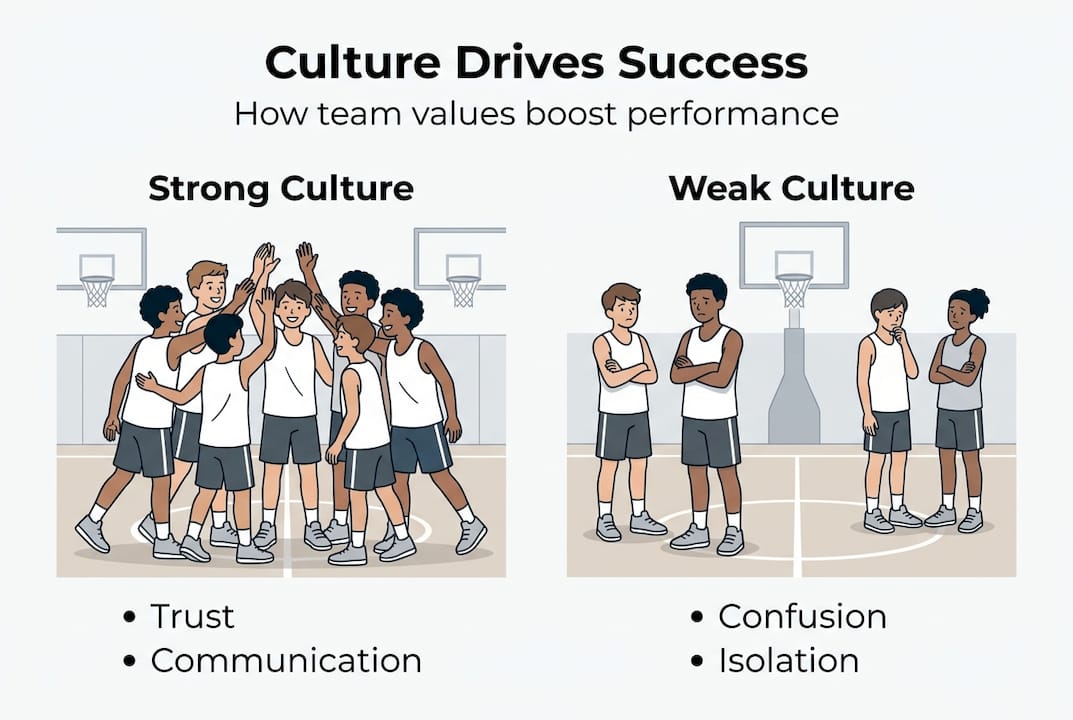
When culture is strong, players communicate better during games, step up in clutch moments, and support each other through adversity. When culture is weak, even talented rosters fall apart under pressure.
The science: How team culture drives performance
Research now gives us clear data on why culture matters so deeply. It is not just a feel-good concept. The coach-athlete relationship quality predicts training engagement at r=0.52, skill improvement at r=0.38, and mediates 46% of the effect on shooting skills. Those are strong correlations. The relationship between a coach and player is not just emotional. It is a direct driver of measurable skill growth.
Three key mechanisms explain how culture shapes performance:
Psychological safety means players feel safe to make mistakes, ask questions, and try new things without fear of humiliation. Teams with high psychological safety learn faster and adapt better under pressure.
Shared mental models mean every player understands their role and anticipates what teammates will do next. This is what makes a team look like they can read each other’s minds. It is not magic. It is culture.
Implicit coordination is when players adjust to each other without needing verbal instructions. It only develops when trust and shared expectations are deeply embedded in the team’s daily habits.
Here is a summary of what the research shows:
| Factor | Outcome | Effect size |
|---|---|---|
| Coach-athlete relationship | Training engagement | r = 0.52 |
| Coach-athlete relationship | Skill improvement | r = 0.38 |
| Positive team culture | Shooting skill development | 46% mediation |
| Shared mental models | Implicit coordination | Significant positive |
Building strong coach-player relationships is not soft coaching. It is evidence-based performance strategy. When you invest time in knowing your players, understanding their motivations, and creating an environment where they feel valued, you are directly improving their on-court output. Learning how to develop team chemistry is one of the highest-return investments you can make as a coach.
“Team cognition and shared mental models enable implicit coordination. A positive culture consistently outperforms raw talent alone when sustained over a full season.”
This is why two teams with similar rosters can produce wildly different results. The difference is almost always culture.
Toxic vs high-performance cultures: What the evidence reveals
Not all team environments are equal. Toxic culture in sports is more common than coaches admit, and its consequences are severe. Research shows that toxic culture leads to 10x more quits than poor pay or poor facilities. Players do not leave bad programs. They leave bad environments.
Here is how toxic and high-performance cultures compare:
| Indicator | Toxic culture | High-performance culture |
|---|---|---|
| Communication | Blame-focused, closed | Open, honest, two-way |
| Accountability | Selective or punitive | Shared and consistent |
| Player retention | High turnover | Strong loyalty |
| Teamwork | Cliques, individualism | Collective effort |
| Outcomes | Inconsistent, declining | Sustained improvement |
Signs of a toxic culture include constant conflict between players, coaches who favor stars while ignoring bench players, and a lack of clear expectations. Pay inequity erodes cooperation even in professional basketball, and the same principle applies at the youth level. When players feel that effort and contribution are not recognized fairly, cooperation breaks down fast.
Negative outcomes of a toxic culture include:
- Low motivation and disengagement at practice
- High player dropout rates between seasons
- Poor execution under game pressure
- Damaged relationships between players and coaches
- A reputation that makes recruiting harder over time
Building strong leadership for team culture means addressing these warning signs early. Do not wait for a losing streak to examine your environment.
Pro Tip: Recruit “force multipliers,” players who elevate everyone around them regardless of their individual stats. One positive leader on your bench can shift the entire team’s energy. Explore team bonding ideas to reinforce that dynamic intentionally.
Frameworks and actionable strategies: Building a great team culture
Knowing culture matters is one thing. Building it is another. Here is a practical step-by-step approach you can start using this week.
- Define your program values. Write down three to five non-negotiable values. Make them specific. “Respect” is vague. “We communicate directly and without blame” is actionable.
- Set team rules together. Players who help create the rules are far more likely to follow them. Review youth team rules frameworks to structure this conversation.
- Establish accountability systems. Culture without accountability is just talk. Use basketball accountability systems to create consistent, fair follow-through.
- Invest equally in every player. Bench players set the tone for your culture more than starters do. If they feel valued, your culture is strong. If they feel invisible, it is fragile.
- Use repetition as a tool. Continuous improvement frameworks show that program-first thinking, where the program’s identity comes before team or individual goals, creates sustainable cultures. Repeat your values at every practice.
Low-resource activities that build culture fast:
- Weekly team meetings with open discussion time
- Shared pre-game rituals that every player participates in
- Peer mentorship pairings between veterans and newer players
- Post-practice reflection questions focused on team behavior, not just performance
Pro Tip: Repetition is a gift. The coaches who build the strongest cultures are not the ones with the best speeches. They are the ones who say the same things, model the same behaviors, and hold the same standards every single day.
Start small. Pick one value. Reinforce it daily. Expand from there.
Hard-won lessons: The uncomfortable truth about team culture
Here is what most coaching resources will not tell you. Culture work feels slow, and most coaches abandon it the moment wins become the priority. That is the mistake.
We have seen talented rosters collapse in playoff games not because of poor execution, but because players did not trust each other when it counted. The research supports this. Program-first thinking consistently outperforms talent-first thinking over a full season. Psychological safety, equity, and genuine buy-in from every player are not nice extras. They are the engine.
The hardest lesson is this: your bench players define your culture more than your stars do. Stars often have external motivation. Bench players are watching to see if you actually mean what you say. If they feel valued, your culture is real. If they feel like props, your culture is performance.
Building real team chemistry takes longer than a preseason camp. It takes a season of consistent choices. The coaches who commit to it do not just win more games. They build programs that players want to be part of for years.
Build your winning team culture with Hoop Mentality
If you are ready to put these lessons into action, Hoop Mentality has the tools to help you move fast.

Hoop Mentality offers practice plans, drills, and leadership resources built from real coaching experience. Use our practice plan template to structure sessions that reinforce your culture values every day. Add targeted skill work with tools like the Big Man Dual Action Drill to keep every player engaged and developing. Every resource is designed to save you time, improve communication with your players, and help you build a program that wins consistently.
Frequently asked questions
How does team culture affect youth player engagement?
Team culture directly shapes how motivated and connected players feel, with training engagement showing a correlation of r=0.52 with coach-athlete relationship quality. Strong culture keeps players showing up and working hard every practice.
What are the main signs of a toxic team culture?
Frequent conflicts, low motivation, and high player turnover are the clearest indicators. Research confirms that toxic culture causes 10x more player exits than compensation issues.
Can team culture really matter more than talent?
Yes. Shared mental models enable implicit coordination, and teams with strong culture consistently outperform more talented but disconnected rosters over a full season.
How can a coach start improving team culture today?
Start by setting two or three clear team values and discussing them openly with your players. Consistent reinforcement and shared accountability build trust faster than any single team-building activity.
Recommended
- How to Coach Youth Basketball for Team Success – Hoop Mentality
- How to Develop Team Chemistry for Basketball Success – Hoop Mentality
- 7 Essential Basketball Teamwork Tips for Youth Coaches – Hoop Mentality
- Basketball Leadership Guide: Build Strong Team Culture – Hoop Mentality
- How team spirit transforms marathon training: 67% stay consistent - MK Marathon Weekend, Milton Keynes 3-4 May 2026