

The role of time management for a basketball coach comes down to three things: how you divide practice minutes, how you control tempo, and how you run the clock and timeouts when a game is on the line. Coaches who plan this ahead of time make fewer late-game errors and win more close games than those who wing it. Three moves to start today:
- Print a timed practice template and post it where your staff and players can see it.
- Designate one assistant as your bench manager for dead-ball situations.
- Rehearse a two-for-one scenario at full speed before your first game.
Key Takeaways
Disciplined time allocation in practice combined with rehearsed, delegated in-game clock and timeout roles is what separates teams that execute late-game situations from teams that guess.
| Point | Details |
|---|---|
| Time your practice blocks | Divide sessions into warmup, skill work, team concepts, scrimmage, and cooldown with a visible timer enforcing each transition. |
| Set sliding-scale rules early | Agree on fouling and tempo thresholds with your staff before the season, not during a live timeout. |
| Delegate bench roles | Assign a timeout communicator and a substitution manager so dead-ball situations run on a script, not improvisation. |
| Rehearse the endgame weekly | Run a live two-minute drill from a random score and clock each week to make late-game decisions automatic. |
| Use a ready-made template | Hoop Mentality’s practice plan template and drill packs give you a structured starting point instead of building your timing system from scratch. |
Table of Contents
- How Should You Structure Practice Time?
- How Do You Manage the Game Clock and Timeouts?
- How Do You Build Tempo Into Practice Design?
- What Systems Keep Your Staff on the Same Page?
- What Does Time Management Actually Mean?
- What Are the Core Principles of Effective Time Management?
- What Gets in the Way of Good Time Management?
- What Do You Actually Gain From Managing Time Well?
- What Tools Actually Help With Time Management?
- How Does Time Management Change Across Settings?
- Sources
- FAQ
How Should You Structure Practice Time?
Every minute of practice should have a job. Break your session into blocks with a start time, an end time, and a purpose, then hold yourself to the clock as strictly as you’d hold a player to a defensive assignment. A standard practice plan divides time into warmup, individual skill work, team concepts, competitive play, and cooldown, and that five-part structure works whether you’re running a 60-minute youth session or a 90-minute varsity practice.
For a 60-minute practice, a workable split looks like this:
- Warmup and ball handling: 8 minutes.
- Individual skill stations: 15 minutes.
- Team concepts (offense/defense): 20 minutes.
- Competitive scrimmage or situational play: 12 minutes.
- Cooldown and teaching points: 5 minutes.
Stretch that to 90 minutes and you get more room for stations and live reps: warmup (10 minutes), skill stations (20 minutes), team concepts (25 minutes), scrimmage (25 minutes), cooldown (10 minutes). Practice duration should also match the age group in front of you. Youth players hold focus for 45 to 60 minutes, middle schoolers can handle 60 to 75, and high school teams can sustain 90 to 120 minutes if the quality of reps stays high. A long practice with sloppy execution teaches bad habits faster than a short, sharp one teaches good ones.
Season phase changes the ratio, too. The FIBA coaching manual recommends spending more time on fundamentals and skill development in the off-season, then shifting to a faster in-season rhythm built around game preparation and situational work, with clear season objectives to measure whether the plan is actually working. Our guide on organizing practice plans walks through this mapping in more detail, and you can pull ready-made examples from our sample practice plan library to skip the blank-page problem.
Enforce transitions with a visible countdown timer and pre-set equipment for the next drill before the current one ends. Assign one assistant to manage the whistle and the clock so you can coach instead of watching a stopwatch. The 80/20 rule applies here too: spend most of your practice reps on the high-frequency situations that decide most games, not on low-probability trick plays.
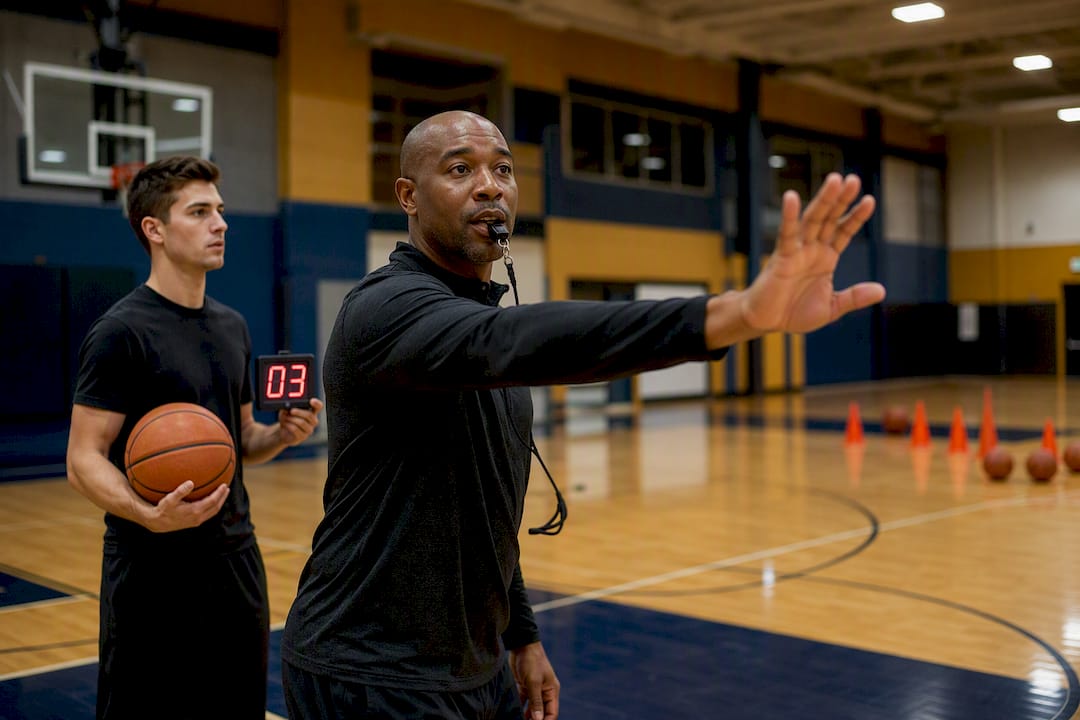
Pro Tip: End every practice with a two-minute live drill simulating the final possessions of a close game. It costs almost nothing in time and pays off the first time your team faces a real one.
How Do You Manage the Game Clock and Timeouts?
Late-game decisions should never be improvised. Clock management works best when it’s rehearsed in practice regularly enough that the decision-making becomes automatic rather than something your players and staff have to think through under pressure.
Set sliding-scale rules before the season starts, not during a timeout with the clock running. A basic framework:
- Down 3 or fewer with under 2 minutes on a shot clock level: play for the best shot, don’t rush.
- Down 4 to 7 with under 90 seconds: begin fouling on the next defensive possession rather than waiting.
- Down 8 or more with under a minute: foul immediately and push tempo on offense.
- Ahead by any margin inside the final two minutes: use the two-for-one, and know exactly how many seconds you want run off before the shot goes up.
These thresholds shift for leagues without a shot clock, where clock control depends more on possession management than forced misses. Pre-season staff agreements on these numbers turn a stressful guess into a rehearsed procedure everyone on the bench already knows.
Two-for-one situations need a specific plan: decide in advance who calls the play (usually you, sometimes a point guard you trust), how many seconds you want off the clock before the shot attempt, and what the backup action is if the first option is covered. Practice this exact sequence, not just the concept.
Timeouts need the same structure. Assign one assistant as the timeout communicator who relays the play to the floor while you talk to the group, and a second person as the substitution manager who tracks fouls and matchups so you’re not scrambling for a lineup card mid-huddle. Script your out-of-timeout plays ahead of the season and rehearse them in scrimmages run at game speed, not walk-through pace. Our breakdown of timeout roles and delegation covers how to divide these responsibilities across a small staff.
Pro Tip: Run a live two-minute drill from a random score and clock situation at least once a week. Rotate who’s ahead and who’s behind so your team learns both sides of the endgame.
How Do You Build Tempo Into Practice Design?
Rep density wins games more often than drill variety does. A station rotation with three or four groups moving every 4 to 6 minutes keeps players working instead of standing in line, and it mirrors the pace shifts they’ll face in real games.
- Design stations so no group waits more than a minute between reps. Idle time in practice is idle time in your team’s habits.
- Build scrimmages that seed late-game conditions on purpose. Start a scrimmage with a fabricated score and clock, like down 5 with 3 minutes left, so players feel fatigue and pressure the way they will in a real fourth quarter.
- Set a decision rule for tempo in games: push pace when you need possessions to close a gap, slow it down and use full clock when protecting a lead. Practice both speeds separately so switching between them doesn’t feel foreign.
Knowing when to “take the air out” of a game is a coaching skill, not a personality trait. Teams that never practice slow, deliberate offense panic when they need it most. Build both gears into your weekly plan and your team will have an answer regardless of which situation shows up on a Friday night.
What Systems Keep Your Staff on the Same Page?
A plan that lives only in your head isn’t a plan your assistants can execute. Share your practice template as a printed handout or a shared link so every coach on your bench knows the schedule, the drill order, and the transition points before the first whistle blows.
Build a short bench-management checklist for dead-ball situations: who signals substitutions, who tracks timeouts remaining, who relays the play out of a huddle. Print a one-page endgame script listing your sliding-scale rules and two-for-one calls so nobody’s improvising during a 20-second timeout.
Simple tools do most of the work here:
- A countdown timer app for practice transitions.
- A whiteboard rotation chart for station groups.
- A printable endgame script pinned to your clipboard.
Coaches who build these habits early in the season report fewer communication breakdowns in close games later on, a pattern Hoop Mentality’s coaching resources are built around. Our downloadable practice plan template gives you a starting structure you can adapt in minutes rather than building one from scratch every week.
What Does Time Management Actually Mean?
Time management, in general terms, is the deliberate allocation of a fixed resource, minutes, toward the outcomes that matter most. It’s not about doing more things faster. It’s about making sure the right things get the time they deserve before the clock runs out, whether that clock is a practice timer, a workday, or the final two minutes of regulation.
The concept matters because time is the one resource nobody gets more of. You can raise a budget, recruit more players, or extend a deadline in some contexts, but every coach, employee, and student operates inside the same 24-hour ceiling. What separates effective time managers from everyone else isn’t extra hours. It’s a system for deciding what earns the hours available.
For coaches specifically, this shows up as a compounding advantage. A team that uses every practice minute with intent accumulates more quality reps over a season than a team that practices the same number of hours without structure. The gap doesn’t show up in October. It shows up in March, when your team executes a late-game situation your staff has drilled a dozen times and the other team hasn’t drilled once.
Good time management isn’t a personality trait some coaches have and others don’t. It’s a set of habits, mostly around planning and delegation, that anyone can build with the right templates and enough repetition.
What Are the Core Principles of Effective Time Management?
Three principles carry most of the weight: prioritization, goal setting, and scheduling. Each one solves a different problem, and skipping any of them weakens the other two.
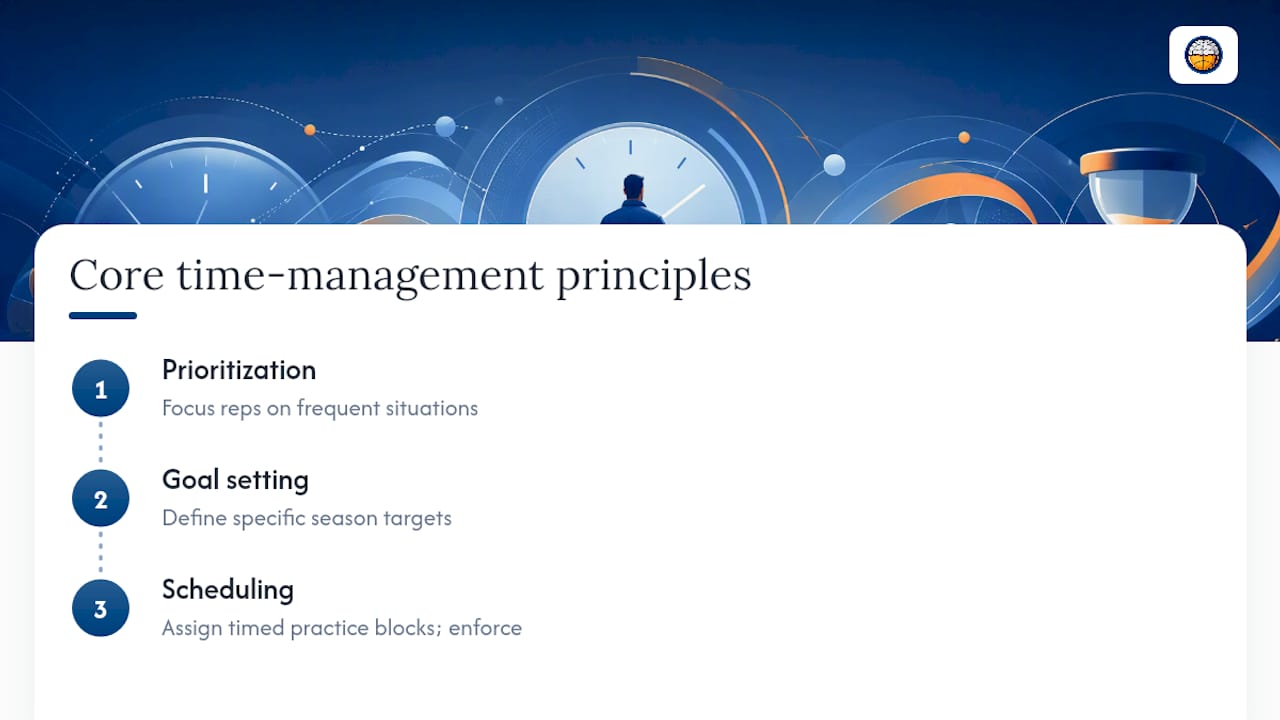
Prioritization means deciding what deserves your limited minutes before you decide how to spend them. For a coaching staff, that means identifying which game situations occur most often and giving them the majority of your practice reps, rather than spreading time evenly across everything your team might theoretically face.
Goal setting gives your time allocation a target to hit. A season objective like “cut turnovers in the final five minutes of close games” tells you exactly which practice blocks deserve extra attention and which ones can shrink. Without a stated goal, every minute looks equally important, which is another way of saying none of them do.
Scheduling is where the first two principles become real. A written, timed plan, whether it’s a weekly practice calendar or a daily task list, forces you to convert intentions into blocks with start and end times. The scheduling step is also where most plans quietly fail, because a plan that isn’t enforced with a visible timer or a designated enforcer tends to drift.
These three principles apply the same way whether you’re managing a roster, a classroom, or a personal to-do list. The mechanics change. The logic doesn’t.
What Gets in the Way of Good Time Management?
The most common barrier isn’t lack of a plan. It’s a plan that exists on paper but gets abandoned the moment something urgent interrupts it. A coach without a visible timer will let a skill station run ten minutes long because it’s going well, then cut the scrimmage short to compensate, which quietly undoes the balance the whole practice plan was built around.
A second barrier is unclear ownership. If nobody on your staff is explicitly assigned to manage transitions, watch the clock, or run the timeout script, the job falls to whoever notices first, usually you, in the middle of coaching something else. The same problem shows up outside basketball: tasks without a named owner tend to get done late or not at all.
Overloaded scheduling is a third trap. Cramming too many drills or too many goals into one session guarantees something gets rushed, and rushed reps teach worse habits than fewer, cleaner ones. The fix isn’t working faster. It’s cutting the plan down to what actually fits the time available.
The strategies that address all three are almost boring in their simplicity: write the plan down, assign a specific person to enforce it, and build in less than you think you need so quality doesn’t collapse under time pressure. Coaches and professionals who solve this problem well aren’t smarter about time. They’re stricter about a smaller number of commitments.
What Do You Actually Gain From Managing Time Well?
The clearest benefit shows up in outcomes: teams and professionals who allocate time deliberately produce more consistent results than those who react to whatever feels urgent that day. For a coaching staff, that means fewer wasted reps, sharper execution in the situations that decide games, and a roster that trusts the structure because the structure actually holds.
Stress reduction follows close behind. A lot of pressure in a close game or a busy workweek doesn’t come from the difficulty of the task. It comes from not having decided in advance how to handle it. A coach with a scripted sliding-scale rule for fouling with two minutes left isn’t guessing under pressure. The decision was already made in the off-season.
Work-life balance benefits the same way, whether you’re a coach with a day job or a full-time staff member managing a roster and a family. Structured time frees up mental space, because decisions that are already made don’t need to be relitigated every day. The benefit compounds: a well-managed practice schedule leaves you with the energy to handle scouting, film, and recruiting instead of spending it all on in-the-moment improvisation.
What Tools Actually Help With Time Management?
Tools work best when they match the size of the problem. For quick scheduling and reminders, a basic calendar app with recurring events handles most of the load, whether that’s a practice block or a recurring work meeting. For task prioritization, simple list apps that let you tag items by urgency or importance do the heavy lifting without requiring a steep learning curve.
For coaches specifically, a countdown timer app on a phone or tablet is the single most useful tool on the practice floor, since it enforces transitions without you having to watch a clock while also coaching a drill. Whiteboard rotation charts serve the same function for station-based practices, giving every group a visual cue for when to move.
In broader professional and personal settings, time-blocking calendars and simple to-do list apps cover most needs without added complexity. The right tool is rarely the most feature-heavy one. It’s the one you’ll actually open and use every single day, because a scheduling app nobody checks provides zero value regardless of how sophisticated it is.
How Does Time Management Change Across Settings?
The core principles hold steady across personal life, the workplace, and education, but the mechanics shift with the setting. In personal life, time management usually means protecting space for health, relationships, and rest against the pull of open-ended tasks that expand to fill whatever time you give them.
In the workplace, time management is often about matching effort to impact, prioritizing the tasks that move a project or a team forward over the ones that just feel busy. Meetings without a clear agenda are the workplace equivalent of a practice with no timer: they expand to fill whatever slot they’re given.
In education, time management determines whether study time turns into retained knowledge or wasted hours. Students who block dedicated time for review, rather than cramming reactively, tend to retain material more consistently. Coaching sits at an interesting intersection of all three: it’s a job, often unpaid or part-time, that demands the planning discipline of a workplace and the physical clock-awareness of an athletic competition, condensed into a couple of hours a few times a week. That combination is exactly why coaches benefit from borrowing structure wherever it exists, including from other timing-sensitive sports. Coaching interventions in sports like tennis face a similar tension between preparation and real-time adjustment, which is a useful parallel for any coach thinking about when to intervene versus when to let a plan run.
A Coach’s Note on Time Discipline
Teams that rehearse the clock win more close games than teams that just hope for composure in the moment. My own habit is simple: every practice ends with a live two-minute drill from a random score, no exceptions, no matter how tired everyone is.
Fit More Reps Into Your Timed Blocks
If your team struggles with post play in the exact stretch of practice where you’re trying to build tempo, the Big Man Dual Action Drill is built to slot straight into a skill-station block without eating extra planning time. The download includes a printable drill diagram, coaching points for both actions, and progressions you can layer in as your post players get sharper, so you’re not building a new drill from scratch mid-season.

It’s a single PDF, ready the moment you check out, and it fits directly into the 15 or 20 minute skill-station window covered earlier in this article. If your practice plan already runs on tight timed blocks, this is one more piece you can drop in immediately rather than design yourself. Grab the Big Man Dual Action Drill and add it to your next skill rotation.
Sources
- FIBA coaching manual — Level 3
- Game Management: What Part Science? What Part Art? - Hoop Coach
- Basketball Practice Plan (Free Templates & Drills) - StriveOn
FAQ
How long should a basketball practice last?
Youth practices work best at 45 to 60 minutes, middle school around 60 to 75, and high school teams can sustain 90 to 120 minutes as long as the reps stay high quality throughout.
When should a coach start fouling in a close game?
Sliding-scale rules vary by staff, but a common framework starts fouling once a deficit reaches 4 to 7 points with under 90 seconds left, and fouls immediately once the deficit grows past that with under a minute remaining.
Who should manage the bench during a timeout?
Assign one assistant as the timeout communicator to relay the play and another as the substitution manager tracking fouls and matchups, so you can focus on talking to the team.
What’s the fastest way to build a timed practice plan?
Start from a structured template rather than a blank page. Hoop Mentality’s practice plan template gives coaches a pre-built minute allocation they can adjust to their roster and season phase.
How often should teams practice endgame scenarios?
Weekly is a reasonable minimum. A short two-minute live drill at the end of practice each week keeps clock management sharp without eating into skill development time.