

Three complete, timed 60-minute basketball practice templates are ready below. Copy them, print them, or load them into an editable planner today. Each plan covers Beginner, Intermediate, and Advanced youth levels.
- Beginner (ages 6–10): Fundamentals first. Ball handling, movement, and simple games. Primary focus: confidence and basic skills.
- Intermediate (ages 10–13): Tighter progressions, passing reads, small-sided games. Primary focus: decision-making and skill connections.
- Advanced (ages 13–16): High-intensity sequences, team concepts, scrimmage with teaching stops. Primary focus: team systems and competitive reps.
Download editable versions from the Basketball Template Bundle For Coaches or the Basketball Starter Pack For Coaches on Hoop Mentality.
Key Takeaways
A structured, timed practice template is the single fastest way to add quality reps and cut wasted minutes from every session.
| Point | Details |
|---|---|
| Match template to skill level | Use Beginner for ages 6–10, Intermediate for 10–13, Advanced for 13–16. |
| Keep drill blocks short | Youth players hold focus for 45–60 minutes; switch activities before attention drops. |
| Post the plan courtside | A printed plan with block times lets assistants run stations without interruption. |
| Track one metric per session | Measure makes per spot or successful reads for two weeks to see real progress. |
| Download editable templates | Hoop Mentality’s Starter Pack and Template Bundle give you print-ready plans in under 10 minutes. |
Table of Contents
- What every basketball practice template must include
- Three ready-to-use 60-minute practice templates
- How to adapt any template for your team
- Running practice efficiently: setup, transitions, and focus
- Why templates change how fast players develop
- Hoop Mentality templates and bundles for coaches
- Sources
- FAQ
What every basketball practice template must include
A solid practice plan template has eight components: session goals, dynamic warm-up, skill stations, progressive drills, team concepts, controlled scrimmage, cooldown, and coach notes. Skip any one of them and you feel it on the court.
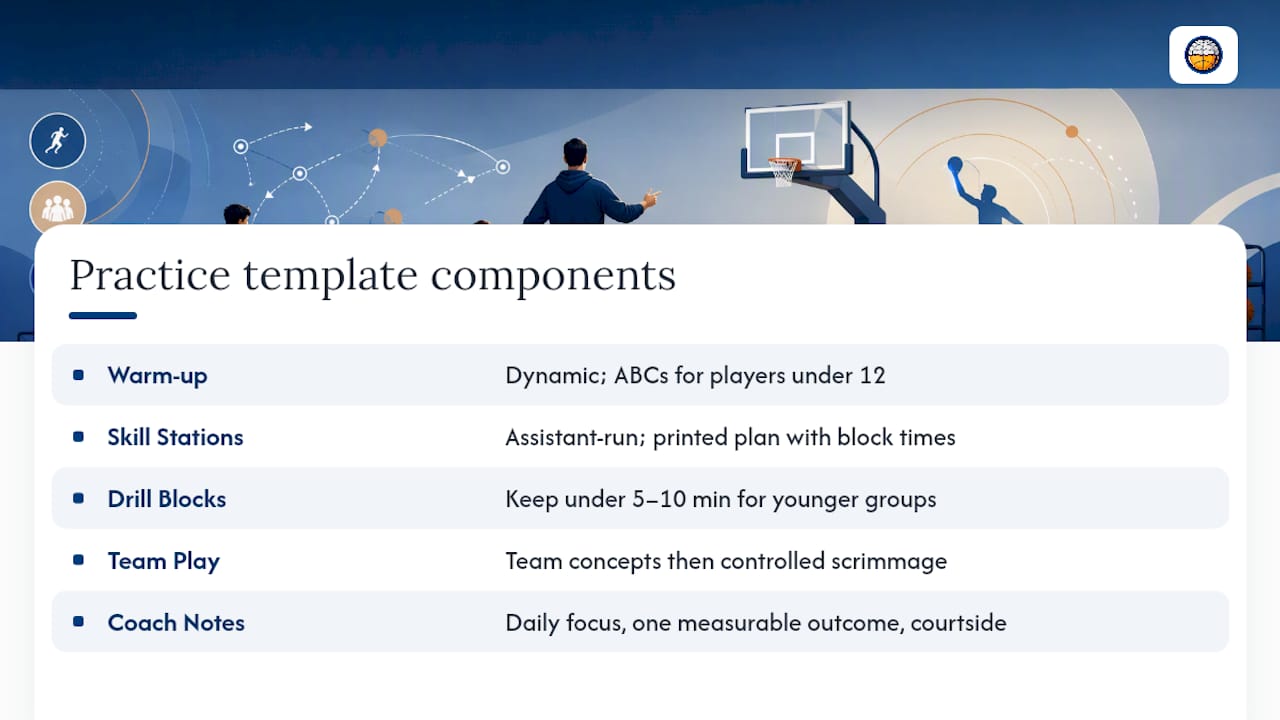
Timing matters as much as content. According to age-appropriate practice guidance, youth players ages 6–10 typically hold focus for 45–60 minutes, middle schoolers for 60–75 minutes, and high schoolers for up to 90–120 minutes. Plan to match attention span, not ambition. Keep individual drill blocks under 5–10 minutes for younger groups. Switch activities before focus drops, not after.
For players under 12, warm-ups should emphasize the ABCs — agility, balance, coordination, and speed — rather than basketball-specific drills alone.
Coach notes belong on the printed plan. Write your daily focus, one measurable outcome (e.g., “8 of 10 players complete a chest pass without stepping”), and cues for each assistant. Post it courtside. A printed plan with block times and focus columns lets assistants run their stations without waiting for direction.
Pro Tip: Write your coaching cue for each drill block in one sentence. If you can’t say it in one sentence, the cue is too complicated for a youth player to act on.
Three ready-to-use 60-minute practice templates
These plans follow the recommended structure of dynamic warm-up, skill work, team concepts, scrimmage, and cooldown. Use them as-is or adjust the drill names to match your team’s vocabulary.
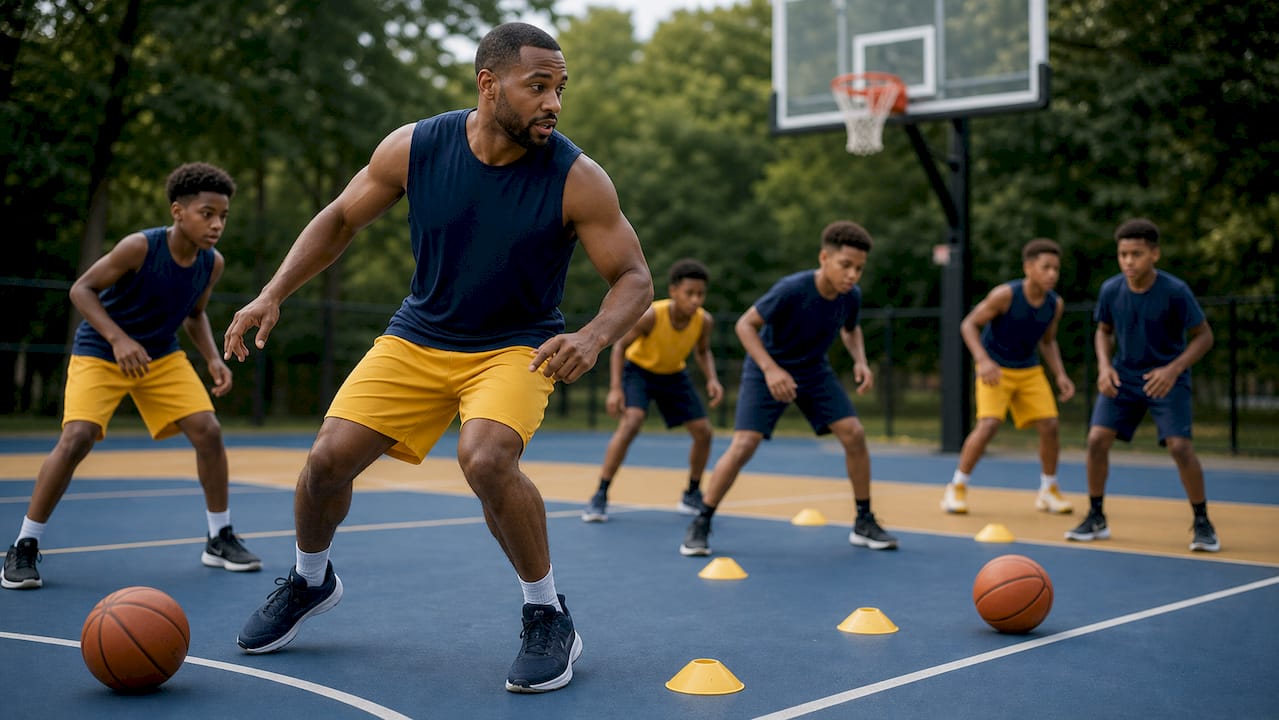
Beginner template (ages 6–10)
| Time | Duration | Segment | Focus |
|---|---|---|---|
| — | 8 min | Dynamic warm-up | Agility, balance, coordination |
| — | 5–10 minutes | Ball handling | Stationary dribble, weak hand |
| — | 8 min | Passing & footwork | Chest pass, pivot, catch stance |
| — | 5–10 minutes | Finishing | Layup approach, two-foot stop |
| — | 8 min | Defense intro | Defensive stance, slide steps |
| — | 12 min | 3v3 small-sided game | Movement, touches, fun |
| — | 5–10 minutes | Shooting game | Form shooting, “Knockout” |
| — | 3 min | Cooldown & review | One coaching point, high-five |
Equipment: 1 ball per 2 players, 8 cones, 2 hoops (lowered if possible). Setup: cones in a grid for warm-up, two half-court areas for 3v3.
Coaching cues: “Pound the floor” (dribbling), “Step to your partner” (passing), “See the basket before you go” (finishing).
Intermediate template (ages 10–13)
| Time | Duration | Segment | Focus |
|---|---|---|---|
| — | 8 min | Dynamic warm-up | Speed, change of direction |
| — | 8 min | Ball handling | On-the-move dribble combos |
| — | 8 min | Passing & decision-making | 2-on-1 reads, skip pass |
| — | 8 min | Shooting | Catch-and-shoot off movement |
| — | 6 min | Defense | Closeout, contest, recover |
| — | 4 min | Team concept intro | Spacing, drive-and-kick |
| — | 13 min | 4v4 half-court scrimmage | Live reads, coaching stops |
| — | 5 min | Cooldown & review | Two corrections, one praise |
Equipment: 1 ball per player, 10 cones, 2 hoops, 6 colored bibs. Setup: two stations for skill work, one half-court for scrimmage.
Coaching cues: “Read the defense first” (passing), “Land balanced” (shooting), “Sprint to close, then brake” (defense).
Advanced template (ages 13–16)
| Time | Duration | Segment | Focus |
|---|---|---|---|
| — | 8 min | Dynamic warm-up | Full-court movement, speed |
| — | 5–10 minutes | Ball handling | Pressure dribble sequences |
| — | 8 min | Shooting | Off-screen, pull-up, spot |
| — | 5–10 minutes | Transition drill | 3-on-2, 2-on-1 continuous |
| — | 8 min | Team concept | Pick-and-roll coverage, rotations |
| — | 15 minutes | 5v5 controlled scrimmage | Teaching stops, live sets |
| — | 5 min | Cooldown & review | Film cue, next-session goal |
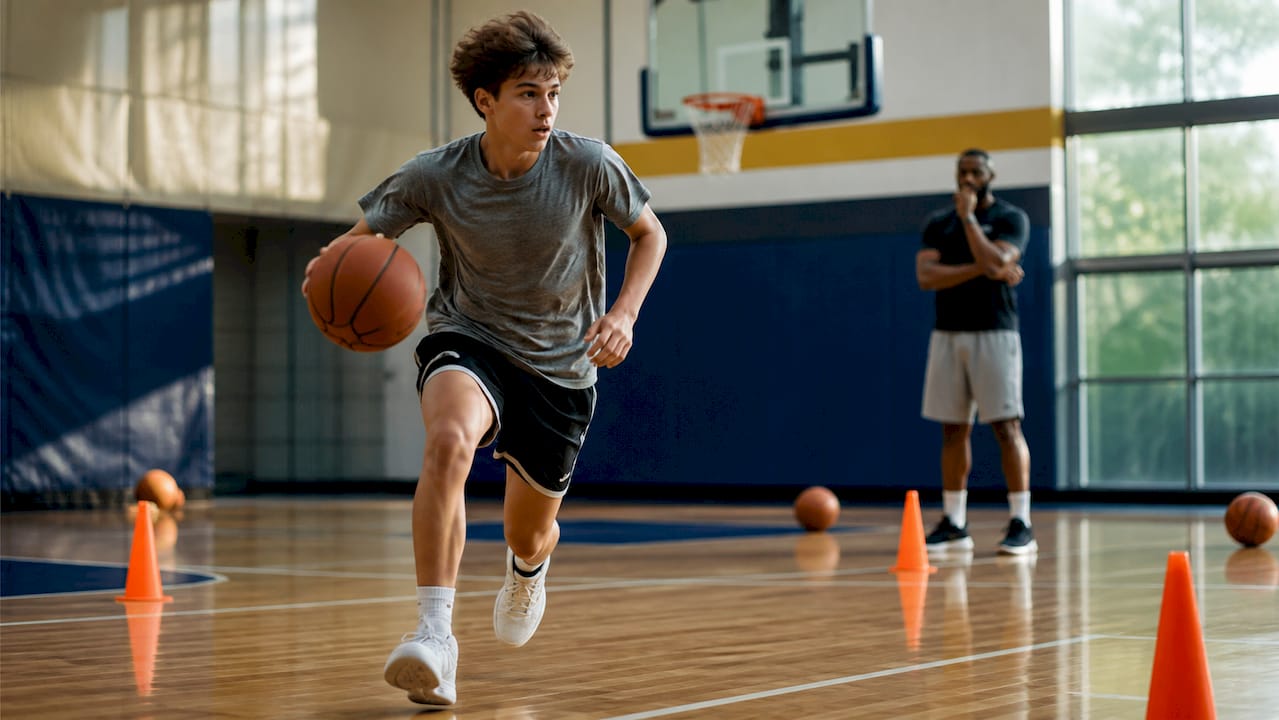
Equipment: 1 ball per player, 12 cones, 2 hoops, 10 bibs. Setup: full court, two assistant stations for shooting and transition.
Coaching cues: “Pressure the ball, not the space” (defense), “Hit the open man early” (offense), “Sprint the lane every time” (transition).
For structured warm-up routines that plug directly into these templates, Hoop Mentality has a dedicated guide.
How to adapt any template for your team
Not every session is 60 minutes with 12 players. Here are four concrete adjustments.
- Shorten to 45 minutes. Cut team concepts entirely. Keep the warm-up, one focused skill block, and the scrimmage. That three-part structure holds the most value per minute.
- Extend to 90 minutes. Add a second skill station (10 minutes) and extend scrimmage by 15 minutes. Use the extra time for position-specific work, not more warm-up.
- Scale for 8 players. Run 2v2 and 3v3 formats instead of 4v4 or 5v5. Small-sided games at U8–U10 give more touches per player and better movement reads than full-sided play.
- Scale for 15+ players. Add a third station. Rotate groups every 6–8 minutes. One assistant per station keeps transitions clean.
Seasonal adjustments:
- Preseason: Prioritize conditioning and fundamentals. Cut team concepts to 5 minutes. Add an extra skill block.
- In-season: Shift to game prep. Increase scrimmage time to 20–25 minutes. Focus coaching stops on opponent-specific reads.
- Postseason: Recovery and situational work. Lower intensity. Run 3v3 games and review film cues.
Age-appropriate guidelines: Reduce drill complexity by one level per age bracket drop. For players under 10, use a size 5 ball and a 9-foot rim where available. Keep drill explanations under 30 seconds. For youth sports programs that manage mixed-ability groups, rotating station formats keep all skill levels engaged.
Running practice efficiently: setup, transitions, and focus
Wasted minutes come from three places: late setup, slow transitions, and coaches who try to coach everything at once. Fix all three before the first whistle.
Pre-practice checklist:
- Court layout marked with cones before players arrive
- Equipment counted and placed at each station
- Printed plan posted courtside (one copy per assistant)
- Assistant roles assigned: who runs which station, who manages substitutions
Transition tactics: Use a single whistle cue to signal station changes. A countdown timer visible to assistants keeps everyone on pace. One assistant owns each station; the head coach moves and observes. Detailed timed blocks cut the 15 minutes coaches typically lose to on-the-fly decisions.
What to focus on during each block:
| Block | Head coach focus | Assistant focus |
|---|---|---|
| Warm-up | Observe movement quality | Lead the drill |
| Skill station | Correct one habit per player | Manage reps and rotation |
| Scrimmage | Coaching stops, key reads | Track substitutions |
| Cooldown | Deliver one clear message | Reset equipment |
Simple measurement: Pick one metric per session. Examples: makes per spot (shooting), successful drive-and-kick reads (scrimmage), completed defensive closeouts. Track it for two weeks. You’ll see the trend without needing a spreadsheet.
Why templates change how fast players develop
Most coaches underestimate how much a consistent structure accelerates skill acquisition. When players know the practice rhythm, they spend less mental energy on “what’s next” and more on the actual skill. That cognitive load shift is real, and it compounds over a season.
The teaching freeze is one of the most underused tools in youth coaching. Stop the scrimmage for 60–90 seconds, walk to the spot where the mistake happened, and show the correct read with the players still in position. No whiteboard, no long explanation. Then resume. Players retain that correction far better than a halftime talk because the context is still live.
Templates also help assistants. A printed plan with clear cues means your assistant coach can run a station without pulling you away from the group you’re watching. That’s not a small thing when you’re coaching 12 players alone.
Hoop Mentality templates and bundles for coaches
Hoop Mentality builds editable practice resources from real coaching experience, not theory. Each product maps directly to the three templates above.
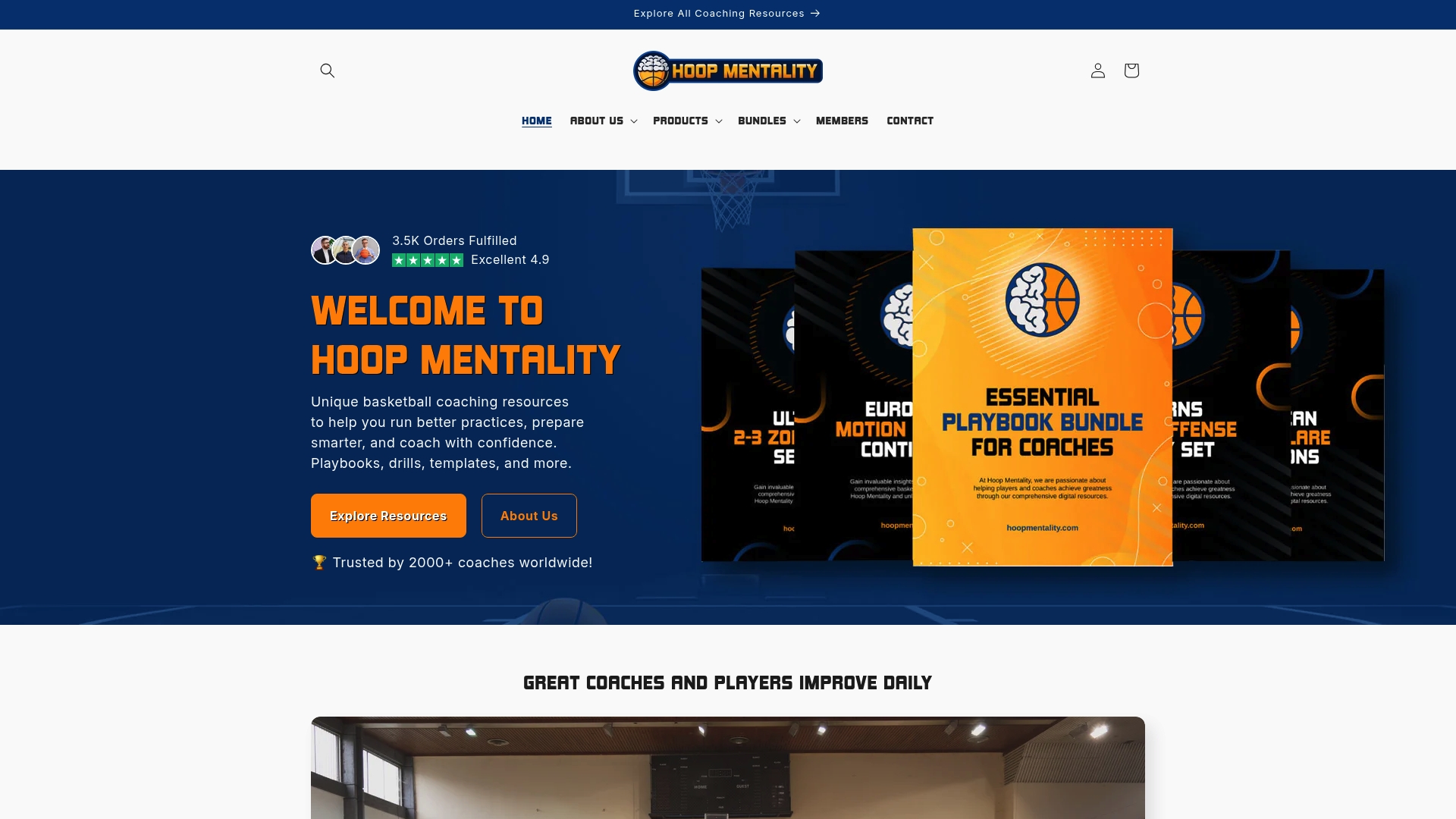
- Basketball Starter Pack For Coaches: Ready-made session flows with prescriptive cues. Best for coaches who want a plug-and-play single-session solution. Open it, fill in the Daily Focus field, print, and you’re ready in under 10 minutes.
- Basketball Template Bundle For Coaches: A full set of editable 60-minute templates covering multiple skill levels and seasonal phases. Best for coaches running multiple teams or planning a full season.
- Basketball Shooting Bundle For Coaches: Focused shooting progressions and printable sheets. Drop these directly into the shooting blocks of any template above.
- Editable Scouting Report Template: Fill in opponent notes before game day. Pairs with in-season practice prep.
- Basketball Scouting Report Template: Printable game-day scouting sheet for opponent tendencies and player matchups.
To use any template: open the file, update the Daily Focus and Equipment fields for your session, print one copy per assistant, and post yours courtside. That’s the full workflow.
Sources
- Basketball Practice Plan (Free Templates & Drills)
- Training and Coaching Tips for Youth Basketball Practice
FAQ
What should a 60-minute basketball practice template include?
A 60-minute plan needs a dynamic warm-up, one or two skill blocks, a team concept segment, a controlled scrimmage, and a cooldown. Each block should have a named focus and a time limit.
How do I shorten a 60-minute template to 45 minutes?
Cut the team concepts block first. Keep the warm-up, one focused skill block, and the scrimmage. Those three segments deliver the most value per minute for youth players.
What is the best practice format for players under 10?
Use 3v3 small-sided games, keep drill blocks under 8 minutes, and emphasize agility, balance, and coordination in the warm-up rather than basketball-specific drills alone.
Where can I download editable basketball practice templates?
Hoop Mentality’s Basketball Template Bundle For Coaches and Basketball Starter Pack For Coaches include print-ready, editable 60-minute plans.
How often should I change my practice template?
Keep the same structure for at least two to three weeks so players learn the rhythm. Adjust drill content weekly based on what you measured the session before.