

TL;DR:
- Running a well-structured basketball practice plan prevents time waste, maintains player focus, and ensures skill development. Effective plans should be age-appropriate, balanced across skills, and include clear timing and progression, allowing for adjustments based on team response. Coaches benefit from adaptable templates or season-long programs that emphasize competition, gradual skill integration, and purposeful drills for maximum improvement.
Running a basketball practice without a written plan is like running a game without a game plan. You waste time, lose players’ attention, and leave the gym wondering if anything actually got better. Solid examples of practice plans give you a proven structure to follow, a reference to adapt, and a way to hold yourself accountable to every minute on the court. Whether you coach 4th graders or high school varsity, seeing how other effective plans are built saves time and raises the quality of every session.
Table of Contents
- Key takeaways
- 1. How to evaluate examples of practice plans
- 2. Example 1: a 90-minute youth basketball practice plan
- 3. Example 2: a 5-minute interval plan with a 500-shot weekly workout
- 4. Example 3: a 30-session editable youth practice ebook
- 5. Comparing the three practice plan examples
- 6. How to decide which plan fits your team
- What I have learned from years of building practice plans
- Ready-to-use practice plan resources from Hoopmentality
- FAQ
Key takeaways
| Point | Details |
|---|---|
| Structure beats improvisation | A written plan with timed blocks keeps players active and focused throughout practice. |
| Use real examples as starting points | Adapt proven practice session outlines rather than building from scratch every week. |
| Age and skill level matter | The best customized practice plans match drill intensity and duration to your specific group. |
| Progression drives development | Moving from fundamentals to game-like scenarios within a single session improves learning. |
| Digital templates save time | Reusable, editable formats help coaches prepare faster and communicate more clearly with players. |
1. How to evaluate examples of practice plans
Not every practice plan you find online will work for your team. Knowing what to look for saves you from downloading something that wastes your players’ time instead of developing them.
Here are the key criteria to check before using any plan:
- Age-appropriate content. A drill that challenges a high school player will frustrate a 10-year-old. Practice plans organized by age group include warm-up, drills, and cool-down scaled to the players’ stage of development.
- Balance across skill areas. A good plan covers ball handling, shooting, passing, defense, and conditioning. If you see a plan that’s 45 minutes of shooting and nothing else, it’s not a full session.
- Timed segments. Each block should have a clear start and end time. Vague plans with no time markers turn into practices that run long on one drill and skip another entirely.
- Progression within the session. Shorter drills progressing toward game-like activities maintains player engagement and improves how well skills transfer to games.
- Flexibility. The plan should work as a template, not a script. You need room to adjust based on how your team is responding on a given day.
Pro Tip: Before adopting any sample training plan, run through it mentally as if you were a player. If you get bored in your head, your players will get bored on the court.
Look for plans that show you not just what drills to run, but why they are placed in that order. That reasoning is what separates a thought-out structure from a random list of activities.
2. Example 1: a 90-minute youth basketball practice plan
This is one of the most practical sports practice examples you will find for coaches working with players in grades 4 through 8. The structure is clear, the timing is realistic, and every block serves a purpose.
Here is how the session breaks down across 90 minutes:
- Pre-practice meeting (10 minutes). Pre-practice meetings to discuss goals and sportsmanship set the tone for the entire session. Keep it short. Cover one or two focus points and expectations for the day.
- Dynamic warm-up (10 minutes). Light jogging, lateral shuffles, high knees, and arm circles. Get the body moving before any ball is introduced.
- Ball handling and footwork (20 minutes). Two-ball dribbling, crossover progressions, defensive slides. These are the building blocks every player needs regardless of position.
- Passing and shooting drills (15 minutes). Partner passing sequences moving to catch-and-shoot repetitions. Keep players in groups of two or three to maximize touches.
- Team concepts: offense and defense (20 minutes). Walk through a simple offensive action like a pick-and-roll and pair it with the corresponding defensive assignment. This is where individual skills start connecting to team play.
- Controlled scrimmage (15 minutes). Apply everything in a live situation. Use constraints like “must make two passes before a shot” to reinforce the session’s focus.
Pro Tip: Keep the scrimmage competitive but coached. Stop play briefly when you see the session’s key concept being done right or wrong. Two corrections in 15 minutes land better than 20.
This plan works because it moves from fundamentals to game scenarios in a natural sequence. Players are not just running drills in isolation. They are building toward something they will use in a real game.
3. Example 2: a 5-minute interval plan with a 500-shot weekly workout
This format is built for coaches who want maximum structure and measurable output. Every drill gets a dedicated window. Nothing runs over. Nothing gets skipped.
The practice session outline looks like this:
| Segment | Duration | Focus |
|---|---|---|
| Dynamic warm-up | 15 min | Injury prevention, activation, light conditioning |
| Ball handling drills | 10 min | Dribble combinations, change of direction |
| Passing and screening | 10 min | Off-screen catches, skip passes, communication |
| Shooting progressions | 20 min | Form shooting, mid-range, three-pointers |
| Conditioning | 10 min | Sprints, defensive slides, closeout footwork |
| Cool-down and review | 5 min | Stretch, coaching points, questions |
The standout feature of this approach is the shooting volume. A 500-shot weekly shooting workout builds shooting skills efficiently by distributing quality repetitions across diverse shot types, rather than piling all the volume into one marathon session.
What makes this plan especially useful for organized coaches is the documentation side. PDF templates break down drills into clear intervals to maximize efficiency, so you never have to guess what comes next. You show up, print it out, and run it.
A few strengths of this approach:
- Easy to delegate. An assistant coach can run any segment without needing a full briefing.
- Measurable output. Tracking shot attempts weekly gives players a concrete goal.
- Consistent structure. Players know the rhythm of practice, which reduces the time lost to transitions.
This format suits coaches who work with motivated players who are ready to put in focused repetitions. It is less ideal for very young players who need more unstructured discovery time built into their sessions.
4. Example 3: a 30-session editable youth practice ebook
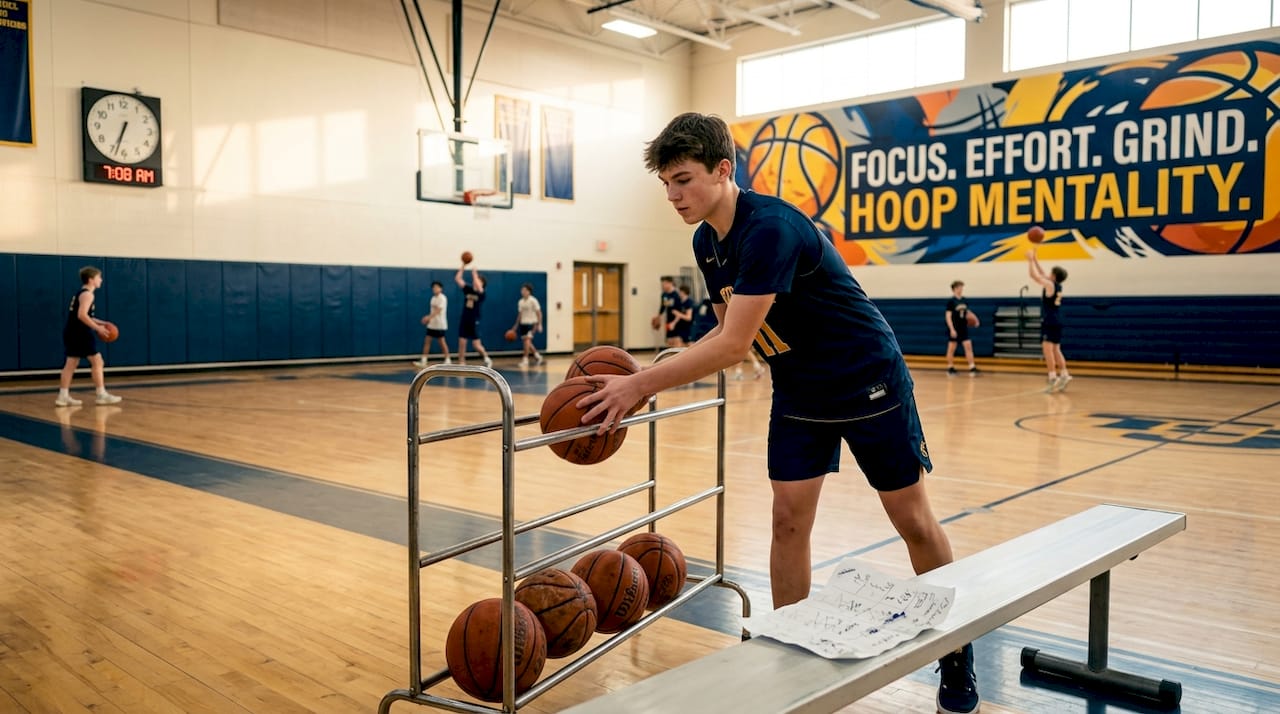
If you coach youth teams and want a full season’s worth of structured material without building every practice from scratch, this is the format that delivers the most value per hour of prep time.
This type of package typically includes:
- 30 complete 90-minute practice sessions designed to progress players from basic individual skills in early sessions to team concepts and competitive play by the final weeks.
- Pre-practice team meeting agendas. These are not just time fillers. Pre-practice meeting agendas with coaching points give you talking points on topics like effort, teamwork, and preparation so you are never standing in front of your team without something meaningful to say.
- Sideline and inbounds plays. Game situations your players will actually face. Having these built into the plan means they get practiced, not just drawn on a whiteboard the morning of game day.
- Skill development and team concept integration. Each session builds on the last. By practice 20, your players have seen the same core concepts reinforced enough times to actually own them.
- Editable digital formats. You can swap in your own drills, adjust timing, or modify the language to fit your team’s vocabulary and culture.
This format is specifically strong for youth sports practice plans because it removes the blank-page problem coaches face at the start of every week. The structure is done. You personalize it, print it, and coach.
5. Comparing the three practice plan examples
Use this table to quickly identify which format fits your current situation.
| Feature | 90-Min Youth Plan | 5-Min Interval Plan | 30-Session Ebook |
|---|---|---|---|
| Best age group | Grades 4 to 8 | High school and up | Grades 4 to 8 |
| Session length | 90 minutes | 60 to 90 minutes | 90 minutes |
| Flexibility | Medium | Low to medium | High |
| Setup time per session | 15 to 20 minutes | Minimal with PDF | Minimal once purchased |
| Shooting focus | Moderate | High | Moderate to high |
| Ideal for | New coaches, rec leagues | Competitive programs | Coaches wanting a full season plan |
| Biggest strength | Clear progression | Accountability and volume | Reusability across seasons |
No single plan wins across every category. A coach running a competitive travel program will gravitate toward the interval format. A first-year recreational coach running youth sports practice plans will get the most out of the ebook package. The 90-minute template sits right in the middle and works for almost any situation with minor adjustments.
6. How to decide which plan fits your team
You do not need to copy any example exactly. These plans are starting points, not contracts. The best practice plan ideas come from coaches who take a proven structure and make it their own.
Ask yourself these questions before choosing a format:
- What is the age and attention span of my players? Younger players need shorter drill windows and more transitions to stay locked in.
- How much time do I actually have? A 90-minute plan squeezed into 60 minutes creates a rushed, incomplete session. Match the plan length to your actual court time.
- What phase of the season am I in? Early-season plans should prioritize fundamentals. Late-season practice sessions before games should emphasize execution and confidence.
- What feedback are my players giving me? If they are checking out after 30 minutes, your drill variety or pacing needs adjustment. If they are asking for more game time, your scrimmage block may be too short.
- What are my season goals? A team that struggles on defense should not have a plan that is 80 percent offense drills, regardless of what a template says.
Blend elements freely. Take the pre-practice meeting structure from Example 1, the time-blocking discipline from Example 2, and the seasonal progression from Example 3. That is how well-organized basketball practice plans actually get built in the real world.
What I have learned from years of building practice plans
I have seen coaches spend more time writing a practice plan than running it. And I have seen coaches who show up with nothing written and then wonder why their team is not improving. The answer is somewhere in the middle, but it leans heavily toward structure.
What I have found over time is that the plan itself matters less than the thinking behind it. When I sit down to build a session, the first question I ask is not “what drills should I run?” It is “what do I need my players to understand by the end of this practice?” Everything else gets built backward from that answer.
The second thing I have learned: competition inside practice beats repetition every time. Players who are competing, even in a simple two-on-two drill, retain more than players running the same movement 20 times in a row without stakes. When you look at your practice plan structure, check whether each drill has a winner and a loser. If it does not, consider how to add that element.
The third thing is the hardest for detail-oriented coaches to accept. The best sessions I have ever run were the ones I was willing to deviate from. Having a plan gives you permission to improvise because you know where you are supposed to be. Without a plan, improvising just means being lost.
— Dejan
Ready-to-use practice plan resources from Hoopmentality
If these examples gave you a clear picture of what effective practice planning looks like, Hoopmentality has the tools to put that into action right away.

The Game Preparation Guide with Weekly Practice Plan gives you a complete system that covers game prep and practice structure together, so your weekly schedule has a clear purpose at every step. For coaches who want a full toolkit, the Basketball Template Bundle for Coaches includes multiple formats you can adapt across different practice lengths, skill levels, and season phases. Both resources are built from real coaching experience and are ready to use from day one.
FAQ
What should a basketball practice plan include?
A solid practice plan includes a pre-practice meeting, a dynamic warm-up, skill development drills, team concept work, and a scrimmage. A structured 90-minute session typically breaks these into clear time blocks to keep the practice moving.
How long should each drill segment be in a practice plan?
Five-minute focused drill segments work well for most skill-building activities. Shorter windows keep attention high and allow coaches to cover more ground within a single session.
How many sessions should a youth practice plan cover?
A full youth basketball program benefits from 30 or more structured sessions that build progressively from individual skills to team concepts. This gives enough repetition for players to actually retain and apply what they learn.
Can I use the same practice plan for different age groups?
Not without adjustments. The drills, duration, and complexity that work for high school players are too demanding for 8-year-olds. Always match your practice session outlines to the specific age group and skill level you are coaching.
How do I keep players engaged during practice?
Add competition to drills wherever possible. Moving from individual fundamentals to game-like scenarios keeps players motivated because they can see how the skill connects to real game situations.