

TL;DR:
- The point guard’s core responsibilities include ball handling, decision-making, and playmaking, which remain crucial even in positionless systems. Key metrics such as usage rate, assist-to-turnover ratio, and assist totals help evaluate performance and guide development. Adapting the role with flexible ownership and skill reinforcement maximizes impact in modern offenses, regardless of system style.
The debate about whether the traditional point guard still matters in modern basketball leaves a lot of coaches stuck. Positionless trends are real, but dismissing the point guard’s role entirely is a mistake that shows up fast in your turnover numbers and offensive efficiency. Understanding what this position actually demands, how to measure it, and how to adapt it to your system gives you a concrete edge in player development and game planning. This article breaks down the core responsibilities, the key metrics that matter, and actionable strategies you can apply right away.
Table of Contents
- Understanding the core responsibilities of the point guard in offense
- Key statistical benchmarks: Usage, assists, and turnovers
- Adapting the point guard role to modern offenses: Traditional vs. positionless debates
- Maximizing point guard impact within different offensive systems
- Why rethinking the point guard’s role is the real unlock for modern offenses
- Enhance your coaching with proven tools and resources
- Frequently asked questions
Key Takeaways
| Point | Details |
|---|---|
| Core responsibilities | Point guards organize offense, create for others, and set tempo through decisions. |
| Statistical focus | Usage rate, assists, and turnover ratio are the most revealing metrics. |
| System flexibility | Modern offenses benefit when point guard roles adapt to team strengths and coaching vision. |
| Coaching for impact | Develop both on-ball and off-ball skills to maximize your point guard’s value in any scheme. |
| Evolving perspective | Success is about empowering the best ballhandlers to lead—titles matter less than skills. |
Understanding the core responsibilities of the point guard in offense
With that context in mind, let’s clarify what exactly distinguishes the point guard’s role on offense and why it matters so much to your overall scheme.
The point guard has always been the traffic controller of your offense. Ball handling, pace setting, reading the defense, and distributing shots are the four pillars that define the position at any level. When your point guard executes all four well, your offense flows. When even one breaks down, possessions stall and your team’s scoring efficiency takes a hit.
Decision-making sits at the heart of everything. A point guard who recognizes a trap early and hits the release pass keeps possession alive. One who hesitates or misreads defensive rotations turns the ball over, and a single turnover doesn’t just cost two points. It shifts momentum, disrupts tempo, and often leads to transition points for the opponent. Point-guard projection framework defines usage and models assist/turnover stats, confirming that play frequency, creation efficiency, and turnover rate are the core empirical markers of point guard performance.
Here are the primary offensive functions every point guard must own:
- Ball handling under pressure: Controlling pace, especially in half-court sets and late-shot-clock situations
- Setting tempo: Deciding when to push in transition versus when to slow it down and run a set play
- Defense recognition: Identifying zone, man, or switching schemes and calling the right play
- Shot distribution: Getting the ball to teammates in scoring positions, not just passing to the open man
- Play calling and communication: Directing traffic vocally and through on-court signals
The growing influence of positionless basketball trends doesn’t erase these functions. It redistributes them. Someone still has to do the job. The question is whether you want one player owning these duties or spreading them across your roster.
Pro Tip: Teach young point guards to anticipate not just the pass, but how a turnover ripples through team rhythm. Run drills that specifically penalize turnovers with sprint consequences. It creates urgency and sharpens decision-making faster than any lecture.
Key statistical benchmarks: Usage, assists, and turnovers
Once you know the core duties, the next step is to measure what matters most using data that actually reflects a point guard’s contribution to your offense.
Usage rate measures the percentage of team possessions a player finishes, through a field goal attempt, free throw attempt, or turnover. A usage rate between 20% and 28% is typical for a primary point guard. Too low and the player isn’t involved enough to direct the offense. Too high and the offense becomes predictable and easy to defend.
Assist totals tell you how much scoring the point guard creates for teammates. Volume matters, but context matters more. A point guard on a team with poor shooters will post lower assist numbers regardless of how well they pass. That’s why assist-to-turnover ratio is the cleaner benchmark.
“The assist-to-turnover ratio cuts through noise. It tells you how efficiently a point guard is creating without wrecking possessions in the process.”
Assist/turnover data and leaderboards for point guards show that elite performance starts coming into focus when you stack these numbers side by side. Tyrese Haliburton’s 752 assists in the 2023-24 NBA season set a modern benchmark, paired with a turnover rate that kept his assist-to-turnover ratio among the best in the league.
Here’s a sample comparison across top point guards using recent data:
| Player | Assists per game | Turnovers per game | Assist-to-turnover ratio |
|---|---|---|---|
| Tyrese Haliburton | 10.9 | 3.2 | 3.41 |
| Trae Young | 10.8 | 4.4 | 2.45 |
| LaMelo Ball | 8.0 | 3.3 | 2.42 |
| Jalen Brunson | 7.7 | 2.4 | 3.21 |
| Chris Paul (career peak) | 11.0 | 2.3 | 4.78 |
Projection frameworks for point guard efficiency indicate that ratios below 2:1 are a regression signal. At youth and college levels, a 2:1 ratio is a realistic minimum target. Anything above 3:1 is elite for those contexts.
Here’s how to use these numbers in your coaching process:
- Establish baseline metrics at the start of your season using your own tracking sheets
- Record assist totals and turnovers in every scrimmage, not just games
- Calculate assist-to-turnover ratio weekly, not just after games
- Set individual improvement targets per player based on starting baseline
- Review video when the ratio drops more than 0.5 points in a single week
Pro Tip: Don’t compare your point guard to NBA stars directly. Instead, track their personal progression over time. A player who moves from a 1.8:1 ratio to a 2.5:1 ratio over eight weeks is developing exactly as you want, even if their raw numbers look modest.
Learning how to evaluate player performance consistently across your roster makes these benchmarks far more actionable than any single-game snapshot.
Adapting the point guard role to modern offenses: Traditional vs. positionless debates
Evaluating point guards means also understanding how their responsibilities fit into ever-shifting offensive philosophies.
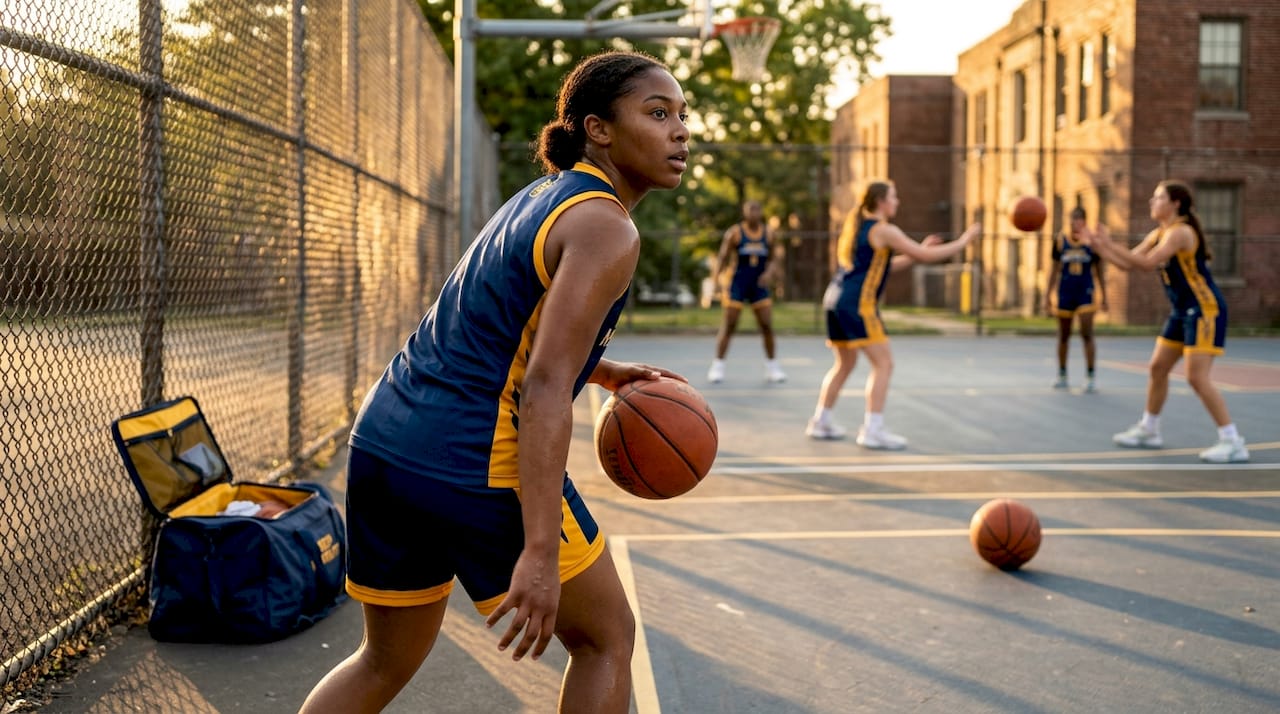
The traditional point guard was a specific body type and skill set. Smaller, faster, a pass-first distributor who deferred to scorers. That model worked well in systems built around isolation scoring and structured sets. The playbook was simple: get the ball to your best scorer, then get out of the way.
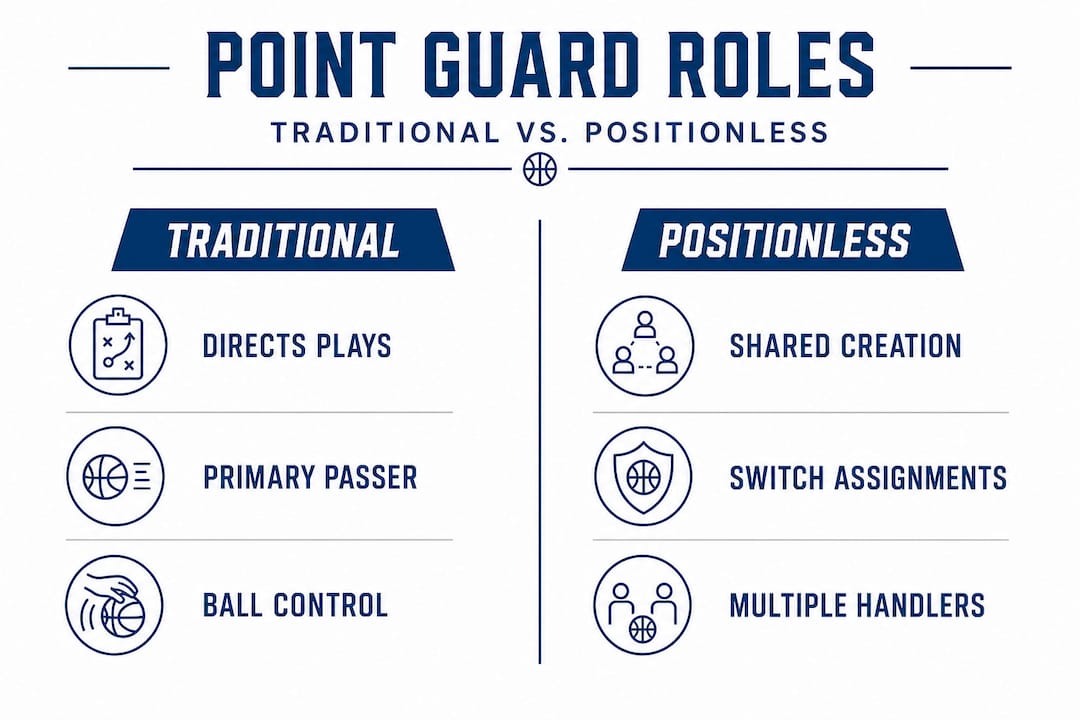
Modern offenses flipped that model. Ball movement, spacing, and positionless switching created a need for multiple players who can handle, read, and direct. That’s where the positionless debate gets real. Some argue the traditional point guard label is less important than the skills themselves, while others push back saying the position still provides unique organizational value that no amount of positionless theory can replace.
Here’s a direct comparison of what each system demands:
| Category | Traditional point guard | Positionless system |
|---|---|---|
| Primary role | Set plays, distribute, protect ball | Multiple players share playmaking duties |
| Ball handling | Concentrated at one position | Spread across 2-3 players |
| Shot creation | Deferred to scorers | Point guard expected to score too |
| Spacing impact | Secondary concern | Central to system design |
| Defensive flexibility | Limited switching expected | Must guard multiple positions |
| Communication | One vocal leader | Distributed leadership expected |
Both systems still need someone directing traffic. The difference is how formal that role is and whether one player owns it or multiple players rotate through it.
There are situations where assigning a true point guard still provides major value:
- Late-game execution, where one voice calling plays reduces confusion
- Press-break situations, where a reliable ball handler absorbs pressure
- Young teams that need structure and a clear organizational anchor
- Half-court offenses that rely on precise spacing and sequencing
“Even in positionless systems, a primary offensive director remains crucial. Distributed playmaking works in transition and early offense, but structure wins in the half-court.”
Transforming team development through positionless principles is valuable, but it works best when at least one player still understands point guard thinking. For a detailed look at spacing systems, the 5-out offense guide offers a strong starting point.
Maximizing point guard impact within different offensive systems
Knowing where the point guard fits lets you unlock their full impact. Now let’s look at how to coach those skills day in, day out.
The role of the point guard in Five Out offense is clear: quick reads, decisive ball movement, and leading the floor without locking the offense into slow, set-heavy patterns. In Five Out, the point guard triggers cuts, reads corner defenders, and decides in real time whether to attack, kick, or reset. That decision-making speed is trainable, but only if your practice structure demands it.
Modern teams also shift the primary ballhandler off-ball to create mismatches, letting other players run the offense briefly while the main playmaker relocates. This approach, seen in real coaching adjustments at the professional level, shows that rigid on-ball usage is a ceiling, not a strategy.
Here are the best practices for maximizing point guard effectiveness across different systems:
- Define the point guard’s decision zones on the court. Know where they are most dangerous and design entries that put them there
- Build two-man game reads into every practice. Pick-and-roll reads, give-and-go timing, and drive-and-kick patterns should be automatic
- Practice shot clock awareness separately. Run specific drills where the clock starts at six seconds and the point guard must generate a quality look
- Use film to reinforce correct reads. Show your point guard both the right decision and what would have happened with the wrong one
- Create off-ball movement habits so the point guard can receive the ball in rhythm coming off screens or cutting, not just bringing it up the floor
- Develop communication routines so play calls happen in one word or one hand signal, saving time and reducing confusion
- Assign leadership responsibilities in practice. Let the point guard call out defensive alignments and set the play. This builds game-ready habits
Ball movement, spacing, and communication strategies for coaches all tie back to the point guard’s decision-making speed and accuracy. When the point guard communicates early and clearly, the whole offense moves with more confidence.
- Run sets that create options, not just outcomes. The point guard should always have two reads available
- Reward good decisions in practice, not just made shots
- Use the Five Out offense strategies to create spacing that gives the point guard clean reads
Pro Tip: Use video breakdowns in practice to reinforce correct reads in motion. Pause film at the moment of decision, not the outcome. Ask your point guard what they saw, not just what they did. That builds real basketball IQ faster than repetition alone.
Why rethinking the point guard’s role is the real unlock for modern offenses
Here’s something coaches rarely say out loud: most offensive problems are actually point guard role problems. Teams stall, spacing collapses, and turnovers spike not because of bad plays, but because no one on the floor is truly directing. Someone has to own that responsibility clearly.
The old model was rigid. Your point guard ran the offense. Everyone else filled roles. That rigidity created a ceiling because if your point guard had a bad game, your entire offense stalled. Modern thinking says distribute the load. But here’s the uncomfortable truth: distributing the load without a clear primary director just creates collective confusion.
The strongest approach is flexibility with ownership. One player holds the primary decision-making role, but that player is trained to read when to share it and when to take it back. They understand their job is to make everyone else better, not accumulate stats. As the saying goes in coaching circles: “The most valuable point guards are those who make everyone else better, not just themselves.”
Following basketball strategy trends 2026 is useful, but the real work is in developing players who can read, react, and lead regardless of what the trend of the week says. Rigid positions limit players. Flexible roles with clear ownership develop them.
Pro Tip: When in doubt, design offense so any primary ballhandler can take point guard actions, then watch which players rise to the moment. That’s your actual point guard, regardless of what position they’ve been labeled.
Enhance your coaching with proven tools and resources
Ready to put these strategies into action in your next practice?

Hoop Mentality has the resources to help you build more structured, efficient practices around your point guard’s development. Start with the practice plan template to organize your sessions clearly, so every drill connects back to your offensive system. Add the Big Man Dual Action Drill to reinforce reads and two-man game concepts that point guards rely on every possession. Each resource is built from real coaching experience. Use them to save time, sharpen your communication with players, and develop the offensive clarity your team needs.
Frequently asked questions
What is the most important skill for a point guard in offense?
Decision-making is the most critical, as point guards must read defenses and make split-second choices to maximize team efficiency. Point guard projection frameworks confirm this as the central driver of offensive performance metrics.
How do coaches measure point guard performance?
Coaches most often assess usage rate, assist totals, and assist-to-turnover ratio, combining these for a complete view of offensive impact. Assist-to-turnover projection models indicate that ratios below 2:1 signal regression risk.
Does every offense need a traditional point guard?
No, but having a reliable lead ballhandler who directs offense is still crucial, even in positionless systems. Controversy exists over the label itself, but playmaking duties remain essential regardless of what you call the position.
What’s a top benchmark for elite point guard offense in recent years?
Tyrese Haliburton led with 752 assists in the 2023-24 season, setting a high bar for modern playmakers combining volume with efficiency.
What are common mistakes coaches make when assigning point guard duties?
Failing to align a player’s natural strengths with system demands often causes turnovers and missed opportunities. Matching role expectations to actual skill sets is the first step to building a functional offensive system.
Recommended
- Basketball Player Positions: Roles and Responsibilities Guide – Hoop Mentality
- Triangle offense mastery: the coach’s guide to winning – Hoop Mentality
- Basketball Offensive Concepts: A Modern Guide For Coaches – Hoop Mentality
- 10 Essential Basketball Offense Techniques Every Player Should Master – Hoop Mentality