

TL;DR:
- The triangle offense is a principles-based system emphasizing spacing, decision-making, and unselfish play. It remains relevant today, influencing modern fast-paced and spacing-oriented offenses. Proper implementation focuses on teaching fundamentals gradually, regardless of talent level.
The triangle offense has a reputation for being a relic of the 1990s, something reserved for superstars and Phil Jackson’s zen coaching circles. That reputation is wrong. Phil Jackson’s triangle offense produced 11 NBA championships and shaped how generations of players think about spacing, reads, and ball movement. More importantly, its core principles still show up in today’s most successful offenses. This guide breaks down the triangle’s origins, how it works on the court, how it compares to modern systems, and how you can install it with any roster at any level.
Table of Contents
- The origins and philosophy of the triangle offense
- How the triangle offense works in practice
- Comparing the triangle to motion offenses and the modern game
- Implementing the triangle offense at any coaching level
- Why the triangle offense still wins: Lessons from the court
- Take your triangle implementation to the next level with Hoop Mentality
- Frequently asked questions
Key Takeaways
| Point | Details |
|---|---|
| Principle-driven system | The triangle offense teaches spacing, ball movement, and high-IQ reads for all levels. |
| Modern adaptability | Its concepts can be integrated and modernized for today’s pace and shooting-focused game. |
| Success isn’t just about stars | Triangle offense elevates role players and produces disciplined, efficient offenses. |
| Implementation matters | Success depends on patient teaching, buy-in, and adapting to your roster’s strengths. |
The origins and philosophy of the triangle offense
The triangle offense did not start with Phil Jackson or even Tex Winter. Its roots trace back to Sam Barry, a coach at USC in the 1940s who built an early version of the system around spacing and player reads. Tex Winter studied under Barry, refined the concepts, and developed what became the formal triangle offense. Jackson brought Winter onto his staff with the Chicago Bulls in 1989, and the rest is basketball history.
What makes the triangle different from most offenses is its philosophy. It is not a set of plays. It is a decision-making framework. Players read the defense and react, rather than running scripted actions from a whiteboard. That distinction matters because it builds genuine basketball intelligence over time.
The system gets its name from the three-player triangle formed on one side of the floor, typically involving the wing, corner, and post. On the opposite side, two players run complementary actions. The entire structure creates spacing that forces defenses to make choices, and those choices create open shots and driving lanes.
Here are the triangle’s main principles:
- Spacing: Five players spread the floor to create driving and passing lanes
- Ball reads: Players react to the defense, not a predetermined script
- Player roles: Everyone has a defined spot but must be able to pass, cut, and shoot
- Unselfish play: No single player dominates the ball; movement is constant
- Weakside activity: The two players away from the triangle stay active and connected
“The triangle is not about plays. It is about principles. When players understand the principles, the offense runs itself.” — Tex Winter
You can explore triangle offense basics to see how these principles translate into a full system. Phil Jackson’s coaching success using this framework produced six championships in Chicago and five more in Los Angeles, making it the most decorated offensive system in NBA history.
How the triangle offense works in practice
The triangle offense sets up in a 1-2-2 alignment. The point guard brings the ball up. One forward occupies the low post on the strong side. The shooting guard fills the wing. The small forward drops to the strong-side corner. The remaining forward and center cover the weak side. That basic shape creates the triangle on the strong side and the two-man game on the weak side.
Here is a step-by-step breakdown of a basic triangle entry:
- Point guard dribbles to the wing and passes to the shooting guard
- Point guard cuts through to the weak side after the pass
- Post player seals and receives a potential entry pass from the wing
- Wing, corner, and post form the triangle and read the defense
- If the post receives the ball, wing and corner cut based on defender positioning
- Weak-side players set screens or relocate to maintain spacing
- The ball moves to the open player based on the defensive read
| Position | Spot | Primary role |
|---|---|---|
| Point guard | Top of key or weak side | Initiates entry, relocates |
| Shooting guard | Strong-side wing | Receives entry pass, reads post |
| Small forward | Strong-side corner | Spacing, corner cuts |
| Power forward | Low post | Post actions, seal, pass hub |
| Center | Weak-side elbow or block | Screen, spacing, weakside options |
Pro Tip: Install the strong-side triangle actions first. Get your players comfortable with the wing-corner-post reads before you add weakside screens and cuts. Trying to teach the whole system at once creates confusion and slows buy-in.
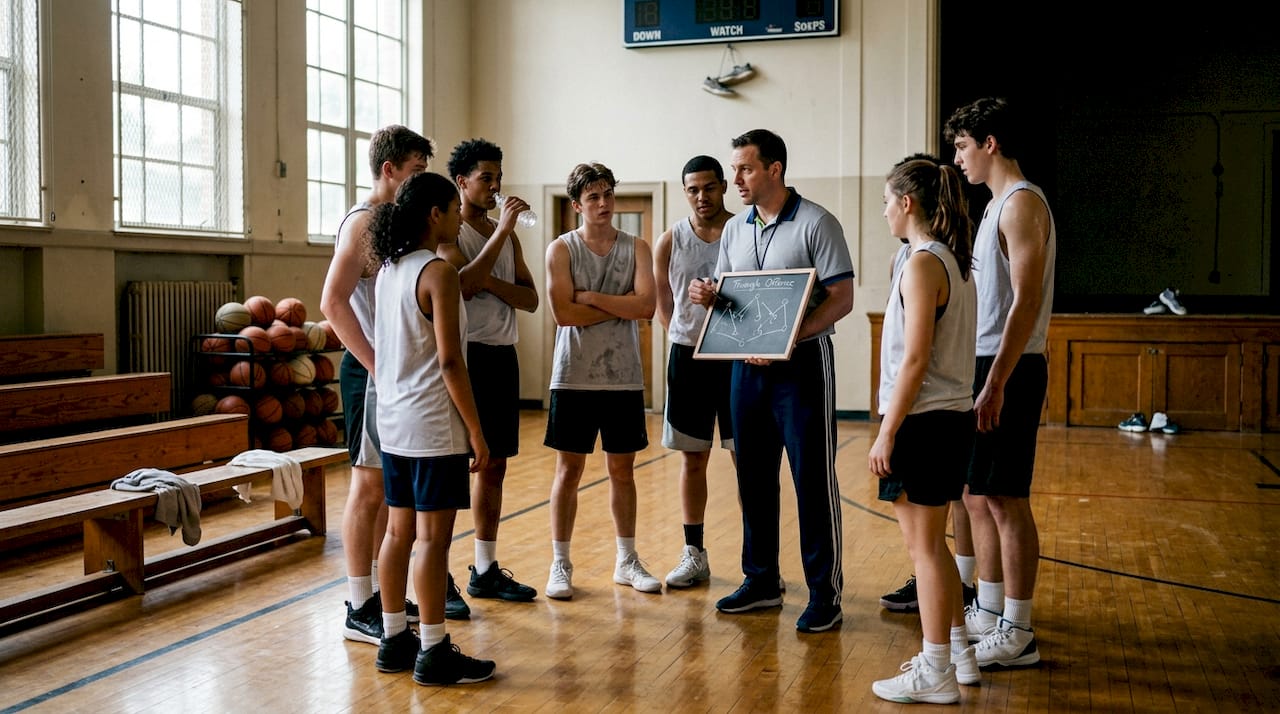
The beauty of the system is that triangle execution does not require elite talent at every position. It requires players who can make simple decisions quickly. Triangle offense in action shows how even basic reads create consistent scoring opportunities when spacing is maintained. Jackson’s teams led the league in offensive efficiency during multiple championship runs using this structure.
Comparing the triangle to motion offenses and the modern game
Coaches often ask whether the triangle is still relevant when pace-and-space and motion offenses dominate the modern game. The honest answer is that the triangle and motion offenses share more DNA than most people realize.
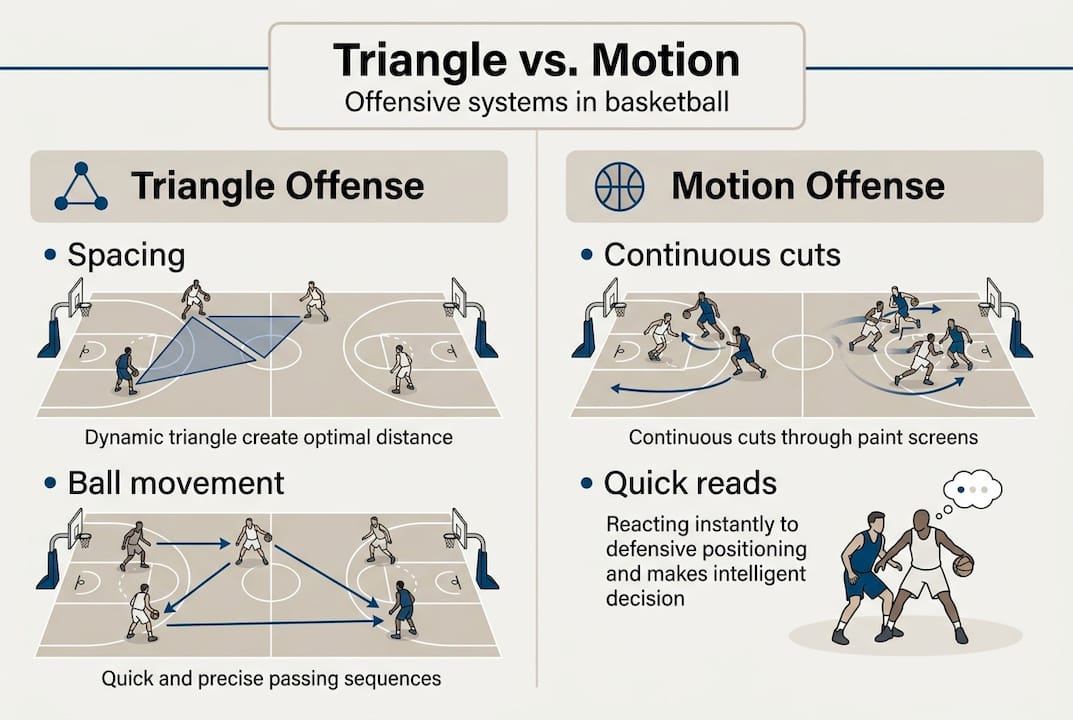
Here is how the two systems compare on key features:
| Feature | Triangle offense | Motion offense |
|---|---|---|
| Structure | Defined spots, reads-based | Free-flowing, rule-based |
| Spacing | Built into alignment | Depends on player discipline |
| Ball movement | Triggered by reads | Triggered by rules |
| Best player type | IQ-first, versatile | Athletic, high-motor |
| Teaching curve | Moderate to high | Low to moderate |
| Three-point integration | Requires adjustment | Built in naturally |
Strengths of the triangle:
- Creates natural spacing without constant coaching reminders
- Builds long-term basketball IQ
- Limits isolation-heavy, ball-stopping habits
- Generates high-percentage shots through movement
Strengths of motion offense:
- Easier to install quickly
- Works well with athletic, less-skilled rosters
- Naturally integrates three-point shooting
- Adapts faster to personnel changes
The triangle’s spacing and movement principles still show up in modern championship teams. The Golden State Warriors use spacing and reads that mirror triangle concepts. The Denver Nuggets run Nikola Jokic as a hub passer in the post, which is essentially a triangle-style read system with a modern roster. Spacing in modern offenses has become non-negotiable, and the triangle was teaching that decades before it became fashionable.
The triangle produced 11 of the 20 championships between 1991 and 2010. That is not a coincidence. It is evidence that the system’s principles are durable. If you want to explore how motion offense fits into your program alongside or instead of the triangle, understanding both systems makes you a more flexible coach.
Implementing the triangle offense at any coaching level
The biggest misconception about the triangle is that it only works with elite talent. Phil Jackson himself insists the system’s principles are fundamentally adaptable, even though Michael Jordan acknowledged that a superstar helps break down defenses. The truth sits in the middle: the triangle works at every level when you phase it in correctly.
Here is a phased approach to installing the triangle:
- Teach spacing first: Run five-out drills before adding any triangle-specific reads
- Install the strong-side triangle: Wing, corner, and post reads only
- Add the entry pass options: Teach the point guard’s role and cut patterns
- Introduce post reads: What does the post player do when they receive the ball?
- Layer in weakside actions: Screens, cuts, and relocations on the opposite side
- Add defensive counters: Teach players how to read different defensive coverages
Pro Tip: Run decision-making drills before you run full-speed triangle sets. Three-on-three reads in the half court build the habits your players need. Unselfish passing and spacing are skills, not attitudes. Drill them like any other skill.
Common pitfalls to avoid:
- Overcomplicating early: Too many reads at once kills confidence
- Ignoring personnel: Force the triangle into your roster’s strengths, not the other way around
- Skipping weakside options: The two-man game on the weak side is half the offense
- Neglecting spacing drills: Players who crowd the ball destroy the triangle’s geometry
- Rushing the timeline: The triangle takes a full season to install properly at most levels
For the modern game, you can adapt triangle offense drills to include dribble handoffs, corner three reads, and pick-and-roll actions that connect triangle spacing to today’s pace-and-space demands. Spacing tips for coaches can help you bridge the gap between classic triangle structure and modern three-point integration. Check adapting triangle strategies for practical examples of how coaches are modernizing the system right now.
Why the triangle offense still wins: Lessons from the court
Here is the part most coaching articles skip. The triangle’s real value is not its aesthetics or its championship pedigree. It is what the system does to your players over time.
The triangle forces accountability. Every player has a read. Every player has a spot. When the offense breaks down, it is visible and correctable. That clarity is rare in basketball systems.
Most coaches who abandon the triangle do so because it is hard to teach, not because it does not work. Consistency and commitment matter more than innovation. A team that runs the triangle with discipline for two full seasons will outperform a team that switches offensive systems every year chasing trends.
The system enabled dynasties not just because of Jordan and Kobe, but because it elevated role players and taught unselfishness as a habit. Dennis Rodman, Ron Harper, and Robert Horry were not superstars. They were triangle-smart players who knew their reads. That is something you can build on any roster.
Even if you eventually move to a motion or pace-and-space system, the concepts your players learn from the triangle transfer directly. Spacing awareness, post reads, weakside activity, and unselfish ball movement are universal. Understanding why teams moved away from the triangle helps you take the best parts of the system and leave the rest.
Take your triangle implementation to the next level with Hoop Mentality
You have the roadmap. Now you need the right tools to execute it.

Hoop Mentality offers coaching resources built for exactly this kind of system installation. Use the basketball practice plan template to structure your triangle teaching progressions from day one. Add the big man dual action drill to develop your post players’ reads and footwork inside the triangle. Every resource at Hoop Mentality is built from real coaching experience. Practical tools. Clear structure. Ready to use.
Frequently asked questions
Can I run the triangle offense without a superstar scorer?
Yes. The triangle emphasizes spacing and team reads, so it creates open shots through movement rather than individual brilliance. Phil Jackson insists the system is adaptable well beyond MJ or Kobe-level talent.
What age level can learn and benefit from the triangle offense?
All levels can benefit when progressions are used correctly. Start with spacing and basic reads, then layer in complexity. Triangle principles are teachable and scale to any roster when introduced gradually.
Why did teams move away from the triangle offense in the modern era?
The shift toward faster pace, more three-point shooting, and motion offenses made the triangle harder to justify in the short term. But triangle principles persist in today’s top offenses, just under different labels.
What are common challenges when implementing the triangle?
Coaches most often overcomplicate early teaching, skip weakside options, or underestimate how long it takes to build unselfish habits. Weakside reads and team play are the most commonly missed elements when installing the system.