

Trust is the single biggest lever for team performance: it drives cooperation, faster decisions, and honest risk-taking. A meta-analysis of 123 studies covering 8,452 teams found a positive link between intrateam trust and performance, with an effect-size estimate of rho = 0.30. The CIPD’s 2024 evidence review backs this up across engagement, satisfaction, and turnover. Here’s what that means in practice, why low trust wrecks teams, and how Hoop Mentality’s coaching tools help you build it back.
- Trust enables cooperation, information sharing, and quicker decisions.
- The performance link holds across 123 independent studies (rho = 0.30).
- Low trust triggers hoarding, over-monitoring, and slower collaboration.
Key Takeaways
Trust works because it directly enables cooperation, information sharing, and faster decision-making, and the effect on performance is measurable at rho = 0.30 across 8,452 teams.
| Point | Details |
|---|---|
| Trust drives performance | A meta-analysis of 123 studies found rho = 0.30 between intrateam trust and team performance. |
| Leader trust cascades | A 2025 longitudinal study found leader trust predicts teammate trust, cooperation, and performance. |
| Low trust has a cost | Missing trust produces hoarding, over-monitoring, blame conflict, and higher turnover. |
| Interdependence raises the stakes | Trust matters most in high-coordination roles where players depend on each other’s reads. |
| Structure builds trust faster | Hoop Mentality’s template bundles and practice plans help coaches deliver the consistency and clarity that trust requires. |
Table of Contents
- Why the Importance of Trust in Teams Shows Up in Performance
- What Happens When a Team Has No Trust?
- Cognitive Trust vs. Affective Trust: Which One Is Broken?
- How Do You Build Trust in a Team?
- What Does the Research Actually Show?
- Trust Directly Shapes Engagement, Output, and Psychological Safety
- A Coach’s Take on Daily Trust Habits
- Build Trust Faster With Ready-Made Coaching Structure
- Sources
- FAQ
Why the Importance of Trust in Teams Shows Up in Performance
Trust changes how people behave when nobody’s watching. Teams with high trust share more information, take more risks, and recover faster from mistakes because members aren’t spending energy protecting themselves from each other.
The core benefits show up consistently across the research:
- Psychological safety: people speak up about problems before they become disasters.
- Faster decisions: less time spent verifying, double checking, and covering bases.
- Better information flow: players and staff share what they actually see, not what sounds safe.
- Higher engagement: the CIPD’s rapid evidence assessment ties trust to job satisfaction and lower turnover intent.
- More risk-taking: players try new moves and admit gaps in their game instead of hiding weaknesses.
That meta-analytic rho of 0.30 isn’t abstract for a coach. It means a team that trusts its coach and each other will follow through on tough practice plans, give honest feedback during film sessions, and stick with adjustments during a losing streak instead of turning on one another.
Pro Tip: Trust-building pays off fastest in high-interdependence work. If your team runs complex sets that require five players reading off each other, prioritize trust drills over generic bonding exercises. Research on task interdependence found trust’s effect on performance nearly six times stronger in high-coordination roles than low-coordination ones.
What Happens When a Team Has No Trust?
Low trust doesn’t announce itself. It shows up as slow, quiet dysfunction that looks like a talent problem until you dig deeper.
Common failure modes include:
- Information hoarding: players or assistants sit on useful observations instead of sharing them.
- Excessive monitoring: coaches over-check, players over-explain, everyone second-guesses everyone.
- Risk aversion: nobody tries the new play in a close game because failure feels dangerous.
- Blame-focused conflict: film sessions turn into finger-pointing instead of problem-solving.
- Turnover and burnout: the Center for Creative Leadership links these protective behaviors to real attrition and lower well-being.
A point guard stops calling out defensive switches because a teammate blamed him publicly for a blown coverage last week. Now the whole back line communicates less, closeouts get slower, and the coach reads it as an effort problem. It’s a trust problem wearing effort’s clothes.
Protective behavior costs time and mental energy that should go toward the game plan, not toward self-defense.
Cognitive Trust vs. Affective Trust: Which One Is Broken?
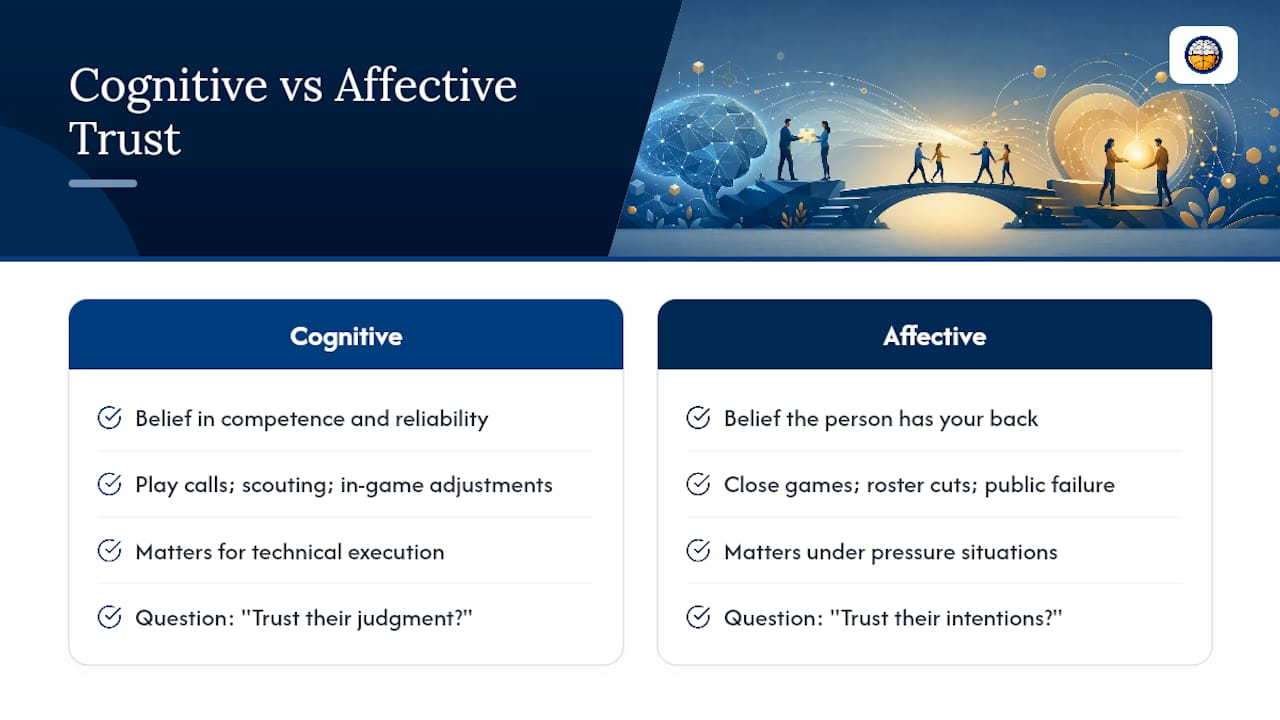
Trust breaks down along two distinct lines, and knowing which one is weak changes your fix. Cognitive trust is belief in someone’s competence and reliability. Do they do what they say, on time, at a standard you can count on? Affective trust is emotional. Do you believe this person actually has your back, not just your assignment sheet?
Vertical trust (in the leader) and horizontal trust (among teammates) interact directly. The 2025 longitudinal study of 307 employees across 71 teams found trust in a leader predicted trust among teammates, which then raised cooperation and performance over three months. Leader trust cascades down; it doesn’t stay contained.
Cognitive trust matters more for technical execution: play calls, scouting accuracy, in-game adjustments. Affective trust matters more under pressure: close games, roster cuts, public failure.
Pro Tip: Ask two diagnostic questions separately: “Do I trust this person’s judgment?” and “Do I trust this person’s intentions toward me?” A weak answer to the first points to a leadership consistency problem. A weak answer to the second points to a communication or fairness problem.
How Do You Build Trust in a Team?
Trust doesn’t build through one retreat or one speech. It compounds through small, repeated behaviors, and leaders go first.
- Model transparency about decisions. Explain the “why” behind rotations, playing time, and strategy shifts. Comcare’s guidance on team trust shows shared context builds trust faster than praise alone.
- Follow through consistently. Say what you’ll do, then do it. Inconsistent leadership behavior is one of the fastest ways to burn cognitive trust.
- Delegate real responsibility. Hand off scouting duties, warmup structure, or captain roles, with support, not just tasks.
- Clarify shared goals. Everyone should know the season’s real priorities, not guess at them.
- Build structured feedback loops. High-performing teams use explicit norms for disagreement and regular debriefs, not occasional venting sessions.
- Model vulnerability. Admit a bad call. Coaches who own mistakes publicly get more honesty back from players.
For remote or hybrid staffs (assistant coaches scouting from different cities, for example), adjust with more frequent synchronous check-ins, shared documentation everyone can access, and clear norms for async updates so nobody’s guessing what happened in a conversation they missed.
When trust breaks, repair it fast and directly:
- Acknowledge the breach immediately, don’t wait for it to blow over.
- Be factually transparent about what happened and why.
- Offer a concrete action plan, not just an apology.
- Follow through visibly so the team can measure the change.
Pro Tip: Use practice structure itself as a trust tool. A consistent warmup routine and predictable practice plan signals reliability before you say a single word.
What Does the Research Actually Show?
The strongest finding is the meta-analytic link: 123 studies, 8,452 teams, rho = 0.30 between intrateam trust and performance. That’s a moderate, consistent effect across a large and varied sample, not a fluke from one industry or study design.
The 2025 longitudinal study adds the mechanism: trust in a leader predicts trust among teammates, and that cascade drives cooperation and performance over time. Trust starts at the top and spreads.
The CIPD’s rapid evidence assessment adds a caveat worth remembering: trust’s effect depends on context. It matters more in larger teams and in roles requiring tight coordination.
- Apply trust-building hardest where players depend on each other most: pick and roll reads, help defense rotations, in game adjustments.
- Treat leader consistency as the first lever, since it cascades down.
Trust Directly Shapes Engagement, Output, and Psychological Safety
Trust isn’t a soft metric that sits next to performance. It’s a mechanism that produces performance. Teams with psychological safety, the belief that speaking up won’t get you punished, learn faster because mistakes get surfaced instead of buried. Amy Edmondson’s research on psychological safety shows this pattern holds across team types, and trust is the foundation underneath it.
Engagement follows the same path. Players and staff who trust their coach and each other show up with more effort because they believe that effort will be seen fairly and used well. The CIPD evidence review links trust directly to job satisfaction and lower turnover intent, findings that translate cleanly to retention in youth and amateur programs where players quit teams, not just jobs.
Productivity gains from trust aren’t about working harder. They’re about wasting less time. Teams that trust each other spend fewer possessions on miscommunication, fewer film sessions on blame, and fewer meetings re-explaining decisions that should have been clear the first time. That reclaimed time goes straight back into skill development and game preparation, which is the entire point of coaching in the first place.
A Coach’s Take on Daily Trust Habits
Trust gets built in ordinary moments, not big speeches. A consistent practice plan, public credit for good habits, and honest postgame debriefs do more than any trust exercise. Try this tomorrow: a five-minute sync after practice where two players each share one thing they learned and one commitment for the next session.
Pro Tip: During roster changes or high-pressure stretches, over-communicate more than feels necessary. Silence gets read as bad news, even when it isn’t.
Build Trust Faster With Ready-Made Coaching Structure
Every trust-building action in this guide, clear goals, consistent routines, transparent feedback, gets easier when you’re not building the structure from scratch mid-season. Hoop Mentality’s resources exist to give you that structure without guesswork.
The Basketball Starter Pack For Coaches gives you foundational practice plans and templates to run consistent, predictable sessions from week one. The Basketball Template Bundle For Coaches includes editable practice plans and rosters that let you communicate roles and expectations clearly, a direct fix for the contextual information gap that erodes trust. If shooting development is your focus, the Basketball Shooting Bundle For Coaches offers structured progressions that build reliability into your practice routine. For fair, consistent evaluations, the Editable Scouting Report Template and Basketball Scouting Report Template standardize feedback so players know exactly where they stand. Browse the full Hoop Mentality collection to find the resource that fits your team’s next step.
Sources
- Trust in Leader as Antecedent to Trust in Team Members, Team Cooperation, and Team Performance: A Multilevel, Longitudinal, Mediational Perspective
- Intra-organisational trust scientific summary (CIPD / CEBMa, 2024)
- How High-Performing Teams Build Trust (Harvard Business Review, 2024)
FAQ
What Does Lack of Trust Do to a Team?
Low trust triggers information hoarding, excessive monitoring, and risk aversion, which slow decisions and increase conflict. The Center for Creative Leadership links these protective behaviors to higher turnover and reduced well-being.
What Role Does Trust Play in Team Decision Making?
Trust speeds up decisions by reducing the need to verify or second-guess each other’s input. Teams with high trust share honest information faster, which the meta-analytic evidence ties directly to better performance.
How Long Does It Take to Build Trust on a New Team?
There’s no fixed timeline; it depends on consistency, not calendar time. Leader trust cascading to teammate trust took measurable effect within three months in one longitudinal study, but daily follow-through matters more than any set number of weeks.
Does Trust Matter More in Some Teams Than Others?
Yes. Research on task interdependence found trust’s effect on performance is far stronger in roles requiring tight coordination than in low-interdependence work.
Can Tools Like Templates Actually Help Build Trust?
Yes, indirectly. Standardized tools like Hoop Mentality’s scouting report templates reduce ambiguity and bias in feedback, which supports the consistency and transparency that trust depends on.