

TL;DR:
- Coaching consistency involves applying the same standards and communication style across all player interactions. It builds trust, improves team performance, and fosters long-term behavior change. Maintaining consistency requires structured practices, written systems, and predictable feedback to develop athletes effectively.
Coaching consistency is defined as the deliberate practice of applying the same standards, communication style, and feedback methods across every player interaction, practice, and game situation. The importance of coaching consistency cannot be overstated. Teams with steady, predictable coaching develop faster, trust their coaches more deeply, and perform better under pressure. Research confirms that structured, consistent coaching reduces turnover by up to 47% after three years and accelerates ramp-up time by 33%. Those numbers translate directly to basketball: players who know what to expect from their coach spend their mental energy on skill execution, not on reading the room.
What does research say about the benefits of consistent coaching?
The evidence for coaching consistency is clear and growing. A meta-review of over 15,000 individuals found that coaching interventions yield a moderate positive impact on performance, with a Hedges’ g score of approximately 0.58. That effect size grows stronger in individualized, long-term programs. Short, one-off sessions simply do not produce the same results.
Longitudinal data reinforces this point. Consistent coaching produces lasting behavior change 12 or more months after a program ends, outperforming one-time training by a wide margin. For basketball coaches, this means that a player who receives steady technical feedback across an entire season retains and applies those corrections far longer than a player who gets a single intensive clinic.
“Regular, structured coaching shows 25–40% team productivity improvement and 15–30% reduction in leadership turnover. Consistent practice yields sustained competitive advantage.”
The compounding effect matters here. Coaching effectiveness does not grow linearly. Each consistent interaction builds on the last, reinforcing habits and deepening trust. A coach who gives the same quality of feedback in game 3 as in game 23 creates a predictable development environment. That predictability is the engine behind sustained performance gains.
Consistent coaching across all team members also stabilizes performance and reduces variance between individuals. Coaches who focus only on struggling players miss the ROI available from developing the entire roster. Raising the floor for every player, not just the weakest links, is what separates good teams from great ones.
| Metric | Impact of consistent coaching |
|---|---|
| Skill ramp-up speed | 33% faster with structured, regular coaching |
| Player/staff retention | Up to 47% reduction in turnover after three years |
| Long-term behavior change | Sustained 12+ months post-program |
| Team productivity | 25–40% improvement with regular structured sessions |
| Performance variance | Reduced across all team members, not just low performers |
How does coaching consistency build athlete trust?
Trust is the foundation of every effective coach-player relationship. Consistency in coaching builds athlete trust by creating predictability and emotional safety, which directly fosters acceptance of feedback and creative risk-taking. When players know their coach will respond the same way on Tuesday as on Friday, they stop second-guessing and start executing.
Psychological safety is the technical term for this state. It describes an environment where players feel safe to attempt new skills, admit mistakes, and ask questions without fear of unpredictable reactions. Coaching consistency manages psychological safety by removing the guesswork from player-coach interactions. A player who trusts their coach’s consistency will try a new move in practice. A player who does not will play it safe every time.
The consequences of inconsistency are measurable and damaging. Inconsistent coaching causes athletes to expend cognitive energy on political calculation rather than skill improvement. Players start watching the coach’s mood instead of watching the ball. That mental shift degrades performance at exactly the moments when focus matters most.
Here is what consistent coaching looks like in practice for building trust:
- Predictable feedback standards. Players receive the same criteria for evaluation regardless of the score or the opponent.
- Steady communication tone. The coach’s voice and body language remain calm and direct after both wins and losses.
- Fair accountability. Rules apply equally to every player, from the starter to the last player off the bench.
- Regular check-ins. Scheduled one-on-one conversations signal that development is a priority, not an afterthought.
- Honest, specific praise. Positive feedback is tied to specific behaviors, not just outcomes, so players know exactly what to repeat.
Pro Tip: After every game, send each player one specific written observation, positive or corrective. This single habit builds trust faster than any pregame speech because it shows players you are watching them individually, every time.
Athletes are more committed and motivated when they trust their coach. That trust is built through consistent behavior over time, not through a single motivational moment. The player-coach relationship deepens every time a coach shows up the same way, regardless of circumstances.
What are the biggest coaching consistency challenges?
Every coach faces pressure that pulls against consistency. Game-day emotions, a losing streak, a star player underperforming, or a packed schedule can all push a coach toward reactive, inconsistent behavior. Recognizing these triggers is the first step toward managing them.
- Emotional reactions after losses. Coaches who change their feedback tone or standards after a bad game send a signal that expectations shift with results. Players notice this immediately and adjust their behavior accordingly, usually by playing more cautiously.
- Time pressure during the season. When practice time shrinks, feedback sessions get cut first. Irregular coaching signals that development is not a priority, which undermines the entire program’s culture.
- Inconsistent standards across players. Holding a star player to different standards than a role player destroys team cohesion. Every player on the roster is watching how others are treated.
- Reactive rather than structured feedback. Spontaneous, in-the-moment corrections are valuable, but they cannot replace structured post-practice or post-game reviews. Scheduled reviews maintain coaching consistency far better than reactive feedback alone.
- No written system. Coaches who rely on memory to track player development miss patterns and repeat feedback without progression. A written tracking system closes that gap.
Pro Tip: Block 15 minutes after every practice on your calendar for written feedback notes. Treat it like film review. You would never skip film, so do not skip the feedback record either.
The fix for most of these challenges is structure. Coaching feedback strategies that are scheduled, documented, and tied to specific player goals remove the reliance on memory and emotion. Templates and practice plans reduce the cognitive load on the coach, freeing up mental space to stay consistent even under pressure.
How to implement coaching consistency for lasting team growth
Effective implementation starts with positioning coaching as a reinforcement mechanism, not a standalone event. Coaching works best as a reinforcement layer following formal training and practice, ensuring that skills introduced in drills get locked in through repeated, consistent feedback. Introduce a skill in practice, then reinforce it through individual feedback across the next several sessions.
Clear expectations are the second pillar. Every player needs to know exactly what is expected of them, in writing, at the start of the season. Vague standards create inconsistency by default because coaches fill the gaps differently each time. Effective coaching integrates behavioral goal clarity and targets specific, measurable outcomes. “Improve your defensive positioning” is not a goal. “Reduce your opponent’s field goal percentage in your defensive zone by the midpoint of the season” is a goal.
Communication cadence is the third pillar. Decide how often you will meet with each player individually and stick to that schedule. Weekly is ideal for in-season work. Biweekly works for the offseason. The frequency matters less than the reliability.
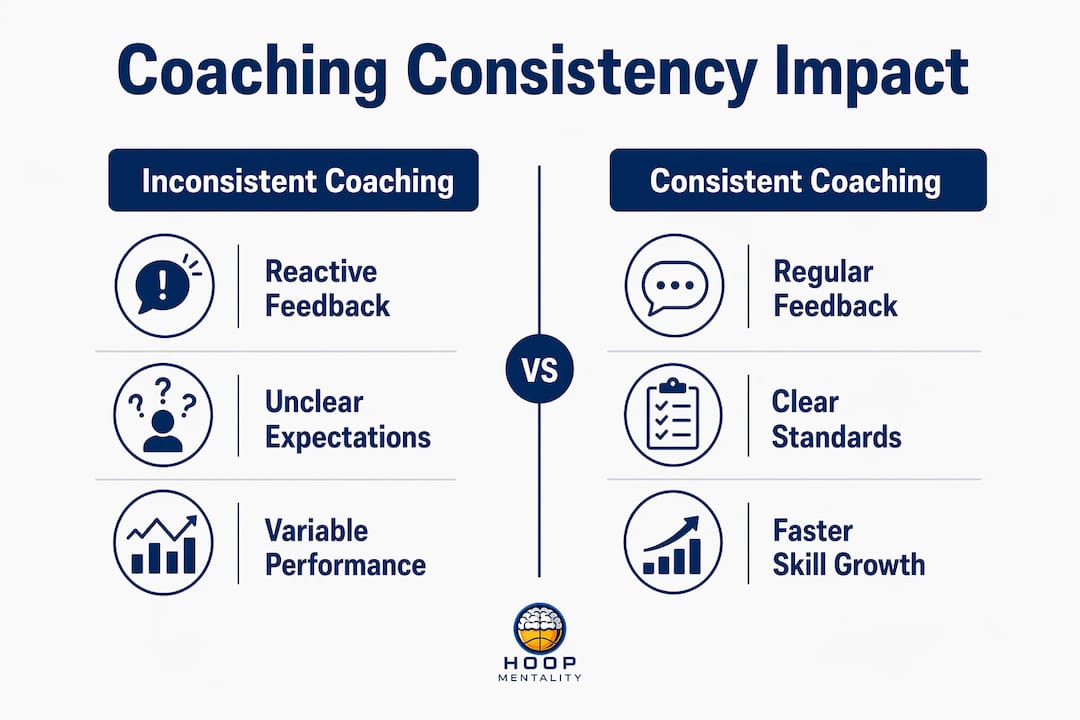
| Approach | Inconsistent coaching | Consistent coaching |
|---|---|---|
| Feedback timing | Reactive, after poor performances only | Scheduled, after every practice or game |
| Standards | Vary by player status or game result | Same criteria applied to every player |
| Communication | Informal, mood-dependent | Structured, documented, predictable |
| Player development | Uneven, driven by individual initiative | Systematic, tracked against clear goals |
| Team culture | Anxious, politically aware | Focused, psychologically safe |
Organizing practice plans around consistent themes and skill progressions reinforces your coaching message every single session. Players internalize the system faster when the practice structure mirrors the feedback they receive individually. That alignment between group training and individual coaching is what drives the fastest skill development.
Key Takeaways
Coaching consistency is the single most reliable driver of athlete trust, skill retention, and team-wide performance improvement.
| Point | Details |
|---|---|
| Consistency accelerates development | Structured coaching reduces ramp-up time by 33% and sustains behavior change 12+ months. |
| Trust requires predictability | Players focus on skill execution only when they can predict their coach’s standards and reactions. |
| Inconsistency costs performance | Athletes who cannot predict their coach spend cognitive energy on politics, not skill. |
| Structure beats willpower | Scheduled feedback sessions and written tracking maintain consistency better than good intentions. |
| Whole-roster engagement pays off | Coaching every player consistently reduces performance variance and raises the team’s baseline. |
Why I think most coaches underestimate consistency
Coaches spend enormous energy on X’s and O’s. Play design, defensive schemes, and offensive sets get hours of attention every week. Consistency in how you deliver feedback gets almost none. That is the wrong priority order.
I have watched teams with average talent outperform more gifted rosters simply because their coach showed up the same way every single day. Players on those teams did not waste energy wondering what version of their coach would walk into the gym. They just played. The mental freedom that comes from a predictable coaching environment is genuinely underrated.
The most common misconception I see is that consistency means rigidity. It does not. You can adjust your game plan, change your rotations, and respond to what the opponent gives you. Consistency is about your standards and your communication, not your tactics. A coach who holds the same expectations for effort, communication, and accountability while adapting strategy is both consistent and flexible.
My advice for coaches who struggle to stay steady: write it down. Your feedback criteria, your practice structure, your player development goals. When everything lives in your head, emotions fill the gaps. When it is written, you have a standard to return to after a tough loss or a frustrating practice. That written system is what separates coaches who grow their players from coaches who just react to them.
— Dejan
Coaching tools from Hoop Mentality
Maintaining consistent coaching practices is easier with the right structure behind you.

Hoop Mentality’s Basketball Template Bundle for Coaches includes practice plans, player development templates, and scouting reports built around the kind of repeatable systems that make consistency possible. Every template is designed to reduce prep time so you can focus on what actually moves the needle: your players. The Basketball Shooting Bundle adds structured drill sets that reinforce consistent technique development across every practice. Both resources are ready to use and built from real coaching experience.
FAQ
What is coaching consistency in basketball?
Coaching consistency is the practice of applying the same standards, feedback methods, and communication style to every player across every practice and game. It creates the predictability that allows players to focus on skill development rather than managing their coach’s reactions.
Why does consistency matter more than coaching intensity?
Intensity fades between sessions. Consistency compounds. Research shows that long-term consistent coaching produces lasting behavior change 12 or more months after a program ends, while one-time intensive sessions do not produce the same retention.
How does inconsistent coaching hurt player performance?
Inconsistent coaching forces players to spend cognitive energy predicting their coach’s behavior instead of executing skills. That mental shift directly reduces performance, particularly in high-pressure game situations.
How often should a coach give individual feedback?
Weekly individual feedback is the standard for in-season development. The frequency matters less than the reliability. Scheduled, documented sessions outperform spontaneous feedback because players know development is a consistent priority.
What is the fastest way to build trust with players?
Apply the same standards to every player, every time, regardless of their role or the game result. Building trust through coaching comes from predictable behavior over time, not from single motivational moments.