

Video analysis speeds up skill acquisition, replaces guesswork with objective feedback, sharpens tactical preparation, and cuts injury risk by catching flawed mechanics early. Coaches get a record that does not fade like memory does. Athletes get proof of what actually happened, not what they think happened. The people who gain the most are coaches, athletes, rehab staff, and anyone scouting or tracking long-term development.
TL;DR:
- Most coaching programs fail to review footage with a specific purpose, rendering the recording largely useless.
- Video analysis enhances skill correction accuracy, tactical understanding, injury prevention, and long-term player development through objective evidence.
- Effective implementation depends on clear goals, proper tagging, short review sessions, and avoiding overloading players with corrections at once.
- Standard 2D footage has limitations like depth distortion and reviewer disagreement, but consistent calibration and multi-angle capture improve reliability.
- Using video to guide practice drills and resource selection directly accelerates skill improvement and tactical adjustments.
Table of Contents
- What Video Analysis Is and Why It Matters
- Core Benefits of Video Analysis Coaches Actually Use
- How Video Analysis Works Across Different Sports and Settings
- Best Practices for Implementing Video Analysis (the ACE Model)
- Where Video Analysis Falls Short and How to Fix It
- The Psychological Payoff: Motivation and Confidence
- Is Video Analysis Worth the Time and Cost?
- Real Coaching Situations Where Video Made the Difference
- How Hoop Mentality Uses Video to Shape Coaching Resources
- Turn What You See on Film Into a Practice Plan
- Sources
- FAQ
What Video Analysis Is and Why It Matters
Video analysis follows a simple workflow: capture the action, break it down into specific moments, then review those moments with a purpose. That third step is where most programs fail. Filming a scrimmage means nothing if nobody watches it with a plan.
The case for recording in the first place comes down to memory. Experienced coaches recall critical game events with only about 59.2% accuracy, according to research on sport coach recollection. That means roughly four out of every ten key moments get misremembered, exaggerated, or lost entirely by the next practice. A camera does not have that problem.
The technology needed to close that gap has never been more accessible:
- A phone propped on a tripod covers most youth and amateur film needs.
- Tablet apps add slow motion, drawing tools, and instant playback.
- AI-assisted platforms track player movement and generate reports for programs with the budget to use them.
Every tier runs on the same core loop: capture, tag, review, and feed what you learn back into practice.
Core Benefits of Video Analysis Coaches Actually Use
The advantages of video data are not abstract. Each one maps to something a coach does on a Tuesday afternoon.
- Objective evidence over memory. With coach recall sitting near 59.2% accuracy, film settles arguments about what really happened on a possession and preserves detail that would otherwise disappear by the next film session.
- Faster technique correction. Video-based feedback speeds up motor learning compared with verbal coaching alone in many training contexts. One frequently cited example: a small study on strength training found every participant improved their deadlift form after reviewing footage of their own lift, a level of visual self-correction verbal cues rarely produce on their own.
- Shared understanding between coach and player. When a player sees the same clip the coach is describing, the conversation shifts from “trust me” to “look here.” That shared reference point cuts down on the back-and-forth where a player insists they boxed out when the tape says otherwise.
- Tactical and opponent analysis. Reviewing an opponent’s out-of-bounds sets or a team’s own defensive rotations reveals patterns that live action moves past too fast to catch.
- Injury prevention and rehab monitoring. Frame-by-frame review of joint angles and landing mechanics flags overuse patterns before they become injuries, and gives rehab staff a visual baseline to track return-to-play progress.
- Recruitment, retention, and long-term tracking. A running library of clips shows a player’s development across a season, which matters for scouting conversations and for parents who want to see progress, not just hear about it.
Quick fact: Coaches misremember or lose roughly 40% of key game moments without video, based on the 59.2% recall accuracy found among experienced coaches.
How Video Analysis Works Across Different Sports and Settings
How video analysis improves performance depends heavily on what you are trying to fix. Team sports and individual sports pull different value out of the same footage.
- Team sports benefit most from wide-angle shots that reveal shape, spacing, and off-ball movement. A single possession filmed from the baseline can expose a blown rotation that no player noticed in real time.
- Individual and technique-heavy sports get more out of tight, frame-by-frame breakdowns of joint angles, release points, or footwork. This is where slow motion and side-by-side comparison earn their keep.
- Remote coaching and fitness training rely on asynchronous review. A client uploads a lift or a shooting rep, the coach annotates it on their own schedule, and feedback goes back without either party needing to be online at the same time.
- Live review works when the fix is immediate and simple, like adjusting a stance between reps. Deeper post-session breakdowns work better for anything requiring context, comparison footage, or a slower conversation, like correcting a shooting pocket that has been wrong for months.
Basketball coaches see this play out constantly with defensive adjustments that only become obvious once you can pause on the exact frame where a gap opened. The same footage that helps a big man fix a pivot in the post can, filmed from a different angle, show an entire team’s zone rotation breaking down. That is the real value of uses of video analysis in sports: one recording, multiple coaching purposes, depending on what you are looking for.
Best Practices for Implementing Video Analysis (the ACE Model)
Why use video analysis in coaching without a plan for reviewing it? A stack of unwatched footage does nothing. A recent peer-reviewed framework called the ACE Model, built from a review of 39 studies on video-based feedback, gives coaches a structure that turns clips into actual improvement.
ACE stands for Aims, Content, and Evaluation:
- Aims — decide what the clip is supposed to accomplish before you film it. One correction per clip, not five.
- Content — choose footage that isolates that one issue clearly, tagged and timestamped so it is easy to pull later.
- Evaluation — check whether the athlete actually improved, comparing baseline footage from early in a training block against footage from the end of it.
A workable weekly routine looks like this:
- Tag each clip by category (technical, tactical, conditioning, decision) so practice planners can grab relevant footage fast.
- Keep review windows short, ten to fifteen minutes, scheduled right after practice while the moment is fresh.
- Compare early-block footage to late-block footage every few weeks to show objective progress, not just a gut feeling that a player got better.
- Fold specific clips directly into the next practice plan as the warmup or teaching point for a drill.
Pro Tip: Never hand an athlete more than one correction per clip. Stacking three coaching points into a ten-second video guarantees they will only absorb the first one, if that.
Where Video Analysis Falls Short and How to Fix It
The effectiveness of video analysis depends entirely on how carefully it gets set up. Standard 2D footage has real limits. A single camera angle can distort depth, making a defender look a step further off than they actually were, and different coaches reviewing the same clip can disagree on what they are seeing, a problem researchers call intra-rater variability.
Common pitfalls show up in almost every program that adopts film study without a system:
- Recording every minute of practice and reviewing none of it, which burns storage and time for zero benefit.
- Sending athletes ten corrections at once instead of one, which overwhelms rather than teaches.
- Skipping consent conversations, especially with minors, before filming and sharing footage.
- Relying on a single camera angle for judgments that really need two or three.
The fixes are straightforward. Use multiple camera angles when a call really matters, calibrate distance and framing consistently so clips are comparable over time, and standardize how clips get annotated so two coaches read the same footage the same way. A structured film-study process built around consistent tagging solves most of the reliability problems teams run into before they ever become a real issue.
The Psychological Payoff: Motivation and Confidence
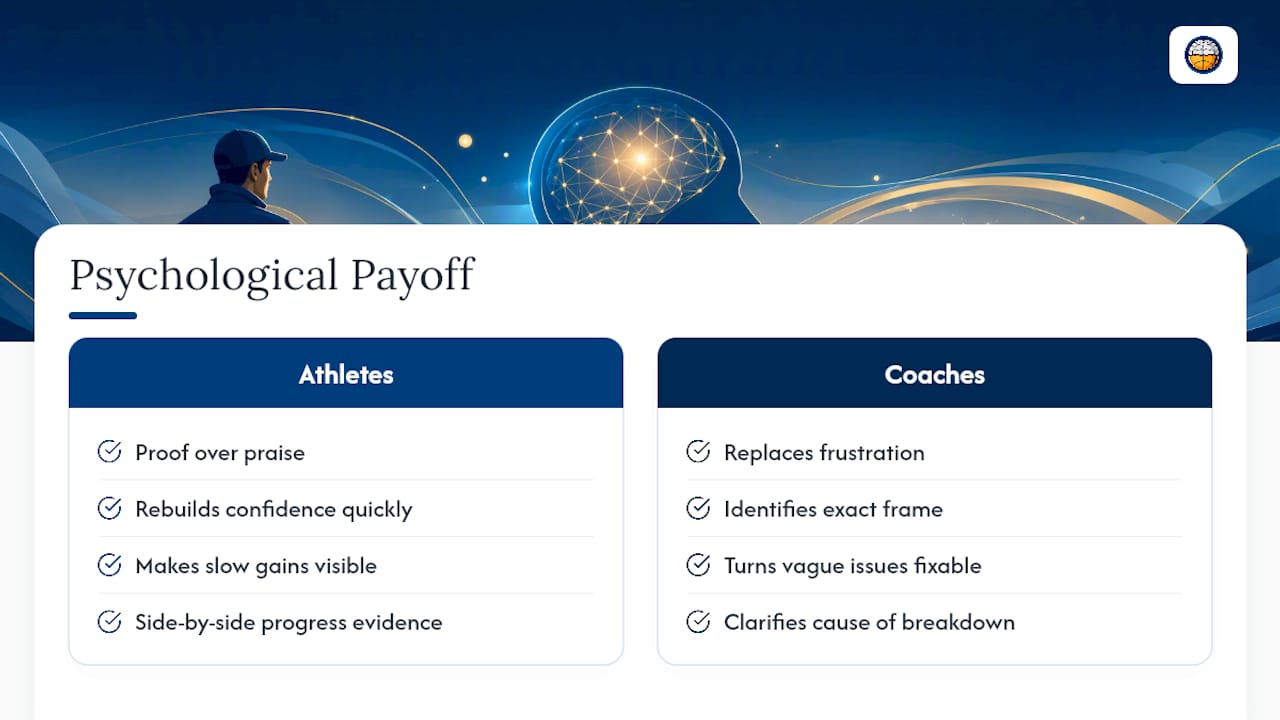
Skill gains are only half the story. Athletes who watch themselves execute something correctly tend to believe in that skill more than they did when a coach simply told them it looked good. Seeing a clean rep on screen carries a different weight than hearing “nice job” shouted across the gym.
That shift matters most for players stuck in a slump. A shooter who has missed ten straight free throws does not need another verbal cue. They need to see the one rep from three weeks ago where their elbow was in the right spot and their follow-through held. That single clip can rebuild confidence faster than a pep talk, because it is proof, not encouragement.
Progress footage also fights the feeling that improvement is invisible. Basketball skill development happens slowly, in centimeters of footwork and fractions of a second in release time. Without a visual record, players rarely notice their own growth. A side-by-side clip from week one against week eight makes that growth undeniable, and undeniable progress is what keeps athletes motivated through the grind of a long season.
Coaches benefit psychologically too. Reviewing tape replaces frustration with clarity. Instead of guessing why a set keeps breaking down, a coach can point to the exact frame where the gap opened, which turns a vague sense of “something is off” into a specific, fixable problem.
Is Video Analysis Worth the Time and Cost?
The barrier to entry has dropped low enough that cost is rarely the real obstacle anymore. A phone and a tripod cover most of what a youth or amateur program needs. The actual cost of video analysis is time: filming, tagging, and reviewing footage on top of an already full coaching schedule.
That time investment pays off fastest when it is narrow. A coach who films an entire practice and never reviews it has spent time for nothing. A coach who films five minutes of a specific drill and reviews it for ten minutes that same day gets a return almost immediately, often visible in the very next practice.
The trade-off scales with level. A youth program does not need multi-angle setups or annotation software. A short weekly review of two or three key clips, tied to one correction each, delivers most of the benefit for almost no cost. Programs with more resources can layer in tagging systems, comparison footage, and AI-assisted tracking, but those additions improve precision, not the core value. The fundamental payoff, catching what memory misses and giving athletes proof of their own progress, is available to any program willing to spend fifteen minutes reviewing what they already filmed.
Real Coaching Situations Where Video Made the Difference
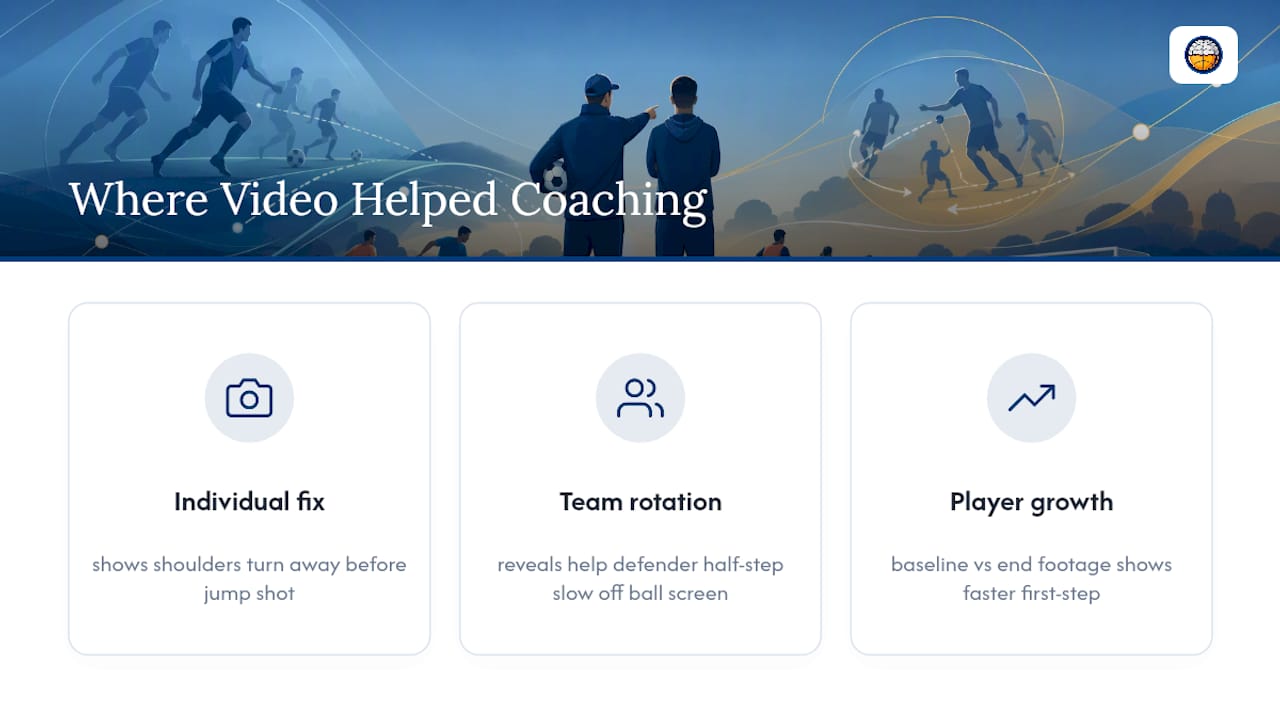
The clearest wins tend to be narrow and specific, not sweeping. A post player who keeps getting his shot blocked because he squares up too early before jump shots looks fine in a coach’s description. On film, the exact moment his shoulders turn away from the defender becomes obvious within seconds, and a coach can build the next week of practice entirely around that one frame.
Team-level breakdowns follow the same pattern. A defense that “keeps giving up open threes” is a vague complaint until someone reviews the tape and finds the same rotation late on every single occurrence, usually a help defender a half step slow off a ball screen. Fixing that one rotation, confirmed on film rather than guessed from memory, solves problems that would otherwise get blamed on effort or attitude.
Player development stories share the same shape: baseline footage from the start of a training block compared against footage from the end of it. A guard whose first-step quickness looked marginal in September but visibly faster by December has proof of growth that a stopwatch alone would not capture with the same clarity. That kind of side-by-side comparison also supports better decision-making on the floor, since players who see their own hesitation on film tend to recognize it in real time faster than players who only hear about it.
How Hoop Mentality Uses Video to Shape Coaching Resources
Film study drives how Dejan builds Hoop Mentality’s drill selection and practice design. A clip showing a hesitation move breaking down or a post player losing balance on a spin points directly to which drill sequence belongs in the next practice plan. The goal is always the same: turn what the tape shows into something a coach can run tomorrow, not theory that stays on a whiteboard.
— Dejan
Turn What You See on Film Into a Practice Plan
Spotting a problem on film is only half the job. Hoop Mentality closes the gap between what you see and what you actually run at practice: tag the clip, match it to a drill or playbook built for that exact issue, then assign it as a practice task instead of a vague note to “work on it.”
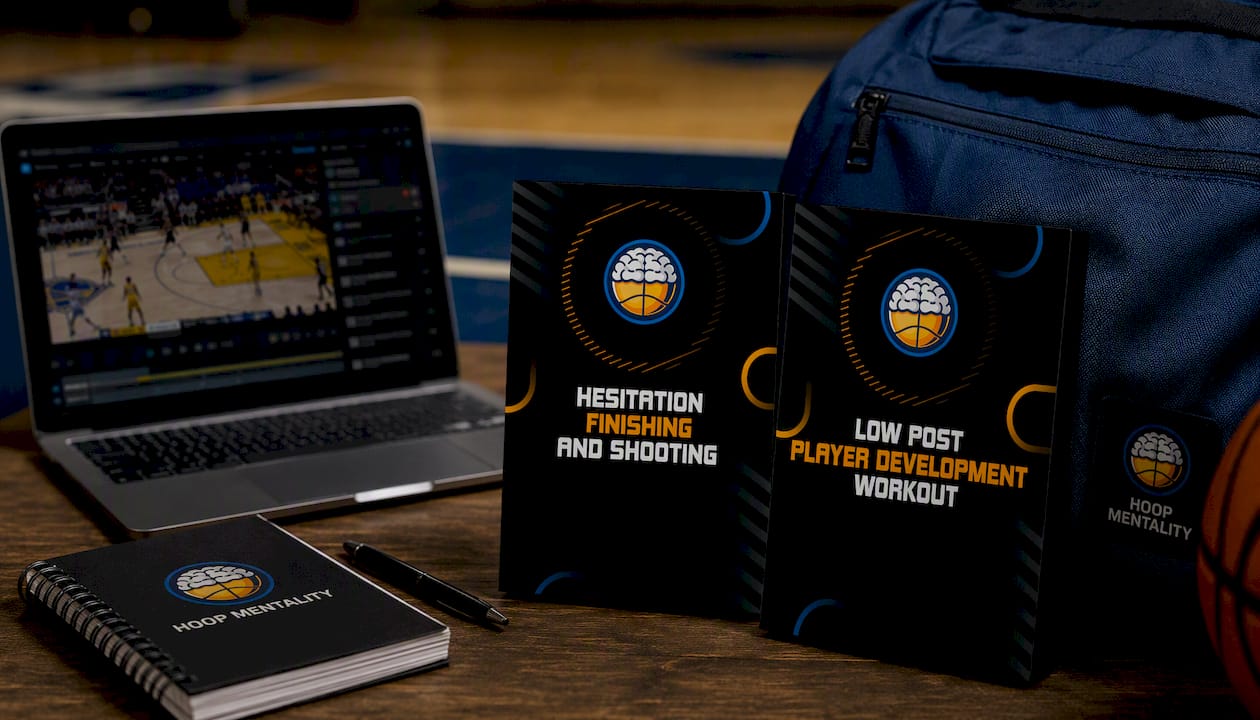
If film review keeps flagging shaky footwork on drives and a slow release on catch-and-shoot looks, the Hesitation Finishing And Shooting All-Access Workout gives you a ready-made progression built for that exact fix. When tape shows a post player getting pushed off his spot or missing simple counter moves, the Low Post Player Development Workout covers the footwork and finishing sequences that close that gap. Both are all-access video workouts you can assign the same week you spot the issue on film, no waiting for a new practice cycle to start.
Beyond those two, Hoop Mentality’s full library of playbooks and drill packs covers most tactical and technical issues film review tends to surface. Browse the collection and match your next tagged clip to a drill you can run at your very next practice.
FAQ
What Are the Main Benefits of Video Analysis?
The core benefits of video analysis are faster skill acquisition, objective feedback that replaces flawed memory, sharper tactical preparation, and earlier detection of injury risk through mechanical breakdowns. Coaches also gain a shared visual reference that improves communication with players, and a running record for tracking long-term development.
What Are the Advantages of Video Data Over Live Observation?
Live observation depends on memory, and experienced coaches recall critical events with only about 59.2% accuracy. Video data preserves the full moment for repeated review, frame-by-frame comparison, and objective evaluation that live viewing simply cannot match.
How Reliable Is Video Analysis?
Standard 2D video analysis is reliable for most coaching decisions but has real limits, including depth distortion and disagreement between reviewers on the same footage. Multi-angle capture, consistent camera calibration, and standardized annotation, alongside a structured framework like the ACE Model, meaningfully improve its trustworthiness.
Does Video Analysis Work for Individual Sports as Well as Team Sports?
Yes. Team sports get the most value from wide-angle footage that reveals spacing and rotations, while individual sports benefit more from tight, frame-by-frame breakdowns of joint angles and technique. Both rely on the same core process of tagging clips and reviewing them with a specific goal.
How Does Hoop Mentality Help Coaches Apply Video Analysis?
Hoop Mentality provides drill packs, playbooks, and workout resources built to match specific issues that show up on film, such as hesitation moves or low post footwork. Prices for individual resources are listed on each product page, including the Basketball Drills and Basketball Playbooks collections.