

A set play is a predefined alignment and sequence of screens, cuts, and passes designed to produce one specific high-percentage shot. This guide gives you eight ready-to-run set plays, the coaching cues that make each one work, and the practice progressions to install them without burning a whole week of practice.
Set plays exist to solve a problem your regular offense can’t always solve on demand: getting a good shot when the shot clock is dying, when you need to attack a mismatch, or when the defense has taken away your first read. They’re not a replacement for your base offense. They’re the tool you pull out when structure beats improvisation.
Here’s what this article covers:
- The common formations (1-4/stack, Horns, Box, 1-3-1, and 3-out/2-in) and what each one is built to produce
- Eight playable set plays with exact steps, personnel assignments, and coaching points
- A decision framework for picking which plays actually fit your roster
- Game situations that call for a set play versus a live read
- Practice progressions to install a play from walk-through to full speed
- Simple counters against man-to-man, switching defenses, and zone
- The Hoop Mentality practice package coaches can use to teach a full playbook in a single week
Key Takeaways
The most effective set play is the one that matches your personnel, gets installed through a real practice progression, and gets tracked by points per possession rather than by how good it looks on a whiteboard.
| Point | Details |
|---|---|
| Match plays to personnel | Pick formations and actions that fit the skills your roster already has, not a clinic favorite. |
| Install through progression | Move from walk-through to half-speed reps to live constraints before full-speed scrimmage use. |
| Limit your active playbook | Fully install three to five plays and rotate the rest instead of spreading practice too thin. |
| Diversify formations | Avoid running your top plays from the same starting alignment so one adjustment can’t take them all away. |
| Track real numbers | Measure points per possession, shot quality, and turnover rate on every installed play. |
| Prepare specific counters | Teach one-line reads for switches, help defense, and zone before game night, not during it. |
| Use Hoop Mentality’s package | The practice plan template, editable diagrams, and cue sheets speed up installing a full playbook in one week. |
Table of Contents
- What Are the Common Basketball Set Formations?
- Eight Set Plays You Can Install This Week
- How Do You Choose the Best Set Plays for Your Team?
- When Should You Call a Set Play During a Game?
- How Do You Install Set Plays in Practice?
- What Are the Best Counters to Common Defenses?
- Hoop Mentality’s Practice Package for Installing Plays Fast
- How Should You Diagram and Film Your Plays?
- Further Reading for Coaches Building a Full Playbook
- What Actually Separates a Good Playbook From a Cluttered One
- Build Your Playbook Faster With Hoop Mentality
- FAQ
What Are the Common Basketball Set Formations?
Every set play starts from a formation, and the formation itself does structural work before a single screen is set. According to Coach’s Clipboard, formations like Horns, 1-4, Box, and 1-3-1 each create a different starting geometry, and that geometry determines what actions are even possible once the ball moves.
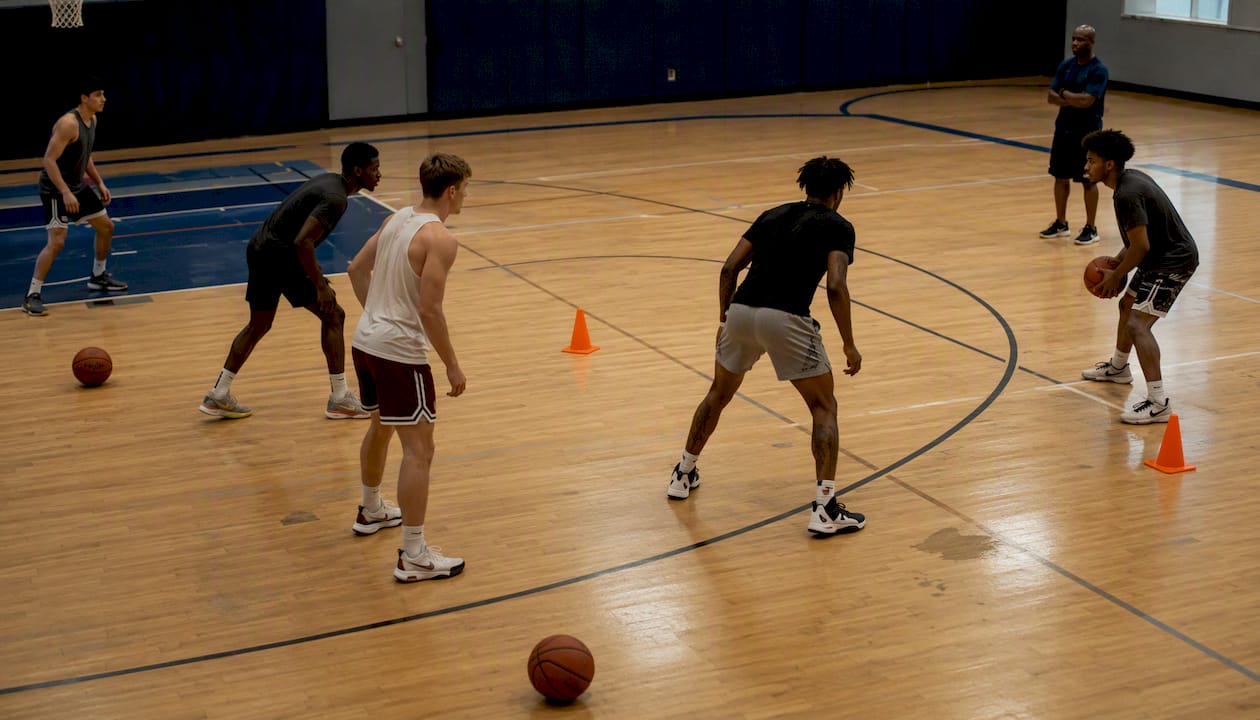
1-4 (stack). One ball handler at the top, four players spaced along the free throw line extended or baseline. This alignment clears driving lanes for the point guard and sets up cross-screens or a high-low post touch. It’s the formation of choice when you have a guard who can create off the dribble and a big who can finish through contact.
Horns. Point guard at the top, two bigs at the elbows, two shooters in the corners. Horns is built for early ball-screen actions, most often a guard using an elbow big as the screener while the second big flashes or cuts. It rewards a team with two skilled bigs, at least one of whom can pass or shoot from 15 feet.
Box. Two players on each block, two at the elbows or short corners, ball at the top. Box sets are compact and disguise their first action well, which makes them a strong choice for baseline out-of-bounds plays and quick-hitters where you need one clean look immediately off the whistle.
1-3-1. One player at the point, two on the wings, one at the high post, one on the baseline. This formation stretches the defense vertically and horizontally at once, which makes it effective for skip passes and attacking a zone, since the high post and baseline players occupy the gaps a 2-3 zone leaves open.
3-out/2-in. Three perimeter players and two post players. As Breakthrough Basketball notes, this works best when at least one post player can shoot or relocate, since that spacing opens driving and passing lanes that a traditional two-guard front closes off.
| Formation | Starting alignment | Best scoring action produced |
|---|---|---|
| 1-4 / stack | Guard top, four spaced at the line or baseline | Drive-and-kick, high-low post touch |
| Horns | Guard top, two bigs at elbows, two corners | Early ball screen, elbow entry |
| Box | Two on blocks, two at elbows/short corners | Quick-hitter off the inbound |
| 1-3-1 | Point, two wings, high post, baseline | Skip pass, zone attack |
| 3-out/2-in | Three perimeter, two post | Dribble penetration, baseline flex cut |
Spacing and timing decide whether any of these formations actually produce the shot they’re designed for. A screen set half a second late lets the on-ball defender recover. Standing too close to a teammate collapses the driving lane you just created. Every play in this guide depends on players holding their spot until the action calls them to move, then moving with purpose instead of drifting.
Pro Tip: Chart which formation your best three plays start from. If two of your top plays both open from Horns, you’re one scouting report away from a defense taking both away with the same adjustment. Diversify your formations, not just your plays.
Eight Set Plays You Can Install This Week
These eight plays cover the situations you’ll actually face: a baseline quick-hitter, a pick-and-roll entry, a shooter freed by a chain of screens, and a couple of zone-busting actions. Each one lists the personnel by number (1 through 5, point guard to center) so you can plug in your own roster.
1. Kentucky 1-4 High
Overview: A high-post entry that hunts a post touch first and a wing ball screen second, so the defense has to guess which read you’re going to take.
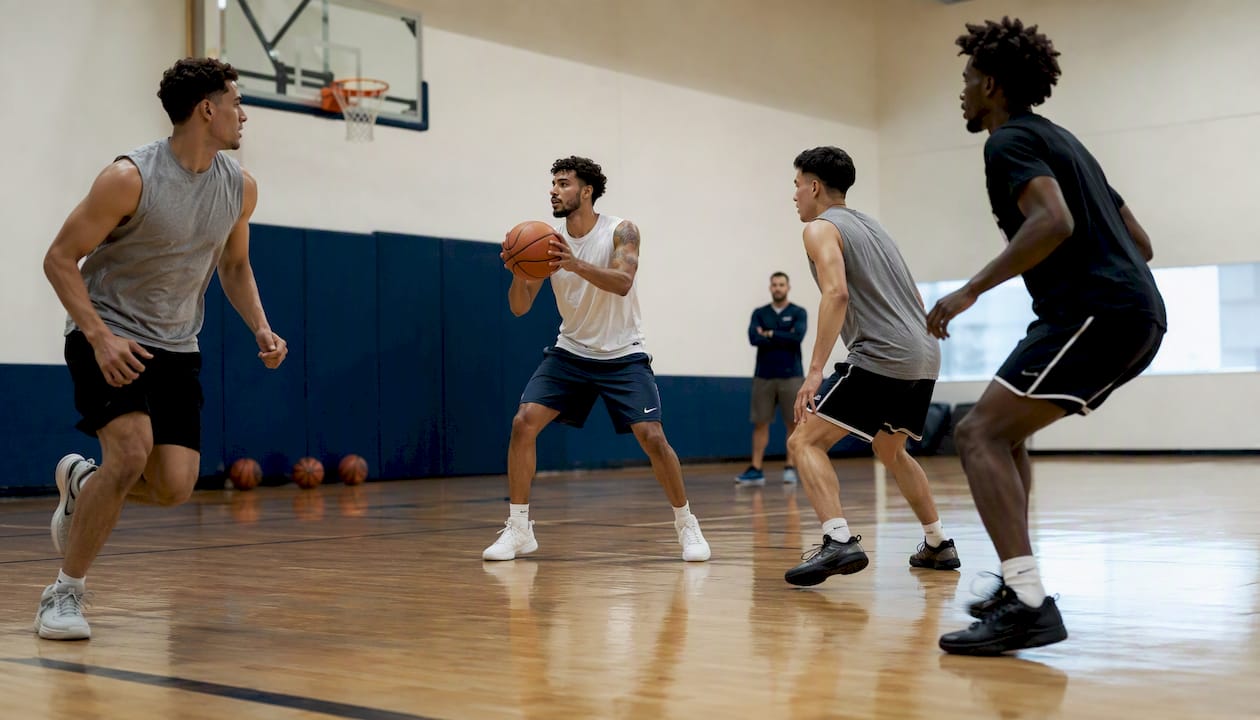
Personnel: 1 brings the ball up top; 2 and 3 stand at the wings; 4 and 5 hold the elbows.
Steps:
- 1 dribbles to the top of the key as 4 and 5 hold the elbows.
- 2 clears the baseline from the strong-side wing to the opposite corner.
- 5 cuts diagonally from the elbow to the vacated low block.
- 1 looks to feed 5 on the block for a high-low read.
- If the post entry is denied, 4 steps out to set a ball screen for 1 at the top.
- 1 uses the screen and attacks downhill, with 5 rolling to the rim.
- 3 stays spaced in the opposite corner as the release valve.
- 1 reads the roll and the corner shooter off the screen.
Coaching points: Sell the post entry hard before the screen so the defense commits low. The wing clear-out must be a real cut, not a jog. The screener’s angle on the second action determines whether the point guard turns the corner. Keep the weak-side corner shooter spaced beyond the arc the entire time.
Common defensive reactions: A big fronting the post opens a lob or reversal to the opposite wing. A defense that hedges hard on the ball screen opens a slip to the rim from the screener, described in more detail in Hoop Coach’s breakdown of the Kentucky 1-4 High.
2. Horns Ball Screen Series
Overview: Two elbow entries that give you a live ball-screen option and a counter action if the first read is taken away.
Personnel: 1 at the top, 4 and 5 at the elbows, 2 and 3 in the corners.
Steps:
- 1 passes to 4 at the right elbow.
- 5 sets a ball screen for 1 as 1 cuts off it toward the middle.
- 4 hands off or hits 1 on the move, then pops to the wing.
- 5 rolls to the rim after screening.
- 2 and 3 hold corner spacing the entire time.
- If the pick-and-roll is taken away, 1 reverses to 4 on the wing.
- 5 re-screens for 4 on the wing side.
- 4 attacks off the second screen with 5 rolling again.
Coaching points: The elbow screener needs to set the pick at the level of the free throw line, not above it, or the guard never turns the corner. Corner shooters must resist the urge to relocate early. Teach the roller to seal, not just run, to the rim.
Common defensive reactions: A switch turns this into a mismatch hunt, covered below in the counters section. Aggressive hedging opens the roll man for a short pocket pass.
3. L.A. Man-to-Man Set
Overview: A three-action chain (scissor, flex, double screen) that gives the defense three different problems in one possession.
Personnel: 1 at the top, 2 and 3 on the wings, 4 at the high post, 5 on the block.
Steps:
- 1 passes to 4 at the high post.
- 2 and 3 scissor cut off 4, crossing off each other’s defenders.
- 5 sets a flex screen along the baseline for whichever wing didn’t get the ball.
- That cutter runs off the flex screen toward the rim.
- If nothing opens, 2 and 3 convert into a double screen for the third perimeter player.
- That shooter curls off the double screen above the arc.
- 4 reverses the ball to the freed shooter.
- 1 fills back to the top for balance and a potential reset.
Coaching points: Each action buys about two seconds. If defenders talk and recover, you still have two more chances in the same possession. Timing between the scissor and the flex screen has to be tight or the cutters collide.
Common defensive reactions: Teams that switch the scissor cut are vulnerable to the flex screen behind them, since chaining actions forces multiple defenders to communicate in sequence rather than solving one action and resetting.
4. Floppy for a Shooter
Overview: A double-screen action on the baseline built to free your best shooter off a curl or a fade, depending on how the defender chases.
Personnel: 5 shooter starts under the basket, 2 and 3 set up as the two screeners at the elbows, 1 at the top, 4 on the weak wing.
Steps:
- 1 holds the ball at the top.
- The shooter starts under the rim and reads both screens set at each elbow.
- The shooter chooses a side, curling tight off the screen if trailed, or fading behind it if the defender fights over the top.
- The unused screener seals their defender to prevent a second defender from tagging the cutter.
- 1 hits the shooter immediately off the catch.
- 4 relocates to the strong-side corner for spacing.
- If the shot isn’t there, the shooter reverses to 1 and re-screens the other direction.
- 2 and 3 reset to elbows for a second rep at the action.
Coaching points: The shooter, not the coach, decides curl versus fade in real time based on how tight the defender trails. Screeners need to hold their position through contact instead of ducking away. This play lives or dies on the pass being on time, since a shooter with no dribble catching a step slow loses the window.
5. Box Baseline Quick-Hitter
Overview: A compact, disguised action off an inbound or dead-ball situation that gets one clean shot before the defense organizes.
Personnel: 4 and 5 on the blocks, 2 and 3 at the short corners or elbows, 1 inbounding or at the top.
Steps:
- 1 takes the ball out or holds at the top after a stoppage.
- 4 and 5 cross screen for each other on the blocks.
- 3 cuts off a screen from 2 at the elbow toward the wing.
- 1 reads the block action first, the wing cut second.
- If both are covered, 2 pops to the top as a safety valve.
- 1 resets to 2 if no shot is available in the first two seconds.
- 5 seals low after the cross screen for a second-chance post-up.
- Team spaces to allow a late-clock reset into your base offense.
Coaching points: Box works because the initial alignment hides which two players are about to screen for each other. Sell the cross screen with real contact, not a jog-through. Keep a designed bailout to your base offense if the quick-hitter doesn’t produce a shot in the first three seconds.
Common defensive reactions: Teams that switch everything on the baseline neutralize the cross screen, so a slip to the rim right as the screen is set often beats the switch before it sets up.
6. 1-3-1 Skip and Attack
Overview: A formation-based action rather than a single set, this play uses the 1-3-1 alignment to attack gaps in a zone or an over-helping man defense with a skip pass.
Personnel: 1 at the point, 2 and 3 on the wings, 4 at the high post, 5 on the baseline.
Steps:
- 1 brings the ball up and holds at the top.
- 4 flashes to the high post for an entry pass.
- 5 slides along the baseline from one corner to the other, reading the defense’s baseline help.
- 4 reverses to 2 or 3, whichever wing is open.
- The ball-side wing attacks off the catch if a closeout is late.
- If the defense collapses, the wing skips cross-court to the opposite wing.
- 5 flashes to the ball-side corner as the skip lands.
- 1 relocates to the top for reversal balance.
Coaching points: The high-post flash from 4 has to happen before the defense sets its zone shell, not after. Skip passes need arc and pace so they aren’t tipped by a zone defender sliding.
7. Double Ball Screen Wing Series
Overview: Two ball screens set back to back for the same ball handler on the wing, designed to wear down a single defender or force a switch.
Personnel: 1 or 2 as the primary ball handler, 4 and 5 as the two screeners, 3 in the weak-side corner.
Steps:
- 1 dribbles to the wing.
- 4 sets the first ball screen.
- 1 uses the screen and attacks downhill.
- 5 sets a second screen if the first defender recovers.
- 1 turns the corner off the second screen.
- 4 pops after the first screen for a reversal option.
- 5 rolls hard to the rim after the second screen.
- 3 spaces the weak corner throughout for the kick-out read.
Coaching points: This play is built specifically to attack teams that switch, since a second screener forces a second decision from a defense that already committed to switching once. Screeners must re-screen at a slight angle to avoid colliding with the recovering defender. As covered in Hoop Mentality’s Ball Screen Offense resource, screener angle and timing matter as much as the screen itself when installing pick-and-roll actions.
8. Sideline Out-of-Bounds Quick Hitter
Overview: A designed sideline inbound built to get a specific shooter open in under three seconds, useful anywhere on the floor but especially valuable late in the shot clock or the game.
Personnel: 1 inbounds the ball, 2 is the primary shooter, 3 and 4 act as screeners, 5 anchors the block.
Steps:
- 1 stands at the sideline with the ball.
- 2 starts near the basket and reads a stagger screen from 3 and 4.
- 3 and 4 set the stagger just above the free throw line extended.
- 2 curls or fades depending on the defender’s positioning.
- 5 seals on the block to prevent low help.
- 1 inbounds directly to 2 off the catch.
- If denied, 1 has a secondary target in 3, who pops after screening.
- Team resets into base offense if neither look is there within three seconds.
Coaching points: Rehearse this against pressure denial specifically, since sideline inbounds get jumped by aggressive defenses more than baseline ones. For more inbound-specific teaching progressions, see Hoop Mentality’s out-of-bounds play guide.
How Do You Choose the Best Set Plays for Your Team?
The plays above only work if they match the players actually on your roster. A checklist keeps that decision honest instead of picking whatever play looks good on paper.
- Does the play fit the skill set you already have (a guard who can turn the corner, a big who can finish through contact, a shooter who moves well without the ball)?
- How often will you realistically run it? A play you’ll use twice a game earns a spot before one you’ll use twice a season.
- What skills does it demand that your team hasn’t mastered yet? A play built on a skip pass is a bad investment if your guards can’t throw one accurately.
- What’s the turnover risk? Plays with multiple entry passes or crosses under pressure carry more risk than a simple ball-screen action.
A workable weekly process looks like this:
- Scout the upcoming opponent’s defensive tendencies (man, zone, switching) using a tool like an Editable Scouting Report Template.
- Pick three to five plays that attack what the scout reveals, not your full playbook.
- Build a practice progression for each chosen play across the week.
- Test them live in a scrimmage before game night and cut anything that isn’t producing.
Match the play type to team strength rather than to whatever looks good on a coaching clinic video. A guard-driven roster gets more out of Horns ball-screen series and the double ball screen wing set. A team with a physical, skilled post gets more from 1-4 High and the Box quick-hitter. Track simple numbers to confirm the fit: points per possession on the play, the quality of the shot it generated (open three, contested midrange, layup), and how often it turns the ball over. If a play produces a contested mid-range shot three times out of four, it’s not doing its job, regardless of how well the team executes the steps.
When Should You Call a Set Play During a Game?
Set plays exist for moments when your team needs a specific, high-percentage shot rather than whatever your continuity offense produces.
- After a timeout. The defense hasn’t set its matchup yet, and you have a clean whiteboard to draw exactly what you want.
- Late shot clock. With 8 to 10 seconds left, a designed quick-hitter beats an improvised isolation almost every time.
- Exploiting a specific matchup. If a slower defender is switched onto your point guard, call the play that attacks that mismatch immediately, before the defense can switch back.
- Out-of-bounds situations. Both baseline and sideline stoppages are free possessions to run a rehearsed action instead of a broken play.
- End of quarter or half. A designed last-shot play beats a rushed heave with the clock at three seconds.
- Foul trouble on a key defender. Attack the player in foul trouble directly with a play built around isolation or a ball screen.
Quick-hitters like the Box set or the sideline inbound fit clock-driven and dead-ball moments. Continuity-style plays like Horns Ball Screen Series or the L.A. set work better when you’re resetting a possession that’s stalled, since they give multiple sequential reads instead of one shot.
Communication matters as much as the play itself. Most coaches signal plays with a number call, a hand signal, or a colored wristband system so the point guard can relay it without the defense overhearing a shouted play name. Whatever system you choose, keep it simple enough that a nervous freshman point guard can execute it under pressure in a road gym.
Balance is the real skill here. A team that calls a set play on every single possession stops reading the defense and becomes predictable. Use set plays to solve specific problems, then let your players play basketball in between.
How Do You Install Set Plays in Practice?
Installing a play is a progression, not a single walk-through. Rushing straight to full speed is the most common reason a play that looks great on the whiteboard falls apart in a game.
- Walk-through at zero speed. Walk every cut, screen, and pass with no defense so players learn the spacing and order of actions.
- Half-speed timed reps. Add a stopwatch and run the play at half speed, checking that timing between actions (like a screen and a cut) lines up.
- Live constraints. Add one defender at a time with a specific job, such as forcing the roller to be covered so the ball handler has to make a real read.
- Full-speed scrimmage insertion. Call the play in a live 5-on-5 scrimmage and grade the possession afterward.
Drills should target the specific actions your plays depend on, not generic skill work:
- Screen-timing drill: Pairs practice setting and using a screen with a coach calling out “late” or “early” to sharpen timing.
- Entry-passing under pressure: A defender closes out hard on the entry passer to simulate denial defense on the first pass of the play.
- Cutter read drills: Cutters practice both the curl and the fade off the same screen so the read becomes automatic rather than decided in the moment.
- Weak-side spacing drills: Players not involved in the primary action rehearse holding proper spacing and relocating on a skip pass.
For a play to reach basic competency, most teams need eight to twelve total reps split across two or three practices. Mastery, meaning players run it without a verbal cue and adjust to a defensive counter on their own, usually takes several weeks of repetition mixed into regular practice. Hoop Mentality’s Basketball Offensive Sets Workflow breaks down how to sequence this installation across a full season rather than cramming it into one week.
Constrained scrimmages sharpen the counter as much as the initial action. If you want your team to recognize a hedging defender, run a live possession where the help defender is required to stay attached to the roller. That forces your ball handler to actually read the coverage instead of running the play on autopilot.
What Are the Best Counters to Common Defenses?
Every play in your library runs into the same three defensive shells eventually: straight man-to-man, a defense that switches everything, and a 2-3 or 3-2 zone. Knowing the one-line counter for each saves you a timeout mid-game.
| Defensive look | Simple counter |
|---|---|
| Man-to-man, help-side collapsing | Skip pass to the weak-side corner shooter |
| Man-to-man, fronting the post | Lob or high-low reversal over the front |
| Switching everything | Flare screen or slip to attack the new mismatch |
| Switching, re-screen situations | Re-screen at a different angle to prevent a second clean switch |
| 2-3 zone | Overload one side, then skip to the weak corner |
| 2-3 zone, high post open | Flash a shooting big to the high post for a middle catch |
| 3-2 zone, wings tight | Baseline drift to the short corner for a clean catch |
- If the defense helps hard off the weak side, the counter is almost always a skip pass, not a tougher shot attempt.
- Against a team that fronts the post, reverse the ball and throw a lob over the top rather than forcing an entry pass into a denied passing lane.
- Against a switch-everything scheme, use flare screens and slip cuts, since a switch only solves the action it sees, not the one that follows immediately after.
- Against zone, attack the seams with an overload to one side and a skip pass to the opposite corner, or flash a shooting big into the soft spot of the zone’s high post.
Give your ball handlers and screening bigs a fast diagnostic checklist: Is the on-ball defender fighting over or under the screen? Is help coming from the nail or the weak-side corner? Is the defense in a stance that suggests they’re about to switch? Teaching players to answer those three questions in real time turns a memorized play into a live read, which is the entire point of running set plays in the first place.
Hoop Mentality’s Practice Package for Installing Plays Fast
Coaches don’t need to build every diagram, cue sheet, and practice plan from scratch. Hoop Mentality’s practice package gives you the pieces to install a full play in one week without spending your weekend drawing on a whiteboard app.
The package includes a practice plan template, editable play diagrams, a coaching-cue sheet for each action, and a scouting template to match plays against upcoming opponents.
- Practice plan template: A structured 60-minute block plan that sequences walk-through, half-speed reps, and live constraints.
- Editable play diagrams: Pre-built diagrams for common formations (Horns, 1-4, Box, 1-3-1) that you can relabel with your own personnel numbers.
- Cue sheet: A one-page reference listing the 3 to 5 coaching points for each play, useful for assistant coaches running a station.
- Scouting template: A form for logging an opponent’s defensive tendencies before you decide which plays to install that week.
A sample 60-minute practice to install one new play:
- 0 to 10 minutes: Dynamic warmup and shooting reps.
- 10 to 20 minutes: Walk-through of the new play at zero speed, three full run-throughs.
- 20 to 35 minutes: Half-speed timed reps with a coach calling out timing corrections.
- 35 to 50 minutes: Live constrained scrimmage, five possessions where the defense must show a specific coverage.
- 50 to 60 minutes: Full-speed 5-on-5 with the play mixed randomly into a normal offensive set, then a quick review of what worked.
Specific products support different pieces of this plan. The Basketball Starter Pack For Coaches gives you the base practice plans and templates to get a new coach or a new season started fast. The Basketball Template Bundle For Coaches provides the editable diagrams you’ll relabel for your own roster. The Basketball Shooting Bundle For Coaches supplies the finishing and catch-and-shoot drills that make sure a play’s designed shot actually goes in once your players get open. The Editable Scouting Report Template and the Basketball Scouting Report Template both support the play-selection process described earlier, letting you match your installed plays to an opponent’s actual tendencies rather than guessing.
For youth teams, simplify: cut every play down to four steps instead of eight, and drop the secondary read entirely until the first action is automatic. For older, more experienced teams, add the full counter progression from week one and hold players accountable for reading the defense rather than running the play blind.
Pro Tip: Track installation progress with a simple pass/fail grade on each live rep: did the play produce the shot it was designed for, yes or no. A play sitting below 50 percent success after two weeks of practice needs simplifying, not more reps.
How Should You Diagram and Film Your Plays?
Players learn a play faster when they can see it, not just hear it described. A simple whiteboard app or a basic animation tool works better than a complicated telestration program most coaches will never fully use. What matters is that the diagram is legible, uses consistent player numbering, and shows the sequence of actions in order rather than cramming every step onto one static image.
Filming practice reps adds a second layer of retention. Capture three angles at minimum: a wide shot from the baseline that shows full-court spacing, a tighter shot from the sideline that shows screen timing, and a shot from behind the action that shows what the ball handler actually sees. The essential moments to capture are the entry pass, the primary screen or cut, and the finish, since those three clips tell a player almost everything they need to self-correct.
Keep clips short. A 10 to 15 second clip of one repetition, trimmed immediately after the possession ends, gets watched. A full unedited practice video does not. Building a shared folder or a simple video library that players can access between practices turns film review into homework instead of something that only happens in the gym.
Hoop Mentality’s own video and diagram resources pair diagrammed plays with example clips, giving coaches a reference point for matching a play to the kind of clip that actually teaches it. Players tend to retain a set play faster when they’ve both walked it and watched it, since the visual reinforces the spacing cues a verbal explanation alone can miss.
Further Reading for Coaches Building a Full Playbook
Coaches who want to go deeper into specific sets or drill progressions have a few strong places to start.
- Ball Screen Offense: Boosting Youth Team Success covers drill-based progressions specifically for pick-and-roll actions used in several plays above.
- Basketball Offensive Systems: Boosting Youth Team Success explains how set plays fit inside a broader offensive system, not as a standalone gimmick.
- What Is Motion Offense in Basketball? compares structured sets with read-based motion offense for coaches deciding which approach fits their team.
- For classic set-play breakdowns with diagrams, Hoop Coach and Breakthrough Basketball offer external references with detailed play designs and continuity options.
What Actually Separates a Good Playbook From a Cluttered One
Most coaches don’t have a shortage of plays. They have a shortage of plays their team can execute under pressure. The instinct after a rough loss is to add three new sets to the practice plan, and that instinct is almost always wrong. A team that runs five plays at 80 percent execution beats a team that runs fifteen plays at 40 percent execution every time it matters.
The conventional advice, run more sets to keep the defense guessing, gets the priority backward. Defenses aren’t confused by volume. They’re confused by tempo and timing they haven’t seen rehearsed against them, which a well-drilled five-play system produces more reliably than a bloated twenty-play binder nobody has fully installed. The plays in this guide were chosen because they cover distinct situations, a baseline quick-hitter, a pick-and-roll entry, a chained multi-action set, rather than because eight is a magic number. If your roster only needs four of them, cut the rest.
What gets underrated is the counter, not the play itself. Coaches spend hours perfecting the primary action and almost no time teaching the read for when a defense switches or helps early, which is exactly the moment a play either survives or collapses. Spend at least a third of your installation time on live constraints that force a defensive reaction, not just clean walk-throughs against air.
If you take one thing from this guide, prioritize installation depth over playbook size. Pick the plays that fit your personnel, drill them until the counters are automatic, and track whether they’re actually producing good shots. Everything else is decoration.
Build Your Playbook Faster With Hoop Mentality
You’ve got eight plays and a progression to install them, but building the diagrams, cue sheets, and weekly practice plans from scratch still eats hours you don’t have during a season. Hoop Mentality solves that specific problem: instead of drawing every formation yourself or reconstructing a practice plan the night before, you get editable templates built by coaches who’ve already run this installation process.
The Basketball Starter Pack For Coaches gives you ready-made practice plans and play templates you can adapt to your own roster in an afternoon instead of a weekend. If you’re specifically after the editable diagrams for the formations covered in this guide, the Basketball Template Bundle For Coaches packages those templates alongside practice plan formats so your whole install fits together. Coaches who want their designed shots to actually fall once players get open should pair either package with the Basketball Shooting Bundle For Coaches for the finishing work a good set play sets up but doesn’t guarantee.
Check the Basketball Starter Pack For Coaches now and have your first play installed by your next practice.
FAQ
What are set plays in basketball?
A set play is a predefined sequence of screens, cuts, and passes run from a specific starting formation to create a single high-percentage scoring opportunity, most often used at specific moments like after a timeout or late in the shot clock.
What is an offensive set in basketball?
An offensive set is the starting formation, such as Horns, 1-4, Box, or 1-3-1, from which a team runs quick-hitters, continuity actions, or option reads, as outlined by Coach’s Clipboard.
What is the best offense to run in basketball?
There’s no single best offense; the right choice depends on personnel, with guard-driven teams favoring ball-screen heavy sets like Horns and post-heavy teams favoring formations like 1-4 High. Hoop Mentality’s offensive sets workflow walks coaches through matching system to roster rather than copying a scheme wholesale.
What is the 3 out 2 in motion offense?
How many set plays should a team actually have in its playbook?
Most teams get more out of fully installing three to five plays than partially installing ten or more, since execution quality on a play matters more than the total number a team can run.