

The six easiest out-of-bounds plays to run with youth teams right now are: Box Set BLOB, Stack Line BLOB, Slip BLOB, Zone Pin-Down BLOB, Quick Scorer SLOB, and Corner Pop SLOB. Pick one baseline play and one sideline play, teach them this week, and you have a functional inbound system.
Quick usage cues:
- Box Set BLOB — baseline, any defense, any score, any time remaining
- Stack Line BLOB — baseline, man defense, need a quick score, under 2 minutes
- Slip BLOB — baseline, man or zone, need a layup, any clock
- Zone Pin-Down BLOB — baseline, zone defense, need a three, mid-game
- Quick Scorer SLOB — sideline, man defense, need a bucket, under 30 seconds
- Corner Pop SLOB — sideline, zone defense, reset possession, any time
Two execution risks to address before game day: the 5-second count (players freeze instead of cutting) and poor spacing (cutters crowd the ball). Sketch a simple court diagram for each play and show a short video clip if you have one.
Three quick coaching checks before every inbound:
- Inbounder sells the fake pass before delivering the real one.
- All four players are spaced at least 12 feet from the ball.
- Cutters make hard, decisive moves — no drifting.
Key Takeaways
Pick one baseline play and one sideline play, teach them through a four-step progression, and your team will execute clean inbounds under pressure before the next game.
| Point | Details |
|---|---|
| Start with two plays | One BLOB and one SLOB cover every game situation without overloading players. |
| Use the four-step progression | Walk spots, walk-through with ball, passive defense, then full-speed reps. |
| Match play complexity to age | Ages 7–9 need two moving actions max; ages 13–14 can handle full timing and spacing. |
| Prevent 5-second violations | Timed pressure drills of 5–8 seconds in practice reduce violations in games. |
| Hoop Mentality templates | The Basketball Starter Pack and Template Bundle give you printable, editable play diagrams ready to use. |
Table of Contents
- How baseline box-set plays work for young players
- Stack baseline plays that create instant scoring chances
- Sideline plays that are easy to teach at any age
- Coaching cues, timing, and how to handle defensive counters
- How to teach these plays in one practice session
- Why simplicity wins at youth levels
- Hoop Mentality resources for busy coaches
- Sources
- FAQ
How baseline box-set plays work for young players
Baseline out-of-bounds plays are grouped into box-set (BLOB), stack, and zone-specific families. Simple BLOBs are the best starting point for youth because the box formation gives every player a clear spot and a clear job. No one wanders. No one guesses.
The box formation: Four players form a rectangle near the lane — two on the low blocks, two on the elbows. The inbounder stands out of bounds under the basket. From this shape, you can run six low-complexity variations.
1. Box Set (basic)
- Low player on the ball-side block cuts hard to the corner.
- Opposite elbow player fills the ball-side elbow as a safety outlet.
- Inbounder hits whichever target is open first.
Age recommendation: 7–9. Two players move, two stay. Very low error rate.
2. Middle Split
- Both low players cut simultaneously — one to the ball-side corner, one to the opposite corner.
- Both elbow players hold for one count, then fill the vacated spots.
- Inbounder reads which corner opened first.
Age recommendation: 10–12. Requires players to cut at the same time without colliding.
3. Box Elevator
- Two players set a side-by-side screen (the “elevator doors”) at the elbow.
- A shooter runs through the gap and catches at the top of the key or wing.
- Inbounder hits the shooter coming off the screen.
Age recommendation: 13–14. Timing between the two screeners is the key teaching point.
4. Cross
- Ball-side low player sets a back-screen for the opposite low player.
- Screened player cuts to the ball-side block for a catch-and-finish.
- Inbounder delivers a short, direct pass to the cutter.
Age recommendation: 10–12. Teach the screener to hold the screen for one full second.
5. 4-Low Clear
- All four players start on the baseline. The two players farthest from the ball clear to the corners.
- The two closest players set a double screen for the primary scorer.
- Scorer curls off the double screen to the ball-side elbow or block.
Age recommendation: 13–14. Spacing is critical — corners must be wide.
6. Slip BLOB (Pittsburgh-style)
A stacked low-post inbound with an early slip or short cut catches defenses off-guard and produces high-percentage layup chances when the post player seals or slips before the defense reacts.
- Two players stack on the ball-side block. The top player of the stack slips immediately to the middle of the lane.
- Bottom player seals the defender and holds position.
- Inbounder delivers a quick pass to the slipping player for a layup.
Age recommendation: 10–12. The slip must happen before the defense adjusts — teach it as a “go on the slap of the ball.”
Pro Tip: Assign your most composed passer as the inbounder and your quickest finisher as the primary cutter. For youth teams, inbounder composure and cutter decisiveness predict inbound success more than play complexity.
Stack baseline plays that create instant scoring chances
The vertical stack compresses defenders into a small area and forces them to choose which cutter to guard. That confusion is the play. For youth teams, the stack works because it requires only one or two reads.
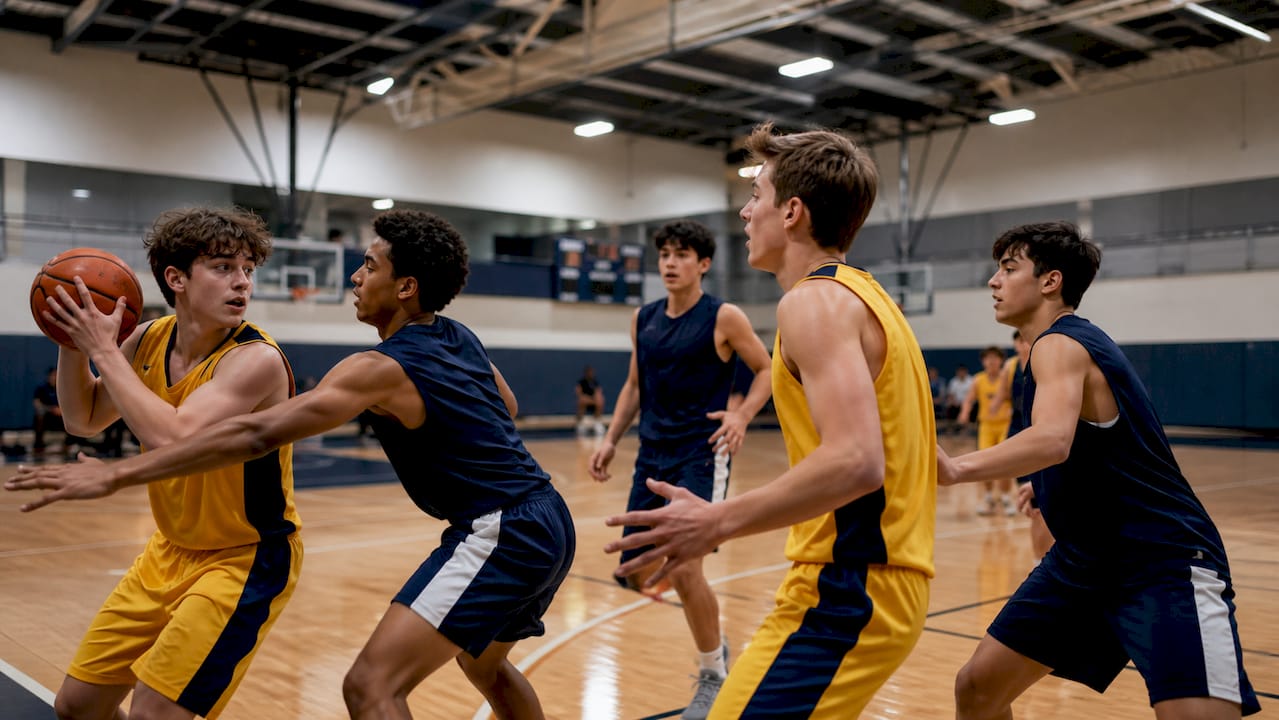
Basic stack alignment: Four players line up vertically from the ball-side block toward the elbow, shoulder to shoulder. The inbounder stands out of bounds under the basket.
Stack variations
-
Line Stack — A vertical Line stack compresses defenders and creates multiple quick options: the top player slips to the rim, the second player pops to the top of the key, and the third player drifts to the corner as a decoy. The inbounder reads top-to-bottom. Recommended for simpler youth execution patterns.
-
Stack 1 (single screen) — The bottom player sets a screen for the second player. The second player cuts to the ball-side corner. The bottom player rolls to the block. Two options, one decision.
-
Double Stack — Two stacks of two players, one on each side of the lane. Players on the ball side cut to the corner; players on the weak side fill the elbow. Creates four simultaneous options — use only with 13–14 age groups who can process multiple reads.
-
Screen-the-Screener — The bottom player screens for the second player, then receives a screen from the third player. The bottom player curls to the block. Adds one extra layer of confusion for older youth groups.
Inbounder read tree (teach this in one drill):
- Primary: Top player slipping to the rim — pass if open.
- Safety: Second player popping to the elbow — pass if primary is denied.
- Reset: Third player in the corner — pass to reset and run a quick set.
Spacing cue: The inbounder must stay directly under the basket, not drifting toward the corner. A drifting inbounder shrinks the passing angles and makes the 5-second count a real threat.
Sideline plays that are easy to teach at any age
The WBCA sideline out-of-bounds play set includes 11 plays with printable PDFs and step-by-step diagrams — a direct resource for any coach who wants ready-made templates. For youth teams, three or four of those sets are all you need.
Prefer sideline plays (SLOBs) over baseline plays when the clock is not urgent and you need a safe possession reset. Use them aggressively when you need a quick score near the opponent’s basket and the defense is in man.
Quick Scorer SLOB
- Three players line up along the lane, facing the inbounder on the sideline.
- The player closest to the basket cuts hard to the ball-side corner.
- The middle player sets a screen for the player farthest from the basket, who curls to the wing.
- Inbounder hits the wing player for a quick catch-and-shoot or drive.
Age recommendation: 10–12. Safe passing lane, short pass, immediate scoring option.
Elevator SLOB
- Two players stand side by side near the free-throw line extended, forming the elevator doors.
- A shooter starts behind them and runs through the gap on the inbounder’s signal.
- Inbounder hits the shooter at the top of the key.
Age recommendation: 13–14. Screeners must stay stationary until the shooter clears.
Pin-Down SLOB
- One player sets a pin-down screen near the block for a shooter.
- Shooter uses the screen to pop to the wing or corner.
- Inbounder delivers a direct pass to the shooter’s hands.
Age recommendation: 10–12. Teach the shooter to read the screen and not drift early.
Corner Pop SLOB
- All three players cut away from the ball toward the opposite side of the court.
- One player peels back to the near corner as a safety valve.
- Inbounder hits the corner player to reset possession.
Age recommendation: 7–9. Zero screens, zero timing, one safe pass. Use when the defense is clogging the lane.
When to use SLOBs vs. BLOBs: Run a BLOB when you need a high-percentage shot near the basket. Run a SLOB when you need a safe inbound or a quick wing score. Against a zone, the pin-down or elevator screen frees a wing three — that principle applies to both baseline and sideline sets.
Coaching cues, timing, and how to handle defensive counters
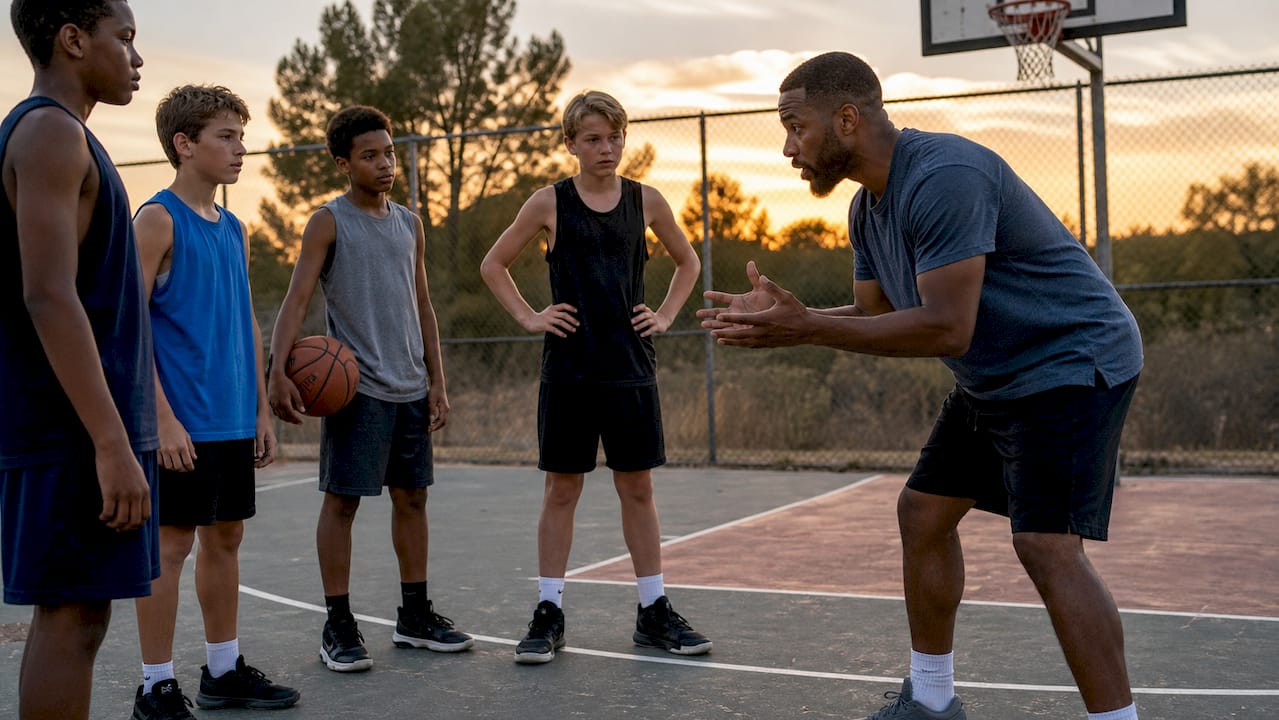
Complex plays cause hesitation, delayed execution, and 5-second violations — especially at youth levels. Keep cues short and physical.
Essential coaching cues:
- Inbounder sell: Fake a pass in one direction before delivering the real one. One fake, then go.
- Target footwork: Cutters must plant and push off the inside foot — no drifting, no jogging.
- Spacing: No player within 12 feet of the inbounder before the play starts.
- Screen contact: Screeners set a legal screen and hold for one full count before moving.
- Quick fill: After the primary cutter goes, the safety outlet fills immediately — no waiting.
Common defensive counters and simple adjustments:
| Defensive look | Simple adjustment |
|---|---|
| Deny show (defender fronts the primary cutter) | Hit the safety outlet at the elbow, reset |
| Bumping screens (defender fights through) | Switch the primary and secondary cutter roles |
| Over-help (help defender sags off corner) | Corner player calls for the ball immediately |
| Zone clog (zone collapses on the lane) | Run the Corner Pop or Zone Pin-Down BLOB |
Safety on the court: Keep passing lanes clear of non-participants. Teach players to call “ball” when they catch the inbound pass so teammates stop cutting. After the catch, all movement stops until the play is set.
Pro Tip: When your team is tired or under late-game pressure, default to your simplest play — the Box Set BLOB or Corner Pop SLOB. A clean possession beats a broken play every time.
How to teach these plays in one practice session
A four-step progression works at every age level. Walk before you run.
- Walk the spots — Players walk to their starting positions with no ball. Coach names each spot aloud. Repeat until every player can find their spot without being told.
- Walk-through with pass, no defender — Run the play at half speed with a ball. No defense. Coach calls the read aloud after each rep.
- Live with a passive defender — Add one or two defenders who contest but do not steal. Players must make a decision under light pressure.
- Full-speed scrimmage reps — Run the play in a live 5-on-5 situation with the clock running.
Three short drills
- Inbound walk-through relay — Split players into two groups. Each group runs the play from scratch, walks through all four steps, and rotates. Six reps per group, 8 minutes total.
- 2-on-1 finishing after inbound — Inbounder plus primary cutter vs. one defender. Cutter must catch and finish at the rim. Five reps per pair, focus on catch-and-go footwork.
- Timed 5-second pressure drill — Inbounder holds the ball while a coach counts aloud. Players must cut and receive before the count reaches five. Drill progressions that put the inbounder under short timed bursts of 5–8 seconds best simulate late-game scenarios and reduce violations in games.
Age-bracket adjustments
- Ages 7–9: Use plays with no more than two moving actions. Positive feedback after every clean rep. No live defense until the walk-through is clean.
- Ages 10–12: Add one decoy action. Introduce passive defense after two clean walk-throughs. Emphasize footwork on the cut.
- Ages 13–14: Full-version timing and spacing. Introduce the inbounder read tree. Run full-speed reps with a live defense from day one of teaching.
For ready-to-download play templates and practice plans, Hoop Mentality has editable resources built for exactly this kind of session structure.
Why simplicity wins at youth levels
Most coaches overestimate how much a youth player can hold in working memory during a live game. A 10-year-old who has practiced a play six times in a gym will forget step three the moment a defender bumps them. That is not a talent problem. It is a load problem.
The plays that work at youth levels share three traits: one primary action, one safety outlet, and a clear “go” signal. When you strip a play down to those three elements, players stop thinking and start reacting. Reaction is faster than recall.
Repetition is the only path to clean execution. Two plays run 20 times each beat six plays run four times each. A small playbook also builds confidence — players who know their role arrive at the inbound line ready, not anxious.
The argument for complexity usually comes from coaches who have watched college or pro film. Those players have run the same sets hundreds of times over years. Youth players need the same repetition before the same complexity is possible. Start with one BLOB and one SLOB. Master them. Add a third play only when the first two are automatic.
Hoop Mentality resources for busy coaches
Prep time is limited. Hoop Mentality gives you editable play templates, printable diagrams, and practice plans you can use the same week you read this.
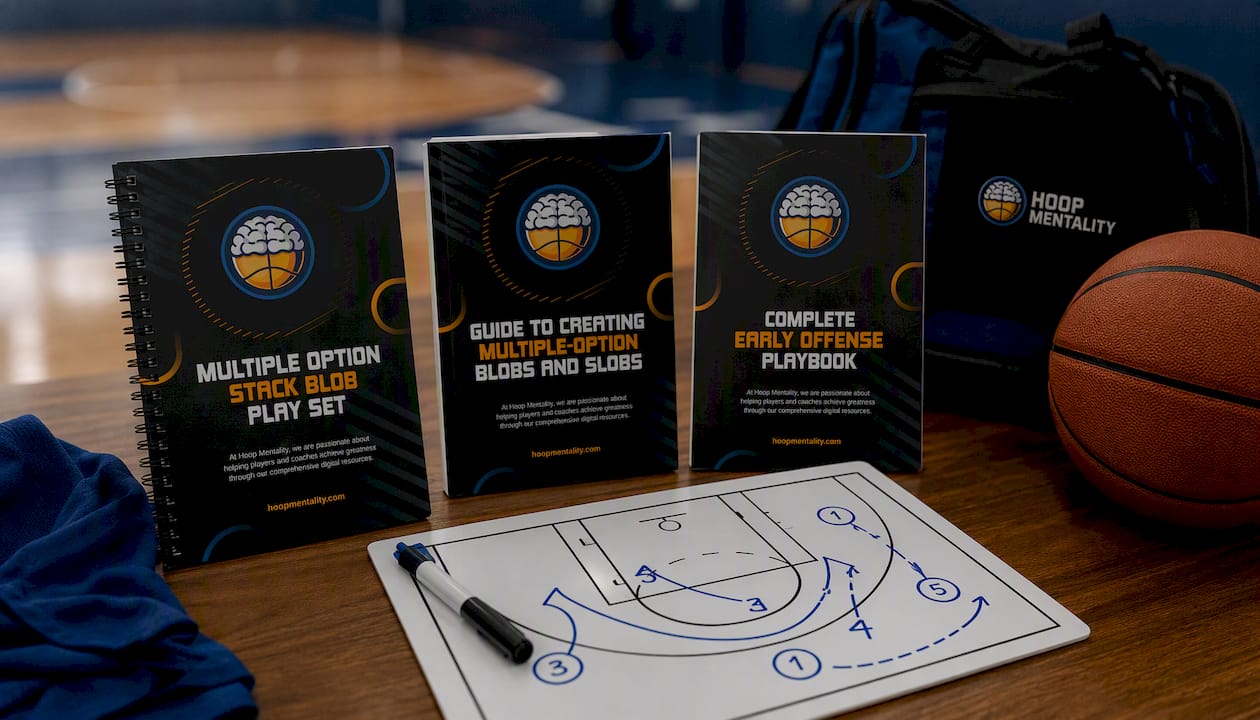
Here are the specific resources worth adding to your coaching toolkit:
- Basketball Starter Pack For Coaches — Basic templates and practice plans. The fastest way to get organized if you are starting from scratch.
- Basketball Template Bundle For Coaches — Editable play and practice templates you can drop directly into a session plan. Saves prep time on every practice.
- Basketball Shooting Bundle For Coaches — Shooting drills and printable charts to pair with inbound finishing work.
- Editable Scouting Report Template — Track opponent inbound tendencies and plan which plays to run against specific defenses.
- Basketball Scouting Report Template — Printable format for noting opponents’ out-of-bounds defensive habits before game day.
Browse the full collection at Hoop Mentality and download what fits your team this week.
Sources
- Sideline Out of Bounds Plays (11 plays) - WBCA
- Baseline Out of Bounds Plays in Basketball
- Simple Inbound Play - Basketball Plays - Hoop Coach | The Basketball IQ Site
FAQ
What is the easiest basketball offense for youth?
A simple motion offense or a two-play inbound system is the easiest to teach and execute. Limit the number of actions to two per possession and assign clear roles so players react instead of recall.
What are the 5 D’s of basketball?
The 5 D’s vary by coaching system, so no single canonical list applies universally. A common version covers dribbling, driving, defense, decision-making, and determination — but your program’s terminology takes priority over any generic list.
What should a 7-year-old be able to do in basketball?
At age 7, players should focus on catching a pass, finding their assigned spot, and making one decisive cut. For inbound plays, a simple two-action set like the Box Set BLOB or Corner Pop SLOB is the right starting point.
How do I stop my team from getting 5-second violations on inbounds?
Run timed pressure drills in practice where the inbounder holds the ball while a coach counts aloud to five. Players must cut and receive before the count ends. Short, repeated bursts of this drill reduce violations in games.
Which inbound play works best against a zone defense?
The Zone Pin-Down BLOB uses spacing and a pin-down screen to free a wing shooter, making it the most direct answer to a zone. The Corner Pop SLOB also resets possession safely when the lane is clogged.