

TL;DR:
- Effective youth coaching focuses on development, effort, and skill growth rather than winning. It emphasizes structured practices, clear communication, and avoiding early specialization and sideline instructions. Coaches should delegate administrative tasks and remain patient to foster long-term player growth and motivation.
Youth coaching dos and don’ts are the essential guidelines that separate coaches who build lasting players from those who burn kids out by age 14. The Positive Coaching Alliance defines effective youth coaching as a balance of skill development, psychosocial support, and clear communication. Get those three right, and you create an environment where players grow, stay engaged, and actually want to come back next season. This article gives you the specific behaviors to adopt and the common coaching mistakes to cut immediately.
1. What are the most important youth coaching dos?
Effective youth coaching starts with one non-negotiable: prioritize development over winning. At the youth level, a loss where every player learned something is more valuable than a win where only your best two kids touched the ball. The Positive Coaching Alliance confirms that mastery-oriented coaching climates, those focused on effort and improvement rather than the scoreboard, produce better motivation and lower dropout rates.
Structure every practice with intention. A proven session flow looks like this:
- Dynamic warm-up: 5–10 minutes
- Focused skill drills: 15–20 minutes
- Small-sided games: 15–20 minutes
- Cool-down and debrief: 5 minutes
This format keeps players moving and learning without wasting time. Active movement should fill at least 70% of practice time. Kids standing in line are kids losing focus and reps.
Teach fundamentals before anything else. Foundational skills like footwork, pivoting, and catching on balance give youth players a developmental edge that shows up for years. Resist the urge to run complex plays before your players can catch a pass without stumbling.
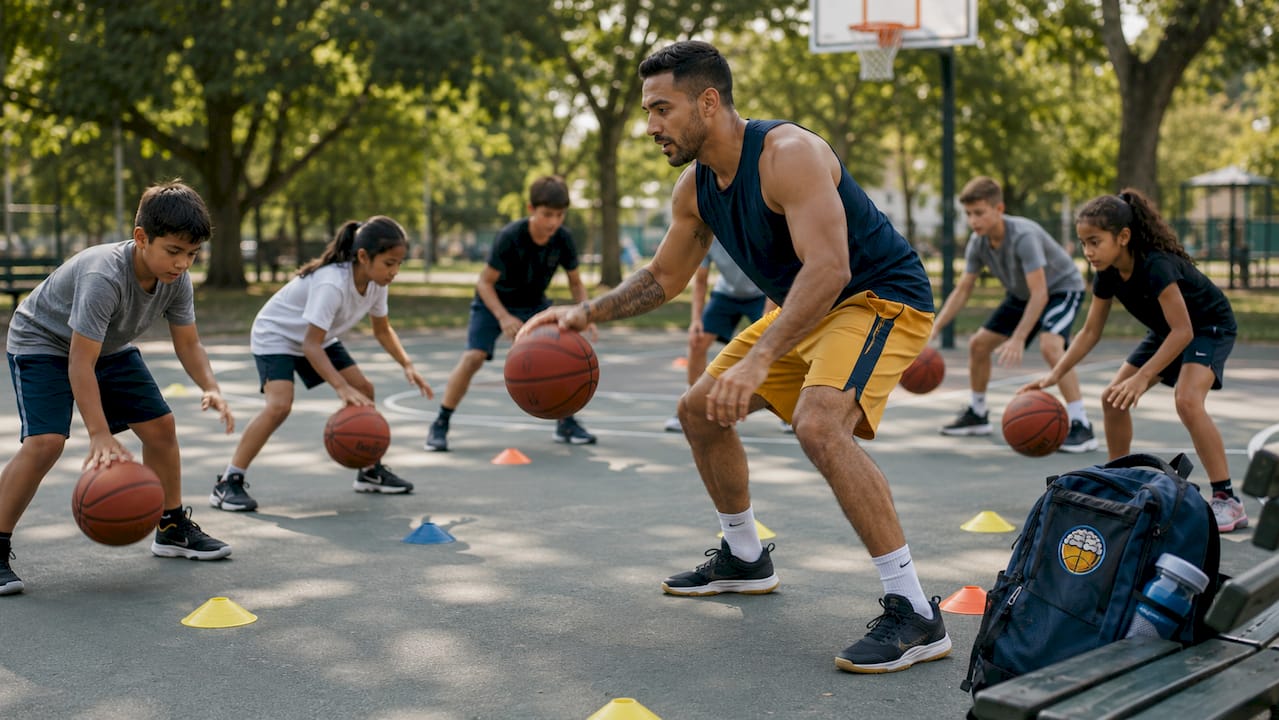
Ask questions instead of giving all the answers. When a player makes the wrong read, ask “What did you see on that play?” rather than telling them exactly what to do. Coaching by asking builds independent thinking and long-term basketball IQ. Rotate players through multiple positions. A point guard who has played center understands spacing. A forward who has handled the ball reads the floor differently.
Pro Tip: Track one improvement per player per week. Write it down. Reference it at the next practice. Players notice when you pay attention to their individual growth.
2. What are the common don’ts youth basketball coaches must avoid?
The most damaging coaching mistake at the youth level is treating every game like a championship. Coaches who yell positions and plays from the sideline during games actually slow player development. Sideline instruction prevents players from learning to read the game independently. The game itself is the teacher during matches. Your job during games is to observe, not narrate.
Common don’ts every coach needs to eliminate:
- Don’t specialize players too early. Early single-sport specialization before puberty leads to higher rates of overuse injuries and burnout. Kids under 14 benefit from playing multiple sports.
- Don’t run drills where players stand in line. Long lines kill engagement and cut reps. Split into smaller groups and keep everyone moving.
- Don’t use punishment as a teaching tool. Running laps for a missed layup teaches fear, not skill. Replace punishment with correction and repetition.
- Don’t play favorites. Overprotecting star players at the expense of others damages team culture and discourages developing players from staying in the sport.
- Don’t send mixed messages. If you tell players effort matters, then only play the most talented kids, your words lose all credibility.
- Don’t ignore emotional well-being. A player who is struggling socially or emotionally will not absorb technical coaching. Check in on your players as people, not just athletes.
Neglecting administrative and communication tasks is another silent killer. Coaches who ignore emails, forget to schedule practice, or communicate inconsistently create chaos that erodes trust with players and parents alike.
Pro Tip: After every game, write down one thing you coached from the sideline that you could have let the players figure out themselves. Over time, you will coach less and teach more.
3. How to structure effective youth basketball practices
A well-structured practice is the single biggest factor in player development. Experts recommend a minimum 3:1 practice-to-game ratio for youth athletes under 14. That ratio only pays off if the practice time is actually productive.
Follow this numbered sequence for every session:
- Dynamic warm-up (5–10 min). Skip static stretching. Use movement-based warm-ups like defensive slides, high knees, and form running. This primes the body and focuses the mind.
- Focused skill drills (15–20 min). Teach one fundamental skill per session. One concept, drilled well, beats five concepts drilled poorly.
- Small-sided games (15–20 min). Use 3-on-3 or 4-on-4 formats. More touches, more decisions, more learning. Add a constraint, like “you must make two passes before shooting,” to reinforce the session’s skill focus.
- Cool-down and debrief (5 min). Ask players what they learned. This is where basketball IQ gets reinforced. Players who can verbalize what they learned retain it longer.
| Practice Element | Duration | Purpose |
|---|---|---|
| Dynamic warm-up | 5–10 min | Activate body, focus attention |
| Skill drills | 15–20 min | Build one fundamental per session |
| Small-sided games | 15–20 min | Apply skills under game pressure |
| Cool-down and debrief | 5 min | Reinforce learning and basketball IQ |
Keep instructions short. A 30-second explanation followed by a demonstration beats a five-minute lecture every time. Players learn by doing, not by listening.
Pro Tip: Use a constraint in your scrimmage that directly ties to the skill you drilled. If you worked on ball reversal, make the rule that teams must reverse the ball once before scoring. The skill gets tested immediately.
4. Best practices for communication with players and parents
Clear communication is one of the most under-rated youth coaching guidelines. Before the season starts, hold a parent meeting. Set expectations around playing time, sideline behavior, and how you prefer to receive feedback. Parents who understand the rules upfront cause far fewer problems mid-season.
Use one communication channel and stick to it. Whether that is a group text, an app, or email, pick one and do not mix them. Coaches who send updates across three platforms create confusion and miss people. Send a weekly update that covers what you worked on in practice and what is coming up logistically. Two to three sentences is enough.
Address conflicts with a 24-hour rule. When a parent or player raises a concern after a game, ask them to wait 24 hours before discussing it. Emotions cool, and the conversation becomes productive instead of reactive. For effective parent communication, focus feedback on specific behaviors and effort, not personality or talent.
When giving feedback to players, name the behavior and the improvement. “You held your follow-through on that last shot” is more useful than “good job.” Specific praise builds confidence and gives players something concrete to repeat.
- Hold a pre-season parent meeting with written expectations
- Use one communication channel for all updates
- Apply the 24-hour rule before responding to conflicts
- Give players specific, behavior-based feedback
- Manage sideline behavior expectations clearly and early
5. How coaches can avoid burnout and manage admin effectively
Volunteer youth coaches spend 30–40% of their time on administrative tasks like scheduling, communication, and logistics. That load causes burnout around mid-season for coaches who try to handle everything alone. Sharing the workload is not a sign of weakness. It is a sign of a coach who plans to finish the season strong.
Practical steps to manage the admin burden:
- Recruit an assistant coach or a reliable team parent to handle scheduling and reminders
- Set communication hours, for example, no messages after 9 PM, and tell parents upfront
- Use reusable practice templates so you are not building sessions from scratch each week
- Batch your admin tasks into one weekly block instead of responding to things as they come in
- Use youth sports management apps to automate scheduling and roster updates
Protecting your time outside of coaching preserves the energy you bring to the court. A burned-out coach is a distracted coach. Players feel that. The 7 communication strategies that experienced coaches use all share one trait: they reduce back-and-forth by setting clear expectations upfront.
Pro Tip: Build a simple practice template you can reuse each week with minor adjustments. Spending 10 minutes updating a template beats spending 45 minutes building a new plan from scratch.
Key takeaways
The most effective youth basketball coaches prioritize player development over winning, structure every practice with purpose, and communicate clearly with both players and parents from day one.
| Point | Details |
|---|---|
| Development over winning | Focus on effort and skill growth; mastery-oriented coaching reduces dropout rates. |
| Structured practice sessions | Use a 4-part session flow to keep players active for at least 70% of practice time. |
| Avoid early specialization | Kids under 14 should play multiple sports to reduce injury and burnout risk. |
| Clear, consistent communication | Use one channel, hold a pre-season parent meeting, and apply the 24-hour conflict rule. |
| Share the admin load | Delegate scheduling and logistics to prevent mid-season burnout as a volunteer coach. |
What I have learned coaching youth basketball
The lesson that changed how I coach
The biggest shift I made as a coach was stopping myself from talking during games. I used to call out every cut, every rotation, every defensive assignment from the sideline. My players were technically correct but mentally dependent. The moment I pulled back and let them make mistakes and figure things out, their decision-making improved faster than any drill I had ever run.
Most new coaches confuse activity with learning. A busy practice is not always a productive one. I have seen coaches run 90-minute sessions where players touched the ball maybe 40 times total. That is not development. That is crowd management. The if-then decision-making framework changed how I teach reads. Instead of telling a player what to do, I teach them: “If the defender sags, shoot. If they close out hard, drive.” That framework sticks because players own the decision.
Patience is the hardest skill in youth coaching. You will have practices where nothing clicks. You will have games where your best-prepared play falls apart in five seconds. That is the job. The coaches who stay consistent, who show up with the same energy and the same standards regardless of the scoreboard, are the ones players remember for life. That is the real measure of this work.
— Dejan
Coaching resources that support what you just read
Knowing the right approach is step one. Having the tools to apply it consistently is what separates a good season from a great one. Hoop Mentality builds resources specifically for youth basketball coaches who want structure without spending hours on prep.

The Basketball Starter Pack for Coaches includes practice plans, progressive drills, and team management tools built around the same development-first principles covered here. If you want to track player progress and plan sessions faster, the Basketball Template Bundle gives you customizable templates ready to use from day one. Both resources are built from real coaching experience and designed to save you time every week.
FAQ
What are the most important dos in youth basketball coaching?
Prioritize player development over winning, structure every practice with a clear session flow, and build a mastery-oriented environment that rewards effort. Rotating players through multiple positions and asking guiding questions instead of giving all answers also accelerates long-term growth.
What is the biggest don’t for youth basketball coaches?
Yelling positions and plays from the sideline during games is the most damaging habit. It prevents players from developing independent decision-making and reading the game on their own.
How much practice time should youth players be active?
Players should be actively moving for at least 70% of practice time. If kids are standing in line, the drill needs to be split into smaller groups or redesigned entirely.
Should youth players specialize in basketball early?
Early single-sport specialization before puberty leads to higher overuse injury rates and burnout. Youth athletes under 14 benefit from playing multiple sports to build broader athleticism and stay motivated.
How do coaches handle difficult parent conversations?
Apply the 24-hour rule: ask parents to wait one day after a game before raising concerns. This reduces emotional reactions and leads to more productive, solution-focused conversations.