

TL;DR:
- Effective basketball coaching involves blending transformational, democratic, and autocratic leadership styles based on the situation.
- Adaptability and continuous adjustment are key to building team cohesion, motivation, and improving on-court performance.
- Rigidity in leadership approach often hampers long-term success; flexible, context-aware strategies are proven winners.
No single leadership style wins championships. That belief is widespread among coaches, but the data tells a different story. Research shows transformational leadership boosts cohesion and mental toughness in college basketball athletes, yet elite coaches rarely rely on one approach alone. The best coaches shift styles based on the moment, the player, and the game situation. In this guide, you will learn the core basketball leadership styles, how each one affects your team’s chemistry and performance, and how to blend them for real results.
Table of Contents
- Core basketball leadership styles explained
- How leadership styles affect team dynamics and cohesion
- Adaptability: The secret ingredient of elite coaches
- Linking leadership to team performance metrics
- A coach’s blend: Why rigid styles rarely win
- Take your coaching to the next level with Hoop Mentality
- Frequently asked questions
Key Takeaways
| Point | Details |
|---|---|
| Blend leadership styles | Top coaches combine transformational, democratic, and autocratic approaches to fit evolving team needs. |
| Boost team cohesion | Transformational leadership, enhanced by mental toughness, consistently strengthens team unity and motivation. |
| Prioritize adaptability | Elite basketball coaches proactively shift tactics and leadership styles during high-pressure situations. |
| Impact team stats | Leadership decisions most strongly influence assists and offensive execution, more than hustle metrics. |
Core basketball leadership styles explained
Every coach leads. The question is how. Three primary styles show up most often in basketball at every level: transformational, democratic, and autocratic. Each has a clear definition, a place on the bench, and a set of trade-offs.
Transformational leadership focuses on inspiring players to exceed their own expectations. The coach sets a vision, builds trust, and connects individual growth to team goals. This style works well for long-term development and building culture. The downside is that it takes time and requires genuine relationships with each player.
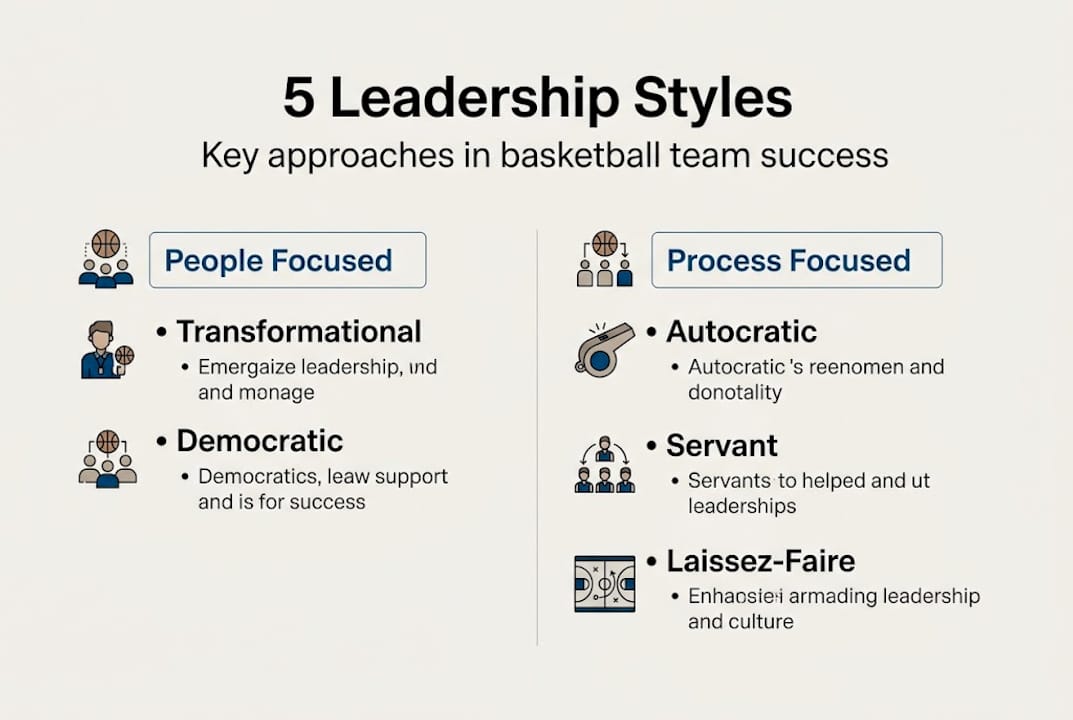
Democratic leadership involves players in decisions. Coaches using this style ask for input on plays, practice structure, or game strategy. It builds buy-in and ownership. The risk is slower decision-making, especially in high-pressure moments.
Autocratic leadership keeps control with the coach. Decisions come fast and without debate. This style fits tactical situations where clarity and speed matter most. Overuse, however, can reduce player motivation and limit development.
Democratic and transformational styles produce motivation and cohesion scores of 4.2 to 4.5 out of 5, compared to 3.0 to 3.1 for autocratic coaching. That gap is significant.
| Style | Core focus | Best used for | NBA example |
|---|---|---|---|
| Transformational | Vision and inspiration | Culture building | Gregg Popovich |
| Democratic | Player input and ownership | Development phases | Steve Kerr |
| Autocratic | Control and fast decisions | High-pressure tactics | Pat Riley |
Here is how three legendary coaches reflect these styles in practice:
- Gregg Popovich blends transformational and democratic approaches, building team-first culture while valuing player voice
- Phil Jackson used transformational leadership through the triangle offense, connecting individual roles to a shared system
- Pat Riley leaned autocratic during playoff runs, demanding execution and discipline above all else
Explore team leadership strategies that show how these styles apply across different team settings. You can also look deeper into developing player leaders to see how leadership extends beyond the coach. Shaq’s insight on coaching styles is also worth a read for a player’s perspective on what actually lands in the locker room.
How leadership styles affect team dynamics and cohesion
Knowing the styles is one thing. Seeing what they do to your team is another. Leadership directly shapes motivation, mental toughness, and how well players trust and communicate with each other.
Team cohesion refers to how connected players feel to each other and to the team’s goals. Mental toughness is the ability to stay focused and competitive under pressure. Both are trainable, and both respond to how you lead.
Transformational leadership impacts cohesion, with 16.34% of its effect mediated by mental toughness. That means when you lead transformationally, you are not just improving relationships. You are building the psychological foundation that holds teams together when games get hard.
| Leadership style | Motivation score (out of 5) | Cohesion score (out of 5) |
|---|---|---|
| Transformational | 4.5 | 4.4 |
| Democratic | 4.2 | 4.3 |
| Autocratic | 3.1 | 3.0 |
The motivation data shows a consistent pattern. Autocratic coaching does not just score lower. It scores significantly lower across both dimensions.
“Mental toughness does not appear by accident. It is built through consistent leadership that challenges players while keeping them connected to a purpose larger than individual performance.”
For coaches focused on developing player mindset, the connection between leadership style and mental toughness is a direct lever. You can also explore resources on building team cohesion for practical frameworks to apply these findings in practice.
Here are three actionable takeaways from the data:
- Shift toward transformational language in pre-game and post-game talks to reinforce purpose
- Use democratic check-ins during practice to increase player ownership and cohesion
- Reserve autocratic directives for in-game adjustments where speed matters more than buy-in
Adaptability: The secret ingredient of elite coaches
Understanding the effects of leadership sets the stage for examining how elite coaches use flexibility to stay ahead. The difference between good coaches and great ones is not which style they prefer. It is how quickly they recognize which style the moment demands.
Elite coaches show superior adaptability, making more tactical changes, faster decisions, and proactive strategy shifts compared to novice coaches who tend to react after problems occur. That gap is not small. It shows up in game outcomes, player confidence, and long-term team development.
Here is how top coaches adjust their style based on scenario:
- Pre-season development calls for democratic and transformational leadership. Players need to feel heard and connected to the vision.
- In-game tactical adjustments require autocratic clarity. Players need one voice and one direction under pressure.
- Halftime resets blend all three. Acknowledge what went wrong, set a clear directive, and reconnect to team purpose.
- Post-game reviews favor democratic input. Ask players what they saw and what they would change.
- Adversity moments (losing streaks, injuries) demand transformational leadership. Reconnect players to identity and long-term goals.
Popovich, Kerr, and Jackson each built reputations for reading the room. Popovich’s adaptability is rooted in his ability to be direct and demanding in one moment, then warm and supportive the next. Kerr invites player input on plays and rotations. Jackson created systems that gave players decision-making ownership within a structured framework.
“Elite coaches do not wait for problems to escalate. They read early signals and shift approach before the situation forces their hand.”
Pro Tip: If your team is executing well but motivation is dropping, that is your cue to shift from autocratic to democratic. Ask players what adjustments they want to make. Ownership drives effort.
For practical application, check out defensive adjustment tips and stay current with basketball tactical trends to align your leadership shifts with modern game demands.
Linking leadership to team performance metrics
With strategy flexibility established, let’s see how specific leadership decisions translate into on-court numbers. Leadership is not abstract. It shows up in the stats.
Coaches influence execution stats like three-point attempt rate, offensive rating, and assists more than hustle statistics. That means your leadership choices have a measurable impact on how your team scores and shares the ball, more so than on effort-based plays like loose ball recoveries or charges taken.
Stats most influenced by coaching leadership:
- Assist rate responds strongly to democratic and transformational coaching, which encourages ball movement and trust between players
- Offensive rating improves when coaches clearly define roles and systems, a hallmark of structured autocratic or transformational approaches
- Three-point attempt rate reflects system design and player confidence, both shaped by how coaches communicate shot selection expectations
- Turnover rate drops when players understand their roles clearly, which connects directly to leadership clarity
- Hustle stats (loose balls, charges, deflections) are less coach-dependent and more player-character driven
This distinction matters. If you want to improve your team’s assist ratio, focus on building trust and communication through transformational or democratic leadership. Learn more about assist ratio impact and how it connects to overall offensive efficiency.
If you want faster in-game execution, autocratic clarity in your play-calling and substitution patterns will move the needle more directly.
Pro Tip: Match your leadership intervention to the stat you want to move. Want more assists? Build trust and run democratic film sessions. Want better offensive rating? Define roles clearly and hold players accountable to the system.
Leadership is not a soft skill. It is a performance variable. Treat it like one.
A coach’s blend: Why rigid styles rarely win
We have seen the data. Now let’s confront the real reason many leadership styles fail in practice. It is not that coaches choose the wrong style. It is that they choose one style and refuse to leave it.
Rigidity is the problem. A coach who leads transformationally during a losing streak but refuses to get direct during a playoff run will lose the locker room. A coach who stays autocratic through an entire development season will stunt player growth and kill motivation.
The research is clear. The most effective coaches blend styles based on context. Practice looks different from game day. Early season looks different from playoffs. A struggling rookie needs something different from a veteran leader.
Reflective self-assessment is the starting point. Ask yourself which style you default to under pressure. That default is usually the one that serves you, not your players. Winning requires building strong team culture through continuous adjustment, not a fixed identity as a coach. The coaches who win long-term are the ones who stay curious about their own leadership and keep adapting.
Take your coaching to the next level with Hoop Mentality
Ready to put proven leadership styles to work for your team? Here’s where to start building your strategy toolkit.
Applying flexible leadership is easier when your practice structure supports it. Clear plans, defined roles, and progressive drills give you the foundation to lead with confidence in any style the moment demands.
Hoop Mentality resources are built for exactly this. The basketball practice plan template helps you organize sessions that reflect your leadership priorities. The big man skill drills give you targeted tools to develop players within your system. Each resource is practical, ready to use, and built from real coaching experience. Explore the full collection at Hoop Mentality and start coaching with more structure and clarity today.
Frequently asked questions
Which leadership style creates the best team chemistry in basketball?
Transformational and democratic styles consistently produce the highest cohesion and motivation scores, making them the most reliable for building strong team chemistry. Autocratic coaching scores significantly lower on both measures.
How can a coach decide when to use autocratic vs. democratic leadership?
Use autocratic leadership for fast, high-pressure tactical decisions during games, and democratic leadership during practice and development phases where player ownership matters. Elite coaches adapt proactively by reading context rather than waiting for problems to force a change.
Does leadership style actually impact statistics like assists and offensive rating?
Yes. Coaches influence execution stats like assists and offensive rating more directly than hustle-based statistics, which are more player-character driven. Your leadership choices show up in the box score.
What makes Gregg Popovich’s leadership style so effective?
Popovich’s effectiveness comes from blending team-first culture, authenticity, player development focus, and genuine adaptability across different moments and personnel. His willingness to shift between demanding and supportive builds deep player trust.
Why is adaptability considered crucial for basketball coaches?
Adaptability lets coaches match their leadership approach to what the team actually needs in a given moment. Elite coaches make faster decisions and shift strategies proactively, while less experienced coaches tend to react after problems have already taken hold.
Recommended
- 7 Essential Basketball Leadership Tips for Coaches – Hoop Mentality
- Key Leadership Skills: Complete Guide for Coaches – Hoop Mentality
- Leadership strategies in team sports for basketball coaches – Hoop Mentality
- Basketball Leadership Guide: Build Strong Team Culture – Hoop Mentality
- Top leadership skills for entrepreneurs to drive success - Ready Accounting