

Basketball player mindset accounts for approximately 80% of performance differences between athletes, yet most coaches focus overwhelmingly on physical drills and tactical execution. Developing mental resilience and adaptive thinking transforms good players into consistent performers who thrive under pressure. This guide equips you with evidence-based strategies to systematically cultivate player mindset, boost emotional regulation, and build a resilient team culture that drives winning results.
Table of Contents
- Defining Basketball Player Mindset Fundamentals
- Types Of Mindsets And Their Impact On Performance
- Techniques For Emotional Regulation And Anxiety Management
- Coach And Player Collaboration In Mindset Development
- Setting Clear And Attainable Goals
- Building A Resilient Team Culture
- Timeframe And Process Of Developing Mental Toughness
- Coaching Philosophy And Mindset Culture
- Unlock Advanced Drills And Planning Tools To Enhance Player Mindset
- What Is The Most Important Mental Skill To Develop In Basketball Players?
- How Long Does It Take To See Results From Mindset Training?
- Can Mindset Development Benefit Youth And Amateur Players?
- What Role Do Coaches Play In Developing Player Mindsets?
Key takeaways
| Point | Details |
|---|---|
| Basketball mindset includes emotional regulation and adaptive thinking, critical to performance | Mental factors like confidence and focus influence outcomes more than physical abilities alone |
| Growth mindset boosts player effort and adaptability by up to 50% | Players who embrace challenges and learning improve dramatically compared to fixed mindset counterparts |
| Techniques like breathing exercises reduce anxiety 35%, improving composure | Simple mental training tools integrated into routines enhance game-day performance measurably |
| Coach-player collaboration and SMART goals reinforce mindset growth | Clear feedback and shared responsibility create accountability and accelerate mental development |
| Noticeable mental toughness improvements occur within 4-6 weeks of deliberate training | Consistent mental skills practice yields visible resilience gains in a realistic timeframe |
Defining basketball player mindset fundamentals
Basketball player mindset refers to the mental and emotional framework that shapes how athletes approach practice, competition, and setbacks. This framework includes emotional regulation, confidence, and adaptive thinking, all of which outweigh raw physical talent in determining consistent performance. Unlike physical skills, mindset is dynamic and trainable, making it a high-leverage area for coaching intervention.
A strong basketball player mindset guide emphasizes three core components. Emotional regulation enables players to manage anxiety and frustration during high-pressure moments. Confidence allows athletes to execute skills without hesitation, even after mistakes. Adaptive thinking helps players adjust strategies mid-game and learn from failures constructively.
Research shows mindset accounts for approximately 80% of performance differences among basketball players. Two athletes with similar physical abilities will produce vastly different results based on mental approach. The player who views challenges as growth opportunities, controls emotions effectively, and maintains focus under stress consistently outperforms peers who lack these mental skills.
Many coaches mistakenly treat mindset as innate or unchangeable. In reality, mental skills develop through deliberate practice just like shooting or dribbling. By integrating mindset training into your program alongside basketball fundamentals guide confident coaching, you create well-rounded athletes prepared for competitive demands.
Key mindset components every coach should develop:
- Emotional regulation to handle game pressure
- Confidence to execute skills without hesitation
- Adaptive thinking for in-game adjustments
- Resilience to bounce back from setbacks
- Focus to maintain concentration despite distractions
Understanding these fundamentals positions you to implement targeted mental training that produces measurable mental side of basketball improvements.
Types of mindsets and their impact on performance
Players operate from either a growth mindset or fixed mindset, and this distinction dramatically affects their development trajectory. A growth mindset views abilities as expandable through effort and learning. Players with this outlook embrace challenges, persist through difficulties, and see failures as feedback rather than judgment.
Fixed mindset athletes believe talent is static. They avoid challenges that might expose limitations, give up quickly when facing obstacles, and interpret mistakes as proof of inadequacy. This defensive posture stifles improvement and creates anxiety around performance evaluation.
Research demonstrates players with a growth mindset improve performance by 50% versus those with a fixed mindset. The growth-oriented player sees a missed shot as information about technique, while the fixed mindset player sees it as evidence they lack talent. This interpretive difference cascades into drastically different practice behaviors and long-term outcomes.
| Characteristic | Growth Mindset | Fixed Mindset |
|---|---|---|
| Response to challenges | Embraces difficulty as learning | Avoids to protect self-image |
| Effort perception | Path to mastery and improvement | Sign of inadequacy |
| Feedback reception | Values criticism as guidance | Takes personally, becomes defensive |
| Teammate success | Inspired by others’ achievement | Threatened by others’ achievement |
| Plateau response | Adjusts strategy, seeks new approaches | Gives up, blames external factors |
Coaches shape player mindsets through daily language and culture. Praising effort and strategy rather than innate talent cultivates growth orientation. When you say “Your defensive positioning improved because you studied the scouting report,” you reinforce that success comes from controllable actions. Contrast this with “You’re a natural defender,” which implies ability is fixed.
Implementing a basketball player mindset guide requires examining your own coaching language. Do you celebrate intelligent adjustments and persistence, or only final outcomes? Players internalize your emphasis. By consistently highlighting process over results, you create an environment where athletes feel safe taking risks necessary for growth.
Effective coaching feedback strategies basketball emphasize specific behaviors:
- Point out concrete improvements in technique or decision-making
- Frame mistakes as diagnostic information, not character flaws
- Celebrate creative problem-solving attempts, even if unsuccessful
- Share stories of elite players who developed through persistent effort
Pro Tip: Track and share individual progress data with players weekly. Showing measurable improvement over time, even in small increments, powerfully reinforces that effort produces growth and combats fixed mindset beliefs.
The self coaching system for mindset research confirms that mindset is malleable. Players are not destined to remain fixed in their current mental approach. With intentional coaching, you can shift team culture toward growth orientation.
Techniques for emotional regulation and anxiety management
Game-related anxiety undermines performance by triggering physiological stress responses that impair decision-making and motor control. Teaching players concrete emotional regulation techniques provides them with tools to maintain composure when stakes are high. Research shows breathing techniques and cognitive reframing reduce game-related anxiety by up to 35%, leading to better composure.
Diaphragmatic breathing is the most accessible anxiety reduction tool. This technique activates the parasympathetic nervous system, countering the fight-or-flight response. Teach players to breathe deeply into their belly rather than shallowly into their chest. A simple protocol: inhale for four counts, hold for four counts, exhale for six counts. Practicing this during timeouts or free throws creates instant physiological calming.
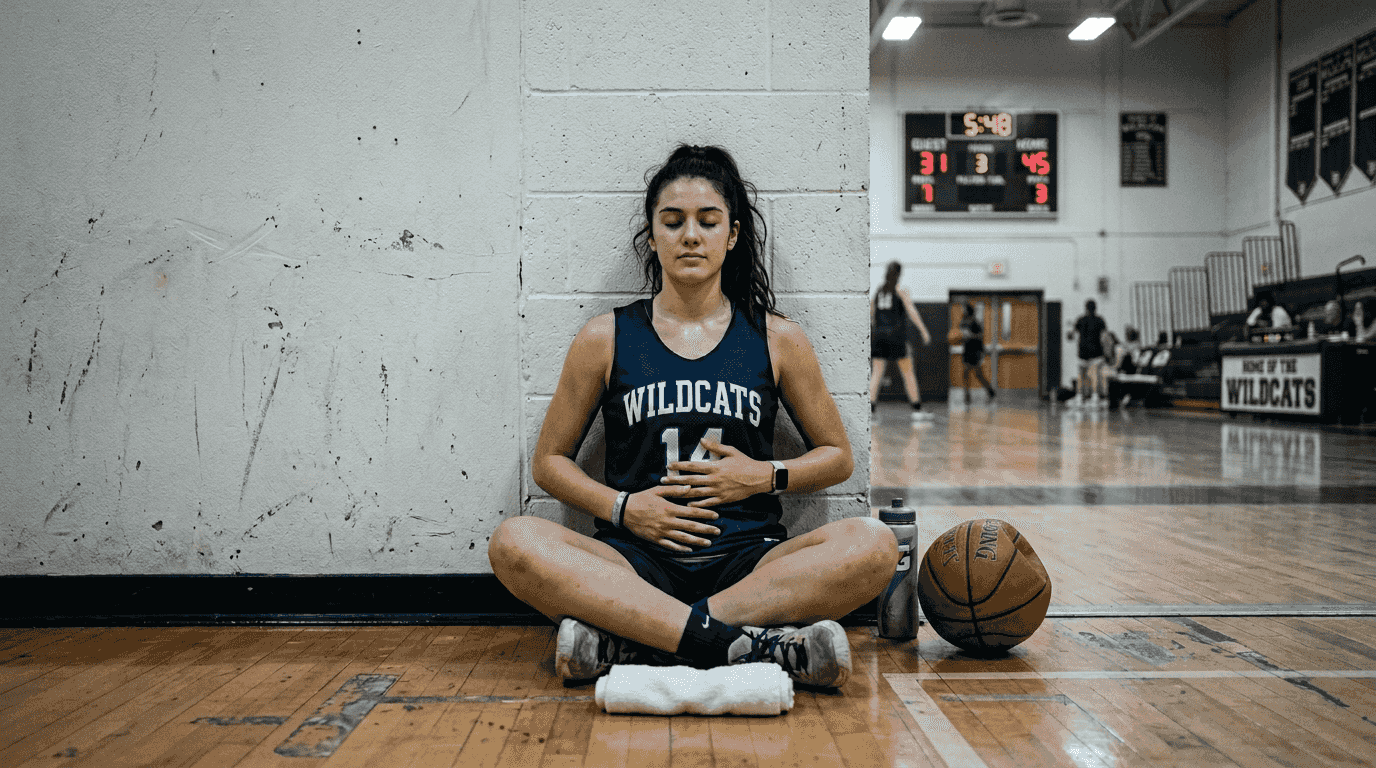
Cognitive reframing transforms anxious thoughts into productive ones. When a player thinks “I can’t miss this free throw,” anxiety spikes. Reframing to “I’ve practiced this a thousand times” shifts focus from fear of failure to confidence in preparation. Train players to catch negative self-talk and deliberately replace it with evidence-based positive statements.
Integrate these techniques into your program systematically:
- Teach breathing exercises during the first five minutes of practice for two weeks until it becomes automatic
- Practice cognitive reframing during film sessions by identifying and replacing negative self-talk examples
- Build mentally get ready for basketball game routines that include these tools before scrimmages
- Use competitive drills boost decision speed to create pressure situations where players practice regulation techniques
Additional anxiety management methods include:
- Visualization of successful performance to build confidence
- Mindfulness meditation to improve present-moment focus
- Progressive muscle relaxation to release physical tension
- Pre-game routines that create predictable mental preparation
“The mind is the limit. As long as the mind can envision the fact that you can do something, you can do it, as long as you really believe 100 percent.”
Pro Tip: Require players to use breathing techniques during every practice free throw for 21 consecutive days. This builds the habit so deeply that it activates automatically during games without conscious effort.
The mental side of basketball research confirms these techniques work across skill levels. Start with one or two methods and expand as players demonstrate mastery. Consistency matters more than variety.
Coach and player collaboration in mindset development
Mindset development requires shared responsibility between coach and player. While you provide guidance and structure, players must take ownership of their mental training. This collaborative approach builds autonomy and accelerates growth compared to coach-directed methods alone.
Clear, specific feedback forms the foundation of effective collaboration. Instead of “Get your head in the game,” say “I noticed you dropped your shoulders after that turnover. Let’s practice your reset routine.” Specificity gives players actionable information they can implement immediately. Vague feedback creates confusion and dependence on external motivation.
Building strong player coach relationships guide dynamics requires trust and open communication. Create regular one-on-one check-ins focused specifically on mental performance. Ask players to self-assess their emotional regulation, confidence, and focus each week. This dialogue surfaces challenges early and reinforces that mindset matters as much as physical skills.
Developing leadership skills in basketball players naturally complements mindset training. Leaders model growth mindset behaviors for teammates, multiplying your coaching impact. Identify players who demonstrate strong mental skills and empower them to mentor peers.
Constructive communication techniques:
- Ask questions rather than giving answers to promote player problem-solving
- Frame feedback as observations rather than judgments
- Separate behavior from identity in all feedback
- Acknowledge effort and strategy before discussing outcomes
Collaboratively setting mental performance goals creates accountability. Guide players through this process:
- Player identifies one specific mental skill to improve, like maintaining focus after mistakes
- Together, you define what success looks like in behavioral terms
- Player proposes practice strategies and you refine them
- You establish check-in points to assess progress and adjust approach
- Celebrate improvements and analyze setbacks without blame
Effective coaching feedback strategies basketball emphasize dialogue over monologue. When players contribute to their own development plans, they internalize lessons more deeply and persist through challenges with greater determination.
This collaborative model respects player agency while providing expert guidance. You become a partner in their growth rather than the sole authority, which builds the self-reliance essential for mental toughness.
Setting clear and attainable goals
SMART goals provide structure for mindset development by making abstract mental skills concrete and measurable. SMART stands for Specific, Measurable, Achievable, Relevant, and Time-bound. This framework transforms vague intentions like “be more confident” into actionable plans with clear success criteria.
Research confirms SMART goals improve motivation and reinforce growth mindset practices effectively. Players need visible progress markers to maintain effort during the weeks required for mental toughness to develop. Without measurable milestones, motivation fades and athletes revert to old patterns.
A specific goal targets one narrow mental skill rather than general improvement. “Improve focus” is too broad. “Maintain defensive stance positioning for all 40 possessions in practice scrimmages” is specific. This clarity eliminates ambiguity about what success means.
Measurable goals include quantifiable criteria so progress is objective. “Use breathing technique during 100% of free throw attempts” can be tracked precisely. “Feel calmer” cannot. Build measurement into every mental goal.
Achievable goals stretch players without overwhelming them. Setting a goal to eliminate all anxiety is unrealistic and sets players up for failure. Reducing anxious thoughts from 20 per game to 10 is challenging yet attainable.
| Goal Component | Mindset Example | Why It Works |
|---|---|---|
| Specific | Execute pre-shot routine before every free throw | Targets one concrete behavior |
| Measurable | Track successful routine completion rate | Provides clear progress data |
| Achievable | Improve from 60% to 85% completion | Realistic improvement target |
| Relevant | Routine includes anxiety-reducing breathing | Directly addresses performance need |
| Time-bound | Achieve 85% within 4 weeks | Creates urgency and focus |
Relevant goals connect to actual performance challenges. If a player struggles with confidence after mistakes, their goal should address mistake recovery specifically. Avoid generic mental skills that do not match individual needs.
Time-bound goals include deadlines that create accountability. “Improve emotional regulation by the playoffs” provides a target date that focuses effort. Open-ended goals lack urgency.
Implementing SMART goals for mindset:
- Review basketball practice goals guide to align mental and physical objectives
- Have each player set one mental SMART goal per month
- Track progress on a visible chart in your team space
- Adjust goals every 4 weeks based on achievement and new challenges
Pro Tip: Schedule brief weekly goal reviews where each player reports their progress in 30 seconds. Public accountability and peer support significantly boost follow-through on mental training commitments.
The self coaching system for mindset approach emphasizes that goals should evolve. As players master one mental skill, set new goals targeting the next development area. This creates continuous growth momentum.
Building a resilient team culture
Individual mindset development multiplies when embedded in a resilient team culture. Culture shapes daily behaviors, expectations, and peer interactions. A positive mental culture spreads growth mindset attitudes organically and creates peer accountability for mental training.
Research shows teams with resilient mental cultures report 29% higher collaboration levels and stronger collective mindset. When the team norm is embracing challenges and supporting each other through setbacks, individual players adopt these behaviors naturally through social learning.
Resilient team culture in basketball means the group maintains focus and composure despite adversity. Players encourage rather than criticize after mistakes. The team views losses as learning opportunities rather than catastrophes. This collective mental approach buffers individuals against anxiety and builds confidence through shared experience.
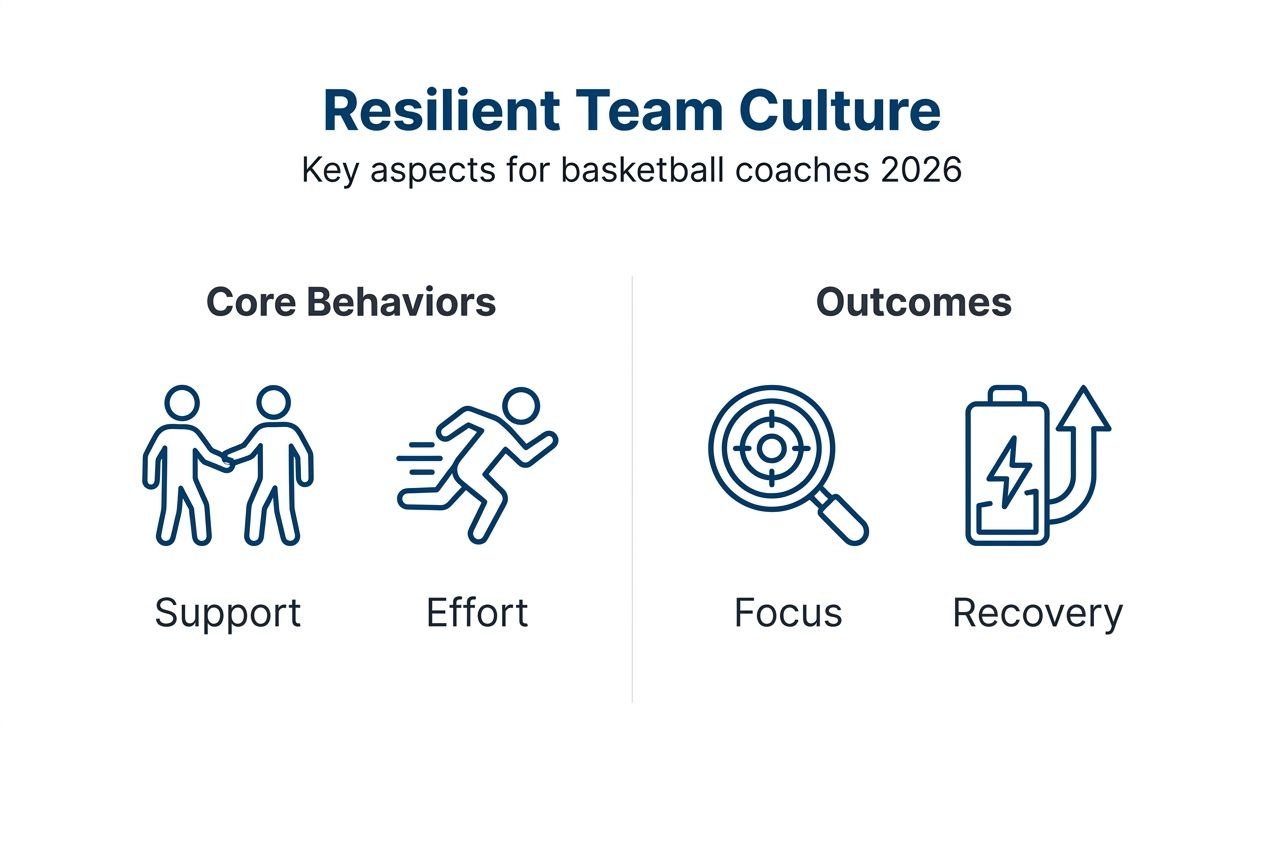
Developing how to develop team chemistry basketball naturally supports resilient culture. Strong relationships create psychological safety where players feel comfortable taking risks and being vulnerable about mental challenges.
Coach behaviors that nurture team resilience:
- Model growth mindset language consistently in all team interactions
- Celebrate teammate encouragement as much as scoring plays
- Address negative peer comments immediately and frame constructively
- Share team progress on collective mental goals weekly
- Create team rituals that reinforce resilience values
Culture-building activities include team discussions about mental challenges, where players share struggles and solutions. This normalizes mental training and reduces stigma. Establishing team mantras or mottos that reflect resilience values creates shared identity around mental toughness.
The ripple effect of culture is powerful. When team leaders demonstrate growth mindset consistently, younger or less confident players mirror those behaviors. Your role is architecting an environment where resilient thinking becomes the path of least resistance.
Invest time explicitly teaching what resilient culture looks like behaviorally. Define specific examples of supportive vs. destructive peer interactions. Role-play scenarios where players practice encouraging teammates after mistakes. Make mental culture as deliberate as your offensive system.
The building mental resilience youth basketball research confirms culture change requires 4-6 weeks of consistent reinforcement. Old patterns reemerge if you stop actively cultivating new norms. Culture maintenance is ongoing, not a one-time initiative.
Timeframe and process of developing mental toughness
Coaches often expect instant mental toughness results, then abandon strategies when change does not happen overnight. Understanding realistic development timelines prevents this premature abandonment. Research indicates noticeable improvements happen between 2 to 6 weeks of consistent mental training.
Mental skills develop through the same learning process as physical skills. Early efforts feel awkward and require conscious attention. With repetition, mental techniques become automatic. A player learning breathing exercises must initially remind themselves to use the technique. After several weeks of practice, the breathing activates reflexively during pressure moments.
Additional research confirms it takes about 4-6 weeks of deliberate training for players to develop lasting mental toughness relevant to basketball. This timeframe assumes consistent daily or near-daily practice. Sporadic mental training extends the development period significantly.
Deliberate practice means focused, intentional work on specific mental skills with feedback. Simply telling players to “be mentally tough” produces no growth. Structured practice of breathing techniques, cognitive reframing, or visualization with coaching feedback creates actual skill development.
Common failure points with unrealistic expectations:
- Expecting change after one team meeting about mindset
- Abandoning strategies after two weeks without visible results
- Inconsistent implementation of mental training in practice
- Focusing only on mental skills during games, not practice
Process steps for integrating mindset training:
- Assess current team mental strengths and weaknesses through observation and player input
- Select two to three specific mental skills to develop initially
- Teach techniques explicitly and demonstrate proper execution
- Practice mental skills in low-pressure situations first to build competence
- Gradually increase pressure while players practice mental techniques
- Provide specific feedback on mental skill execution, not just outcomes
- Track progress quantitatively to show improvement over weeks
Maintain patience and persistence. Mental toughness builds gradually through accumulated repetitions. Your basketball player mindset guide implementation should span an entire season with progressively advancing challenges.
“Mental toughness is not an event. It’s a process that unfolds through consistent practice of specific skills over weeks and months.”
Players need to see the long game. Explain the 4-6 week development timeline upfront so they maintain effort during the initial period when progress feels slow. Share milestone markers so they can track advancement toward mental toughness.
The mental training for basketball research emphasizes that early visible improvements motivate continued effort. Celebrate small wins like a player successfully using breathing techniques during one timeout. These early successes build momentum toward larger mental toughness gains.
Coaching philosophy and mindset culture
Your underlying coaching philosophy shapes every interaction and ultimately determines whether players develop robust mental skills. Belief-based coaching prioritizes language, identity, and emotional resilience as the foundation for performance. This contrasts sharply with tactics-focused coaching that emphasizes X’s and O’s above mental development.
Research shows belief-based coaching builds stronger mindset cultures than tactics-focused methods. When you consistently communicate belief in players’ capacity for growth and frame challenges as opportunities, you create an identity-level shift. Players begin to see themselves as mentally tough individuals, which becomes self-fulfilling.
Language shapes team identity profoundly. The words you choose either reinforce growth mindset or undermine it. Saying “We’re a team that fights through adversity” creates identity around resilience. Saying “We always fold under pressure” creates the opposite identity. Players unconsciously conform to the identity you articulate.
Emotional resilience emerges from an environment where feelings are acknowledged but do not dictate behavior. Belief-based coaches validate that pressure feels uncomfortable while maintaining expectation that players will execute despite discomfort. This balanced approach builds genuine toughness rather than suppression.
Principles of belief-based coaching:
- Communicate unwavering belief in every player’s potential for growth
- Use language that frames challenges as opportunities consistently
- Define team identity around mental qualities like resilience and adaptability
- Prioritize emotional development alongside technical skill development
- Model the mental skills and attitudes you want players to adopt
Integrating this philosophy into everyday coaching requires examining your default language patterns. Do you instinctively focus on what went wrong or on the learning opportunity? Do you label players with fixed descriptors like “not a shooter” or growth descriptors like “developing their range”? Small language shifts accumulate into major cultural changes.
Your basketball player mindset guide implementation succeeds or fails based on philosophical alignment. If you genuinely believe mindset is trainable and prioritize it accordingly, players will invest in mental development. If you treat it as secondary to physical skills, players mirror that priority.
“The coach’s belief in the player’s potential becomes the player’s belief in themselves. This transference of confidence is the foundation of all mental development.”
Practical tips to integrate belief-based philosophy:
- Begin every practice with a brief statement reinforcing team identity around mental strength
- End practices by highlighting examples of players demonstrating growth mindset behaviors
- Use team meetings to explicitly discuss the philosophy connecting mindset to success
- Share stories of elite players whose mental development drove their achievement
The art of coaching mindset research emphasizes consistency. Players test whether you truly believe the philosophy during difficult moments. When you maintain growth mindset language after a tough loss, you prove the philosophy is authentic, not just motivational talk.
Unlock advanced drills and planning tools to enhance player mindset
Developing player mindset requires more than understanding concepts. You need practical drills and structured plans that systematically build mental skills alongside physical abilities. Hoop Mentality offers specialized resources designed specifically to support mindset development within your existing practice framework.
Our big man dual action drill incorporates decision-making under pressure, forcing players to regulate emotions while executing technical skills. This simultaneous physical and mental demand accelerates mindset growth more effectively than separated mental training sessions.
The basketball practice plan template includes dedicated segments for mental skills training, ensuring you integrate mindset work consistently rather than sporadically. Each template provides specific mental focus points for drills, transforming standard physical practices into comprehensive mental development sessions.
These tools align directly with the evidence-based strategies covered in this guide. Rather than creating your own mindset drills from scratch, leverage resources developed through extensive coaching experience. This saves preparation time while ensuring proper implementation of mental training principles.
Pro Tip: Use these resources consistently for 6 weeks to establish strong mental training habits in your program. Regular application accelerates the 4-6 week timeline for visible mental toughness improvements by providing structure and accountability.
What is the most important mental skill to develop in basketball players?
Emotional regulation stands out as the most impactful mental skill because it enables all other mental abilities. Players who manage anxiety and frustration effectively maintain focus, execute confident decisions, and recover quickly from mistakes. Without emotional control, confidence and focus collapse under pressure.
Prioritize teaching breathing techniques and cognitive reframing first, as these provide immediate tools players can apply during games. Once emotional regulation becomes reliable, layer in confidence-building and advanced focus training. The basketball player mindset guide emphasizes this sequential approach to mental skills development.
How long does it take to see results from mindset training?
Expect noticeable improvements in mental toughness and focus within 4-6 weeks of consistent, deliberate mental training. Mental skills improvements appear between 2-6 weeks depending on practice frequency and player commitment. Early gains include better composure during timeouts and improved mistake recovery.
Consistent practice means daily or near-daily application of specific mental techniques, not occasional discussions about mindset. Track progress weekly to identify gradual improvements that might otherwise go unnoticed.
Can mindset development benefit youth and amateur players?
Mental training improves focus, confidence, and resilience at all competitive levels, not just elite play. Youth players often respond especially well to mindset coaching because they have not yet developed negative mental patterns that require unlearning. Early mindset training builds strong psychological foundations that support long-term player development and enjoyment of the game.
Amateur players competing for school or recreational teams face similar pressure and adversity as professionals relative to their experience level. Mental skills help them perform to their potential regardless of absolute skill level.
What role do coaches play in developing player mindsets?
Coaches must provide specific, actionable feedback on mental performance regularly, not just during crisis moments. Your language shapes team identity and culture around either growth or fixed mindset. Goal setting and collaborative planning deepen player investment in mental development.
Most critically, you model the mental skills you want players to adopt. Players observe how you handle adversity, communicate under pressure, and respond to mistakes. Your behavior teaches more powerfully than your words. Strong player coach relationships guide interactions create the trust necessary for vulnerable mental skills work.