

TL;DR:
- Structured basketball practice plans improve player development, save preparation time, and build team culture. They ensure skill progression, increase engagement, and foster confidence by providing clear objectives and organized drills. Coaches who adopt a written, phased approach see faster progress and stronger team cohesion.
A practice plan is a detailed, purpose-driven blueprint that tells a basketball coach exactly what to run, when to run it, and why it matters for player development. Without one, you are guessing. With one, every minute on the court has a job. The question of why use practice plans comes down to one simple fact: structure is the difference between a team that improves and one that just shows up. Coaches who plan deliberately give their players a better experience, build stronger skills, and waste far less time on logistics.
What are the key benefits of using practice plans?
Structured practice plans deliver measurable advantages across time management, skill development, and player engagement. These are not soft benefits. They show up in how quickly your players learn and how long they stay motivated.

Time savings are immediate. Manual practice planning consumes 30–60 minutes per session without a system. That time compounds fast across a full season. Coaches who use templates or digital planners reclaim those hours and redirect them toward actual coaching.
Skill development becomes deliberate. Deliberate practice requires 3–5 exposures to a new skill before a player reaches competency. A written plan tracks which skills have been covered and how often, so nothing slips through the cracks. Without a plan, coaches tend to repeat what is comfortable rather than what is needed.
Player engagement stays high. Well-organized practices reduce boredom by minimizing downtime and keeping energy levels consistent. Players who stand around lose focus and lose interest. A tight plan keeps everyone moving.
The benefits of practice plans also extend to team culture. When players know what to expect, they arrive mentally ready. That predictability builds trust between coaches and athletes.
- Saves 30–60 minutes of prep time per session
- Guarantees 3–5 skill repetitions for real competency gains
- Reduces player downtime and disengagement
- Builds consistent team expectations and culture
- Supports age-appropriate cognitive load management
Pro Tip: Write your practice plan the night before, not the morning of. Your brain processes structure better after rest, and you will catch gaps you would have missed in a rushed morning session.
How do structured plans compare to unstructured basketball practices?
The gap between a planned practice and an unplanned one is wider than most coaches expect. Unstructured practices slow player development and often lead to redundant drills, repeated mistakes, and players mentally checking out before the session ends.
A structured plan creates what coaches call skill compounding. Each drill builds on the last. Players finish a session having touched the same concept from multiple angles, which locks in retention. An unplanned session, by contrast, often circles back to the same comfortable drills without any progression.
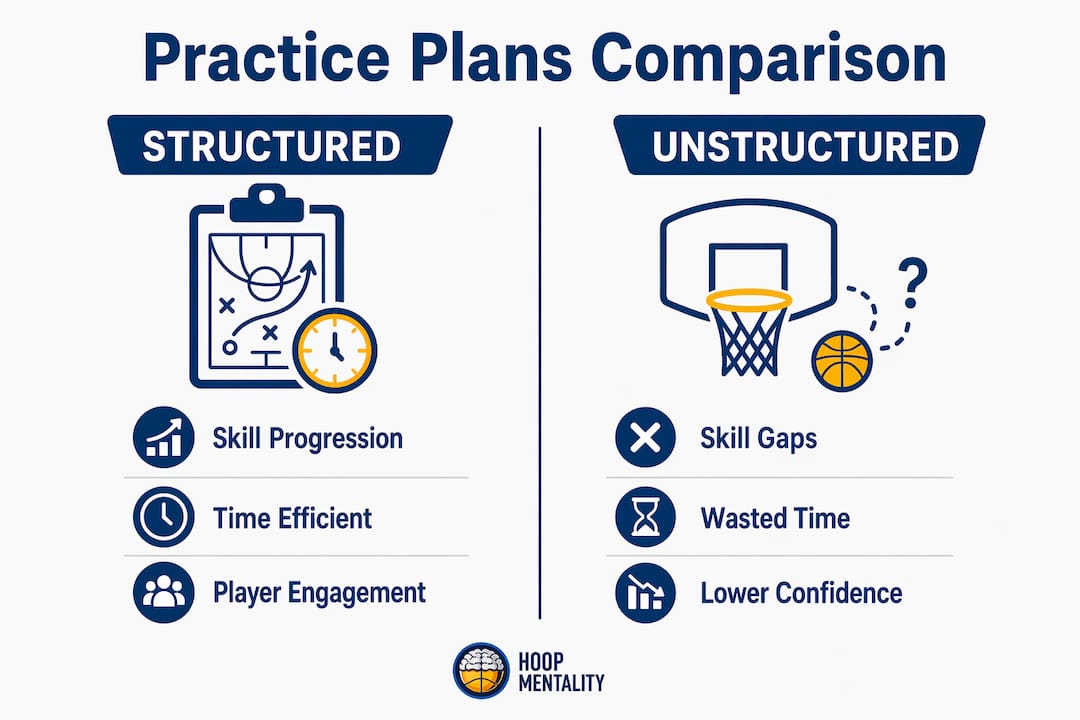
The mental side matters too. Players who walk into a disorganized practice feel the chaos. Their confidence takes a hit before they even touch the ball. A clear plan signals that the coach is prepared, and that signal alone raises the energy in the gym.
| Factor | Structured practice | Unstructured practice |
|---|---|---|
| Skill progression | Deliberate, compounding | Random, inconsistent |
| Player engagement | High, with clear purpose | Low, with frequent downtime |
| Coach prep time | Reduced with templates | High and reactive |
| Drill variety | Balanced across skills | Defaults to familiar drills |
| Player confidence | Boosted by clear expectations | Undermined by disorganization |
| Time on task | Maximized | Lost to transitions and confusion |
The table above shows why the importance of practice plans goes beyond organization. It is a direct input into player confidence and skill retention. Coaches who run organized youth basketball practices consistently see faster skill development and lower dropout rates.
What are the essential elements of an effective basketball practice plan?
A strong practice plan is built around a few non-negotiable components. Miss one and the whole session loses focus.
-
Clear objectives. Every plan starts with 2–3 specific goals tied to your team’s current development stage. “Work on ball handling” is not an objective. “Complete 3 sets of two-ball dribbling at game speed” is.
-
A sharp warm-up. The first 5–10 minutes set the tone. Use dynamic movement, not static stretching. Get players physically and mentally switched on before any skill work begins.
-
Individual skill work as the foundation. For athletes under 12, 60–70% of practice time should focus on individual skills rather than team tactics. Early specialization in team systems actually hinders individual development at younger ages. Build the player first, then build the team.
-
Attention-span-aligned segments. Pre-adolescent athletes focus for 15–20 minutes before performance drops. Structure your plan in blocks that respect this window. Switch activities before players lose focus, not after.
-
Competitive elements. Add small-sided games or timed challenges to every session. Competition raises intensity and gives players a reason to apply what they just learned.
-
Planned transitions. Dead time between drills is where practices fall apart. Write your transitions into the plan. Know exactly what players do while you reset cones or explain the next drill.
-
A posted plan. Displaying your practice plan publicly before the session starts creates a classroom-ready environment. Players arrive knowing what is coming, which cuts the mental ramp-up time and sets a professional tone.
Pro Tip: Use stations or small groups for skill work sections. More stations mean more reps per player in the same amount of time. A group of 12 players at 4 stations gets triple the touches compared to a single-line drill.
Coaches looking to build a skills development workflow will find that these elements form a repeatable system rather than a one-off plan.
How can coaches implement and maintain practice plans throughout a season?
Consistency is where most coaches struggle. Writing one great plan is easy. Writing 40 of them across a season without burning out requires a system.
Start by mapping your season into phases. Early season focuses on individual skills and team identity. Mid-season shifts toward execution and game preparation. Late season sharpens specific plays and mental readiness. This phase structure means you always know what category of work belongs in each week.
Experienced coaches build repeatable planning systems or use digital planners to avoid drafting from scratch each week. A template with pre-filled sections for warm-up, skill work, team work, and cool-down cuts your prep time dramatically. You fill in the specifics rather than rebuilding the structure every time.
Sharing plans with players before practice is a habit worth building. It is not just about transparency. Practice plans displayed publicly set the cultural tone and mentally prepare athletes before they step on the floor.
Common pitfalls to avoid:
- Overcrowding the plan. Fitting 12 drills into 90 minutes means nothing gets done well. Pick fewer drills and run them with more reps.
- Skipping transitions. Unplanned transitions eat 10–15 minutes per session. Write them in.
- Ignoring player feedback. If a drill consistently falls flat, replace it. Your plan should evolve with your team.
- Neglecting rest. Cognitive fatigue is real. Practices exceeding 90 minutes without structure cause attention and output to decline sharply.
- Starting from scratch every week. Use a template. Rebuild only what needs to change.
Coaches who want to avoid the most common planning errors can review the most frequent coaching mistakes that derail player progress and team engagement.
Key Takeaways
Structured practice plans are the single most direct tool a basketball coach has for improving player development, saving prep time, and building a focused team culture.
| Point | Details |
|---|---|
| Time savings are real | Digital tools and templates cut 30–60 minutes of prep time per session. |
| Skill repetition drives competency | Players need 3–5 exposures to a new skill; plans track and guarantee this. |
| Attention spans set the structure | Build practice in 15–20 minute blocks to match pre-adolescent focus windows. |
| Posting plans builds culture | Displaying plans before practice mentally prepares players and sets professional expectations. |
| Unstructured practice costs development | Without a plan, drills repeat, transitions drag, and player engagement drops. |
Planning is a coaching skill, not an admin task
I have watched coaches spend years developing their eye for talent and their knowledge of the game, then walk into practice with nothing written down. The talent and knowledge are real. But without a plan, they leak out in the wrong order, at the wrong time, for the wrong players.
The coaches I have seen develop the most consistent teams are not always the most technically gifted. They are the ones who treat planning as a core coaching skill. They know that a practice plan is more than a schedule. It is a cultural statement. It tells your players that their time matters, that you prepared for them, and that this session has a purpose.
The shift to digital planning tools changed things for me. Getting that 30–60 minutes back each week is not a small thing over a full season. It is hours you can spend watching film, talking to players, or simply recovering so you show up with more energy.
One thing I push back on is the idea that structure kills creativity. A good plan creates space for creativity by handling the logistics in advance. You are not improvising transitions or scrambling for the next drill. You are free to coach the moment in front of you.
If you are not planning your practices in writing, start this week. One session with a written plan will show you what you have been leaving on the table.
— Dejan
Hoop Mentality practice planning resources for coaches
Coaches who want to cut prep time and run better sessions have a direct path forward with Hoop Mentality.

The Basketball Template Bundle for Coaches includes prebuilt, customizable practice plan templates built around the skill development frameworks covered in this article. Each template is ready to use and easy to adapt for any age group or skill level. Coaches also get access to a weekly practice and game prep guide that maps practice priorities directly to game preparation. Both resources are built to reduce your planning burden and put more of your energy where it belongs: on the court with your players.
FAQ
What is a practice plan in basketball?
A practice plan is a written blueprint that outlines every drill, transition, and time block for a coaching session. It gives coaches a clear structure to follow and ensures all session objectives are covered.
Why use practice plans instead of coaching by feel?
Structured plans guarantee skill repetition, reduce wasted time, and keep players engaged. Coaching by feel tends to repeat familiar drills and miss key development areas.
How long should a basketball practice plan be?
Most effective sessions run 60–90 minutes. Practices beyond 90 minutes without structured segments cause attention and output to decline, especially for younger athletes.
How often should coaches update their practice plans?
Update your plan weekly based on team progress and player feedback. Use a seasonal phase structure so each week’s plan connects to a larger development goal.
What percentage of practice should focus on individual skills?
For athletes under 12, individual skill work should make up 60–70% of practice time. Team tactics become a larger focus as players develop their foundational skills.