

TL;DR:
- A structured basketball practice plan with clear objectives, purposeful drills, and immediate feedback is essential for player development and team success. Effective drills replicate game situations through constraints and progressive challenges, enhancing skill transfer. Organizing sessions into focused segments and maintaining engagement through competition and goal-setting maximizes efficiency and motivation.
A structured basketball practice plan is the single most reliable predictor of player development and team improvement across a season. Research by K. Anders Ericsson and applied by basketball coach Brian McCormick confirms that deliberate practice requires clear goals, concentrated effort, and immediate feedback. Without those three elements, repetitions are just activity. These practice plan tips give you a direct framework for building sessions that produce real skill transfer, better team organization, and measurable results on game day.
1. The most important practice plan tips for basketball coaches
The foundation of every effective session is a written objective. Before players step on the floor, you need to know exactly what skill problem you are solving that day. Vague goals like “work on defense” produce vague results. Specific goals like “improve help-side positioning in half-court sets” give you a measurable target and a clear drill selection filter.
Here are the core principles that separate productive practices from busy ones:
- Set one primary objective per session. Every drill should connect back to it.
- Use deliberate, individualized repetitions. Improvement depends on effortful, concentrated reps with specific goals and immediate feedback. Most practices miss these conditions entirely.
- Design drills that address specific skill gaps. Generic passing lines do not fix poor decision-making under pressure.
- Structure for flow. Minimize transition time between activities. Dead time kills focus and momentum.
- Provide feedback in real time. Waiting until the end of practice to correct a shooting mechanic means 40 minutes of reinforced bad habits.
- Balance fundamentals with game-like scenarios. Effective practice plans balance introducing new drills with reinforcing fundamentals across passing, dribbling, shooting, offense, and defense.
- Include a warm-up and a cool-down. Both serve physical and cognitive purposes. The warm-up primes movement patterns; the cool-down is your feedback window.
- Manage time with a written schedule. If a drill is not on the plan, it does not happen.
Pro Tip: Write your session objective at the top of your practice plan template and read it aloud to players at the start of practice. It sets the tone and gives players a reason to focus.
2. How to design drills that actually transfer to games
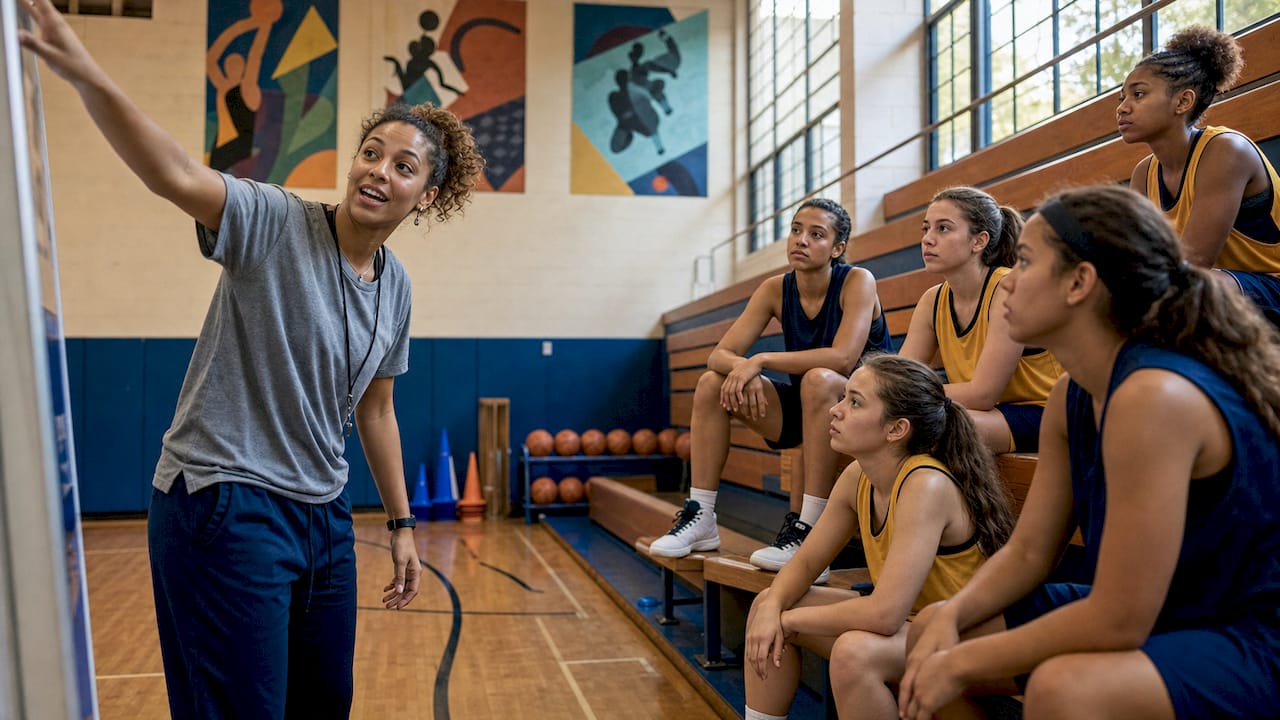
Drill design is a problem-and-solution system. You start with the specific decision or action you want to teach, then build constraints and context that allow players to succeed at a basic level before increasing complexity. This approach, detailed by Brian McCormick, is the opposite of running the same drill because it looks good on a whiteboard.
The most common mistake coaches make is running drills that lack defenders or realistic decision points. A shooting drill where the ball is always passed from the same spot, at the same speed, with no contest, does not prepare players for game shooting. It trains a motor pattern that has no game equivalent. That is called negative transfer, and it wastes practice time.
Here is a four-step process for designing drills that translate:
- Identify the specific skill problem. Example: your guards are losing the ball on drive-and-kick reads because they are not seeing the corner defender rotate.
- Build the simplest version of the constraint. Walk-through pace, no live defense, coach points to the open man. Players learn the read without pressure.
- Add progressive challenge. Introduce a token defender, then a live closeout, then a full 3-on-2 scenario. Expert musicians adapt practice difficulty with clear intention and systematic recontextualization. Coaches can apply the same logic.
- Evaluate transfer. Watch the same situation in your next scrimmage. If players are still missing the read, the drill needs adjustment, not more repetitions.
“Drills lacking defenders or context often fail to improve game performance. Purposeful drills solve defined skill problems.” — Brian McCormick
This framework applies to every skill category. For shooting, add a live closeout. For passing, add a rotating defender. For defense, add a second offensive option. The constraint forces the decision, and the decision is what you are actually training.
3. How to organize your practice for maximum efficiency
Practice organization is where most coaches lose time without realizing it. A session divided into clear segments, each with a defined focus, keeps players mentally engaged and gives you control over the floor. Segmented practice plans and group drills maintain coach and player focus while addressing multiple team needs simultaneously.
The table below shows a practical segment structure for a 90-minute practice:
| Segment | Duration | Focus |
|---|---|---|
| Warm-up and activation | 10 minutes | Movement prep, ball-handling |
| Individual and small-group skill work | 20 minutes | Deliberate practice on targeted skill |
| Team offense | 25 minutes | Half-court sets, spacing, reads |
| Team defense | 20 minutes | Rotations, communication, positioning |
| Competitive scrimmage | 10 minutes | Game-speed application |
| Cool-down and feedback | 5 minutes | Review objective, correct errors |
For larger rosters, stations are the most effective tool. Split players into groups of four to six and rotate every eight to ten minutes. Each station targets a different skill. This structure gives every player more repetitions and lets you circulate for targeted feedback rather than managing a crowd.
Pro Tip: Use a practice plan template to map your segments before practice. Coaches who plan on paper spend less time making decisions on the floor and more time coaching.
Flexibility matters too. If a drill is not working, cut it. If players are locked in on a concept, extend it. A written plan is a guide, not a contract. The best coaches adjust based on what they see, not what they wrote the night before.
4. How to keep players engaged and motivated throughout practice
Player engagement is a direct function of drill design and session structure. When drills are too easy, players coast. When they are too hard, players disengage. The target is a challenge level that requires full effort without producing repeated failure.
Here are the most effective strategies for sustaining focus and energy:
- Make drills competitive. Competition and gamified drills increase player motivation and concentration. A simple scoring system, first team to five stops wins, transforms a defensive drill into a high-effort activity.
- Set achievable short-term targets. “Make 8 of 10 catch-and-shoot threes before we move on” gives players a concrete goal within the drill.
- Use positive reinforcement with specific language. “Good read on the skip pass” is more useful than “nice job.” Specificity tells players exactly what to repeat.
- Rotate drills every 10 to 15 minutes. Sustained attention drops sharply after that window. Rotation keeps energy up and prevents mental fatigue.
- Limit total practice length for younger players. Ericsson’s research suggests limiting intense deliberate practice to about one hour for beginners. More time does not mean more learning when concentration has already dropped.
- Schedule consistent practice routines. Players perform better when they know what to expect. A predictable structure reduces anxiety and lets players focus on execution rather than logistics.
- Build in recovery windows. Water breaks and brief pauses between high-intensity segments are not wasted time. They are part of the learning cycle.
The goal is not to make practice easy. The goal is to make effort feel worthwhile. When players see the connection between what they do in practice and what happens in games, motivation takes care of itself.
5. Using feedback and technology to sharpen your sessions
Immediate, individualized feedback during practice significantly improves skill acquisition and helps players correct errors in real time. This is not optional. It is the mechanism that turns repetitions into learning. Without feedback, players repeat mistakes with confidence.
The most practical feedback tool is your voice, used precisely. Correct one thing at a time. Correct it during the drill, not after. Name the player, name the error, give the fix. “Marcus, your pivot foot moved before the catch. Reset and try again.” That is a complete feedback loop in one sentence.
Technology adds a second layer. Video review using tools like Hudl or Coach’s Eye lets players see what you are describing. Seeing a footwork error on screen is more convincing than hearing about it. Even a phone mounted on a tripod at half court gives you footage to review during the cool-down segment. Pair video with your coaching feedback strategies and players retain corrections at a significantly higher rate.
Templates and planning tools also reduce cognitive load on the coach. When your session structure is pre-built, you spend mental energy on observation and feedback rather than deciding what comes next. Hoopmentality’s resources are built specifically for this purpose, giving coaches a structured starting point that they can adapt to any roster or skill level.
Key takeaways
Effective basketball practice plans require clear objectives, purposeful drill design, and immediate feedback to produce real skill transfer and team improvement.
| Point | Details |
|---|---|
| Set a session objective | Write one specific goal per practice and connect every drill to it. |
| Design purposeful drills | Build constraints that force game-relevant decisions, not just motor repetitions. |
| Segment your practice | Divide sessions into offense, defense, skill work, and feedback windows. |
| Use immediate feedback | Correct one error at a time, during the drill, with specific language. |
| Manage session length | Limit intense deliberate practice to one hour for younger or developing players. |
What I’ve learned from building practice plans that actually work
The biggest mistake I see coaches make is confusing activity with progress. A two-hour practice full of drills is not automatically better than a 75-minute practice built around one clear objective. Volume without purpose is just fatigue.
The coaches who develop players fastest are the ones who ask one question before every drill: what specific problem does this solve? If the answer is vague, the drill gets cut or redesigned. That discipline is hard to maintain, especially when you have a full roster, limited gym time, and a game on Friday. But it is the difference between players who improve week to week and players who plateau.
I have also found that copying drills from other coaches without understanding their purpose is a fast way to waste practice time. A drill that works for a college program with 20 hours of practice per week does not automatically translate to a youth team with two 90-minute sessions. Context matters. The drill is a tool. You need to know what it is building before you use it.
Flexibility is the other underrated skill. Your written plan is your best guess before practice starts. Once players are on the floor, you observe and adjust. If a concept clicks in 10 minutes, move on. If it takes 30, stay with it. The plan serves the players, not the other way around.
For coaches looking to build this discipline into their workflow, Hoopmentality’s practice plan examples are a solid reference point for seeing how structured sessions are built from the ground up.
— Dejan
Build better practices with Hoopmentality resources
Hoopmentality provides ready-to-use tools that take the guesswork out of practice planning.

The Basketball Practice Plan Template gives you a pre-structured format for every session. Segments, timing, drill slots, and feedback windows are already built in. You fill in the specifics for your team. It saves preparation time and keeps your sessions organized from warm-up to cool-down. For coaches working with big men, the Big Man Dual Action Drill targets center and power forward skills with a position-specific, progressive drill format. Both resources are built from real coaching experience and designed to work at any level.
FAQ
What are the most important practice plan tips for coaches?
Set one clear objective per session, design drills that solve specific skill problems, and provide immediate feedback during repetitions. These three elements define deliberate practice and produce the fastest skill development.
How long should a basketball practice session be?
Research by K. Anders Ericsson suggests limiting intense deliberate practice to approximately one hour for developing players. Longer sessions are productive only when concentration and effort remain high throughout.
How do you design drills that transfer to game performance?
Start with the specific decision or action you want to teach, build the simplest constraint that enables success, then add progressive difficulty. Drills without defenders or realistic decision points rarely improve game performance.
How do you keep players motivated during practice?
Use competitive scoring systems within drills, set short-term achievable targets, and rotate activities every 10 to 15 minutes. Specific positive reinforcement, naming exactly what a player did correctly, sustains effort better than general praise.
What tools help coaches organize practice plans?
Templates and pre-structured session formats reduce preparation time and keep coaches focused on observation rather than logistics. Hoopmentality’s practice plan tools are built specifically for basketball coaches at every level.