

TL;DR:
- Continuity offense provides a structured, repeatable pattern that builds rhythm and confidence.
- It reduces mental overload and adapts well for players of all skill levels.
- Modern coaching blends continuity with decision-making reads to enhance flexibility and effectiveness.
Why run continuity offense? Boost team performance and flow
Most coaches fall into the same trap: they pile on play after play, expecting complexity to solve execution problems. It rarely does. A continuity offense gives your players a repeatable structure of cuts, screens, and passes that cycles back to its starting point, building rhythm and confidence every possession. Instead of memorizing a different script for every situation, players learn one reliable pattern and execute it automatically. This guide breaks down what continuity offense is, why it works, when to use it, and how to blend it with modern concepts for better results at any level.
Table of Contents
- What is a continuity offense?
- Key benefits of running a continuity offense
- When and how to run a continuity offense
- Modern adaptations: Blending continuity with read-and-react
- Our take: The overlooked value of simplicity and rhythm
- Take your offense to the next level
- Frequently asked questions
Key Takeaways
| Point | Details |
|---|---|
| Repeatable patterns matter | Continuity offenses use predictable movement to help teams execute consistently under stress. |
| Great for all levels | These offenses reduce mental overload and suit both youth and experienced teams. |
| Blending is key | Combine continuity’s structure with adaptive, read-and-react principles to beat smart defenses. |
| Simplicity wins games | Simple, practiced rhythms often outperform complex, memory-heavy playbooks. |
What is a continuity offense?
Let’s be precise. A continuity offense is a structured offensive system built around a repeating sequence of actions. Players run a set pattern of cuts, screens, and passes. When the sequence ends, the alignment resets, and the pattern begins again. The offense loops continuously until a good shot opens up.
This is fundamentally different from a set play, which has a defined beginning and end. Set plays are scripted actions designed to create one specific look. Once the play concludes, your team has to call another one. That constant decision-making puts mental load on players at exactly the wrong moment.
A motion offense is different again. Motion gives players freedom to read the defense and make decisions on the fly. It relies heavily on individual basketball IQ and works best with experienced players who can process multiple reads quickly. Motion offense can look fluid and unpredictable, but it also demands a high level of skill and trust across all five positions.
Continuity sits between these two systems. It gives players clear structure without micromanaging every decision. As noted by researchers and coaches, continuity offenses are movement, screen, and pass patterns that return to the start and repeat, reducing the burden of remembering changing plays while creating rhythm through repetition.
Here is a simple comparison of the three main offensive systems:
| Offensive system | Structure level | Decision freedom | Best for |
|---|---|---|---|
| Set plays | High | Low | Specific game situations |
| Continuity offense | Medium | Medium | All levels, consistent rhythm |
| Motion offense | Low | High | Experienced, skilled rosters |
Core elements that define continuity offense:
- Pattern repetition: The same sequence of actions loops throughout the possession.
- Defined roles: Each player knows where to move and when.
- Built-in screening: Screen actions are part of the pattern, not improvised.
- Reset alignment: After each cycle, players return to starting spots and begin again.
“Structure without scripts” is the simplest way to describe continuity offense. Players know the pattern, not just the play.
This structure is why continuity offense works for improving team scoring across all competitive levels. It removes guesswork and replaces it with habit. When you consider how much pressure players face during late-game possessions, removing cognitive load from their plate is a real competitive advantage. The flex offense structure is one of the most widely used continuity systems, built around a specific screen-and-cut pattern that resets automatically.
Key benefits of running a continuity offense
Understanding what continuity offense is gives you a foundation. But the reason coaches at every level keep running it comes down to what it actually does for a team over time.
1. It builds automatic execution under pressure.
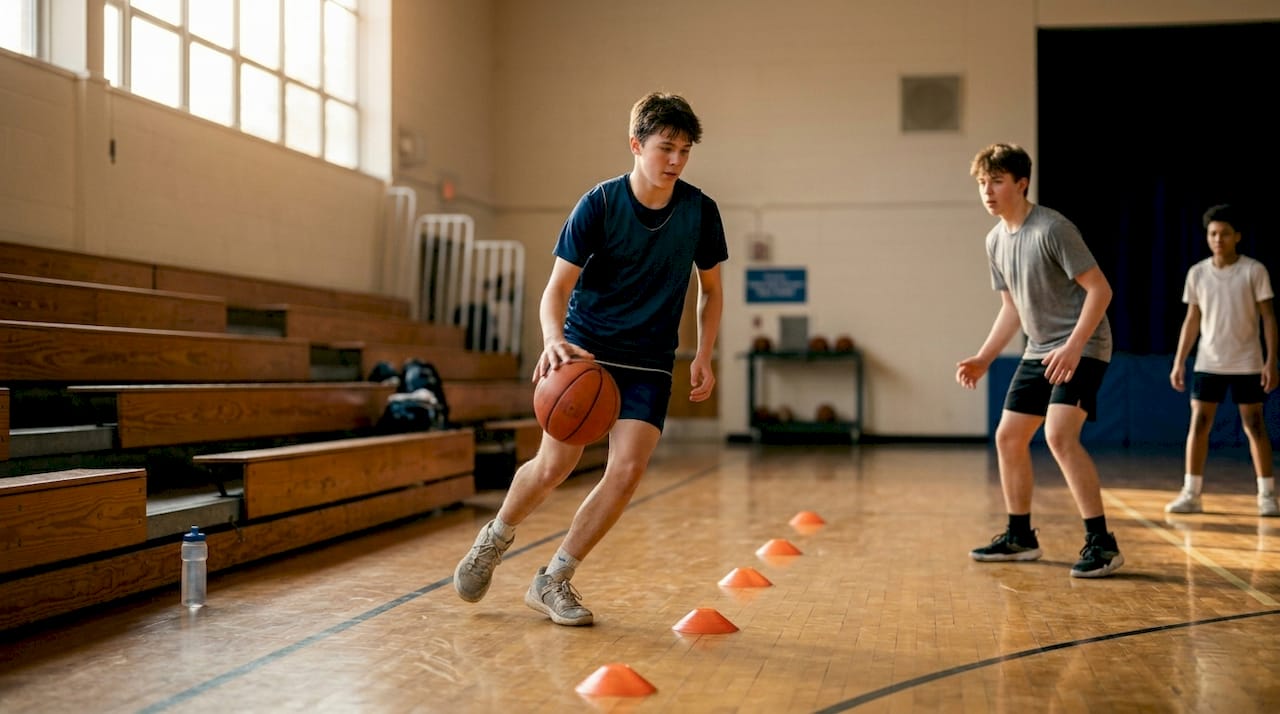
Repetition creates muscle memory. When your players run the same pattern in practice hundreds of times, they stop thinking about what comes next. Their bodies know. This is exactly what you want in a close game with the shot clock winding down. Coaches run continuity offenses to create a repeatable pattern of cuts, screens, and passes that cycles back to the starting alignment, so execution becomes automatic under pressure.
2. It reduces mental overload.
Younger players and teams that struggle with turnovers usually have one thing in common: they are making too many decisions. Continuity offense limits the variables. Each player has a defined role within the pattern. You are not asking a 15-year-old point guard to read four defenders and improvise. You are asking them to follow a sequence they already know.
3. It is adaptable across skill levels.
This is a big one. The same fundamental continuity structure you teach a 12-year-old team works at the high school and college level too. You scale up the reads and add layers over time, but the core remains consistent. That long-term familiarity pays off as players develop.
4. It creates natural spacing.
Because everyone has a designated spot and movement, the floor stays balanced. You avoid the clumping that kills offensive flow in youth and recreational leagues. Good spacing means better passing lanes, cleaner catch-and-shoot opportunities, and more room to operate in the paint.
Here is a direct comparison to put this in perspective:
| Feature | Continuity offense | Motion offense | Set plays |
|---|---|---|---|
| Learning curve | Low | High | Medium |
| Pressure performance | Strong | Variable | Situational |
| Adaptability by level | Excellent | Moderate | Limited |
| Player role clarity | Clear | Flexible | Scripted |
Steps to build benefit from continuity offense:
- Introduce the basic pattern without defense.
- Add passive defense to reinforce decision timing.
- Run live rep drills to cement automatic responses.
- Review film to identify where rhythm breaks down.
- Adjust the pattern as players internalize each layer.
Pro Tip: Run your continuity pattern at least three times per practice without interruption. Let players build the rhythm before you correct details. Stopping too early trains hesitation, not execution.
When you boost scoring efficiency through structured repetition, you are not just running more plays. You are building the kind of team confidence that holds up in tough games. Coaches looking to reinforce individual skills within a system should explore basketball offense techniques that pair well with continuity concepts.
When and how to run a continuity offense
Knowing what continuity offense does is only half the job. You need to know when it fits your roster and how to build it systematically from day one.
When is continuity offense the right call?
Continuity offense fits best when your team is new, rebuilding, or struggling with turnover problems. It is also the right fit when you have players who work hard but lack elite individual skill. The offense rewards effort and discipline over raw athleticism.
It works especially well with younger or less experienced players. Youth coaches benefit enormously from it because it gives players a safe structure to operate within. According to coaching analysis, continuity offenses are effective because their rhythm and pattern help teams execute confidently against most defenses. That confidence is worth more than any single play call.
Here is a step-by-step approach to implementing continuity offense with your team:
- Start with the skeleton. Teach the full pattern without any passes or defenders. Walk players through every cut, screen, and spot. Use the court markings as guides.
- Add the ball. Walk through the pattern slowly with passing. Correct positioning errors before adding pace.
- Introduce passive defense. Use defenders who stand in position but do not contest. Players learn to read basic defensive alignment within the pattern.
- Run full speed in practice. No defense yet. The goal is rhythm, not reaction. Time this phase until the sequence flows naturally.
- Add live defense. Now players must execute the pattern against real pressure. This is where the automatic execution built in earlier becomes a real asset.
- Film and debrief. Short film sessions that highlight rhythm and correct execution keep players progressing quickly.
This youth offense guide offers a practical framework coaches can use at the beginning stages. Pairing continuity structure with purposeful fast break drills also keeps your team sharp in transition before the half-court offense sets up.
Pro Tip: Against zone defenses, teach players to slow the pattern slightly and prioritize ball reversal. The continuity structure still works against zones. You just need to adjust the timing of cuts relative to defensive positioning. Practice this explicitly, not as an afterthought.
Common implementation mistakes to avoid:
- Moving to live defense too fast before players know the pattern.
- Calling new plays mid-pattern and breaking team rhythm.
- Forgetting to practice the reset alignment after each full cycle.
- Neglecting to teach the entry into the pattern from different set-up positions.
Modern adaptations: Blending continuity with read-and-react
Running a tight continuity pattern gives your team structure, but today’s defenses are better prepared for fixed systems than ever before. Scouting is detailed. Defensive schemes are more sophisticated. This is why the most effective coaches in 2026 are blending continuity’s structure with read-and-react principles.
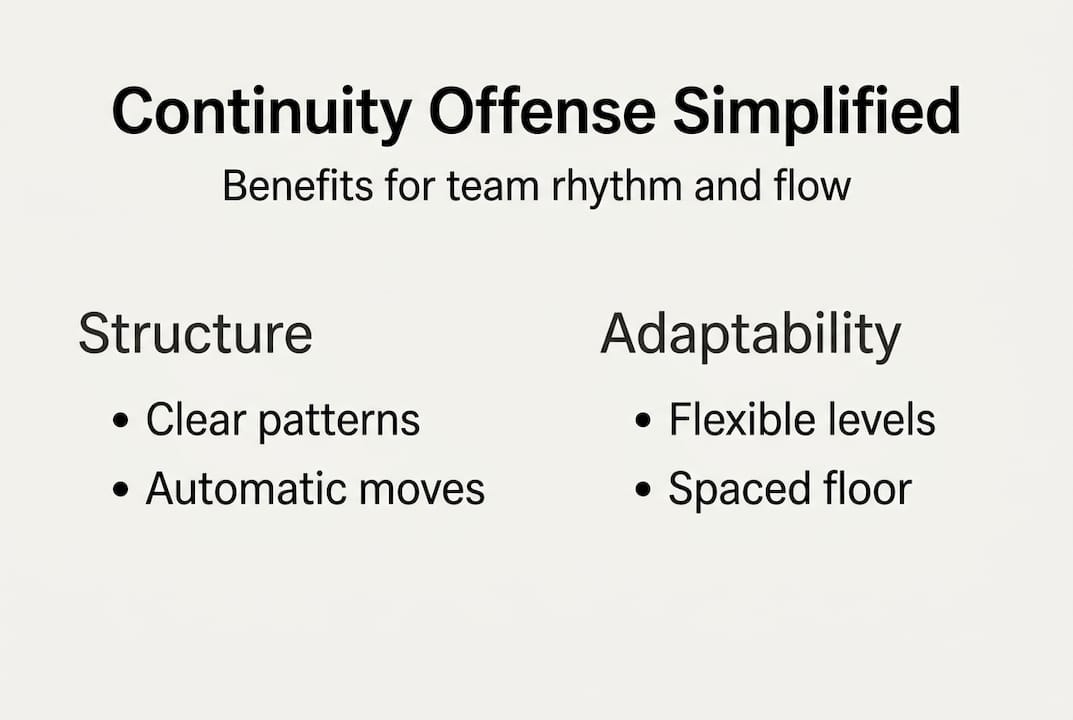
The NBA trend toward read-and-react offense shows that coaches are moving away from rigid scripts and toward systems where players process information and make decisions within structure. Erik Spoelstra’s approach with the Miami Heat is a strong example: the emphasis is on spacing, decision-making, and reading defensive coverages rather than running only a fixed sequence.
You do not need to scrap your continuity system to do this. You layer reads into the existing pattern.
Practical tweaks to modernize your continuity offense:
- Add spacing rules. Define where players should position themselves based on ball location. Keep the weak side clear to open driving lanes within the pattern.
- Build in reads at key points. Instead of a scripted pass, teach the ball handler to read whether the cutter is open or to continue the pattern. One read. Clear decision.
- Combine scripted and unscripted actions. Use the continuity pattern to set up one live read. The first two actions are fixed. The third is a live decision based on what the defense gives.
- Teach the override. Players should know when to break the pattern for an obvious advantage: a clear mismatch, an open corner three, or a broken defensive rotation.
- Practice switching coverages. Run your continuity pattern against switching defenses, zone, and pressure. Each defensive style requires a small adjustment, not a new offense.
“The best offensive systems create habits, and the best habits have room for intelligent decisions built in.” This balance is what separates teams that execute from teams that simply run plays.
Connecting your continuity base with defensive adjustment tips helps you see both sides of the tactical equation. Coaches who want to go deeper on blending structure with flexibility should review modern offensive concepts for a broader strategic framework.
The key point: continuity is a foundation, not a ceiling. Build on it as your players develop. The pattern gives your team stability. The reads give them adaptability. Together they create an offense that is hard to prepare for and harder to stop.
Our take: The overlooked value of simplicity and rhythm
Here is something most coaching content will not tell you: the real power of continuity offense is not tactical. It is psychological.
Coaches who jump to complex schemes early in a season often do so because they want to appear sophisticated. But sophistication that confuses your own players is not sophistication. It is noise. Teams that master simple, repeatable patterns under pressure will beat more talented rosters running complicated systems they have not fully internalized.
Rhythm is undervalued. When a team finds its offensive rhythm, decision-making speeds up, turnovers drop, and players begin to trust each other and the system. That trust is built through repetition, not variety.
Even experienced teams at the college and professional level return to fundamentals during losing streaks. They simplify. They run what they know. They rebuild confidence through execution. The offensive flow guide at Hoop Mentality addresses exactly this: how rhythm-driven offense reduces stress and maximizes output when it matters most.
Simplicity executed with precision beats complexity executed with hesitation. Every time.
Take your offense to the next level
Ready to put these continuity principles into real practice? Hoop Mentality has the resources to help you get there.

Our coaching library includes structured drills, step-by-step practice plans, and strategy guides built for coaches at every level. If you want to sharpen your big men within a continuity system, the Big Man Dual Action Drill gives you a ready-to-use tool for practice tomorrow. For full-season preparation, the weekly practice guide helps you organize your sessions around real game objectives. Browse our full library and find what your team needs right now.
Frequently asked questions
What’s the biggest advantage of running a continuity offense?
A continuity offense gives your team a repeatable, reliable framework, reducing errors and letting players focus on execution even under pressure.
Is continuity offense suitable for youth or beginner teams?
Yes, the simple, repeatable nature makes it especially good for teams with newer or less experienced players, since the clear structure can be followed by players at all skill levels.
How can I prevent my continuity offense from becoming predictable?
Incorporate modern read-and-react actions and encourage decision-making within the structured pattern. The NBA trend toward read-and-react shows that combining continuity with smart spacing and live reads keeps defenses guessing.
What’s the difference between continuity offense and motion offense?
Continuity offense repeats a set pattern automatically, while motion offense is more free-flowing with players making decisions on the fly based on how the defense reacts.