

TL;DR:
- The flex offense is a teachable, movement-based system suitable for all skill levels.
- It emphasizes player movement, screening, and spacing to create scoring opportunities.
- Proper teaching, variation, and decision-making are key to maintaining its effectiveness.
The flex offense gets labeled as a complex system for advanced teams. That’s a misconception that holds a lot of coaches back. In reality, it’s one of the most teachable offenses in basketball, built around movement, screens, and spacing that players at any level can learn. Many successful high school and college teams use it specifically because it develops fundamental skills while creating real scoring opportunities. This article breaks down what the flex offense is, how it works, why it’s effective, and exactly how you can start teaching it to your team.
Table of Contents
- What is the flex offense?
- Key elements and positions in the flex offense
- Advantages and common variations of the flex offense
- How to teach and implement the flex offense
- Why the flex offense remains relevant—lessons from experienced coaches
- Take your coaching to the next level with Hoop Mentality resources
- Frequently asked questions
Key Takeaways
| Point | Details |
|---|---|
| Flex offense defined | A structured basketball offense based on off-ball screens and player movement. |
| Universal adaptability | This offense suits all experience levels and is especially effective for teaching fundamentals. |
| Versatility creates success | Flex offense offers predictability for coaching but flexibility for on-court adjustments. |
| Key to teaching | Break down the offense into teachable actions and use drills to reinforce movements. |
What is the flex offense?
The flex offense is a continuity-based basketball system. It keeps all five players moving, cutting, and screening in a repeating pattern until a good shot opens up. There’s no single star waiting for the ball. Everyone has a role, and the offense flows until the defense breaks down.
Flex offense is based on continual player movement and screening, which is what separates it from static set plays. Instead of running one action and resetting, the flex keeps cycling. The defense has to stay alert on every possession.
The two signature actions that define it are:
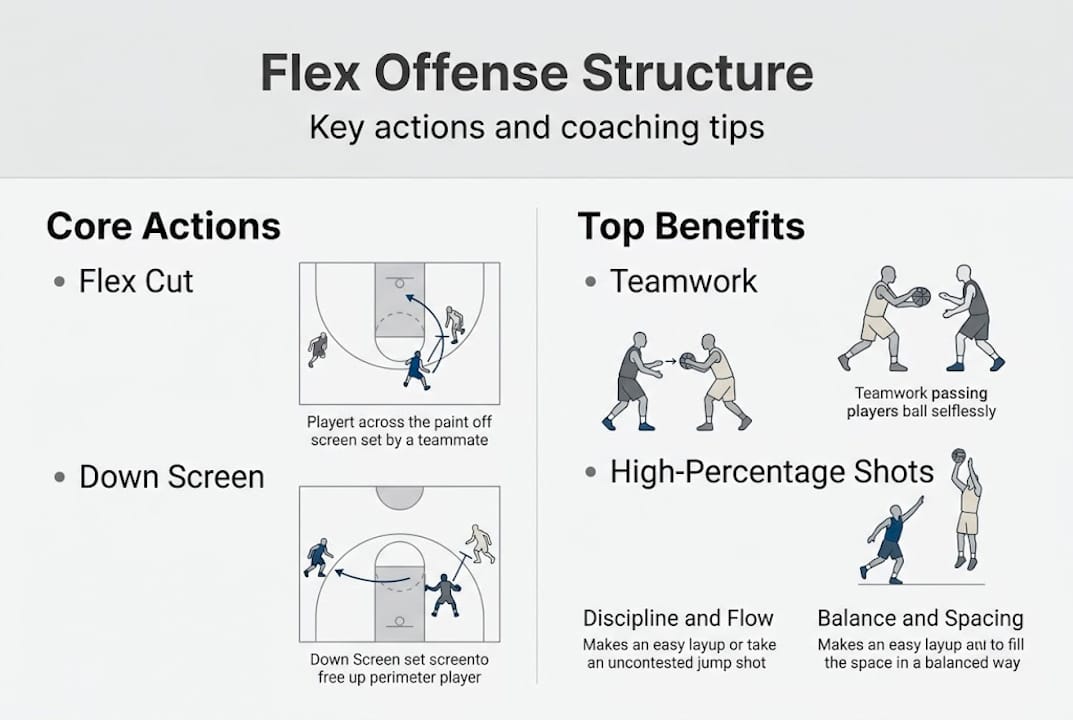
- The flex cut: A player cuts from the weak-side corner along the baseline toward the ball-side block, looking for a pass and layup opportunity.
- The down screen: After the flex cut, a teammate sets a down screen for the cutter’s original teammate, creating a catch-and-shoot or drive option.
- Spacing: Players fill specific spots on the perimeter and in the post to keep the floor open.
- Continuity: If no shot opens, the pattern repeats on the other side of the floor.
This structure works because it forces the defense to guard both the cutter and the screener on every action. One mistake by a defender and the offense gets a clean look.
“The best offenses don’t just run plays. They create problems the defense has to solve every single time down the floor.”
The flex offense fits man-to-man offense settings especially well, because the cuts and screens directly attack how man defenders are positioned. It also connects naturally with modern offensive concepts like spacing and player reads.
Originally developed as a teaching tool, the flex offense has stayed relevant because it builds habits. Players learn to cut without the ball, set screens with purpose, and read defenders instead of just following a script.
Key elements and positions in the flex offense
The flex offense typically uses a 1-4 low alignment to start. One guard brings the ball up top. Two players set up on the elbows (the corners of the free-throw line). Two players occupy the low-block corners. From there, the action begins.
Here’s the basic sequence every player needs to know:
- Pass to the wing: The point guard passes to a wing player to initiate the offense.
- Flex cut: The weak-side corner player cuts along the baseline toward the ball-side block.
- Screen for the cutter: The weak-side elbow player sets a down screen for the player who just cut.
- Replace and read: The cutter pops to the elbow or wing. The passer fills the vacated spot. Everyone rotates.
- Repeat or attack: If no shot opened, the pattern continues on the opposite side.
Flex offense uses predictable patterns but allows for creative options within that structure, which means players aren’t robots. They read the defense and make decisions inside the framework.
| Role | Flex offense | Motion offense | Set offense |
|---|---|---|---|
| Guard | Initiates, rotates | Reads and reacts freely | Executes assigned action |
| Forward | Screens, cuts | Fills open spots | Holds position or sets screen |
| Center | Post presence, screens | Reads gaps | Anchors play |
| All players | Interchangeable | Interchangeable | Role-specific |
| Teaching value | High | Medium | Low |
Good offense techniques like setting solid screens and reading the cutter’s defender are what make the flex work. Without them, the cuts become predictable and easy to stop.
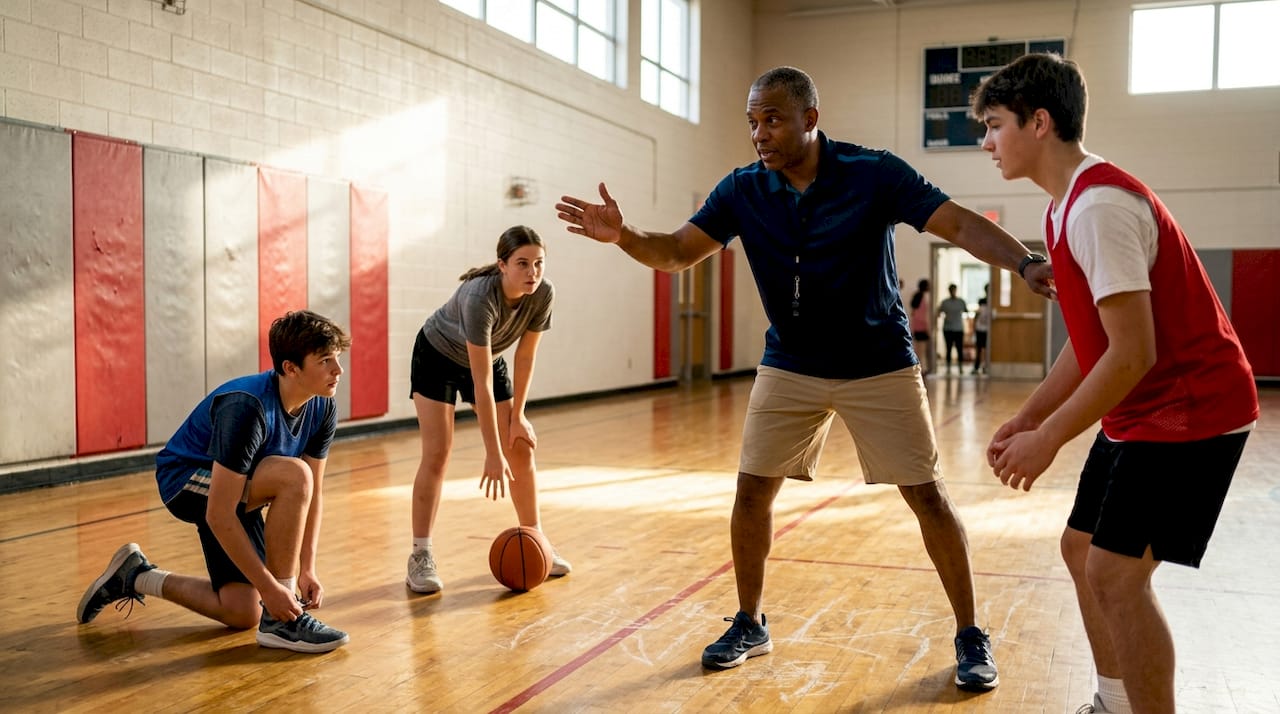
Timing matters more than athleticism in this offense. A player who cuts a half-second too early gives the defender time to recover. Off the ball movement is the engine of the whole system.
Pro Tip: When teaching young players, focus first on the flex cut itself. Have them read the defender’s hip position. If the defender is above them, they cut hard to the block. If the defender cheats low, they pop to the elbow instead.
Advantages and common variations of the flex offense
The flex offense has stayed in coaching playbooks for decades. Here’s why coaches keep coming back to it:
- Promotes teamwork: No isolation plays. Every player touches the ball and contributes.
- Teaches reads: Players learn to react to defenders, not just memorize movements.
- Adaptable: Works against zone looks with minor adjustments.
- Equalizes talent gaps: A less athletic team can compete by executing better than the opponent.
- Builds fundamentals: Screening, cutting, spacing, and passing all get reinforced every possession.
Flex offense promotes teamwork and minimizes isolation plays, making it a strong fit for balanced rosters where no single player dominates.
Teams that run the flex with patience and proper spacing consistently generate high-percentage looks near the basket and clean catch-and-shoot opportunities. When executed well, the offense creates layups and short mid-range shots rather than contested threes.
| Category | Flex offense | Motion offense | Set offense |
|---|---|---|---|
| Adaptability | High | High | Low |
| Predictability | Medium | Low | High |
| Teaching value | High | Medium | Low |
| Execution difficulty | Medium | High | Low |
| Youth suitability | High | Medium | Medium |
Common variations coaches use include:
- Flex-continuity: The standard repeating version, best for teams that need structure.
- Flex with staggered screens: Two screeners set consecutive screens to free up shooters.
- Simplified flex for youth: Fewer actions, slower pace, focus on the cut and one screen only.
For offensive systems for youth, the simplified version works well because it teaches the core skills without overwhelming players.
Pro Tip: Add one counter action per month of practice. A simple back-cut option when the defense overplays the flex cut keeps defenses honest and prevents your offense from becoming a pattern they can shut down.
For a deeper look at how to build offensive flow into your system, reviewing how continuity and spacing connect will sharpen how you teach this offense.
How to teach and implement the flex offense
Introducing the flex offense works best in stages. Dumping the whole system on players in one practice leads to confusion and frustration. Build it piece by piece.
- Explain the concept: Show players the big picture first. Use a whiteboard or video. Explain why the offense works, not just what to do.
- Walk through the pattern: Run it at half-speed with no defense. Focus on footwork, spacing, and the timing of each cut.
- Breakdown drills: Isolate each action. Practice the flex cut alone. Practice the down screen alone. Then connect them.
- 3-on-3 with rules: Add defenders but limit what they can do. This helps players see reads without full defensive pressure.
- 5-on-5 competitive play: Run it live. Let mistakes happen and correct them in real time.
Flex offense can be adapted for youth teams and beginner skill levels, so don’t feel locked into the full version from day one.
Key drills to build the offense:
- Baseline cut drill: Two players, one ball. Practice the flex cut timing and the pass into the cutter.
- Screen and pop drill: Focus on the down screen footwork and the screener’s pop to the elbow.
- Continuous 5-on-0: Run the full pattern without defense at game speed to build muscle memory.
- Shell drill with flex reads: Add defenders and practice making the correct decision at each action.
For coaching youth basketball specifically, keep early practices to two or three actions maximum. Add complexity only when players execute the basics cleanly.
Pro Tip: The most common early mistake is players cutting too slowly. Make it a rule in practice: every flex cut is a sprint. Lazy cuts teach defenders that they don’t need to respect the action.
Refer to this youth offense guide for additional breakdowns on sequencing offense instruction by skill level.
Why the flex offense remains relevant—lessons from experienced coaches
Some coaches assume the flex offense is outdated. The game is faster now. Teams shoot more threes. Pace and space dominate. So why run a continuity offense?
Here’s the real answer: the flex offense never stopped working. It evolved. Coaches who understand it don’t run it as a rigid pattern. They use it as a framework. The cuts, screens, and spacing principles inside the flex are the same principles that power modern NBA actions.
Veteran coaches consistently report one thing. Players who learn the flex offense early develop better instincts. They understand how to move without the ball. They set screens with purpose. They read defenders instead of waiting for instructions.
The confident coaching fundamentals that make a team hard to guard come from teaching systems that demand decision-making, not just memorization. The flex does exactly that.
The teams that struggle with it are the ones who run it without teaching the reads. They memorize the pattern and stop thinking. That’s when it becomes predictable. Teach the why behind every action, and the flex stays effective at any level.
Take your coaching to the next level with Hoop Mentality resources
You now have a clear picture of how the flex offense works and how to teach it. The next step is putting it into practice with the right tools.

Hoop Mentality has resources built for exactly this. The Big Man Dual Action Drill fits directly inside a flex offense system, developing the post presence and screening skills your bigs need to make the offense run. Pair that with the Game Preparation Guide with Weekly Practice Plan to structure your practices around flex offense teaching progressions. Both resources are practical, ready to use, and built from real coaching experience.
Frequently asked questions
What is the primary objective of running a flex offense?
The main goal is to create high-percentage scoring opportunities through constant player movement, screening, and balanced spacing. Flex offense revolves around continually creating open shots and mismatches that the defense cannot cover.
Is the flex offense suitable for youth or beginner teams?
Yes, it’s commonly used to teach fundamental skills and teamwork even at youth and novice levels. Flex offense can be adapted for beginner skill levels with simplified actions and slower progressions.
What’s the biggest challenge when implementing the flex offense?
Teams can become too predictable if the offense is not balanced with counters or variations. Flex offense uses predictable patterns but must include creative options to stay effective against prepared defenses.
What skills should players have to excel in the flex offense?
Players need good cutting, passing, and communication skills to maximize the scheme’s potential. Effective flex offense relies on strong player movement and communication to keep the defense off balance.