

A swingman is a basketball player skilled enough to play both shooting guard (the 2) and small forward (the 3), swinging between the two based on matchups and game plan. The role demands a hybrid skill set: perimeter shooting, ball-handling, and defense that can guard multiple body types. Pro-level swingmen tend to stand around 6’6", tall enough to battle forwards on the boards but agile enough to check guards on the perimeter.
TL;DR:
- Swingmen typically stand between 6’5" and 6’8", combining perimeter shooting, ball-handling, and multi-position defense, making them versatile on both ends of the floor.
- Positionless basketball has expanded the swingman’s role, requiring them to handle primary ball duties, create off the dribble, and switch onto guards and forwards seamlessly.
- Effective development emphasizes hybrid drills that incorporate transition, shooting, and footwork, enabling swingmen to maximize open-floor opportunities and matchup advantages.
- Coaches value at least one true swingman for lineup flexibility, as they can fill multiple roles and create more diverse, adaptable lineups with fewer specialist players.
- Retail jerseys dubbed “swingman” are made from polyester and are unrelated to the player’s on-court role; the term’s true meaning refers to position flexibility in basketball.
Table of Contents
- What Does Swingman Mean in Basketball?
- The Physical Profile and Skills Behind Every Great Swingman
- How Positionless Basketball Changed the Swingman Role
- Swingman Jersey vs. Swingman Player: Don’t Mix Them Up
- How Coaches Actually Deploy and Develop Swingmen
- Why Every Team Needs at Least One True Swingman
- Train the Swingman Skill Set With Ready-to-Use Practice Materials
- Sources
- FAQ
What Does Swingman Mean in Basketball?
The word comes straight from what the player does on the floor: they “swing” between two positions instead of staying locked into one. Basketball uses a numbering system to label the five positions on the court, and the swingman sits at the intersection of two of them.
- Point guard (1): primary ball-handler and floor general
- Shooting guard (2): perimeter scorer, often the best pure shooter on the roster
- Small forward (3): combo scorer and defender, bigger than a guard but quicker than a power forward
- Power forward (4): interior scorer and rebounder
- Center (5): the tallest player, anchoring the paint
A swingman lives between the 2 and the 3, which is why some coaches simply call the role a “wing.” The Merriam-Webster definition describes exactly this: a player capable of playing both guard and forward. It’s worth noting the term isn’t exclusive to basketball. Wikipedia’s entry on swingman points out that baseball uses it for pitchers who swing between starting and relief roles, and hockey has its own loose version tied to positional flexibility. Basketball’s usage is the most established, but context always matters.
The Physical Profile and Skills Behind Every Great Swingman
Size sets the floor for the role. NBA swingmen typically run 6’5" to 6’8", tall enough to trade elbows with a small forward on the block but mobile enough to stay in front of a shooting guard on a closeout. That range isn’t arbitrary. Go much shorter and defensive rebounding suffers; go much taller and lateral quickness against smaller guards becomes a problem.
Skill-wise, four traits separate a real swingman from a player who simply fills in at multiple spots:
- Outside shooting consistent enough to punish a defense that sags off
- Ball-handling solid enough to attack a closeout or bring the ball up in a pinch
- Passing and playmaking to make quick decisions when the offense flows through them
- Perimeter defense that holds up switching onto either guards or forwards
Coaching resources like Under Armour’s swingman breakdown note that swingmen are expected to defend multiple positions and switch assignments depending on the matchup, not just play good defense on one type of opponent.
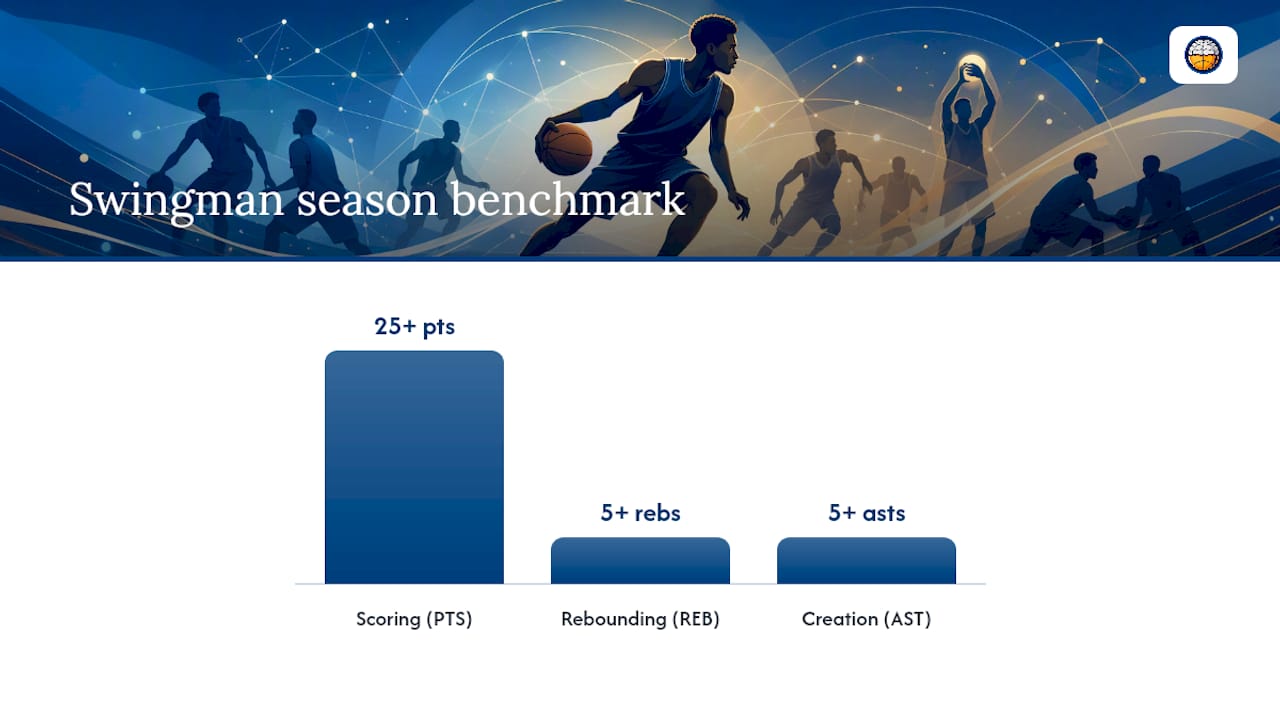
Statistic callout: the same Under Armour breakdown highlights that elite swingmen have historically produced seasons with 25-plus points, 5-plus rebounds, and 5-plus assists in the same year, a stat line that only makes sense for a player touching the game at every level. That kind of production shows up because the swingman role forces a player to contribute in scoring, rebounding, and creation simultaneously, not just one column of the box score. Fans tracking assist leaders and season-long playmaking trends will notice that many top facilitators over the years have come from the wing rather than the point guard spot alone.
How Positionless Basketball Changed the Swingman Role
Positionless basketball describes lineups built around skill sets instead of fixed labels. A team doesn’t ask “who’s our 2 and who’s our 3?” anymore. It asks “who can shoot, create, and defend well enough to be on the floor together?” That shift overlaps heavily with the swingman concept, because the swingman was already doing two jobs before “positionless” became a coaching buzzword.
What’s changed is the scope of the job:
- Swingmen now handle more primary ball-handling duties, not just secondary playmaking
- They’re expected to create their own shot off the dribble, not just spot up
- Defensively, switching onto point guards and power forwards in the same possession has become standard
The result at the team level is lineup flexibility. A coach can slot a swingman next to a traditional big and still switch every screen, because the swingman’s size and mobility cover multiple matchups. Hoop Mentality’s guide on positionless basketball and team development walks through how this shift affects practice planning, and the broader shift toward modern offensive concepts leans on exactly this kind of hybrid player to function.
Pro Tip: When scouting a young player for swingman potential, watch what they do in transition before anything else. A true swingman pushes the ball, finishes at the rim, and pulls up from three in the same possession. That range of comfort is harder to teach than any single skill.
Swingman Jersey vs. Swingman Player: Don’t Mix Them Up
Search “swingman” and you’ll hit two completely different meanings. On the court, it’s the position hybrid this article covers. In a store, “swingman” is a jersey grade, not a role.
Retail swingman jerseys sit between cheap replicas and authentic on-court uniforms. They’re typically made from 100% polyester and built for fan durability at a mid-tier price point, but they aren’t the same stitching or fabric players wear in games. Baseball and hockey add more confusion since both sports use “swingman” in their own specialized ways, tied to roster flexibility rather than a jersey category or a court position.
- Shopping context (a jersey site, a size chart) means the retail product
- Roster or coaching context (a lineup breakdown, a scouting report) means the player role
When in doubt, the surrounding content tells you which meaning applies.
How Coaches Actually Deploy and Develop Swingmen
Coaches lean on swingmen to solve two problems at once: scoring versatility and defensive matchups. A swingman gives you a small-ball option without sacrificing size on the glass, a switching defender who doesn’t get exploited in space, and a secondary ball-handler who takes pressure off the point guard late in games.
Matchup strategy usually comes down to hiding a weakness while attacking a mismatch. If a swingman isn’t a great on-ball defender, pairing them with a stronger perimeter stopper lets the swingman focus on scoring and switch only when necessary. On offense, coaches often hunt mismatches by running the swingman off a screen against a slower forward or posting them against a smaller guard.
Building these skills takes structured repetition. Here’s a simple progression worth running in practice:
- Ball-handling under pressure using two-ball dribbling series to build control at speed
- Catch-and-shoot reps off movement, not just stationary spot-up shooting
- Drive-and-finish combos that mix guard moves with forward-style finishes around bigger defenders
- Closeout and recovery drills that simulate switching onto both guards and forwards in the same rep
Hoop Mentality’s Versatile 3 Player Shooting Drill targets exactly this kind of movement shooting, while the Basketball Offseason Improvement Drills pack covers the broader conditioning and ball-handling base a swingman needs year-round. For agility and closeout speed specifically, the Basketball Agility Ladder Drills resource builds the footwork that makes switching believable instead of a liability. Once the skills are there, a system like the Diamond Offense Playbook gives coaches actual sets that put a versatile wing in position to score off movement rather than standing in a corner.
Pro Tip: Track how many possessions your swingman touches the ball in transition versus half-court sets. If the number skews too heavily toward half-court, you’re underusing their open-floor advantage.
Why Every Team Needs at Least One True Swingman
Planning practices around a swingman changes how you build every drill. You’re not designing guard drills and forward drills separately anymore. You’re designing overlap drills that force one player to do both jobs in the same rep, because that’s what game situations demand.
The value isn’t just versatility for its own sake. It’s the matchup leverage a coach gets on both ends of the floor from a single roster spot. Practice plans and drill progressions can be built around this kind of hybrid development, since a roster with two or three real swingmen can offer a coach more lineup combinations than any single specialist ever could.
— Dejan
Train the Swingman Skill Set With Ready-to-Use Practice Materials
Building a swingman doesn’t happen by accident. It takes structured reps that blend guard skills and forward skills in the same practice block, and Hoop Mentality builds its resources around exactly that overlap instead of generic, one-position drill packs.
The Complete Early Offense Playbook gives coaches sets that put a versatile wing in scoring position in transition, before a defense sets up. The Basketball Play Names and Effective Playcalling Strategies guide helps coaches communicate those sets clearly under game pressure. For skill development away from the playbook, the Basketball Agility Ladder Drills and Basketball Offseason Improvement Drills resources build the conditioning and footwork base every swingman needs before the ball ever gets involved. Browse the full Basketball Drills collection to find the progressions that fit your team’s current level, and start building practice plans around the players who can do more than one job on the floor.
Sources
- SWINGMAN Definition & Meaning - Merriam-Webster
- What Is a Swingman in Basketball? Everything Players Should Know | Under Armour
- Swingman - Wikipedia
FAQ
What Does Swingman Mean in the NBA?
In the NBA, a swingman is a player who can play both shooting guard and small forward at a high level, offering coaches flexibility on both ends of the floor. Most NBA swingmen run 6’5" to 6’8", combining guard skills with forward size.
What Is the Meaning of Swingman Outside of Basketball?
Outside basketball, “swingman” describes a similarly flexible role in other sports, such as a baseball pitcher who moves between starting and relief duties. The Wikipedia entry on swingman covers these cross-sport usages in more detail.
Are Swingmen Typically Good Defenders?
Swingmen are generally expected to defend multiple positions and switch onto both guards and forwards depending on the matchup, which makes defensive versatility a core part of the role. Not every swingman is elite individually, which is why coaches sometimes pair a weaker on-ball defender with a stronger perimeter stopper to cover for it.
What Are Swingman Jerseys Made Of?
Retail swingman jerseys are typically made from 100% polyester and sit between entry-level replicas and authentic on-court uniforms in both quality and price. This is a retail category, unrelated to the on-court playing position of the same name.
How Can Coaches Develop a Swingman on Their Roster?
Coaches develop swingmen through drills that blend guard skills, like ball-handling and catch-and-shoot shooting, with forward-oriented actions like post-entries and closeout recovery. Resources such as Hoop Mentality’s Basketball Agility Ladder Drills and Basketball Offseason Improvement Drills are built specifically around that kind of hybrid skill progression.