

Here are six ready-to-run 5-out motion offense set plays you can teach in one practice session. Quick hitters are short, one-action calls that create an immediate scoring look, then flow back into your motion continuity if the primary read is covered.
The six plays and when to call them:
- Stagger: Call it when your best shooter is being overplayed on the wing. Two staggered screens free them off the ball.
- Lob: Use it against a switching defense or a big who cheats toward the ball. The lob action catches them flat-footed.
- Boston: Best against a team that hedges hard on ball screens. The slip or pop option punishes the hedge.
- Boomerang: Call it when your point guard has a clear speed advantage. The dribble handoff creates a downhill attack.
- Flare: Use it when the defense is sagging into the paint. The flare screen kicks the ball to a corner shooter.
- Georgia: Best late-clock or after a timeout. A quick double screen gets your shooter a clean catch-and-shoot look.
Start with Stagger. Run a 10-minute walk-through: set your alignment (1 at top, wings in corners, bigs at elbows), walk the two-screen sequence twice, then add a live passer and shoot off the catch. Ten minutes. One play. That is how you install it.
Key Takeaways
The most effective 5-out motion offense set plays combine a clear primary read, a rehearsed counter, and a flow back into continuity when the first look is covered.
| Point | Details |
|---|---|
| Spacing is non-negotiable | All five players must hold the three-point line to keep the paint clear for cuts and drives. |
| Teach one play at a time | Install a single quick hitter per session using the 30-minute walk-through to live-rep progression. |
| Build in a counter | Every play needs a secondary action so players never force a low-percentage shot. |
| Call quick hitters situationally | Use them after timeouts, late clock, or when you spot a defensive tendency, not as your base offense. |
| Hoop Mentality templates | The Basketball Template Bundle For Coaches speeds play-sheet creation and practice planning. |
Table of Contents
- How to run each 5-out motion offense set play step by step
- Where each player stands and what they must do
- Reading the defense and calling the right counter
- A 30-minute practice plan to install one quick-hitter play
- Quick adjustments for your personnel and the defense you face
- Video breakdowns and play diagrams worth bookmarking
- Why quick-hitter 5-out plays work best in specific game moments
- Hoop Mentality resources that speed up play installation
- Sources
- FAQ
How to run each 5-out motion offense set play step by step
Each script below gives you alignment, entry, action sequence, and primary finishes. Use these as your whiteboard notes.
Stagger
Alignment: 1 at top, 2 in right corner, 3 in left corner, 4 at right elbow, 5 at left elbow.
Sequence:
- 1 passes to 3 on the wing.
- 4 and 5 set a staggered screen for 2 cutting from the corner toward the top.
- 2 reads the defense: curl if the defender trails, fade if they go over.
- 3 hits 2 for the catch-and-shoot or curl finish.
Counters: If 2’s defender cheats over the first screen, 5 slips to the rim. If the defense switches, 2 attacks the smaller defender off the curl.
Coaching tip: The timing between the two screeners is the play. 4 sets first, 5 sets second. A half-second gap between screens makes the stagger work.
Lob
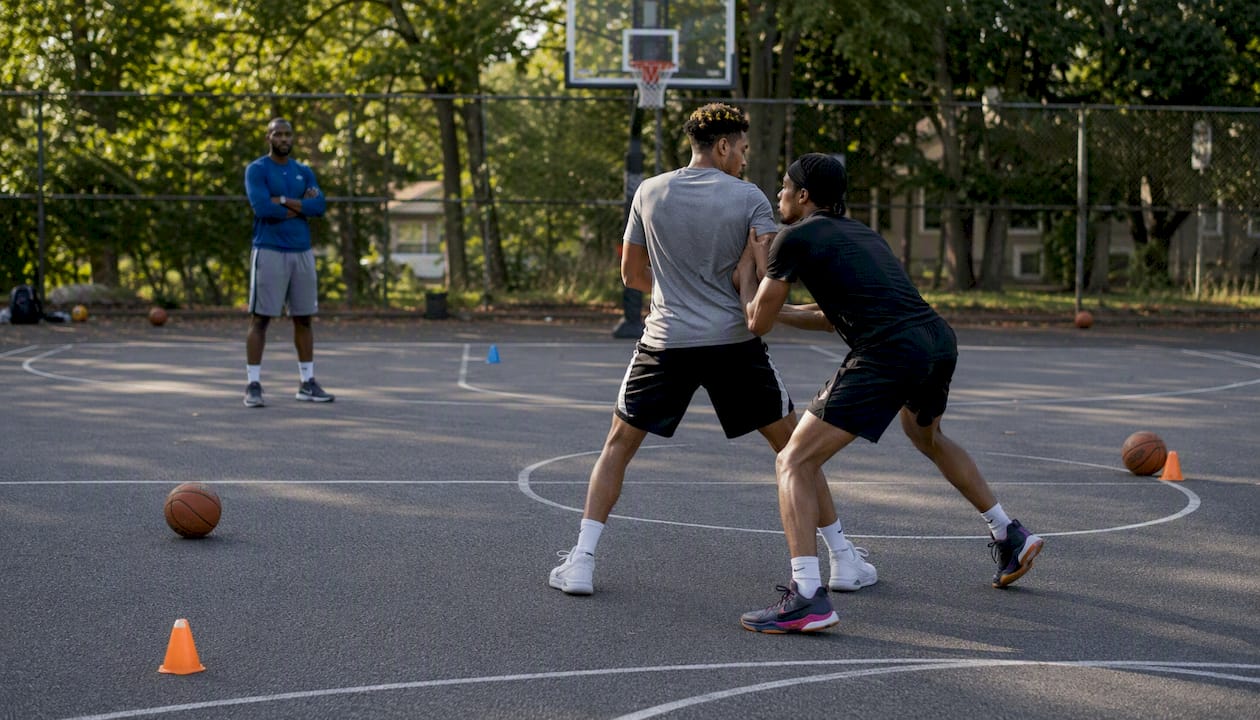
Alignment: 1 at top, wings in corners, 4 at ball-side elbow, 5 at weak-side elbow.
Sequence:
- 1 dribbles toward the wing, signaling 5 to cut hard to the rim from the weak side.
- 4 sets a back screen on 5’s defender.
- 1 lobs to 5 over the top.
Primary finish: Lob dunk or layup for 5. If the lob is denied, 4 pops to the elbow for a mid-range look.
Coaching tip: 5 must sell a cut away from the basket before reversing to the rim. No sell, no lob.

Boston
Alignment: 1 at top, wings in corners, 4 and 5 at elbows.
Sequence:
- 1 initiates a ball screen with 4 at the top of the key.
- 1 uses the screen and attacks the lane.
- 4 reads the defense: roll to the rim if the defender hedges, pop to the three-point line if they switch.
As Hoop Coach’s Kentucky 1-4 High breakdown shows, a dribble entry with a clear-out baseline creates immediate post and pick-and-roll continuity options.
Primary finish: Drive and finish, kick to a corner shooter, or hit the rolling 4.
Boomerang
Alignment: 1 at top, 2 on the right wing, 3 in the left corner, 4 and 5 in corners or at elbows.
Sequence:
- 1 dribbles at 2 on the wing.
- 2 sets a dribble handoff screen for 1.
- 1 hands off and 2 attacks downhill off the handoff.
- 1 spaces to the corner after the exchange.
Primary finish: 2 drives to the rim or pulls up at the elbow. If the defense traps, 1 is open in the corner.
Coaching tip: 2 must read the defender’s positioning before the handoff. Defender on the hip means drive. Defender sagging means pull-up jumper.
Flare
Alignment: 1 at top, 2 in the right corner, 3 on the left wing, 4 at the right elbow, 5 at the left elbow.
Sequence:
- 1 passes to 3 on the wing.
- 4 sets a flare screen for 2 cutting from the corner to the wing.
- 3 swings the ball to 2 for a catch-and-shoot three.
Primary finish: 2 shoots the three off the flare. If the defense cheats, 4 rolls to the rim.
Georgia
Alignment: 1 at top, 2 in the right corner, 3 in the left corner, 4 and 5 at the elbows.
Sequence:
- 1 passes to 4 at the elbow.
- 4 and 5 set a double screen for 2 cutting from the corner to the wing.
- 4 hits 2 for the catch-and-shoot.
Chaining sequential screening actions like this forces defensive communication and creates layered scoring windows in a single possession.
Primary finish: 2 shoots off the double screen. If denied, 3 cuts weak-side for a skip pass.
Pro Tip: Run Georgia as your first timeout play of the game. The defense has not seen your double-screen timing yet, and your shooter gets a clean look before they adjust.
Where each player stands and what they must do
The 5-out alignment puts all five players outside the three-point line. No post. No clogging the paint. Every player is a spacing threat.
| Role | Position | Primary Responsibility | Spacing Target |
|---|---|---|---|
| Point guard (1) | Top of key | Initiate entry, read the first action | 3 feet above the arc |
| Wing guard (2) | Right corner/wing | Cut, catch, shoot, or attack | Deep corner or wing |
| Wing forward (3) | Left corner/wing | Receive entry pass, swing ball | Deep corner or wing |
| Big/Forward (4) | Ball-side elbow | Screen, roll, or pop | Elbow extended or arc |
| Trailing big (5) | Weak-side elbow | Set back screen or drag screen | Weak-side elbow or rim |
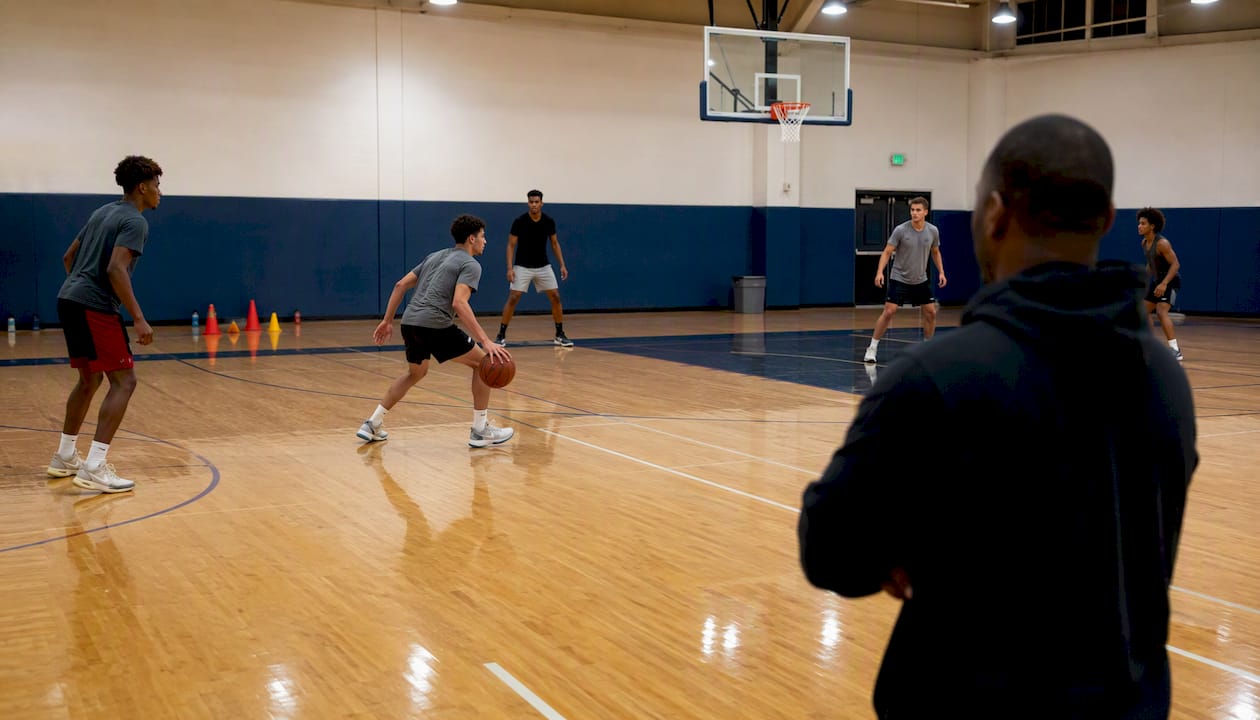
Sprinting wings to deep corners in transition and using the trailing big to set a drag screen inside the arc creates immediate spacing advantages before the defense sets. The trailing 5’s role is the most undercoached position in this system. They must sprint the floor, arrive at the elbow on time, and be ready to screen or slip on the first read.
For a deeper look at 5-out spacing and scoring principles, Hoop Mentality’s dedicated guide covers the full alignment in detail.
Reading the defense and calling the right counter
Every quick hitter has a primary read and a counter. Teach both, or the play stalls.
Ball handler reads:
- Defender goes over the screen: attack the curl or drive the lane.
- Defender goes under the screen: shooter fades for the three.
- Defense switches: attack the mismatch immediately.
Screener/roller reads:
- Defender hedges hard: roller slips to the rim before the screen is set.
- Defender switches: screener pops to the three-point line.
- Defender trails: screener holds and re-screens.
Common defensive reactions and counters:
- Hedge and recover: The ball handler attacks the hedge gap before the big recovers. Corner shooter is the release valve.
- Switch: Identify the mismatch and post up or attack in isolation.
- Go under: The shooter catches and shoots immediately. No hesitation.
- Trap the handoff (Boomerang): The passer spaces to the corner. The ball handler splits the trap.
If the primary look is covered, flow back into your motion continuity rather than forcing a low-percentage shot. Design every quick hitter as “one action plus flow” so players always have a rehearsed secondary sequence.
Troubleshooting cues:
- Play stalls at the entry: the passer is not reading the defense before throwing. Slow the walk-through.
- Screener sets too early: the cutter has not sold their move yet. Drill the timing separately.
- Shooter hesitates off the catch: add a “catch and shoot” rep constraint in practice.
A 30-minute practice plan to install one quick-hitter play
Use this block to install a single play in one session. Stagger is the recommended starting point.
- Minutes 1–5: Walk-through (no defense). Walk all five players through the alignment, entry, and screening sequence at half speed. Coach calls out each step. Repeat twice.
- Minutes 6–10: Skeleton reps (no defense, live passes). Add a passer at the top. Players move at game speed through the sequence. Coach corrects timing between screeners.
- Minutes 11–18: 3-on-3 live reps. Add three defenders on the cutter and two screeners. Run the action live. Coach stops play to correct reads.
- Minutes 19–25: 5-on-5 live reps. Full team. Run the play from the called alignment. Coach tracks clean executions.
- Minutes 26–30: Situational scrimmage. Call the play from a timeout or a dead-ball situation. Simulate game conditions.
Drag screen actions like the spread drag and double drag are worth adding to the skeleton rep phase once players understand the base alignment. They create downhill advantages and simple reads before the half-court set begins.
Readiness marker: Eight clean executions out of ten live reps before moving to the next play. Clean means correct alignment, correct timing, and a shot or layup attempt on the primary read.
Pro Tip: Speed your reps by running the play from both sides of the floor in the same session. Players learn the action faster when they see it mirrored, and it prepares them for game-speed adjustments.
Quick adjustments for your personnel and the defense you face
Not every roster fits the base script. Here are lightweight changes that preserve the play’s structure.
Non-shooting wing: Replace the flare or stagger cut with a basket cut. The wing cuts to the rim instead of spotting up. The ball handler reads the cut and either feeds the cutter or resets.
Stretch big: If your 4 or 5 can shoot, flip the roll to a pop on Boston or Stagger. The defender must close out, which opens the drive lane for the ball handler.
Athletic big, no shooting: Keep the roll on every play. Never ask a non-shooter to pop. The rim pressure is more valuable than a contested mid-range look.
Turning Stagger into a Flare: If the defense is cheating over the first screen, tell the second screener to set a flare instead of a straight stagger. The shooter fades to the three-point line. One word change, same spacing.
Converting Lob into a dribble handoff: If the lob is being denied consistently, have 5 catch the back-screen action and set a dribble handoff for the guard instead of cutting to the rim. The defense has to adjust, and the handoff creates a new driving angle.
Video breakdowns and play diagrams worth bookmarking
These resources give you visual references to pair with the scripts above.
- Hooper University: 5-Out Early Offense Actions: Video and diagram breakdowns of drag screen variants. Watch the spread drag and double drag segments.
- Hoop Coach: L.A. Man-to-Man Set: Step-by-step breakdown of chained screening actions. Useful for understanding how to layer counters.
- Hoop Coach: Kentucky 1-4 High Play: Entry and continuity model for quick-hitter sets. Watch the dribble entry and baseline clear-out sequence.
- Online Basketball Drills: Basketball Plays: Broad library of set plays organized by situation. Useful for finding inbounds and late-clock variations.
One-page play sheet template: For each play, write the name, alignment (five positions in one line), the three-step action sequence, and the two primary reads. Add a simple court diagram with numbered positions. That is one page. Players can hold it, read it in 30 seconds, and refer to it during a timeout.
Use Hoop Mentality’s offensive sets workflow to structure how each play fits into your practice plan and weekly schedule.
Why quick-hitter 5-out plays work best in specific game moments
Quick hitters are not a replacement for motion continuity. They are a precision tool for specific situations.
Call a quick hitter when you need a guaranteed look: late shot clock, coming out of a timeout, or when you have spotted a defensive tendency in the first half. Running continuity in those moments wastes time and gives the defense a chance to recover. A named play called with confidence gets your best shooter a clean look in under six seconds.
The best time to call Stagger or Georgia is immediately after a timeout, when the defense has not had time to communicate their coverage. The worst time is when your players are fatigued and cannot execute the screening timing. A poorly timed screen is worse than no screen.
One caution: if you call the same quick hitter three possessions in a row, the defense will adjust. Rotate two or three plays in your quick-hitter package, and vary the entry so the defense cannot anticipate the action. Unpredictability is what keeps these plays effective deep into a game.
Understanding when to run set plays versus continuity is a core coaching decision that affects your entire offensive structure.
Hoop Mentality resources that speed up play installation
Translating a play script into a practice-ready format takes time. Hoop Mentality cuts that process short.
The Basketball Starter Pack For Coaches gives you play templates, practice plans, and drill structures in one bundle. Use it to build your quick-hitter package from day one. The Basketball Template Bundle For Coaches is where the one-page play sheet described earlier lives. Fill in the alignment, sequence, and reads for each play, print it, and hand it to your players before practice. The Basketball Shooting Bundle For Coaches adds finishing and shooting drills that pair directly with the catch-and-shoot reps in the practice progression above. For scouting, the Editable Scouting Report Template and Basketball Scouting Report Template help you track opponent defensive tendencies so you know exactly which quick hitter to call and when. Get your Basketball Starter Pack and have your first play installed by next practice.
Sources
- 5-Out Actions to Create Early Offense — Hooper University
- Play Breakdown: Scissor Cut, Flex Screen, and a Double Screen for Your Shooter - Hoop Coach
- Playbook Breakdown: Kentucky 1-4 High Play - Hoop Coach
FAQ
What are the most common 5-out motion offense set plays?
The most frequently used quick-hitter plays in 5-out systems are Stagger, Lob, Boston, Boomerang, Flare, and Georgia. Each targets a specific defensive look and flows back into motion continuity if the primary read is covered.
What are some famous motion offenses?
Princeton offense, Dribble Drive Motion, and the Swing offense are among the most recognized motion systems in basketball. The 5-out motion offense is widely used at the college and high school levels for its spacing and read-based structure.
How do you teach 5-out set plays to beginners?
Start with one play, walk through the alignment and sequence at half speed, then add live passes before introducing defense. Eight clean executions in ten live reps is a reliable readiness marker before moving to the next play.
When should a coach call a quick hitter instead of running continuity?
Call a quick hitter after a timeout, in late-clock situations, or when you have identified a specific defensive tendency. Continuity is better when you have time and the defense has not shown a clear weakness to attack.
How does the 5-out alignment help set plays work?
All five players on the three-point line keeps the paint open for cuts, drives, and rolls. That spacing forces defenders to guard the arc, which creates driving lanes and open catch-and-shoot opportunities on every action.