

TL;DR:
- Analytics in basketball scouting uses data and models to evaluate players and streamline recruitment decisions. It complements traditional scouting by filtering prospects and assessing scheme fit, while human judgment evaluates intangible qualities. Combining both approaches enhances accuracy and organizational efficiency in player evaluation.
Analytics in basketball scouting is defined as the systematic use of data, metrics, and statistical models to evaluate players, assess team fit, and guide recruitment decisions. The role of analytics in scouting has shifted from a supplementary tool to a core function. By 2026, 75% of professional sports teams rely on real-time analytics for performance and strategy decisions. That number tells you the competitive floor has moved. Platforms like StatsPerform, Wyscout, and Hoopmentality analytics resources now sit at the center of how scouts and coaches build rosters. Analytics does not replace your eye for talent. It sharpens it.
What is the role of analytics in scouting?
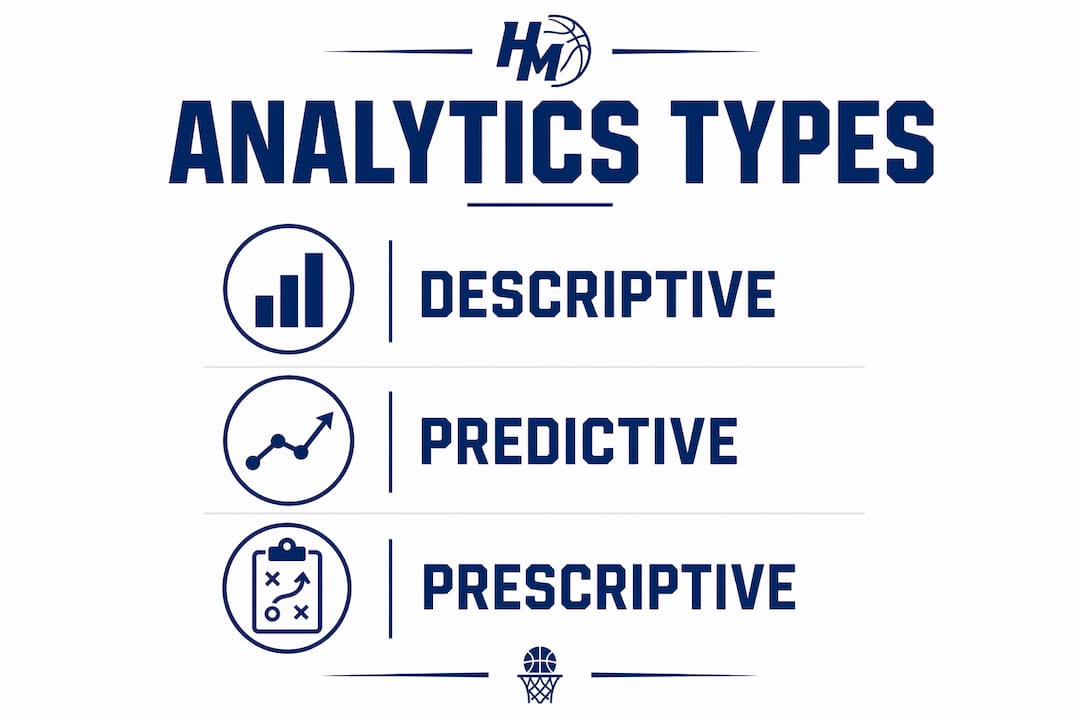
Analytics in scouting operates across three distinct categories, each serving a different purpose in the evaluation process.
Descriptive analytics answers the question: what happened? Shooting percentages, player efficiency ratings (PER), true shooting percentage, and turnover rates all fall here. These metrics give you a factual baseline on any player you are evaluating.
Predictive analytics answers: what is likely to happen next? Models compare a prospect’s development trajectory against historical player comps to estimate future performance. Predictive models provide more accurate player outcome probabilities than traditional observation alone. That accuracy matters most when you are committing roster spots or scholarship money.
Prescriptive analytics answers: what should you do? This is the most advanced tier. Fewer than 30 clubs globally use prescriptive AI in recruitment processes, which means any program that adopts it now holds a real structural edge.
Beyond these three categories, modern scouting also uses role-based and scheme-fit analytics. These metrics evaluate whether a player’s skill set matches the specific demands of your system, not just whether they are talented in the abstract. A player who averages 18 points in a pace-and-space offense may be a poor fit for a half-court, post-heavy scheme. The numbers tell you that before you fly out to watch a game.
| Analytics type | Primary question | Scouting application |
|---|---|---|
| Descriptive | What happened? | Shooting splits, PER, assist-to-turnover ratio |
| Predictive | What will happen? | Development trajectory, injury risk modeling |
| Prescriptive | What should we do? | Roster construction, scheme-fit recommendations |
| Contextual | Why did it happen? | Opponent quality, pace adjustments, lineup context |
Leading platforms like StatsPerform’s Opta Pro Hub maintain centralized databases of over 730,000 players worldwide. That scale removes geographic bias and lets you benchmark an international prospect directly against domestic starters.
How do analytics complement traditional scouting methods?
Analytics does not make the scout obsolete. It makes the scout more efficient. The most productive use of data in scouting is as a filtering tool. You use metrics to narrow a pool of 200 prospects down to 15 worth watching live. Analytics acts as a high-efficiency filtering tool that saves time and improves recruitment quality. That time savings is real. A scout who spends three weeks watching the wrong players is a liability.

Traditional scouting still owns the territory that data cannot reach. No metric captures a player’s response to adversity, their communication on the floor, or how they process a coach’s correction in real time. Those intangibles require a trained human eye. The best programs treat these two inputs as equal partners, not competitors.
Here is where most organizations get it wrong. They build an analytics department and a scouting department that barely speak to each other. Building a culture where analytics and scouting collaborate equally provides the greatest organizational advantage. That collaboration has to be structural, not occasional. Weekly joint meetings, shared shortlist reviews, and unified reporting formats all help.
- Analytics filters large candidate pools to a manageable shortlist
- Live scouting assesses effort, attitude, and game intelligence
- Integrated workflows produce faster, more confident decisions
- Shared reporting formats keep scouts and analysts aligned
Pro Tip: Never send a scout to evaluate a player the data has already disqualified. Use analytics to set the floor, then use live observation to find the ceiling.
What advanced analytics techniques are changing basketball scouting?
The most significant shift in data-driven scouting techniques is the move from describing performance to predicting it. Predictive modeling now compares a prospect’s statistical trajectory against thousands of historical player profiles to estimate where their game is headed at age 24 or 27. This is not guesswork. It is pattern recognition at scale.
Risk management is the next frontier. Robust optimization techniques like CVaR help programs manage financial risk and improve downside stability in recruitment. Conditional Value at Risk, borrowed from finance, runs scenario simulations to identify which roster decisions carry the most exposure if a player underperforms. For programs operating under scholarship caps or salary constraints, that kind of downside modeling is not optional. It is responsible management.
Advanced scouting treats player fit as a multi-dimensional matching problem against team archetypes. A player’s statistical profile is matched against the specific behavioral and tactical demands of your system. Pure statistical ranking misses psychological readiness and learning speed entirely. That is why the multi-dimensional model exists.
AI and machine learning now power real-time scouting insights, injury prediction, and film tagging. AI platforms enable secure, auditable analytics pipelines covering film tagging, injury prediction, and fit modeling. The pipeline itself follows a clear structure: data ingestion, labeling, modeling, deployment, and explainability. That last step matters. If a coach cannot understand why the model flagged a player, the model will not get used.
| Advanced technique | What it does | Impact on scouting |
|---|---|---|
| Predictive trajectory modeling | Compares prospect arc to historical comps | Reduces bust rate on high-investment picks |
| CVaR risk simulation | Models downside scenarios for roster decisions | Protects budgets and scholarship allocations |
| Multi-dimensional fit matching | Maps player profile to team archetype | Improves scheme compatibility accuracy |
| AI film tagging | Automates clip labeling and pattern detection | Cuts manual review time significantly |
| Injury prediction modeling | Flags physical risk factors pre-recruitment | Reduces injury-related roster disruptions |
Pro Tip: Start with explainability. If your analytics output cannot be communicated to a coach in two sentences, it will not influence a single decision.
How can scouts and coaches implement analytics effectively?
Implementation is where most programs stall. The technology exists. The data exists. The gap is workflow. Here is a practical sequence for getting analytics into your scouting process without overhauling everything at once.
- Start with film tagging. Tag clips by play type, defensive scheme, and player action. This creates a labeled dataset you can query later. Even a small tagged library produces useful patterns within one season.
- Secure reliable data sources. Free public data has gaps and lags. Invest in a platform that provides consistent, auditable player data. Hoopmentality analytics resources and platforms like StatsPerform give you structured data you can trust.
- Build metrics for your system. Generic efficiency ratings are a starting point, not a destination. Define two or three metrics that directly reflect what your scheme demands. A defense-first program needs different filters than a transition-heavy one.
- Assign a translator role. Recruitment analysts act as translators between data scientists and coaches to create defensible shortlists. If you do not have a dedicated analyst, designate someone on staff to own the data-to-decision pipeline.
- Track data quality. Small sample sizes produce misleading numbers. A player with 8 games of data is not statistically reliable. Set minimum sample thresholds before any metric influences a decision.
- Iterate every cycle. Review which analytics predictions matched outcomes at the end of each season. Adjust your models and filters based on what you learned.
The most common pitfall is over-relying on rankings. A player ranked 47th nationally by one aggregator may be a perfect fit for your system and a poor fit for the programs ranked above you. Context always overrides raw ranking. Data serves as a compass for coaching, not a final verdict. Use it to point direction, then apply judgment.
Pro Tip: Run a controlled pilot for one recruiting cycle. Set specific KPIs, measure outcomes, and compare results against your previous cycle before scaling the process.
For a structured starting point, the basketball scouting workflow guide from Hoopmentality walks through how to coordinate scouts, analysts, and coaches inside a single repeatable process.
Key takeaways
Analytics in basketball scouting works best when descriptive, predictive, and prescriptive data methods are combined with live observation and a shared decision-making culture.
| Point | Details |
|---|---|
| Three analytics tiers | Use descriptive, predictive, and prescriptive analytics together for complete player evaluation. |
| Analytics as a filter | Use data to narrow large prospect pools before committing scout time to live observation. |
| Culture over tools | Integrate scouts and analysts into shared workflows to produce consistent, defensible decisions. |
| Risk modeling matters | Apply CVaR and scenario simulation to protect budgets and reduce downside on recruitment decisions. |
| Start small and iterate | Pilot film tagging and key metrics for one cycle, then scale based on measurable outcomes. |
Why analytics will not replace your scouting instincts
I have watched programs chase the analytics trend by buying expensive platforms and then doing nothing differently. The tool is not the strategy. The strategy is building a process where data and human judgment reinforce each other at every decision point.
What I find most underrated is the translator role. Successful teams construct a unified culture where analytics output carries equal weight with scouts’ reports in decision meetings. That only happens when someone on your staff can take a predictive model output and explain it to a head coach in plain language. Without that person, your analytics investment sits unused.
The future I see coming is real-time scouting integration. Imagine getting a player’s shot selection tendencies, defensive positioning data, and scheme-fit score updated live during a game you are watching. That is not science fiction. It is already happening at the top levels. The programs that build the habits and workflows now will absorb those tools faster when they arrive at every level.
My honest advice: stop treating analytics as a separate department and start treating it as a shared language. Every scout on your staff should be able to read a basic efficiency report. Every analyst should watch at least one live game per prospect. The importance of scouting analytics is not in the data itself. It is in what your organization does with it together.
— Dejan
Build your analytics-ready scouting system with Hoopmentality
Knowing the theory is one thing. Having the tools to act on it is another.
Hoopmentality offers practical resources built for coaches who want to connect analytics insights directly to player development. The Basketball Practice Plan Template gives you a structured format to organize training around the specific skill gaps your scouting data identifies. The Big Man Dual Action Drill targets the post and perimeter skill sets that advanced fit modeling most often flags in big-man recruitment. Both resources are built from real coaching experience and designed to save you time. Browse the full collection at Hoopmentality and put your scouting data to work on the practice floor.
FAQ
What is the role of analytics in scouting?
Analytics in scouting uses data and statistical models to evaluate players, filter large prospect pools, and assess scheme fit before committing to live observation or recruitment decisions.
How does analytics complement traditional scouting?
Analytics narrows the candidate pool efficiently, while traditional scouting assesses intangibles like effort, attitude, and game intelligence that no metric currently captures.
What analytics tools do basketball scouts use?
Scouts and coaches use platforms like StatsPerform’s Opta Pro Hub, Wyscout, and resources from Hoopmentality to access structured player databases and scouting templates.
How do you avoid over-relying on analytics in recruitment?
Set minimum sample size thresholds before any metric influences a decision, and always validate data findings with live observation and coaching judgment before finalizing a recruitment target.
What is predictive analytics in basketball scouting?
Predictive analytics compares a prospect’s statistical development trajectory against historical player profiles to estimate future performance, reducing the bust rate on high-investment recruitment decisions.