

TL;DR:
- Strong team defense depends on disciplined communication, positional awareness, and collective accountability. Consistent practice of transition, paint protection, verbal calls, and teamwork creates elite defensive units. Building a strong defensive culture starts with emotional intelligence and commitment from the best players on the team.
Team defense principles are the shared tactics, roles, and behaviors that allow a basketball team to stop opponents and control game flow as a unit. Strong collective defense does not happen by accident. It requires structured communication, positional discipline, and a culture where every player accepts a defined role. Coaches like Dan Hurley have built national championship programs on these exact foundations, and resources from Hoop Mentality show that teams at every level can apply the same systems. The difference between a good defensive team and a great one comes down to how consistently these principles are practiced and enforced.
What are the team defense principles every coach must teach?
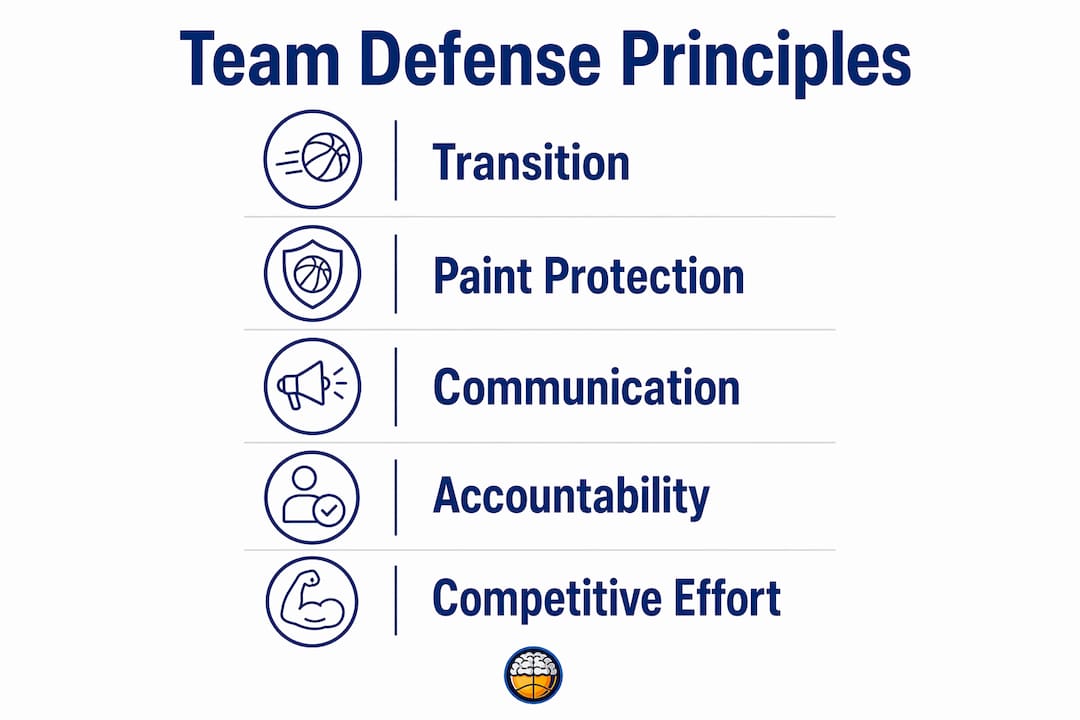
The core team defense principles fall into four categories: transition discipline, paint protection, verbal communication, and collective accountability. Most defensive breakdowns trace back to a failure in at least one of these areas. Coaches who address all four build defenses that are hard to attack systematically.
Transition defense is where games are most often lost. The moment a shot goes up, every player must make an immediate decision. Passive retreat, where players jog back or watch the play develop, is the single most common error at every level. The first defender back must sprint to protect the paint before attempting any individual matchup. Teams that reverse this order give up a significantly higher rate of fast break layups.
Paint protection sets the foundation for everything else. Once the paint is covered, defenders can rotate outward and match up properly. Trying to find your man first leaves the basket exposed and forces help defenders into impossible recovery positions.
Verbal communication is the third pillar. At least three clear calls must happen before the ball reaches half-court on every possession. Calls like “I got ball,” “help,” and “gap” tell teammates where coverage exists and where it does not. Without these calls, defenders double-guard one player while another stands open.
Collective accountability is the fourth principle. Every player must know their assignment and accept correction without ego. A team that communicates well but refuses to hold each other accountable will still break down under pressure.
Pro Tip: Grade your team’s first three steps back in transition during film review. If players are not sprinting immediately after a shot attempt, that is the first habit to fix before installing any other defensive scheme.
How do “pack mentality” and competitive effort shape elite defense?
The mindset behind great defense is just as important as the tactics. Coach Dan Hurley built UConn’s championship defense on four core principles: strength of the pack, daily improvement, relentless competitive effort, and mindful communication. Each one addresses a different layer of what makes a defensive unit hold together under pressure.
The “pack” concept is the most misunderstood. It does not mean playing zone or clustering near the basket. It means every player subordinates individual ego to the team’s collective defensive strength. As Hurley’s framework states:
“The strength of the pack is the wolf, and the strength of the wolf is the pack. Elite team defense requires every player to prioritize the unit over personal recognition. When one player chases a steal or gambles for a block, the pack breaks, and the opponent scores.”
This principle directly limits the gambling and freelancing that destroys defensive schemes. When players trust the system and their teammates, they stay in position instead of reaching for highlight plays.
Daily improvement means defense is never treated as finished. Coaches who build elite defensive teams schedule defensive reps into every single practice, not just before big games. The habit of competing defensively every day creates muscle memory that holds up in late-game pressure situations.
Emotional intelligence shapes how players communicate during those pressure moments. Players must self-regulate their verbal leadership, avoiding toxic interactions and timing feedback appropriately. A player who screams at a teammate after a breakdown often causes a second breakdown on the next possession.
- Accept your defensive role without complaint
- Sprint back on every possession, not just when you feel like it
- Call out screens, cutters, and ball movement before they happen
- Hold teammates accountable with tone that builds up rather than tears down
- Compete at the same intensity in practice as in games
Pro Tip: At the start of each week, ask each player to name one defensive habit they will improve. Public commitment creates personal accountability without you having to police every rep.
What tactical positioning and help defense techniques actually work?
Tactical execution separates teams that understand defensive principles from teams that actually apply them. The most important tactical concept is the sink and fill rotation, where the “low man” defender drops toward the paint when the ball drives, and the next defender fills the gap left behind. This rotation requires players to anticipate rather than react. At amateur levels, this timing is rarely taught correctly, which is why so many teams give up the same drive-and-kick sequence repeatedly.
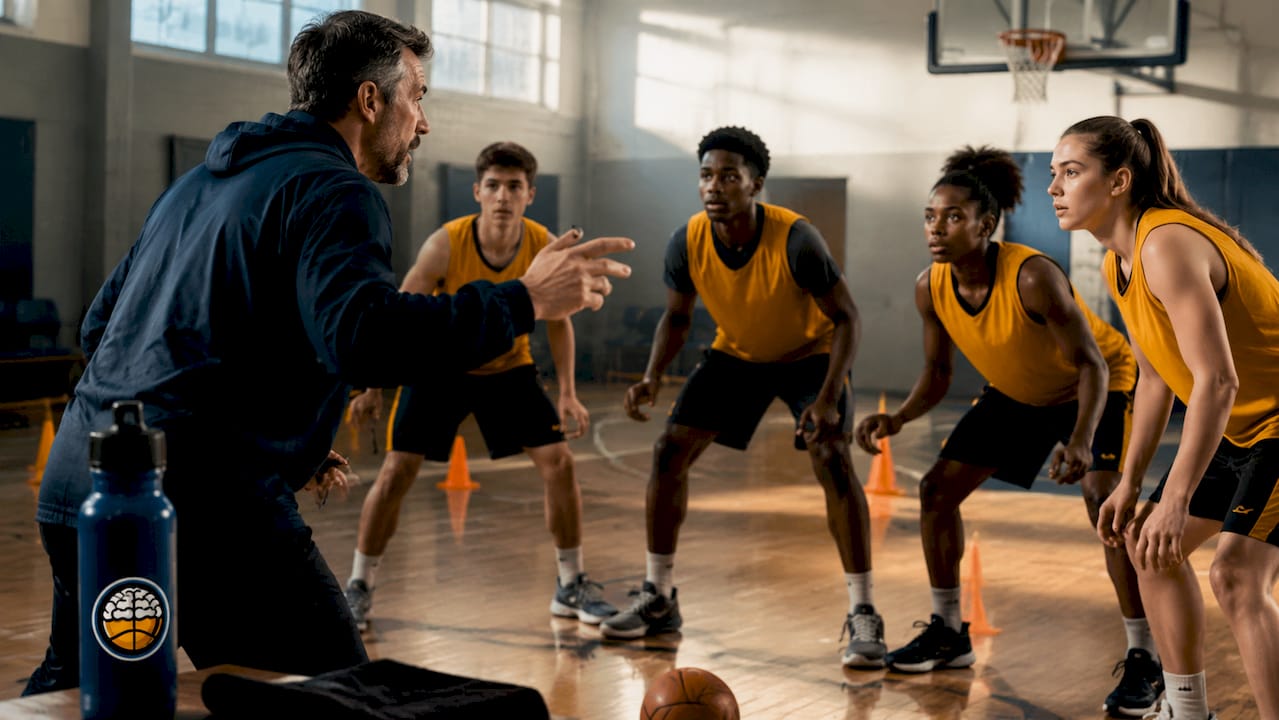
Defensive stance is the foundation of individual positioning. Feet should be shoulder-width apart, weight on the balls of the feet, and the chest angled toward the ball. A flat-footed defender cannot change direction quickly enough to stay in front of a ball handler.
The table below shows the difference between correct and incorrect positioning choices and their typical outcomes.
| Situation | Correct action | Incorrect action | Outcome of error |
|---|---|---|---|
| Ball drives baseline | Low man sinks to paint | Low man stays on shooter | Open layup or kick-out three |
| Offensive screen set | Defender calls “screen” loudly | Defender stays silent | Teammate gets caught, open shot |
| Fast break, 2-on-1 | Defender protects paint, stops ball | Defender commits to one attacker | Easy pass for layup |
| Help side position | Defender in gap, one pass away | Defender ball-watches | Uncontested catch and drive |
| Post entry pass | Fronting or 3/4 denial | Playing behind post | High-percentage post score |
Communication cues make these rotations work in real time. The call “ball” tells teammates who has primary ball pressure. “Gap” signals that a defender is positioned between two offensive players to cut off a pass. “Help” announces that a defender is leaving their assignment to stop a drive. Without these three calls, rotations collapse because players guess instead of react to information.
Assigning a designated safety, typically a guard, to hold at the foul line and never crash the offensive glass is a universal recommendation from middle school through NBA level. This player sacrifices offensive rebounding opportunities to guarantee floor balance. The cost is small. The benefit is eliminating the easiest fast break points an opponent can score.
Pro Tip: Teach the “gap” call in a 3-on-2 shell drill before introducing it in full five-on-five. Players learn the concept faster when the reads are simpler and the consequences of a wrong decision are immediately visible.
How can coaches train and implement defensive principles effectively?
Effective defensive training requires structure, repetition, and honest evaluation. The best defensive drills build habits that transfer directly to game situations rather than isolating skills that never appear in context.
Start with these drill categories:
- Transition sprint drill. Five players start at the offensive end. On the coach’s signal, all five sprint back to the defensive end. The coach grades the first three steps. Any player who jogs or hesitates runs again. This builds the habit of an immediate sprint response before any other defensive skill is layered on top.
- 4-on-3 cascade drill. Four offensive players attack three defenders in transition. The fourth defender sprints back and joins the play after five seconds. This forces the three defenders to protect the paint and communicate under pressure before help arrives.
- 5-on-4 shell drill. Five offensive players run half-court sets against four defenders. The missing defender forces the four to rotate and communicate constantly. This drill exposes every gap in your team’s help defense scheme.
- Communication-only possession. Run a full five-on-five possession where defenders must call every screen, every cut, and every ball movement out loud. Stop the drill immediately if any player goes silent. This trains the verbal habits that hold rotations together.
Beyond drills, video review accelerates learning faster than any live repetition alone. Show players exactly where communication broke down and what the correct rotation looked like. Players who see their own errors on film correct them faster than players who only hear verbal feedback.
In-game adjustments require a short checklist. Use these when your defense breaks down in competition:
- Check whether the safety is holding position or crashing the glass
- Identify which call (“ball,” “gap,” or “help”) is missing from your team’s communication
- Watch the first three steps of your slowest transition defenders
- Confirm that the low man is sinking before the drive reaches the paint
- Evaluate whether accountability conversations are happening on the bench between possessions
Coaches who teach defense principles through process-focused feedback rather than outcome-focused criticism build teams that self-correct during games. The goal is players who diagnose and fix their own defensive errors without waiting for a timeout.
Key Takeaways
Strong team defense is built on four non-negotiable pillars: transition discipline, paint protection, structured verbal communication, and collective accountability enforced every day in practice.
| Point | Details |
|---|---|
| Sprint back immediately | Grade the first three steps in transition; jogging is the root cause of most fast break points allowed. |
| Protect the paint first | The first defender back covers the basket before finding a matchup, not after. |
| Use three verbal calls per possession | “Ball,” “gap,” and “help” must be called loudly before the ball crosses half-court. |
| Assign a designated safety | One player, typically a guard, never crashes the offensive glass to maintain floor balance. |
| Build pack mentality daily | Subordinating individual ego to team defense requires consistent practice, not just game-day reminders. |
Defense is built in practice, not discovered in games
Coaches often treat defense as something players either have or do not have. That framing is wrong. Defense is a skill set, and like every skill set, it degrades without deliberate repetition. What I have found after working through defensive systems at multiple levels is that the biggest gap is not physical. It is emotional.
Players who struggle most on defense are usually the ones who cannot handle being wrong in real time. They avoid calling for help because it feels like admitting a mistake. They stop communicating after a breakdown because they are embarrassed. Emotional intelligence on defense means players stay vocal and accountable even when they have just given up a basket. That is genuinely hard to teach, and most coaches skip it entirely.
The other thing coaches underestimate is how much defensive culture depends on your best players buying in first. If your leading scorer jogs back in transition, every other player reads that as permission to do the same. The fastest way to change a team’s defensive identity is to hold your best offensive player to the same sprint standard as everyone else. That single act communicates more than any film session or practice drill.
Defensive talk is the most undercoached skill in basketball at every level below the NBA. Coaches spend hours on offensive sets and maybe ten minutes on what players should be saying to each other on defense. Flip that ratio for two weeks and watch what happens to your defensive efficiency. The results will surprise you.
— Dejan
Hoop Mentality resources for building your team defense
Coaches who want structured tools to implement these principles have clear options at Hoop Mentality.

The Basketball Starter Pack for Coaches gives you a complete foundation, covering defensive schemes, practice plans, and player development frameworks built from real coaching experience. The Basketball Template Bundle for Coaches provides customizable defensive planning templates you can adapt to your team’s specific needs. For coaches focused on weekly preparation, the Game Preparation Guide includes structured weekly practice plans with defensive drills built in. All resources are available directly at Hoop Mentality.
FAQ
What are the core team defense principles in basketball?
The core principles are transition discipline, paint protection, verbal communication, and collective accountability. Every defensive breakdown traces back to a failure in at least one of these four areas.
How many verbal calls should defenders make per possession?
At least three verbal calls must happen before the ball reaches half-court on every possession. Calls like “ball,” “gap,” and “help” prevent mismatches and double-guarding errors.
What is the role of the designated safety in transition defense?
The designated safety is typically a guard who holds at the foul line and never crashes the offensive glass. This role guarantees floor balance and eliminates easy fast break scoring opportunities.
How does the “pack mentality” improve team defense?
The pack mentality requires every player to prioritize collective defensive strength over individual ego. Teams with strong pack cohesion allow fewer points per possession because players stay in position instead of gambling for personal highlight plays.
What drills best reinforce team defensive tactics in practice?
The 4-on-3 cascade drill and the 5-on-4 shell drill are the most effective for building transition rotations and help defense habits. Pairing these drills with film review accelerates player understanding faster than live repetition alone.