

TL;DR:
- Mixing defensive schemes helps teams limit predictability and exploit offensive weaknesses by rotating coverages. It enhances unpredictability, disrupts passing, and allows personnel-based role optimization, creating a versatile and resilient defense. Effective implementation relies on a structured system like the Set-Stress-Break method, emphasizing practice, communication, and disciplined adjustments.
Mixing defensive schemes is the most direct way to limit what an offense can predict, prepare for, and exploit. In basketball, this approach, formally called hybrid defense, means rotating between man-to-man, zone, and combination coverages within a single game or possession. San Diego State’s 2025 defense showed exactly how powerful this is, allowing only 162.8 passing yards per game and ranking top 10 nationally. Coaches who understand why mix defensive schemes matter gain a structural edge that rigid, single-scheme teams simply cannot match.
What are the core benefits of mixing defensive schemes?
Hybrid defense wins because it attacks the offense from multiple angles at once. Mixed schemes leverage complementary strengths while covering the gaps that any single system leaves open. A team locked into pure man-to-man is vulnerable to off-ball screens. A team running only zone gives up the short corner and the high post. Rotating between the two forces the offense to solve two different problems instead of one.
The benefits of mixed defenses break down into four clear categories:
- Unpredictability. When the offense cannot identify your coverage before the ball is inbounded, their play calls lose value. Consistent pre-snap looks with varied post-snap rotations force ball handlers to hesitate and make late decisions.
- Offensive disruption. Rotating coverages reduce passing efficiency. Cutters and shooters find themselves in unexpected defensive alignments, breaking timing.
- Player-specific fit. Not every player guards the same way at the same level. Mixing schemes lets you put your best man defender on the opponent’s primary scorer while hiding a weaker defender in a zone assignment.
- Reduced vulnerability. No single defensive system stops all threats. Layering complementary approaches prevents total saturation of one scheme.
Green Bay Packers defensive coordinator Jonathan Gannon built his entire philosophy around this idea. ESPN reported that Gannon prioritizes player-strength alignment over fixed scheme labels, rejecting the traditional 4-3 or 3-4 identity in favor of flexible, personnel-driven calls. Basketball coaches can apply the same logic: build your defense around what your players do well, then rotate schemes to keep opponents off balance.
Pro Tip: Start with two base coverages your players know cold, then add a third only after the first two are automatic. Complexity without mastery creates confusion on your end, not theirs.
How do coaches implement mixed defensive schemes in games?
Effective implementation requires a system, not just a collection of calls. The Set-Stress-Break system is the clearest framework available for managing defensive rotations. It organizes calls into three tiers: your base defense (Set), a pressure adjustment (Stress), and a disruptive change-up (Break). You run your Set until the offense finds consistent success, then escalate.
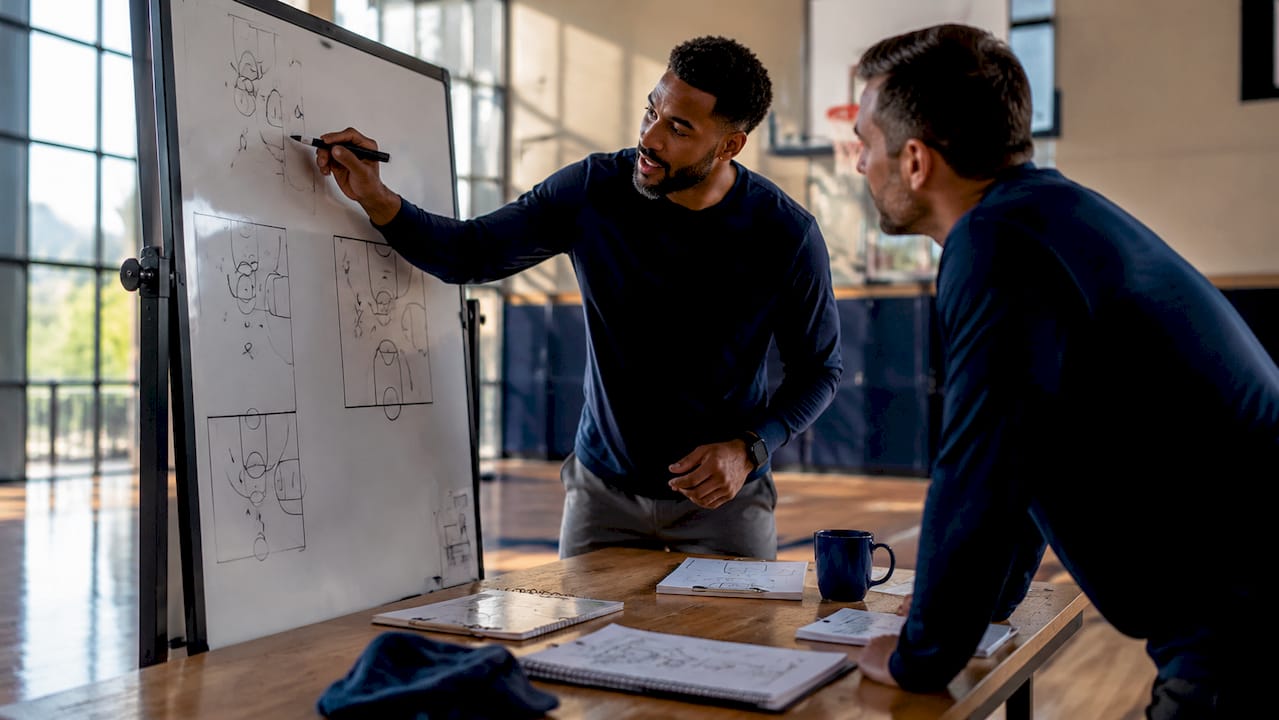
The threshold that triggers a change is specific. When the offense reaches a 40% success rate on a given call or action, you rotate to a Stress or Break call to reclaim the advantage. That number matters because it prevents emotional, reactive changes after one bad possession. Experienced coordinators do not overhaul their defense after a single breakdown. They track patterns and respond to data.
Here is a practical five-step process for in-game implementation:
- Establish your Set defense. Run your base coverage for the first several possessions. Collect information on what the offense is targeting.
- Track success rate by action. Note which offensive actions are working and at what frequency. Use a simple tally on your clipboard or tablet.
- Call Stress at the 40% threshold. When one action hits a 40% success rate, rotate to your Stress call. This is a targeted adjustment, not a full scheme change.
- Use Break calls for momentum shifts. Reserve your most disruptive coverage for critical moments: late-game situations, runs by the opponent, or when the offense has solved your Stress call.
- Maintain consistent pre-snap presentation. Show the same defensive alignment before every possession. Disguise actual coverage post-snap to prevent the offense from reading your rotation before the ball moves.
Communication is the engine behind all of this. Your players need to know the call, their assignment, and the trigger that changes it. Practice your scheme rotations in live situations, not just walk-throughs. The importance of defensive variety only shows up in games when players have already solved the communication problem in practice.
Pro Tip: Decompose your pressure packages into individual fronts and coverages. Mix and match them like building blocks rather than treating each blitz as a standalone call. This keeps your playbook manageable while multiplying your options.
What mistakes do teams make when mixing defensive schemes?
Most teams fail at scheme mixing not because the concept is wrong but because execution breaks down in predictable ways. Recognizing these mistakes before they cost you games is the difference between a functional hybrid defense and a chaotic one.
- Overloading the playbook. Adding five or six coverages before players master two creates hesitation. Hesitation is worse than running the wrong scheme confidently. Keep the rotation tight until execution is automatic.
- Skipping counter preparation. Not practicing offensive counters to your own defense leaves your team vulnerable when opponents scout your tendencies. Run your own offense against your defense in practice. Find the holes before your opponent does.
- Ignoring player mismatches within schemes. A zone rotation that puts your slowest defender on the perimeter against a shooter is not a scheme problem. It is a personnel problem. Map your players’ strengths before you assign scheme roles.
- Treating pressure calls as isolated plays. Blitzes and pressure packages work best when they are integrated front-coverage combinations, not standalone gambles. If your players do not know the coverage behind the pressure, the pressure fails.
- Reacting emotionally to single plays. Changing your entire defensive approach after one explosive possession destroys your structure. Use thresholds, not feelings, to trigger adjustments.
The defensive adjustment tips that separate good coaches from great ones all come back to the same principle: discipline in the system beats improvisation every time.
Mixed vs. fixed defensive schemes: which delivers better results?
Fixed schemes have real value in specific situations. A team with elite man defenders and deep conditioning can run pure man-to-man and win. But the evidence consistently favors flexibility over rigidity at the highest levels of competition.
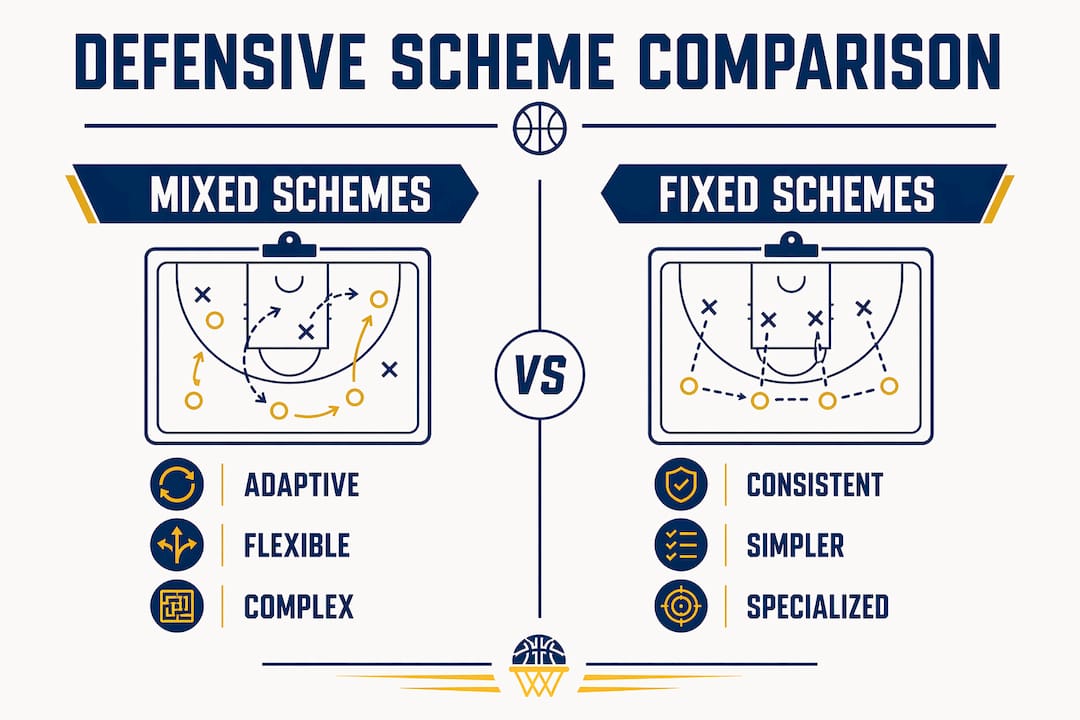
| Criteria | Mixed Defensive Schemes | Fixed Single Scheme |
|---|---|---|
| Adaptability | Adjusts to personnel and game flow in real time | Locked into one structure regardless of opponent |
| Offensive disruption | Forces multiple reads and adjustments from the offense | Offense can prepare a single game plan to attack it |
| Player fit | Assigns roles based on individual strengths | Requires all players to fit the same mold |
| Complexity | Higher learning curve, requires strong communication | Simpler to install and execute |
| Vulnerability | Covers weaknesses of any single system | Exposed when opponent identifies and attacks the scheme |
San Diego State’s 2025 defense is the clearest recent example of mixed scheme success. Their 2-high shell pre-snap presentation looked identical on every possession. Post-snap, they rotated into multiple different coverages. The offense could not confirm the coverage until the ball was already in the air. That disguise translated directly into limiting passing efficiency.
Fixed schemes still win when the talent gap is large enough. But as competition levels rise and opponents get more film, a single-scheme defense becomes a solved problem. Modern coaching philosophies shift from strict schemes to flexible styles built on player strengths, and the results back that shift up. For basketball coaches looking to teach defense principles that hold up under pressure, flexibility is not optional. It is the standard.
Key takeaways
Mixing defensive schemes is the most effective way to limit offensive efficiency, force decision errors, and adapt to any opponent in real time.
| Point | Details |
|---|---|
| Hybrid defense covers scheme gaps | Rotating coverages removes the single-scheme vulnerabilities that opponents exploit with film study. |
| Use the Set-Stress-Break system | Trigger scheme changes at the 40% offensive success threshold, not after emotional reactions to single plays. |
| Disguise is a weapon | Show the same pre-snap look every possession and vary post-snap rotations to slow quarterback and ball handler decisions. |
| Player fit drives scheme selection | Assign defensive roles based on individual strengths before layering in scheme complexity. |
| Practice counters to your own defense | Run your offense against your defense in practice to find and close the gaps before opponents do. |
The shift i had to make as a coach
When I started coaching, I believed in one defense done perfectly. The logic felt sound: master one system, execute it without hesitation, and the results follow. What I found instead was that good offensive coaches solve a single defense by halftime. They watch film, they identify the rotation, and they call plays that attack the same spot every time.
The shift to mixing schemes felt uncomfortable at first. More calls meant more chances for miscommunication. But what I learned is that the discomfort is temporary and the payoff is permanent. Once your players internalize two or three coverages and understand the triggers for each, the defense becomes harder to read than any single scheme ever was.
The biggest mistake I see coaches make is treating scheme mixing as an advanced concept reserved for experienced rosters. It is not. Even youth and high school teams can run two base coverages with clear triggers. Start simple. Run man-to-man as your Set and a 2-3 zone as your Stress. Practice the transition. Then add complexity only when the foundation is solid.
The teams that beat you are not always more talented. They are often just harder to prepare for. Mixing your defense is the most direct way to become that team.
— Dejan
Build your defense with Hoopmentality resources
Knowing why mix defensive schemes matter is step one. Putting it into practice with your roster is where the real work happens.

Hoopmentality has the tools to make that work faster and more structured. The Big Man Dual Action Drill builds the defensive versatility and reaction speed your big men need to function across multiple scheme rotations. For coaches who want a full system, the Game Preparation Guide with Weekly Practice Plan gives you a structured framework to install mixed defensive schemes across a full practice week. Both resources are built from real coaching experience and designed to save you time while improving how your team executes under pressure.
FAQ
Why mix defensive schemes instead of mastering one?
Mixing defensive schemes forces the offense to solve multiple problems instead of one. A single scheme, no matter how well executed, becomes predictable with enough film study.
What is the set-stress-break system in defense?
The Set-Stress-Break system organizes defensive calls into three tiers: a base defense, a pressure adjustment, and a disruptive change-up. Coaches rotate between them using a 40% offensive success rate as the trigger threshold.
How do you disguise defensive schemes effectively?
Show the same pre-snap alignment on every possession, then rotate to different coverages after the ball moves. San Diego State’s 2025 defense used this exact method to limit passing efficiency and slow ball handler decisions.
What is the biggest mistake when mixing defensive schemes?
Overcomplicating the playbook before players master the base coverages. Two schemes executed with confidence create more confusion for the offense than five schemes run with hesitation.
How many defensive schemes should a team carry?
Start with two base coverages and one pressure package. Add a third coverage only after the first two are automatic in live game situations.