

Soft coaching uses empathy, active listening, and structured questions to unlock player insight and commitment. It is a deliberate, performance-focused method, not a passive one. Frameworks like the GROW model and Co-Active Training principles give it structure. Hoop Mentality templates make it plug-and-play for your next practice.
Two actions you can take this week:
- After your next drill, pause for 60 seconds and ask one player: “What did you notice about your decision there?” Let them answer fully before you respond.
- Schedule one 15-minute 1:1 this week. Open with: “What’s one thing you want to get better at before our next game?”
Table of Contents
- What does soft coaching mean for basketball performance?
- What core skills and frameworks do you actually need?
- When should you use soft versus hard coaching?
- How do you build soft coaching into your practice plan?
- What scripts and prompts can you use right now?
- How do you measure whether soft coaching is working?
- What mistakes do coaches make with soft coaching?
- Which Hoop Mentality resources support soft coaching?
- What does a 7-day sprint and 90-day plan look like?
- Key Takeaways
- Why soft coaching belongs at the center of player development
- Hoop Mentality resources for coaches ready to apply this
- Useful sources
- FAQ
What does soft coaching mean for basketball performance?
Soft skills coaching focuses on interpersonal abilities: empathy, active listening, conflict resolution, and psychological safety. In basketball, that means how you talk to a player after a turnover, how you structure a halftime conversation, and how you ask questions during a drill pause, not just what plays you run.
Hard coaching covers tactics, schemes, and execution standards. Soft coaching covers the human layer underneath. Neither replaces the other. The coaches who develop players fastest use both, switching between them deliberately.
Direct benefits for your team:
- Players self-correct faster when they understand why, not just what
- Repeated mistakes drop when players feel safe flagging confusion early
- Practice engagement rises when players feel heard, not just directed
- Trust builds, and trust accelerates every other coaching input
Pro Tip: After a tactical correction, add one question: “Does that make sense to you, or do you see it differently?” That single sentence shifts a player from passive receiver to active thinker.
What core skills and frameworks do you actually need?
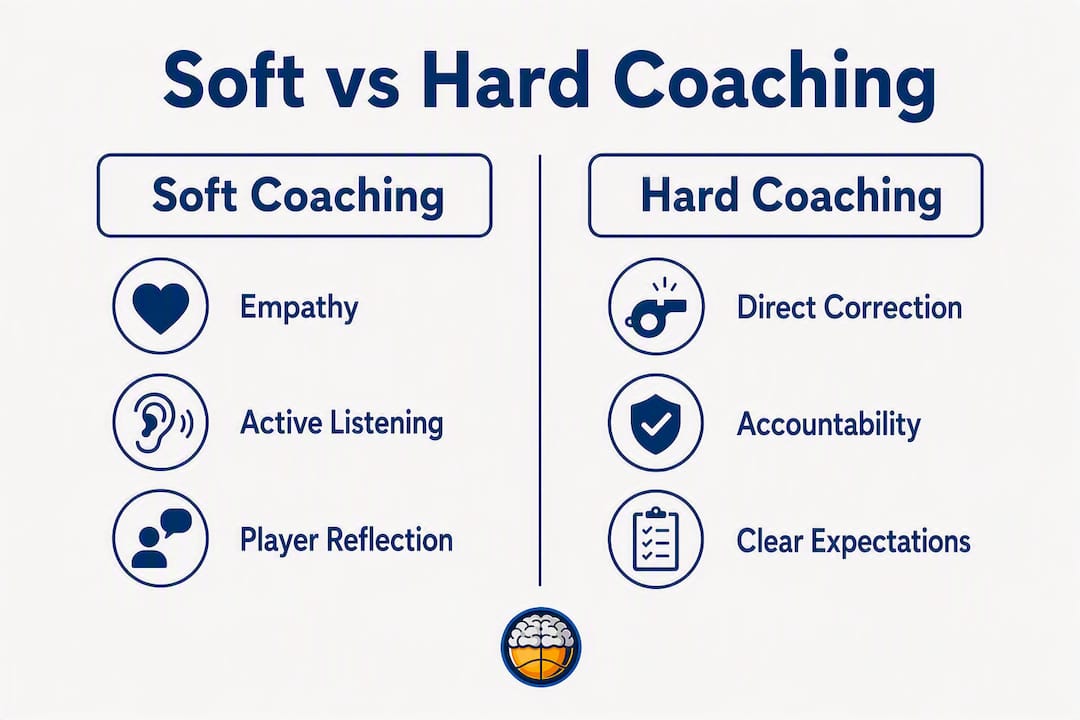
The Co-Active Training Institute frames compassionate coaching as empathy plus clear challenge. Empathy builds trust. Challenge keeps players moving toward performance goals. You need both.
Core interpersonal skills:
- Empathy (imagine-other): Picture the situation from the player’s perspective, not your own past experience. Research on imagine-other empathy shows it produces better attunement than imagining yourself in their shoes.
- Active listening: Full attention, no interrupting, reflect back what you heard before responding.
- Curiosity: Ask questions you genuinely don’t know the answer to.
- Clear accountability: Name the specific behavior and the specific standard, every time.
- Conflict resolution: Separate the person from the problem; address the pattern, not the moment.
Three frameworks, one line each:
| Framework | What it does | When to use it |
|---|---|---|
| GROW model | Structures a conversation through Goal, Reality, Options, Will | 1:1 development check-ins |
| Empathy Sandwich | Acknowledge, challenge, reinforce belief | Corrective feedback after a mistake |
| Gentle nudge | Asks ownership questions instead of giving directives | Low-stakes drill pauses |
Sample GROW questions you can use today:
- Goal: “What do you want to be able to do by the end of this season?”
- Reality: “Where are you with that right now, honestly?”
- Options: “What are two things you could try differently?”
- Will: “Which one will you commit to this week?”
Pro Tip: The Empathy Sandwich runs: “I see what you were going for there. Here’s what needs to change. I know you can make that adjustment.” Keep each layer to one sentence.
When should you use soft versus hard coaching?
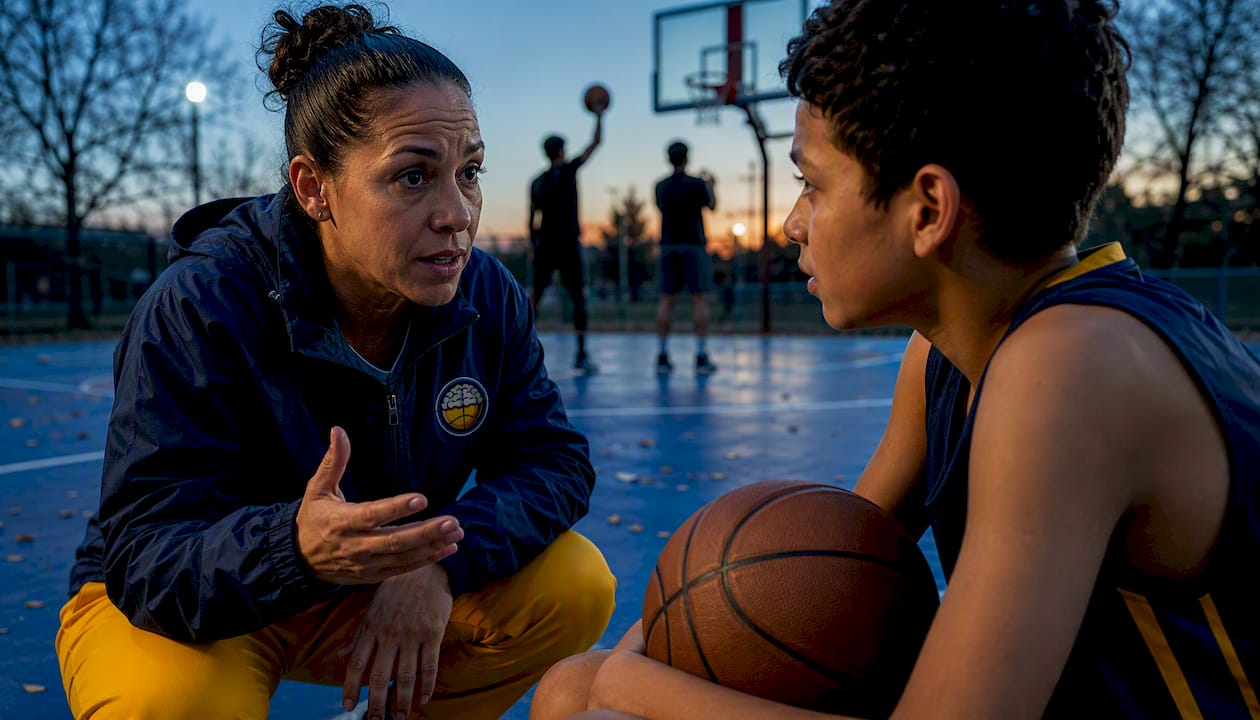
The decision comes down to three factors: emotional arousal, learning versus execution focus, and how complex the behavior change is.
Use hard/tactical coaching when:
- A player needs an immediate execution fix during a timeout
- The team is in a high-stakes execution moment and clarity is the priority
- The correction is simple, specific, and already understood
Use a supportive coaching approach when:
- A player is confused about why they keep making the same mistake
- You’re in a post-practice or post-game conversation with time to reflect
- A player’s confidence or motivation is visibly affecting their performance
- The behavior change requires self-awareness, not just repetition
Mixing both in one conversation: Signal the shift clearly. “I’m going to give you a direct correction now, then I want to hear your take.” That sentence tells the player which mode you’re in and prevents mixed signals.
How do you build soft coaching into your practice plan?
You don’t need to restructure your whole practice. You need two or three intentional moments per week.
Sample 90-minute practice with embedded soft-coaching moments:
- Warm-up (10 min): Normal dynamic warm-up. Coach circulates and asks one player: “What’s your focus today?”
- Skill block (25 min): Shooting or ball-handling drills. After the second rep set, pause for 90 seconds. Ask the group: “What are you adjusting and why?”
- Tactical block (30 min): Scheme work, hard coaching mode. Clear, direct, execution-focused.
- Coachable pause (5 min): Pull one player aside. Use the Empathy Sandwich on a pattern you’ve observed this week.
- Scrimmage (20 min): Decision-making scrimmage. Coach calls brief pauses to ask: “What did you see there? What were your options?”
- Micro-reflection (5 min): Team huddle. One question: “What’s one thing you’ll do differently next practice?”
15-minute 1:1 structure:
- Minutes 1–3: Open question (“How are you feeling about your role right now?”)
- Minutes 4–10: GROW conversation, player-led
- Minutes 11–13: One specific commitment from the player
- Minutes 14–15: Coach affirms and closes (“I’ll check in with you on that Thursday.”)
For player feedback methods that pair with these sessions, Hoop Mentality’s blog covers current, practice-tested techniques.
What scripts and prompts can you use right now?
Quick practice correction (Empathy Sandwich): “I see you’re trying to attack the closeout. That’s the right read. Right now, you’re going too early and losing the angle. I know you can time that better. Let’s run it again.”
1:1 performance reflection: “What’s one moment from last game you’d like to redo? What would you do differently? What stopped you from doing that in the moment?”
Accountability check-in: “Last week you said you’d work on your left-hand finish. How did that go? What got in the way? What’s your plan for this week?”
Prompt bank for any conversation:
- “What’s your read on why that keeps happening?”
- “What would you tell a teammate who was struggling with the same thing?”
- “On a scale of 1–5, how confident do you feel in that situation right now?”
- “What’s one thing I can do differently to support you?”
A gentle interruption is also a tool: when a player spirals into self-criticism, cut it short with “Stop there. What’s the one thing you’re taking from this?” Brief, respectful, refocusing.
These prompts fit directly into Hoop Mentality’s practice planning templates, which have dedicated fields for player reflection notes.
How do you measure whether soft coaching is working?
KPIs and tracking plan:
| KPI | How to measure | Frequency |
|---|---|---|
| Practice engagement | Attendance rate + drill completion | Weekly |
| Drill success quality | % of reps meeting your standard | Per session |
| Repeated mistakes | Count of same-error corrections per player | Weekly |
| Player confidence | 1–5 self-rating after 1:1 | Bi-weekly |
Realistic timeline:
- 2 weeks: Players start answering reflection questions without prompting. Conversations feel less one-sided.
- 6 weeks: Repeated mistakes on specific skills drop noticeably. Players begin self-correcting mid-drill.
- 12 weeks: Behavioral patterns shift. Players take ownership of their development between sessions.
Reducing perceived threat through empathy activates reflection networks in the brain, which speeds skill acquisition. That’s the mechanism behind the timeline above.
What mistakes do coaches make with soft coaching?
Red flags to watch for:
- Empathy becoming coddling: You acknowledge the struggle but never name the standard. Fix: end every empathy statement with a clear expectation.
- Praise without progress: Telling a player they’re doing great when they’re not. Fix: use the Empathy Sandwich, not just the first layer.
- Skipping accountability: Soft conversations that end with no commitment. Fix: every 1:1 closes with one named action from the player.
- Empathy fatigue: You’re absorbing every player’s frustration and it’s affecting your own clarity. Fix: set a time boundary on 1:1s and keep a brief coach self-check log.
A gentle approach is active leadership, not lowered standards. If your soft conversations aren’t producing commitments, they’re not coaching. They’re just talking. For a full list of pitfalls, Hoop Mentality’s guide on common coaching mistakes covers the most frequent errors coaches make at every level.
Which Hoop Mentality resources support soft coaching?
- Basketball Starter Pack For Coaches: Includes practice plan templates with built-in pause points. Good starting point if you’re new to structured soft-coaching moments.
- Basketball Template Bundle For Coaches: Covers 1:1 tracking, player development notes, and practice planning. The most complete system for coaches who want ready-made tools.
- Basketball Shooting Bundle For Coaches: Drill sets with progress trackers. Pair these with reflection prompts during skill blocks.
- Editable Scouting Report Template: Customizable fields let you add developmental prompts and player reflection notes alongside performance data.
- Basketball Scouting Report Template: Ready-to-use format with sections that support post-game 1:1 conversations and developmental feedback.
How to pick one: If you have less than 30 minutes to set up, start with the Starter Pack. If you want a full system for the season, go with the Template Bundle.
What does a 7-day sprint and 90-day plan look like?
7-day sprint:
- Day 1: Observe one player during practice. Write down one behavioral pattern you want to address.
- Day 2: Run one Empathy Sandwich correction during a drill pause.
- Day 3: Schedule your first 15-minute 1:1 using the GROW structure.
- Day 4: Add one reflection question to your end-of-practice huddle.
- Day 5: Review your notes. Did the player respond differently? Adjust your approach.
- Day 6: Try a gentle interruption during a scrimmage pause.
- Day 7: Rate each player’s engagement on a 1–5 scale. This is your baseline.
90-day roadmap:
- Weeks 1–3 (Foundation): Run 2–3 soft-coaching moments per week. Track repeated mistakes and engagement scores.
- Weeks 4–8 (Habit formation): Add bi-weekly 1:1s for your key development players. Review KPI data at the 6-week mark.
- Weeks 9–12 (Reinforcement): Players should be self-initiating reflection. Shift your role from prompter to listener. Adjust where patterns haven’t shifted.
Checkpoint checklist:
- [ ] Players answer reflection questions without being asked
- [ ] Repeated mistakes on tracked skills have dropped
- [ ] 1:1 commitments are being followed through
- [ ] Your own empathy fatigue is manageable
Key Takeaways
Soft coaching works because it pairs empathy with clear accountability, giving players the psychological safety to reflect and the structure to act.
| Point | Details |
|---|---|
| Definition | Soft coaching uses empathy, active listening, and structured questions to accelerate player development. |
| Core frameworks | GROW model, Empathy Sandwich, and gentle nudge give every conversation a performance focus. |
| Timeline for change | Expect micro-shifts at 2 weeks, behavioral patterns at 6–12 weeks. |
| Biggest mistake | Empathy without accountability is coddling; every soft conversation must end with a named commitment. |
| Hoop Mentality | The Basketball Template Bundle For Coaches gives you ready-made 1:1 and practice planning tools to start immediately. |
Why soft coaching belongs at the center of player development
Most coaches I talk to already use soft coaching instinctively. They pull a player aside, ask what’s going on, and listen before correcting. What’s missing is the structure to do it consistently and the confidence to call it a real coaching method.
The conventional wisdom says soft coaching is for youth leagues or struggling players. That’s wrong. The CCL’s research on soft skill development shows the most effective leaders at every level have highly developed interpersonal skills. Basketball is no different. The coaches who build the deepest player commitment aren’t the loudest in the gym. They’re the ones whose players know exactly what’s expected and feel safe enough to fall short on the way to meeting it.
The gap isn’t knowledge. It’s application. Coaches know they should listen more. They don’t have a system for doing it during a 90-minute practice with 12 players. That’s what the frameworks and templates in this guide solve.
Hoop Mentality resources for coaches ready to apply this
The Basketball Starter Pack For Coaches gives you practice plan templates, drill sets, and player tracking tools built for coaches who want to add structure without adding prep time. The Basketball Template Bundle For Coaches goes further, with 1:1 session formats, development tracking, and scouting report fields you can customize with reflection prompts.
Both products are ready to use out of the box. Pick the one that fits your current season phase, download it, and run your first soft-coaching moment at your next practice.
Useful sources
“Empathy, when paired with coaching, reduces perceived threat and activates reflection networks in the brain, making learning and self-generated insight more likely.” — Training Journal, Empathy in Action
- Soft skills coaching overview (Indeed) — Definition and recommended practices for interpersonal coaching
- Coaching techniques and models (PositivePsychology.com) — GROW model and Empathy Sandwich framework details
- Compassionate coaching: empathy and accountability (Co-Active Training Institute) — Balancing support with clear challenge; avoiding the coddling trap
- A gentle approach in coaching practice (Coaching Confidence) — Active, directional coaching versus passive permissiveness
- Empathy in action (Training Journal) — Neuroscience-informed view of empathy’s role in coaching conversations
- Gentle interruption as a coaching tool (Coached Consulting) — Technique for breaking unproductive thought patterns
- Imagine-other empathy research (Springer) — Scientific basis for perspective-taking in coaching conversations
- Soft skill development for leaders (CCL) — Research on interpersonal skills across leadership levels
FAQ
What is soft coaching in basketball?
Soft coaching uses empathy, active listening, and structured questions to develop players’ self-awareness and commitment. It complements tactical coaching rather than replacing it.
How is soft coaching different from being too easy on players?
A gentle coaching approach is active and directional. Every soft-coaching conversation ends with a clear expectation and a named commitment from the player.
How long does soft coaching take to show results?
Expect visible micro-shifts in player behavior at 2 weeks. Sustained behavioral patterns typically emerge at 6–12 weeks of consistent application.
Which Hoop Mentality product is best for starting soft coaching?
The Basketball Starter Pack For Coaches is the fastest entry point, with practice plan templates and player tracking tools ready to use immediately.
Can soft coaching work during games, not just practice?
Yes, in limited moments. Timeout conversations and halftime check-ins are the best in-game opportunities. Keep it to one question and one clear expectation given the time constraints.